• Quick note - the problem with Youtube videos not embedding on the forum appears to have been fixed, thanks to ZiprHead. If you do still see problems let me know.

Oh God, here we go again - micro/macro evolution

dogjones

Graduate Poster
Joined
Oct 3, 2005
Messages
1,303
A friend of mine is slowly descending into religiosity. He is a smart chappie but cannot handle the implications of "materialism", "naturalism", etc - namely, that objective moral truths cannot exist within this worldview. Fine, I have a good time debating him philosophically over a few glasses of indifferent Malbec.

Unfortunately though, he is now straying into the realm of attempting to debunk evolution. Not, of course, 'micro' evolution, but 'macro'. His main thing appears to be "evolution cannot explain augmentation of DNA by external information/stimuli alone". I'm not sure even he knows what this means. I guess I would take it to mean that:

1. Evolution successfully describes changes in already existing DNA ("microevolution").
2. But some species have more DNA than others, and possibly this should be the definition of "species".
3. There is no evidence for how this 'creation' of new DNA ("macroevolution") comes about by purely naturalistic processes.
4. Therefore it is reasonable to 'doubt' macroevolution.

Oh yeah, and also the fossil record is incomplete and provides no evidence of said macroevolution.

Um. Help!?
 
Last edited:
um find a new friend.....or topic of conversation.

Surely you have better things to do with your once around than "save" adult idjits from their own foibles...

If he doesn't get it by now nothing you are going to say will steer him off the path he has chosen and is looking for "justification" for. :garfield:
 
Ah well, the thing is, despite his agenda I do find it an interesting question, me being a layman and all...
 
Unfortunately though, he is now straying into the realm of attempting to debunk evolution. Not, of course, 'micro' evolution, but 'macro'. His main thing appears to be "evolution cannot explain augmentation of DNA by external information/stimuli alone". I'm not sure even he knows what this means. [...]

Oh yeah, and also the fossil record is incomplete and provides no evidence of said macroevolution.

Um. Help!?

If you're really interested in this stuff, then help yourself to a copy of

Eugenie C Scott. Evolution vs Creationism: an Introduction. Second Edition. University of California Press, 2009.

Then follow up by reading the full references cited by the parts that interest you most.

Will
 
Fine, I have a good time debating him philosophically over a few glasses of indifferent Malbec.

Indifferent? A good Malbec is never indifferent.

Unfortunately though, he is now straying into the realm of attempting to debunk evolution. Not, of course, 'micro' evolution, but 'macro'. His main thing appears to be "evolution cannot explain augmentation of DNA by external information/stimuli alone".

Argument by incredulity. That he (or anybody else, for that matter) do not find it explained, is not an argument that it doesn't exist.

Note that both the distinction between micro- and macro evolution and the definition of a species is entirely arbitrary.

1. Evolution successfully describes changes in already existing DNA ("micro evolution").

One definition of micro evolution. However, still arbitrary. And circular, if you define micro evolution as that we have observed, and then claim the fact that we have not observed macro evolution as argument for anything but the definition itself.

2. But some species have more DNA than others, and possibly this should be the definition of "species".

One definition of species. Arbitrary. See above.

3. There is no evidence for how this 'creation' of new DNA ("macro evolution") comes about by purely naturalistic processes.

Yes there is such evidence: doubling of chromosomes, inversion and recombination of DNA strings, all which can increase the dataset, have been objectively observed.

4. Therefore it is reasonable to 'doubt' macro evolution.

Not in itself. Macro evolution, by the definition above (which is as good as any) is extrapolated from micro evolution. There is no reason to believe that such an extrapolation is not valid, since we can observe no distinct barrier that should keep micro evolution from progressing till the point where it qualifies as macro evolution.

Oh yeah, and also the fossil record is incomplete and provides no evidence of said macro evolution.

Even incomplete as it is, and must be, it provides plenty of evidence:

1. The slow progress over time where groups of species appear, proliferate, and vanish.

2. Several groups of species can be followed continuously over long time-spans, showing distinct evolution.

3. The less obvious fossil record that exists in DNA and mitochondrial DNA supports the archaeological one.

Hans
 
If he's going to sit pat on the bible and thats that then I'd suggest discussing another topic with your friend. You know him better than we do.
I think that one thing to point out to a bible believer is that creation is not falsifiable. An almighty god can, of course, create the world and all species in 7 days, 6,000 years ago, and make it appear as if it evolved over billions of years.

However, an almighty god can also create the world last week, or fifty billion years ago, or ......

If he claims that it is preposterous to say that god created the world last week, ask him why. Especially why it is more preposterous than any other time.

Hans
 
... Macro evolution, by the definition above (which is as good as any) is extrapolated from micro evolution. There is no reason to believe that such an extrapolation is not valid, since we can observe no distinct barrier that should keep micro evolution from progressing till the point where it qualifies as macro evolution. ...
Hans

Well put, Hans.
Here's a vintage Dawkins video (1989) on the subject of natural selection. Perhaps it's very basic, but an enjoyable six and a half minutes.
http://www.youtube.com/watch?v=v2etmGcRl1c
 
If you're really interested in this stuff, then help yourself to a copy of

Eugenie C Scott. Evolution vs Creationism: an Introduction. Second Edition. University of California Press, 2009.

Then follow up by reading the full references cited by the parts that interest you most.

Will

Thanks!
 
If he's going to sit pat on the bible and thats that then I'd suggest discussing another topic with your friend. You know him better than we do.

No, he’s not a bible basher in that sense. He’s quite maddeningly complex actually. He’s fine with pretty much all of science, voraciously reads things like ‘The Elegant Universe’ and “Cosmos”, etc etc, even the Demon Haunted World. He has a genuinely inquiring mind. Unfortunately he has also had a religious experience. He even acknowledges that it could all be in his head, but he doesn’t think so. And he attempts to back this up with well reasoned arguments. Generally these are metaphysical in nature and are perfectly ok (probably wrong but never provably so). But I am annoyed about his reasoning straying into the realm of the physical.
 
Indifferent? A good Malbec is never indifferent.


Argument by incredulity. That he (or anybody else, for that matter) do not find it explained, is not an argument that it doesn't exist.

Note that both the distinction between micro- and macro evolution and the definition of a species is entirely arbitrary.


One definition of micro evolution. However, still arbitrary. And circular, if you define micro evolution as that we have observed, and then claim the fact that we have not observed macro evolution as argument for anything but the definition itself.


One definition of species. Arbitrary. See above.


Yes there is such evidence: doubling of chromosomes, inversion and recombination of DNA strings, all which can increase the dataset, have been objectively observed.


Not in itself. Macro evolution, by the definition above (which is as good as any) is extrapolated from micro evolution. There is no reason to believe that such an extrapolation is not valid, since we can observe no distinct barrier that should keep micro evolution from progressing till the point where it qualifies as macro evolution.


Even incomplete as it is, and must be, it provides plenty of evidence:

1. The slow progress over time where groups of species appear, proliferate, and vanish.

2. Several groups of species can be followed continuously over long time-spans, showing distinct evolution.

3. The less obvious fossil record that exists in DNA and mitochondrial DNA supports the archaeological one.


Hans

Lovely! Thanks Hans. Can you/anyone point me to any reading suitable for a layman on the parts I've bolded, or if anyone here has the time, post some examples?

As for
A good Malbec is never indifferent
, this is correct but tautologous.
 
3. There is no evidence for how this 'creation' of new DNA ("macroevolution") comes about by purely naturalistic processes.

His whole argument seems to hinge on this one. When DNA is copied in the cell, sometimes something goes wrong and an error is made. If a gene is making a protein that's necessary for that creature to live, and an error occurs in that gene, then that error is probably going to be detrimental to the creature and it will be selected against.

However, one type of error is that a whole gene will accidentally get duplicated, giving the creature two functional copies. In these cases, errors can occur in one and not be detrimental. Sometimes those errors will be some change that turns out to be helpful. In those cases, new DNA has occurred (and the information content of the DNA has increased) by purely natural, well-understood processes.

This simple example completely refutes those ID proponents who claim that the information content in DNA can only be created by an intelligent designer (Stephen Meyer and Michael Egnor both specifically make this claim).
 
Whenever anyone asks how "The information got into DNA", I generally try to develop an answer along these lines:

The idea that DNA contains information is only an analogy. A useful analogy, to be sure (I use it myself, sometimes), but like all analogies, it does not completely tell the full story. DNA is NOT literally a computer.

If you want to know how it looks like DNA acquired all of that "information", it helps to change your framing of how you think of DNA.

You can think of DNA as a self-replicating, self-catalyzing model. Therefore, the "information" it ends up containing is NOT really used to build life forms. It is used to replicated its own self. The molecular signatures have to change, as the environment changes, through a process of natural selection. And our lives happen to be byproducts of the process.

You can also think of DNA as something like a snowflake crystal. I started a whole thread on that one a little over one year ago: http://www.internationalskeptics.com/forums/showthread.php?t=125866
A snowflake forms as water freezes, and crystallizes, on a microscopic speck of dirt, using its own local rules of chemistry and physics, in its construction. DNA is something like that, with one notable exception: DNA strands have the opportunity to go through many iterations of growing complexity. When a snowflake melts, it rarely (if ever) melts "half-way". When certain organic compounds are placed through iterations of warming and cooling, they could actually melt and refreeze only "part-way", and that adds to the increasing complexity of the system.

These models are, in fact, useful for conducting scientific research. Most discoveries made in the field of abiogenesis uses some alternative model of DNA that is not seen as "information for building life forms".

And, it is here that I link to some specific examples of papers, such as these:
http://www.ncbi.nlm.nih.gov/pmc/articles/PMC18108/?tool=pmcentrez
http://www.pnas.org/content/92/18/8158.abstract
http://www3.interscience.wiley.com/journal/114212107/abstract?CRETRY=1&SRETRY=0
http://www.sciencemag.org/cgi/content/abstract/1167856
http://www.sciencemag.org/cgi/content/abstract/281/5377/670
Etc.

A creationist might try to argue that those papers are not the whole story, that we will never truly know if they even represent part of the true story, etc. But, the one thing they can't deny (unless they are dishonest) is that they represent progress in a realm of science: New discoveries about this universe we live in; that creationist ideas can never seem to help us develop.
Scientists with the real responsibility of making new discoveries about life, will often shift the frame from the obvious approach.

Then I recommend folks read The Selfish Gene (second edition or later) by Richard Dawkins.
 
2. But some species have more DNA than others, and possibly this should be the definition of "species".

So, by your friend's logic, someone with Down's syndrome (extra 21st chromozome, and therefore 'more DNA') isn't a member of the Human species?
 
Originally Posted by dogjones
3. There is no evidence for how this 'creation' of new DNA ("macroevolution") comes about by purely naturalistic processes.

Has he looked at the mess that maize genome consists of

http://www.ncbi.nlm.nih.gov/pubmed/17658954

People, plants, and genes: the story of crops and humanity - Google Books Result
by Denis J. Murphy - 2007 - Science - 401 pages
Maize A complex genome Maize is a diploid plant with 20 chromosomes and, ... the maize genome, at 2400 Mb, is about six-fold larger than that of rice. ...

http://books.google.com/books?id=P8...nepage&q=the complex maize genome six&f=false

Rice, oats all with a complex relationship over time.....

BTW viruses are exchange vectors for genes
 
Last edited:
If you believe in microevolution but not macroevolution, it's like saying 1+1+1+1 can be 4 but 2+2 can't. The distinction is completely artificial.
 
A friend of mine is slowly descending into religiosity. He is a smart chappie but cannot handle the implications of "materialism", "naturalism", etc - namely, that objective moral truths cannot exist within this worldview. Fine, I have a good time debating him philosophically over a few glasses of indifferent Malbec.

Unfortunately though, he is now straying into the realm of attempting to debunk evolution. Not, of course, 'micro' evolution, but 'macro'. His main thing appears to be "evolution cannot explain augmentation of DNA by external information/stimuli alone". I'm not sure even he knows what this means. I guess I would take it to mean that:

1. Evolution successfully describes changes in already existing DNA ("microevolution").
2. But some species have more DNA than others, and possibly this should be the definition of "species".
3. There is no evidence for how this 'creation' of new DNA ("macroevolution") comes about by purely naturalistic processes.
4. Therefore it is reasonable to 'doubt' macroevolution.

Oh yeah, and also the fossil record is incomplete and provides no evidence of said macroevolution.

Um. Help!?

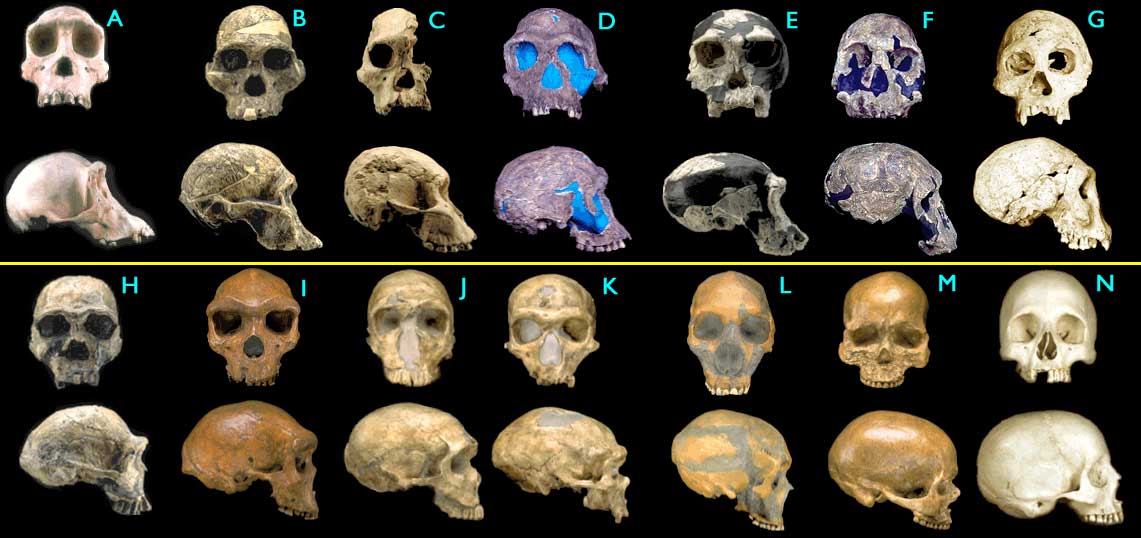
try showing him this and asking him to explain it
fossil-hominid-skulls.jpg

(A) Pan troglodytes, chimpanzee, modern
(B) Australopithecus africanus, STS 5, 2.6 My
(C) Australopithecus africanus, STS 71, 2.5 My
(D) Homo habilis, KNM-ER 1813, 1.9 My
(E) Homo habilis, OH24, 1.8 My
(F) Homo rudolfensis, KNM-ER 1470, 1.8 My
(G) Homo erectus, Dmanisi cranium D2700, 1.75 My
(H) Homo ergaster (early H. erectus), KNM-ER 3733, 1.75 My
(I) Homo heidelbergensis, “Rhodesia man,” 300,000 – 125,000 y
(J) Homo sapiens neanderthalensis, La Ferrassie 1, 70,000 y
(K) Homo sapiens neanderthalensis, La Chappelle-aux-Saints, 60,000 y
(L) Homo sapiens neanderthalensis, Le Moustier, 45,000 y
(M) Homo sapiens sapiens, Cro-Magnon I, 30,000 y
(N) Homo sapiens sapiens, modern
was it Gods practice attempts ?
if so how come these werent mentioned in the babble
;)
if hes using the outdated "missing link" belief, then perhaps you should also explain to him what a "transitional fossil" is
http://en.wikipedia.org/wiki/Transitional_fossil
Transitional fossils (popularly termed missing links) are the fossilized remains of intermediary forms of life that illustrate an evolutionary transition. They can be identified by their retention of certain primitive (plesiomorphic) traits in comparison with their more derived relatives, as they are defined in the study of cladistics. Numerous examples exist, including those of primates and early humans.

According to modern evolutionary theory, all populations of organisms are in transition. Therefore, a "transitional form" is a human construct of a selected form that vividly represents a particular evolutionary stage, as recognized in hindsight. Contemporary "transitional" forms may be called "living fossils", but on a cladogram representing the historical divergences of life-forms, a "transitional fossil" will represent an organism near the point where individual lineages (clades) diverge.
 
Last edited:
try showing him this and asking him to explain it
[qimg]http://anthropologynet.files.wordpress.com/2007/06/fossil-hominid-skulls.jpg[/qimg]

Those are retarded chimps, man! Everyone knows that! And the one with half the skull missing...crushed by Noah's Ark.
 

Back
Top Bottom