• Quick note - the problem with Youtube videos not embedding on the forum appears to have been fixed, thanks to ZiprHead. If you do still see problems let me know.

Null Physics anyone?

4. The issue of the neutron beta decay clearly is one pertaining to the unbounded neutron. Now if the neutron consists of quarks of different flavours and protons consist of quarks of different flavours there is huge commonality between them. ie the same components with different characteristics. Therefore the assumption that the neutron has the building blocks of the proton electron and electron antineutrino is not unreasonable.

Given the last hundred years of progress in science you are wrong. It is entirely unreasonable. Consistently repeating that it is reasonable does not make it so.

ETA: Its a bit like saying Earth is a bit like Mars. Therefore the Earth is a bound state consisting of Mars and the Moon.
 
Last edited:
Einstein studied philosophy and his approach was philosophical.
Once again his theories were based on the current paradigm.
Newton , Maxwell , Mach , Bohr, Brown , de Broglie to name a few

de Broglie was 13 in 1905. Niels Bohr was 17.
 
Given the last hundred years of progress in science you are wrong. It is entirely unreasonable. Consistently repeating that it is reasonable does not make it so.

ETA: Its a bit like saying Earth is a bit like Mars. Therefore the Earth is a bound state consisting of Mars and the Moon.


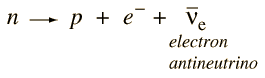
What does a neutron and a proton consist of?

neutrondec.gif

Are you then saying that this equation is incorrect?
Are you saying that if the arrow was reversed the equation would be incorrect?
 
What does a neutron and a proton consist of?

[qimg]http://hyperphysics.phy-astr.gsu.edu/hbase/particles/imgpar/neutrondec.gif[/qimg]
Are you then saying that this equation is incorrect?
No. The equation is correct. But the proton is not preformed inside the neutron. The decay requires the emission of a virtual W- boson which then gives the electron and antineutrino.

Are you saying that if the arrow was reversed the equation would be incorrect?
You'd be hard pushed to get a neutrino to interact with anything, let alone at the same time as an electron.
 
Correction. This was Witts statement not mine.
Correction noted.

For the record, the post of yours I quoted begins (emphasis added): "Hi All
First of all I want to restate a few things again."
How can you say that Dark Energy is not consistent with the cosmological constant.
Huh?

Did I say otherwise?!? :confused:

Perhaps you are not aware of the relevant history of cosmology?

The statement was about "the current paradigm"; at the time of the landmark papers (on high-z supernovae), that paradigm was, crudely, that Einstein's cosmological constant was, indeed, a curious historical blunder.

Surely they are different interpretations of the same set of observations.:boxedin:
Perhaps, perhaps not.

It's irrelevant ... you (or as we now know Witt) were making a bald statement concerning the reception an idea ("theory") outside the current paradigm would receive; I cited a specific example of something that falsified your claim.

Period.
PS These individuals who wrote these papers were well known in Astronomy, they were not unknowns.
So?

Your (or Witt's) claim said nothing about being known, unknown, Martian, or gnome ...

Perhaps you wrote in haste? Perhaps you'd like to revise your claim (or maybe Witt would)?
 
Skwinty, your notion of what particles "consist of" won't hold up to scrutiny. What does a kaon consist of? It has a dozen or two dozen decay modes:

K+ --> mu+ nu_mu
K+ --> e+ nu_e
K+ --> pi+ pi0
K+ --> pi0 mu+ nu_mu
K+ --> pi0 e+ nu_e
K+ --> pi+ pi+ pi-
K+ --> pi+ pi0 pi0
and so on, down to the ultra-rare
K+ --> pi+ e+ e-
and the ultra-ultra-rare (and exciting)
K+ --> pi+ nu nubar

(That was an easy one; the lists get longer and longer for heavier particles.)

Decays don't tell you directly what the decaying particle was "made of". A muon isn't "made of" an electron and two neutrinos; a pi+ isn't "made of" a muon and a neutrino; a pi0 isn't "made of" two photons. It just doesn't work that way, and you will make exactly zero progress in predicting particle properties unless you can shake that notion.

Decays can tell you about conservation laws; note that all of my K decays (as well as the one neutron decay) conserve charge, baryon number, lepton number, and lepton flavor, which is why those all seem to be exact conservation laws. The exact rates/probabilities of these decays tells you even more, about the conservation (or lack thereof) of quantities like C, P, CP, CPT, spin, and flavor. And so on.
 
Witt is an unknown and his theory rejects the current paradigm in favour of his. The odds are totally against him regardless of the validity of his theory.

Back to the facetious one liners sigh

Einstein studied philosophy and his approach was philosophical.
Once again his theories were based on the current paradigm.
Newton , Maxwell , Mach , Bohr, Brown , de Broglie to name a few

I agree that the odds are against him. The problem is that Witt is not even trying to win against the odds. He must know that papers that reject the paradigm in existence at the time have been published before.
I dislike saying this but the phase "courage of his convictions" comes to mind. As far as I know he has not even tried to get a paper published on null physics.

Einstein studied philosophy, mathematics and physics and his approach was mathematical.

Your generalization in the next sentence is definitely wrong. de Broglie and Bohr had no effect on his 1905 papers nor on his first scientific work (1894) nor on his first publication (1901).
Newton's law of gravity had little effect on General Relativity except as a neccessary solution in the appropriate limit.


Oddly enough an unknown (before 1905 he had only published 1 paper) could publish several theories that rejected the current paradigm:
  • The Special Relativity paper argued that the current paradigm (luminiferous aether) was superfluous.
  • Mass–energy equivalence was against the current paradigm (mass and energy are two separate concepts).
  • His paper on the particulate nature of light introduced quanta as physical entities rather than the previous mathematical treatment by Planck. This was against the current paradigm (wave theories of light).
 
6.Some of you may or may not buy his book for further investigation.
It is not fair to trash him based on the excerpts.

What nonsense. If he wants his theory to be taken at all seriously, he should publish it for free. Science isn't for sale.


What does a neutron and a proton consist of?

[qimg]http://hyperphysics.phy-astr.gsu.edu/hbase/particles/imgpar/neutrondec.gif[/qimg]
Are you then saying that this equation is incorrect?

No one is saying that.

Are you saying that if the arrow was reversed the equation would be incorrect?

Essentially, yes. The inverse process basically never occurs - the kinetic energies of the three incoming particles would have to be precisely right.

More importantly (as I have already explained three times), if the neutron was a bound state of those three particles, it could not decay into them without violating conservation of energy.

Look - when that decay occurs, the three particles all come out with some kinetic energy. That means the neutron, at rest, has MORE energy than all three of those particles at rest put together. Therefore it is not a bound state of them. This is totally obvious - I don't know how to make it any clearer.
 
Are you saying that if the arrow was reversed the equation would be incorrect?
You'd be hard pushed to get a neutrino to interact with anything, let alone at the same time as an electron.

The half-reversed reaction nu_e + n --> p + e- occurs routinely; that's one of the ways that neutrinos are detected at the Sudbury Neutrino Observatory, via the sudden appearance of an electron in a neutron-rich target.
 
What nonsense. If he wants his theory to be taken at all seriously, he should publish it for free. Science isn't for sale.
I agree that science is not for sale. But the works of authors are, even if their subject is science.

In fact there are a limited number of copies of the book available for free through his forum. Send a PM to percygrail at the forum www(dot)ourundiscovereduniverse(dot)com/dev/forum/
 
I don't expect him to publish his research for free. What I would expect him to do, if he were a serious physicist, would be to submit his research to a peer-reviewed physics journal.
 
Look - when that decay occurs, the three particles all come out with some kinetic energy. That means the neutron, at rest, has MORE energy than all three of those particles at rest put together. Therefore it is not a bound state of them. This is totally obvious - I don't know how to make it any clearer.

You have to make some allowance for casual usage, Sol. It obviously wouldn't be a bound state, but it could be a long-lived unstable state. If someone had said "The 238U atom is made of a 234Th atom with an extra two protons and two neutrons bound to it" ... well, it wouldn't be far from the truth. Ditto if someone described the delta resonance as a "proton and a pion bound together". No, it's not the physics definition of "bound" but it's easy enough to see what they're talking about.

Anyway, there's no shortage of non-pedantic ways to show that Terence Witt is a crackpot, so I'd prefer to stick to those ...
 
You have to make some allowance for casual usage, Sol. It obviously wouldn't be a bound state, but it could be a long-lived unstable state.

No, it couldn't. The Coulomb potential has no positive energy unstable states, full stop. And by the way, it was precisely by this logic that it was proven that the neutron is NOT a bound state of proton and electron: http://npg.nature.com/physics/looking-back/chadwick2/index.html

If the "electron" and "proton" which are supposedly inside the neutron act totally unlike unbound electrons and protons, then sure, it's possible. Come to think of it, I have a great model where they act like three quarks in a long-lived unstable state...

Anyway, the whole idea is incredibly childish. There are many particles that have lots of different decay modes. For example the neutral pion usually decays to two photons, but sometimes to an electron, a positron, and a photon. So what's it made out of? Two photons? An electron and a positron?
 
Last edited:
(emphasis added)Do you happen to recall the two 'high-z' supernova teams (of astronomers), who published independent papers that (in effect) announced the discovery of 'dark energy'?

Do you happen to know what the (then) "current paradigm" was, in cosmology? (HINT: someone's 'greatest blunder')

DRD, This is a bad example of your point. The "current paradigm" needed dark energy to make the paradigm work.

Rather than being criticized, they were looked on rather as heroes.
 
Okay, so let me see what I have learned here.

1.neutrons and protons consist of quarks. A different variety of flavours etc.
2.Quarks consist of nothing.
3.So then it would be true to say that the neutron and proton after the free neutron decays have nothing in common.
Sounds like lots of null physics here.

Its a bit like saying "Last night my car was stolen, but thats okay because it was replaced by an exact duplicate before I woke up"

I suppose that there is only one member of each of the particles in the particle zoo that are shared throughout the universe.
I believe it was Richard Feynman who suggested this about the electron.

It's no wonder that Mark Twain had this to say about science.
"Wholesale returns of conjecture on such a trifling investment in fact"

He forgot about the financial investment here.


It strikes me that particle physics is a self fulfilling prophecy.
Someone postulates a hypothetical particle to explain an effect in a billion dollar cloud chamber. Another few billion dollars are spent to prove the existence of this particle. Lo and behold the particle is discovered. No one can peer review the discovery other than a citizen of Planet Erudite.
If it wasnt, the gravy train would grind to a halt and the physicists would be doing nothing instead of postulating nothing.

I realise that this is a cynical view of things, but it explains why people write books like Null Physics and The Problem with Physics.:dig:
Yep, thats me digging a fallout shelter:D
 

Back
Top Bottom