Reality Check
Penultimate Amazing
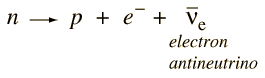
I agree that on this point Witt has been misinterpreted. The extract only talks about bound electrons in the nucleus (not free neutrons). It does not state that neutrons are protons and electrons. It is strange though that the last diagram for a neutron star is described as "two protons and two bound electrons, a neutron doublet".
Leonard Susskind, lee Smolin, David Greene etc etc did not need to put their books through peer review. Peer review is not for books, it is for scientific papers. But the contents of their books are based on scientific papers with a bit of speculation mixed in as is proper for popular books.
There are other issues with null physics. When I get his book I will be in a position to comment better. The issues I can see now are:
Leonard Susskind, lee Smolin, David Greene etc etc did not need to put their books through peer review. Peer review is not for books, it is for scientific papers. But the contents of their books are based on scientific papers with a bit of speculation mixed in as is proper for popular books.
There are other issues with null physics. When I get his book I will be in a position to comment better. The issues I can see now are:
- There is no zero-point energy in null physics.
But there are experimentally verified effects (Casmir Effect, Lamb Shift) that rely on there being a zero-point energy.
- No black holes in null physics. It does not allow matter to compress further than the "core repulsion" of neutrons.
There is a lot of evidence for things that look like supermassive black holes in the center of many galaxies including ours. Null physics does have hypermassive objects. From my last posting in his forum:
The point of the quote from Wikipedia was not really about the supermassive black hole in our galaxy. It was that any mass with the density of water over 150,000,000 solar masses will have a Schwarzschild radius that is greater than its radius. Supermassive objects up to 18 billion solar masses have been observed. Many of these objects have masses over 150,000,000 solar masses and so are counter-examples to your calculation for Sag A* in that they do not have mass that extends outside of their Schwarzschild radius.
So now we have 2 types of supermassive objects: hyperdense objects with mass outside of the Schwarzschild radius (and no event horizon?) and supermassive black holes whose mass lies inside their Schwarzschild radius and thus have event horizons.
- The null physics explanation for the cosmological redshift ("intergalactic redshift" in the book is lumetic decay. This is the gravitational redshift caused by the universal gravitational field in a flat universe.
But gravitational redshift depends on the gravitation field changing (see Wikipedia).
Thus we would need a non-uniform gravitational field of the universe that increases in all directions from the observer to give a redshift that increases with increasing distance. This allows the light to climb "uphill" out of a gravity well to the observer and thus redshift in all directions. This makes that observer privileged which is not allowed in GR.
Alternately every observer will deduce that the density of matter in the universe increases as distance increases from them.
- He has a white paper called "Einstein's Nonphysical Geometry" where he derives an equation stating that the % change in radial length diverges far from a Schwarzschild radius.
I think that he is using infinity improperly since using the exact solution (see equation 8) for the change in the Schwarzschild coordinate r gives the percentage change as (infintity - infinity)/infinity.
He uses an approximation that starts with the statement "In the limit (R2 − R1) → dr" where R1 and R2 are 'radial lengths' and dr is an infintesimal change in the Schwarzschild coordinate r. This looks incorrect since it assumes that r is a radial length which is is not.
Just below equation 8 in the above paper:
The coordinate r is an “areal” radius — it labels spherical surfaces of area 4πr2, but it does not label proper distance in a simple way.