• Quick note - the problem with Youtube videos not embedding on the forum appears to have been fixed, thanks to ZiprHead. If you do still see problems let me know.

Merged nuclear power safe?

The backup batteries worked (as designed) for eight hours. Any plane with a backup engine that worked for half that time would be able to make it to a runway.

Yes, and now you're the one trying to stretch the analogy too far. Basically now you're putting wings on a nuclear power plant.

Or do you think that a "backup engine" could hold that plane up for so long ?

Of course, it doesn't matter. What failed here is not the reactor.
 
All right, lets say that it is 300 microsieverts at the plant perimeter, or the edge of the companies control and it is public or private ground on the other side of the fence.

Public or private owned by other than TEPCO.

And it is 300 microsieverts on both sides of the fence. Is it ok to assume that?

There will be a dose of 262 Rem per year on the other side of the fence which is 50 times higher than the allowable limit for radiation workers in the US, and an amount of radiation that would be considered to put one at a rather high risk for harm.

It is also 500 times higher than the allowable limit for exposure to the public, therefore the evacuation is required.

Look up the limits for radiation exposure, make yourself more informed.

http://www.ndt-ed.org/EducationResources/CommunityCollege/RadiationSafety/safe_use/exposure.htm

Oops, I was wrong, it is 2620 times higher.

That's evidence, are you happy now?

No, because you still haven't provided any evidence whatsoever that this would require an evacuation of 20 km. And there is still no evidence whatsoever this is a INES 6 as other poster pretend to be.

I am sorry but you are just saying your opinion. Nothing official.

It is fine. You are entitled your opinion. But as soon as you start saying it is a fact, I am sorry but I expect a tad bit more than that.
 
You're still missing my point. Most back up power systems only have to work for a short time.

The back up power supply on a computer server works for perhaps half an hour, and if the main supply is absent for more than, say ten minutes, the computer shuts itself down so that it no longer needs any power. Similarly an aircraft doesn't need any power once it safely back on the ground.

Contrast this with a boiling water nuclear reactor - the backup power supply doesn't just have to work for a few hours - it has to work reliably for many days, even weeks before the reactor can be put into a safe 'no power necessary' state.
 
Then somebody, or a lot of somebodies, are really stupid. They build six nuclear reactors on the ocean, on flat land? In Japan? And the only thing protecting it from complete disaster is a 25 foot high wall?

And yes, if you are building a critical system next to the ocean in an earthquake prone area, you put the critical system a hundred feet up. And you build them so they don't fall down, flood or blow up.

Because otherwise....

You are so smart, please explain us where they get the water needed ? Beside river and ocean, where do you think they can get it ?
 
I have been trained in the methods for the detection of discrete highly radioactive particles one would encounter when dealing with suspected fuel element defects.

Radiation levels aren't normal in Tokyo.

And you?

But do you agree now that I have posted evidence that the evacuation is required?

Are the elevated radiation levels due to pieces of fuel rods scattered all the way to Tokyo or simply short lived nobel gas isotopes?
 
Sorry, but I believe this is fallacious.
No. He's right aluminum does burn. In fact his point flew over your head because he said the same thing you did. Also, I'm fairly certain the recycling and manufacturing gets done in an inert atmosphere because almuminum is that dam reactive. In fact its probably one of the most reactive elements you will ever come in contact with outside of elements like Lithium. Mind you that is what makes it such a great building material because technically speaking you the surface you are looking at when staring at aluminum isn't aluminum.
 
Last edited:
I have been trained in the methods for the detection of discrete highly radioactive particles one would encounter when dealing with suspected fuel element defects.

Radiation levels aren't normal in Tokyo.

And you?

But do you agree now that I have posted evidence that the evacuation is required?

The radiation level in Tokyo while higher than normal, are still the same as in other city with more backgroudn radioactivity aka : an acceptable range. And no you haven't provided any evidence of the necessity of a 20 KM evacuation.
 
Are the elevated radiation levels due to pieces of fuel rods scattered all the way to Tokyo or simply short lived nobel gas isotopes?

How are the short lived nobel gas isotopes separated from all the other fission products?
 
The radiation level in Tokyo while higher than normal, are still the same as in other city with more backgroudn radioactivity aka : an acceptable range. And no you haven't provided any evidence of the necessity of a 20 KM evacuation.

You are right, I have not provided evidence for the necessity of the 20 KM evacuation, but I have provided evidence that evacuation is required at the plant boundary.

It is required at some point past the plant boundary, how far, who knows.

You have not provided evidence that the evacuation is only a precaution and not required.
 
What kind of mentality is in place that builds critical systems down near the ocean, then builds a wall around them?

Even with the risk of tsunami, ocean front property is a logical place to build a reactor. To have access to the largest heat sink on the planet and not make use of it would have been an infinitely worse design decision.

They wouldn't have been able to get the units they have gotten under control were it not for the ready access to abundant supplies of seawater.
 
You are right, I have not provided evidence for the necessity of the 20 KM evacuation, but I have provided evidence that evacuation is required at the plant boundary.

It is required at some point past the plant boundary, how far, who knows.

You have not provided evidence that the evacuation is only a precaution and not required.

Emphasis mine.

Why should I have to ? I accept the japabese official version. You are the one saying that the japanese INES assement of 4 is wrong and the INES should be bumped up to 5 or even 6. So you are the one which need to provide evidence.
 
The back up power supply on a computer server works for perhaps half an hour, and if the main supply is absent for more than, say ten minutes, the computer shuts itself down so that it no longer needs any power. Similarly an aircraft doesn't need any power once it safely back on the ground.

We are discussing circumstances in which ALL backups are out, though. You can NEVER make something 100% safe. Hell, you can kill yourself while cooking dinner.

Contrast this with a boiling water nuclear reactor - the backup power supply doesn't just have to work for a few hours - it has to work reliably for many days, even weeks before the reactor can be put into a safe 'no power necessary' state.

Indeed. But what would you have done ? Build the diesels higher ? What if the wave had reached them ? Would you still critisize that decision ?
 
Emphasis mine.

Why should I have to ? I accept the japabese official version. You are the one saying that the japanese INES assement of 4 is wrong and the INES should be bumped up to 5 or even 6. So you are the one which need to provide evidence.

Three Mile Island was rated as a 5, and the hydrogen produced by the fuel elements failures there was contained and didn't explode.

In this recent incident the hydrogen did explode and there is spread of radiation outside the plant boundaries.
 
No. He's right aluminum does burn. In fact his point flew over your head because he said the same thing you did. Also, I'm fairly certain the recycling and manufacturing gets done in an inert atmosphere because almuminum is that dam reactive. In fact its probably one of the most reactive elements you will ever come in contact with outside of elements like Lithium.

You're fairly certainly wrong.

Finely divided Al will burn in an oxygen stream but the Al superstructure of ships will not burn in air. That was my point and I bolded it in my post. Aluminium is easily melted in the presence of air, hence pretty simple smelting of Al waste.

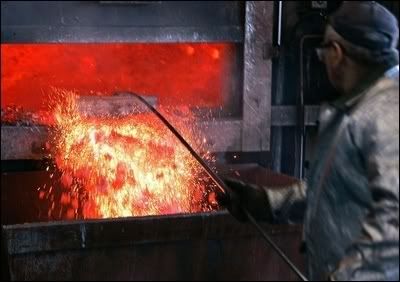
moltenaluminium.jpg
moltenaluminium.jpg


Meanwhile Potassium, Sodium, Lithium, Calcium and Magnesium are all above Al in the reactivity series of metals. Cheers, but this was part of my 'O' level chemistry lessons back in '64. Lessons I recall.
 
Last edited:

Back
Top Bottom