
That's the right question indeed.Thank goodness they did not waste their time with a goal free pursuit of Mr Monk like obsession with smoothing data beyond recognition, or some form of "Demolition-itis". NIST suffer from being goal oriented, not into making fancy curves.
When will this NIST bashing be published, and how does it lead to a new probable (yep, probable) collapse sequence?

-
Security incident: ISF was recently accessed by intruders. Please change your password, and change it anywhere else you used it. Read more
You are using an out of date browser. It may not display this or other websites correctly.
You should upgrade or use an alternative browser.
You should upgrade or use an alternative browser.
NIST blew WTC7 Stage 1 analysis
- Thread starter tfk
- Start date
When will this NIST bashing be published, and how does it lead to a new probable (yep, probable) collapse sequence?
Wow, just wow. Trolls. Look, there's a quite a difference between 25s collapse and 180s collapse, right?

Wow, just wow. Trolls. Look, there's a quite a difference between 25s collapse and 180s collapse, right?
Where is your paper on this? Wow, you have all this stuff, where is it published? You are an engineer, right?
Were you next to WTC 7 on 911? Did you know it was making noises? It appears your observables are limited. Where is your computer model?
The collapse sequence starts with debris hitting and setting fire in WTC 7. Better work on the math. Better include all the links in the chain of failure; have you had accident investigation courses? You could apply technique from those classes. Did you go to USC for those courses? What engineering school did you attend?
When you did your thesis for your Masters degree in engineering, presenting your thesis to your adviser and the panel of professors, when a professor asked a flippant question to test your depth and breath of knowledge on the topic, did you call him a troll? How did that work?
Correct. Erronious placement of the elusive T0. Effectively arbitary placement of Stage 1 end-point.NIST blew the calculation of the Stage 1 of WTC7 collapse.
Correct(ish), though as I've said, the NIST decision to define such "staging" at all was not a good idea. They misinterpreted early motion direction, yes, but there are additional reasons why the 1.75s timing is inaccurate.NIST mistook horizontal motion for vertical motion, resulting in an actual Stage 1 descent of much less than 1.75 seconds.
As you know, East Penthouse descent preceeded release of the NW corner (and North facade) by ~6s. Motion of the building was detectable minutes prior to release...And uglypig believes that there was approximately 2 minutes of collapse going on prior to "global collapse" that was measurable from some motion of the external wall(s) of the building.
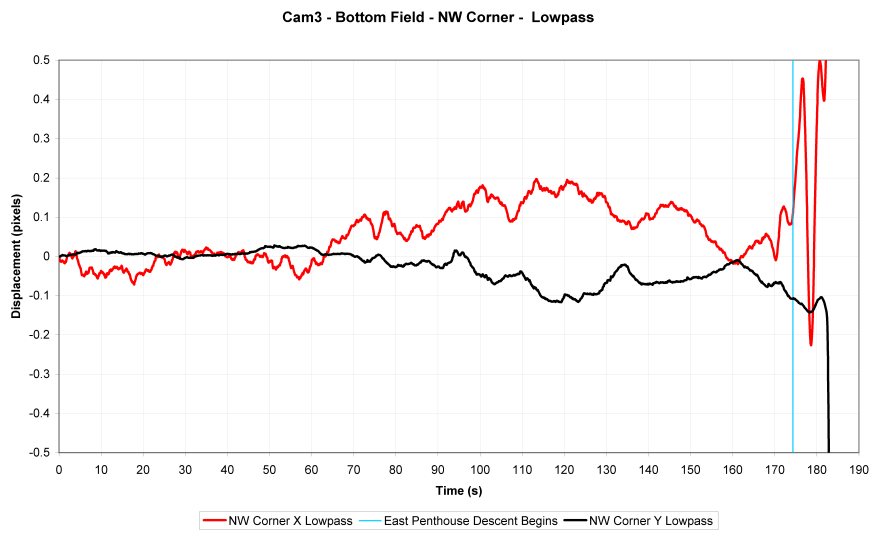
...and the preceeding few minutes...

Where would you suggest the "start" is ?
Further to my previous posts here, I thought I'd expand, as many folk don't tend to follow enclosed links...Why don't you guys go ahead & make your respective cases.
NIST T0 Selection
By usage of the brightness profile in NIST Figure 12-75 the exact pixel and (interlaced) frame that NIST selected was determined...
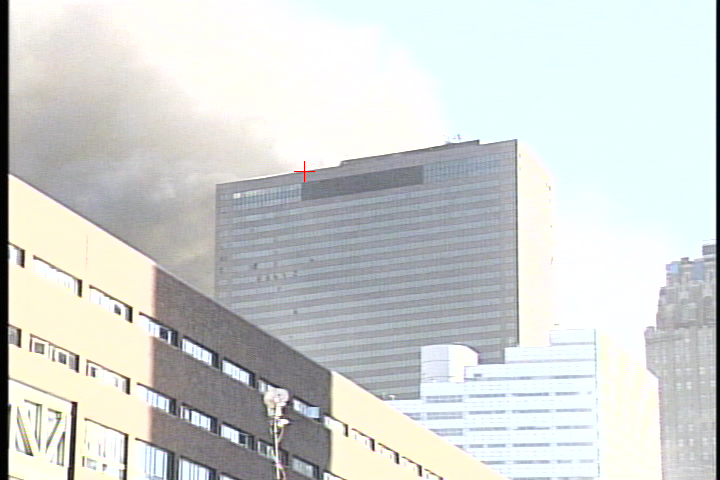
Pixel | 304, 171
Frame | 5398
That point is the exact start of the NIST Stage 1.
It is also ~6s after the start of the East Penthouse descent.
The following graph shows motion of the NW corner relative to the NIST T0 and their East Penthouse release time...

As you can see, relative to NW corner motion, the NIST T0 looks pretty meaningless.
The NIST release time for the East Penthouse is also inaccurate, but that's not relevant for this thread. (It's much closer to exactly 6s prior to their T0).
NIST chose that spot with the assumption that detected motion after that point in time was vertical. In fact that motion is initially primarily North->South, as the formation of the "kink" was misinterpreted by NIST to be vertical in nature.
If they had compared the roofline profile of their chosen Cam#3 viewpoint...

...against that seen from the Dan Rather viewpoint...

...it would have been obvious that the "kink" was formed primarily North->South.
There are other ways to prove such, but comparison of the two images above (which are synchronised at the same point in time) is by far the simplest way to present the NIST interpretation error.
So, the start point of NIST "Stage 1" is, at best, flawed.
However, given that T0 (release) placement is always slightly subjective, that can be put aside, and focus can be placed upon the actual 1.75s "Stage 1" interval...
NIST Stage 1 Interval
Here is a graph of the NIST acceleration profile as derived from the equation provided, along with the Stage 1 1.75s timing...
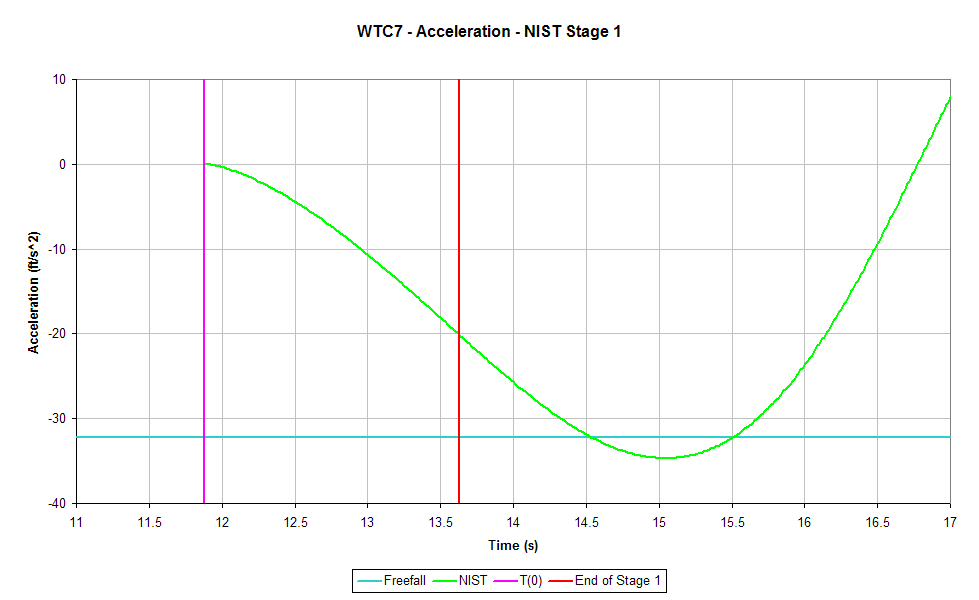
Well, it would seem that NIST didn't derive their (time derivative of curve fit) velocity equation for acceleration, as that would put their stage 1 (which is defined by NIST as being terminated when "freefall" was attained) a little later on.
So how did they come up with the time ?
I'd suggest a guesstimate, using eye-balled velocity graph slope as a rough indicator.
Is it therefore surprising that their Stage 1 period is inaccurate ?
A more correct "Stage 1" Timing
If Stage 1 "means" the time between release and the start of the period of approximately freefall descent, then firstly acceleration profile data must be determined...
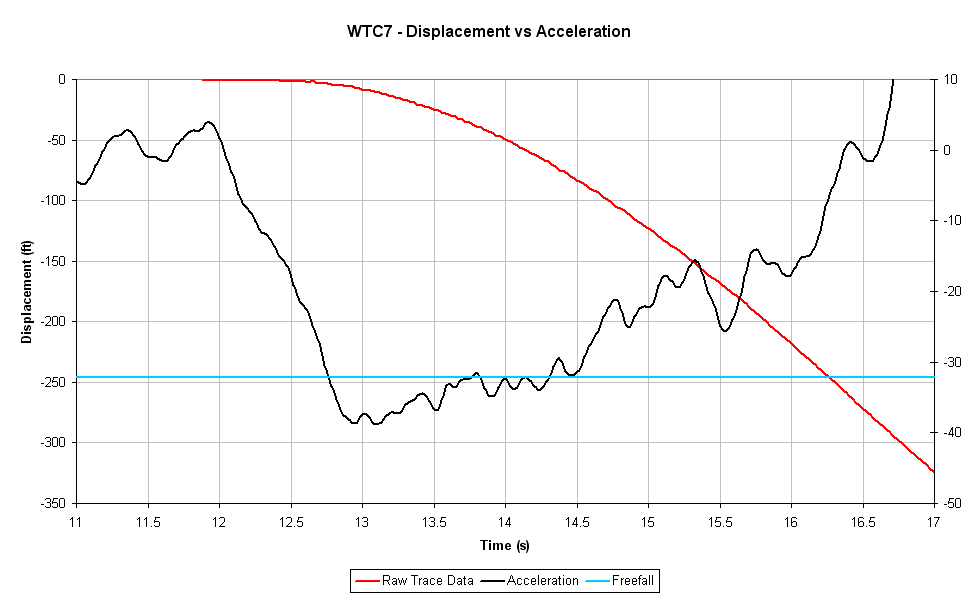
...then simply measure the time between release and maximum acceleration...
~1s
(Just before the 12s mark to just before the 13s mark)
If you want to suggest the end-point should be a little earlier (as the maximum acceleration is over "freefall", fine. That would put "Stage 1" period down to ~0.75s.
As you also know, there are a number of additional factors which affect the NIST data...
The NIST data suffers from the following (non-exhaustive) series of technical issues, each of which reduce the quality, validity and relevance of the data in various measures...
- NIST did not deinterlace their source video. This has two main detrimental effects: 1) Each image they look at is actually a composite of two separate points in time, and 2) Instant halving of the number of frames available...half the available video data information. Tracing features using interlaced video is a really bad idea, especially for features changing vertical position. I have gone into detail on issues related to tracing of features using interlaced video data previously.
- NIST did not sample every frame, reducing the sampling rate considerably and reducing available data redundancy for the purposes of noise reduction and derivation of velocity and acceleration profile data.
- NIST used an inconsistent inter-sample time-step, skipping roughly every 56 out of 60 available unique images. They ignored over 90% of the available positional data.
- NIST likely used a manual (by hand-eye) tracking process using two single pixel columns, rather than a tried and tested feature tracking method such as those provided in systems such as SynthEyes. Manual tracking introduces a raft of accuracy issues. Feature tracking systems such as SynthEyes employ an automated region-based system which entails upscaling of the target region, application of LancZos3 filtering and pattern matching (with FOM) to provide a sub-pixel accurate relative location of initial feature pattern in subsequent frames in video.
- NIST tracked the *roofline* using a pixel column, rather than an actual feature of the building. This means that the trace is not actually of a point of the building, as the building does not descend completely vertically. This means the tracked pixel column is actually a rather meaningless point on the roofline which wanders left and right as the building moves East and West.
- NIST chose an initial trace location which precluded starting the trace before the East Penthouse had already descended (as the East Penthouse obscured their trace location). Consequently they no way of gathering early motion data, or quantifying long term noise levels.
- NIST chose a trace endpoint which could not be traced from their selected T0 time, and so subsequently merged data from two separate traces together, without accounting for change in scaling metric.
- NIST used the Cam#3 viewpoint which includes significant perspective effects (such as early motion being north-south rather than up-down and yet appearing to be vertical motion). It also means that each horizontal position across the facade requires calculation of a unique scaling metric, which NIST did not bother to do.
- NIST did not perform perspective correction upon the resultant trace data.
- NIST did not recognise that the initial movement at their chosen pixel column was primarily north-south movement resulting from twisting of the building before the release point of the north facade.
- NIST did not perform static point extraction (H, V). Even when the camera appears static, there is still (at least) fine movement. Subtraction of static point movement from trace data significantly reduces camera shake noise, and so reduces track data noise.
- NIST did not choose a track point which could actually be identified from the beginning to the end of the trace, and so they needed to splice together information from separate points. Without perspective correction the scaling metrics for these two points resulted in data skewing, especially of the early motion.
- NIST performed only a linear approximation for acceleration, choosing not to further derive their chosen displacement function.
- NISTs displacement function, if derived to obtain acceleration/time contains a ~1s period of over-g acceleration. Whilst that in itself is fine, it's at the wrong time, and in their conclusions they ignore it.
- NISTs displacement function, if derived to obtain acceleration/time does not suggest a 2.25s period of roughly gravitational acceleration.
- The displacement data appears to have been extracted initially from the T0 pixel column, but using the scaling factor determined for a point above Region B, further skewing the displacement data.
As I have said many times, WTC7 was in motion several minutes prior to release. Those proposing explosives->immediate descent must ask themselves what was causing the early motion.It'd be, like, you know totally way cool if you could make some statement, after you've made your cases, as to how your interpretation of the timing impacts the question of "CD vs. no CD", or "inside job vs. outside job".
Oystein
Penultimate Amazing

- Joined
- Dec 9, 2009
- Messages
- 18,941
...
As I have said many times, WTC7 was in motion several minutes prior to release. Those proposing explosives->immediate descent must ask themselves what was causing the early motion.
femr2, or anyone who is better read than I am,
a few serious quest for information which I don't have, because, frankly, I never have looked deep into any details of the WTC 7 collapse, especially not NIST's version. So yes, I am lazy, and don't expect you to pull quotes, find links or create or post graphics - short text answers off the top of your head will be very much appreciated:
- Have you established that this "motion several minutes prior to release" was unusual? In other words, have you analysed vidoes of the same building, preferably taken by the same cameras, a long time before release and determined that the building stood still then? I understand that it is not unusual for high rise buildings to sway move in the wind, for example. I just wouldn't know by how much.
- Did NIST detect such motion several minutes prior to release? What's their take on it?
- We have all this talk of progressive collapse allegedly (per NIST) starting with the girder walk-off at column 79. I understand this happened seconds, not minutes, before the east penthouse started to descend. Correct? So that would mean that the building moved a long time prior to this alleged initiating event. To your knowledge, does anyone - NIST, you, anyone - have an explanation (suggestion, susoicion...) for such early movement?
...but you are the one who suffers all the time a twoofer isn't correct a 101% if 95% are enough for seeing the picture.Thank goodness they did not waste their time with a goal free pursuit of Mr Monk like obsession ...
(I'm the banana guy, you know!)
- Have you established that this "motion several minutes prior to release" was unusual? In other words, have you analysed vidoes of the same building, preferably taken by the same cameras, a long time before release and determined that the building stood still then? I understand that it is not unusual for high rise buildings to sway move in the wind, for example. I just wouldn't know by how much.
- Did NIST detect such motion several minutes prior to release? What's their take on it?
- We have all this talk of progressive collapse allegedly (per NIST) starting with the girder walk-off at column 79. I understand this happened seconds, not minutes, before the east penthouse started to descend. Correct? So that would mean that the building moved a long time prior to this alleged initiating event. To your knowledge, does anyone - NIST, you, anyone - have an explanation (suggestion, susoicion...) for such early movement?
1) it's almost impossible since there are just a few videos and the duration of the available material is almost always pretty short.
But you point in the cucial direction. Camera 3 looks up from Weststreet sideways towards the WTC7. Hence, any sway of small angles to the north appears as "growing" and any motion toward south appears as sinking.
NIST measured very close to the known kink position and that kink looks like "sinking". Imo there is just a very little downward acceleration (if any) but mostly a bowing and folding of the north face towards the core (south).
NIST interpreted that motion as pure "downward" and established their "stage 1" on these data.
I talk about this motion: the center of the wall walks south while the NE corner walks north.

as you can see, that kink isn't visible from a higher ventage point and the roofline appears straight.

The NIST-stage 1 marks that bowing (imo) towards the core and pulled by the core. The onset of real downward motion of the north face is much shorter. It's pretty much the begin of "stage 2".
Let's think about the time derivative function in 3D. It's nonsense.

This is not about the onset of collapse, it's just a question of the mechanics. While the NIST model disintergates into thousands of falling pieces the real middle-part of the core appears to be one falling block and well connected to the exterior walls via the floor slaps.
That falling core (imo) took the north face down simply by pulling one floor (floor 14 ???) inward while the floor below was unaffacted.
That mechanism can also explain the short time of "above free fall" acceleration of the northface since the center of mass was somewhere inside the earlier falling core. Hence, the "above free fall" occurrence seems to confirm this mechanism.
2) as far as I know NIST released or discussed no data prior to the -15sec point. Allegedly the firefighters had eqipment to track the building in time and came therefore to the conclusion that it might fall soon. I don't know if any data or picture can confirm this claim. I never saw anything like that and it would have been the simpliest way to argue against CD.
3) that early movement looks like a small amount of "growing", right? Since the building cannot grow by fire I would suggest it leans a little bit towards north and east. It's indeed the entire building because it is measurable in the same way at different spots.
That leaning it not irreversible. Shortly prior to the onset of global collapse the entire building is back to "normal" (138s) and leans again slowly towards north.
At about second 166 something happened. The building appears to twist a little bit and began to swing. At about second 171 the penthouse starts to fall into the roof.
I'm not an architect but I have problems to believe in girder walk-offs mostly because the fires inside the office area just needed about 20 minutes to burn out. Given a fire resistance rating of 3 hours there was hardly enough time to heat up the NE corner area. The fires took out every window and the wind came from north. 3 good reasons to say that the walk-off in the NE corner appears like utter nonsense.
Even if a girder walked off for any reason, according to NIST do we need 5 floors of unsupported column length because otherwise 79 wouldn't buckle.
Problem: no fire at floor 10!
Hence, we need some pancaking collapse to get 5 floors unsupported (in one direction).

Last edited:
How is that a problem? 3 floors falling on one would most surely cause it to collapse even if not weakened by fire.Problem: no fire at floor 10!
Hence, we need some pancaking collapse to get 5 floors unsupported (in one direction).
Animal
Master Poster
ThankfullyI'm not an architect

but I have problems to believe in girder walk-offs mostly because the fires inside the office area just needed about 20 minutes to burn out.
No, it is 20-30 minutes for any one point, not "inside the office area"
Given a fire resistance rating of 3 hours there was hardly enough time to heat up the NE corner area. The fires took out every window and the wind came from north. 3 good reasons to say that the walk-off in the NE corner appears like utter nonsense.
3 reasons to be assured you do not have a clue as to what you are talking about.
Even if a girder walked off for any reason, according to NIST do we need 5 floors of unsupported column length because otherwise 79 wouldn't buckle.
Problem: no fire at floor 10!
Hence, we need some pancaking collapse to get 5 floors unsupported (in one direction).
[qimg]http://i46.tinypic.com/al2bsh.jpg[/qimg]
3 floors worth of mass imposing a dynamic load on a floor structure designed for 80 lb s.f. live load......and you don't see a problem?

Obviously you are one of the brainy ones.No, it is 20-30 minutes for any one point, not "inside the office area"
The fuel load of the "not inside of the office area" area called "core" tended to be pretty small. NIST extended the carpet into the core to simulate it.
On the other hand 20-30 minutes for any given point gives a function over time depending on the speed of fire distribution. So you can have a slow and small fire or a faster and bigger fire. You can also read the McGratton part of the NIST report to answer the question: How fast was the fire and how long lasted the fire in the NE corner of each floor.
Wow, good argument. Here is the way NIST did it. And they opend the windows by hand and they copied the simulation features to 11 and 13 with a slight offset in time. Result: Girder walk-off.3 reasons to be assured you do not have a clue as to what you are talking about.

Would you say the NE corner in the photographs had something less than 1000°C upper layer temperature?
3 floors worth of mass imposing a dynamic load on a floor structure designed for 80 lb s.f. live load......and you don't see a problem?
You are one of those who believe that all the connection give way in a blink of an eye and the entire floor slap drops down with a comic strip like BANG.
Any example?
Well, NIST found one example of inner pancaking collapse. Building 6 I guess. The one floor without fire stopped the fall of all the floors above because probably it wasn't like a comic strip a la NOVA.
Last edited:
newton3376
The Truth Movement.....still not at 1%

- Joined
- May 16, 2009
- Messages
- 1,320
Obviously you are one of the brainy ones.
The fuel load of the "not inside of the office area" area called "core" tended to be pretty small. NIST extended the carpet into the core to simulate it.
On the other hand 20-30 minutes for any given point gives a function over time depending on the speed of fire distribution. So you can have a slow and small fire or a faster and bigger fire. You can also read the McGratton part of the NIST report to answer the question: How fast was the fire and how long lasted the fire in the NE corner of each floor.
Wow, good argument. Here is the way NIST did it. And they opend the windows by hand and they copied the simulation features to 11 and 13 with a slight offset in time. Result: Girder walk-off.
[qimg]http://i42.tinypic.com/fviy6x.png[/qimg]
Would you say the NE corner in the photographs had something less than 1000°C upper layer temperature?
You are one of those who believe that all the connection give way in a blink of an eye and the entire floor slap drops down with a comic strip like BANG.
Any example?
Well, NIST found one example of inner pancaking collapse. Building 6 I guess. The one floor without fire stopped the fall of all the floors above because probably it wasn't like a comic strip a la NOVA.
What is disturbing is that after all these years...........you still don't understand why you are wrong. Your last post makes this painfully obvious.
Animal
Master Poster
Obviously you are one of the brainy ones.
The fuel load of the "not inside of the office area" area called "core" tended to be pretty small. NIST extended the carpet into the core to simulate it.
On the other hand 20-30 minutes for any given point gives a function over time depending on the speed of fire distribution. So you can have a slow and small fire or a faster and bigger fire. You can also read the McGratton part of the NIST report to answer the question: How fast was the fire and how long lasted the fire in the NE corner of each floor.
Wow, good argument. Here is the way NIST did it. And they opend the windows by hand and they copied the simulation features to 11 and 13 with a slight offset in time. Result: Girder walk-off.
[qimg]http://i42.tinypic.com/fviy6x.png[/qimg]
Would you say the NE corner in the photographs had something less than 1000°C upper layer temperature?
You are one of those who believe that all the connection give way in a blink of an eye and the entire floor slap drops down with a comic strip like BANG.
Any example?
Well, NIST found one example of inner pancaking collapse. Building 6 I guess. The one floor without fire stopped the fall of all the floors above because probably it wasn't like a comic strip a la NOVA.

Not in defence of some of the "brainy" JREFers here but:
The fuel loading was capable of heating the floor system to some 350°C, enough to breake the connections, then when the floor contracted it slided and fell down.
The local collapse (may have) got arrested after a few floors, maybe 4. (the dust on the photo).
The fuel loading was capable of heating the floor system to some 350°C, enough to breake the connections, then when the floor contracted it slided and fell down.
The local collapse (may have) got arrested after a few floors, maybe 4. (the dust on the photo).
The fuel loading was capable of heating the floor system to some 350°C, enough to breake the connections, then when the floor contracted it slided and fell down.
Yes, I know that theory. There is a chance of occurrance. There is a chance for pancaking. There is a chance it occurred all around column 79. There is a chance 79 buckled. There is a chance that the buckling of 79 caused a global collapse of the building.
It's a chance of a chance of a chance of a chance. It's the opposite of "propable" while some brainy people around here want it to appear like an inevitable chain of events. No, they KNOW it happend that way without any shred of evidence.
A full scale test of that assembly would be great but do not exist to my knowledge, while those chains of events usually happen in the surroundings of Bugs Bunny.
It's just a chance.
Btw, the heavy smoke infront of the north side was probably caused by burning cars. There was indeed a moment of extremely increased smoke around 4:51pm but it's only visible in the distant NBC live cam compared to other times.
The rising smoke suggest some event more in the center or west half of the building.

Last edited:
Oystein
Penultimate Amazing
- Joined
- Dec 9, 2009
- Messages
- 18,941
Wow, just wow. Trolls. Look, there's a quite a difference between 25s collapse and 180s collapse, right?
No, not really. It's mostly a matter of definition.
Not conclusively, although...Have you established that this "motion several minutes prior to release" was unusual?
...I am of the opinion that motion from 60s onward seems linked to latter events.
Something certainly occurred at the 160s mark.
100s seems a hell of a long time for a natural building harmonic, and could be viewed as a kind of creep ?
I view the early motion as a kind of oscillating flexure, which increased in magnitude until something went pop, perhaps caused by gradual load redistribution around creeping members.
Similar, though without static point extraction the data is...flawed.Did NIST detect such motion several minutes prior to release?

NIST only considered motion from 6s prior to East Penthouse descent to be relevant to their investigation. The other motion they (incorrectly) assumed to be camera motion only (but as they didn't remove camera motion from their data, that is hardly surprising).What's their take on it?
I suggest that the destruction of column 20 (and subsequent internal effects)...To your knowledge, does anyone - NIST, you, anyone - have an explanation (suggestion, suspicion...) for such early movement?
[/LIST]

...enabled oscillating flexure of the building.
At the 160s mark, the flexure (which had been increasing in magnitude) suddenly inverted direction.
The 160s mark is ~15s prior to East Penthouse descent, not 6s.
The 60s mark is still significant imo.
I suggest others stick to the thread topic... NIST blew WTC7 Stage 1 Analysis.
Oystein
Penultimate Amazing
- Joined
- Dec 9, 2009
- Messages
- 18,941
...
100s seems a hell of a long time for a natural building harmonic, and could be viewed as a kind of creep ?
...
Thanks
 Yes, I agree, 100s seems too long. I kind of remember that the twins took something like 12 seconds for have a round of sway.
I'd suggest it's creep if it doesn't recover / return to previous position, particularly height. I.e. creep is a result of gravity (mostly) pulling something down for good (this could result in something else moving up, but on average things move down; center of mass does.)
LSSBB
Devilish Dictionarian

Yes, I know that theory. There is a chance of occurrance. There is a chance for pancaking. There is a chance it occurred all around column 79. There is a chance 79 buckled. There is a chance that the buckling of 79 caused a global collapse of the building.
It's a chance of a chance of a chance of a chance. It's the opposite of "propable" while some brainy people around here want it to appear like an inevitable chain of events. No, they KNOW it happend that way without any shred of evidence.
A full scale test of that assembly would be great but do not exist to my knowledge, while those chains of events usually happen in the surroundings of Bugs Bunny.
It's just a chance.
Btw, the heavy smoke infront of the north side was probably caused by burning cars. There was indeed a moment of extremely increased smoke around 4:51pm but it's only visible in the distant NBC live cam compared to other times.
The rising smoke suggest some event more in the center or west half of the building.
[qimg]http://i45.tinypic.com/flm2qr.jpg[/qimg]
What exactly is that chance? That must be some heck of a fault tree you built up in Visio to figure that out. Can I see it?
So let me get this right. Your claim is that the building was collapsing BEFORE the proposed NIST time? And that means what exactly? I see you throwing a lot of spaghetti against the wall in hopes some of it will stick but still I have to ask so what? Is it possible they got the timing wrong? Sure no one was inside measuring things and would have to assume they did not have all that much data on the types of cameras, lenses, distances, etc. I see you don't pay much heed to those sorts of things either so you don't even consider that both motion and lens distortion could be giving your data false positives.
Take the first image shown in this thread, for example. I agree that the building appears to be "leaning" but if reference the surroundings then you have a list to the building on the left, too. For that matter the front face of the lower building on the right has virtually the same angle while the left back corner appears almost dead 90 degree vertical with the framing of the picture. In fact that building appears more twisted than WTC 7. So is it collapsing too? I don't have a protractor handy but my guess would be find there is not much telling about that particular picture.
In the end I fail to see what significance any earlier distortion means. The first real outward signs the collapse is widows breaking just before the penthouse disappears. Whether it you think it actually is collapsing inside earlier or not is really best guess because no one was inside. However, ask yourself this: If the fire fighters were suspecting it might collapse, as is verified in earlier communications that day, what were those signs?
I really don't see what the purpose of focusing on small segments the overall event. No event this big or small accident comes down to ONE small thing or segment of that event. Ultimately conspiracy theories fall apart because they do this. CTer's look for that one single thing, the smoking gun if you will, when it was never a smoking gun that set the chain of events in motion.
Take the first image shown in this thread, for example. I agree that the building appears to be "leaning" but if reference the surroundings then you have a list to the building on the left, too. For that matter the front face of the lower building on the right has virtually the same angle while the left back corner appears almost dead 90 degree vertical with the framing of the picture. In fact that building appears more twisted than WTC 7. So is it collapsing too? I don't have a protractor handy but my guess would be find there is not much telling about that particular picture.
In the end I fail to see what significance any earlier distortion means. The first real outward signs the collapse is widows breaking just before the penthouse disappears. Whether it you think it actually is collapsing inside earlier or not is really best guess because no one was inside. However, ask yourself this: If the fire fighters were suspecting it might collapse, as is verified in earlier communications that day, what were those signs?
I really don't see what the purpose of focusing on small segments the overall event. No event this big or small accident comes down to ONE small thing or segment of that event. Ultimately conspiracy theories fall apart because they do this. CTer's look for that one single thing, the smoking gun if you will, when it was never a smoking gun that set the chain of events in motion.
Redwood
Graduate Poster

- Joined
- May 9, 2012
- Messages
- 1,557
Btw, the heavy smoke infront of the north side was probably caused by burning cars. There was indeed a moment of extremely increased smoke around 4:51pm but it's only visible in the distant NBC live cam compared to other times.
The rising smoke suggest some event more in the center or west half of the building.
[qimg]http://i45.tinypic.com/flm2qr.jpg[/qimg]
That's a lot of smoke for a few cars burning. Did they burn all day and flare up in the late afternoon? Or do you think that something, or "someone" started them burning?