• Quick note - the problem with Youtube videos not embedding on the forum appears to have been fixed, thanks to ZiprHead. If you do still see problems let me know.

Newton's Bit's letter published...

Sounds to me like he got his idea of what a "straw-man" argument is from Alex Jones. Lots of footnotes, which makes it look vaguely scholarly.

I am amused that the conclusion is "deliberate disinformation" rather that the obvious which is that Fetzer and Wood are crackpots.

I remember Gordon's bizarre rants about your website.
Instead of OCT's he was starting to use the word FK's (Short for Fighting Keyboardists) from a logo shown on your site.
I think he believes you're a part of some massive goverment disinfo group.

Here's one of his posts
http://forum.physorg.com/index.php?showtopic=7444&st=1275&#entry114888
 
I remember Gordon's bizarre rants about your website.
Instead of OCT's he was starting to use the word FK's (Short for Fighting Keyboardists) from a logo shown on your site.
I think he believes you're a part of some massive goverment disinfo group.

That's probably been our biggest secret weapon. When James and I started SLC I added us to a blogroll alliance called the 101st Fighting Keyboardists, in which every member has the blogroll on their site. The result was that hundreds of blogs link to us with the term "Screw Loose Change", which acted as a huge Google bomb for "Loose Change" as well. So we've almost from the start been on the first page of search results for that and are currently fifth, behind Loose Change's website, two Google video versions and the Wikipedia entry. I don't think there's any doubt that's how a lot of readers found us in the first place, although I note with some pride that we see more searches for "Screw Loose Change" than for "Loose Change" these days.
 
As I have noted before, Gordon Ross assumes that all sections of the towers were created (more or less) equal.... However, the upper (tilting) section of WTC 1 was surely more resiliant than the lower (fixed) section because of the stiffening effect of the hat truss. Try crushing a beer can that has been damaged with a horizontal cut near the top of the can. The can buckles completely near the cut, and down from the cut; but it is very difficult to initiate buckling near the top of the can.

The hat truss was an antenna holder and extended only down to the 107th floor. Does the hat truss somehow project its rigidity into the area 10 floors below?

The rest of the structure in the upper part (i.e. floors 106-96) was weaker than the top of lower section, especially if one ascribes to the "fire weakening steel" argument. Don't forget that the fires spread upwards in the building.

For the Bazant et al. model to be any good it must be in accord with the video evidence, where the upper part is destroyed at a higher rate that the lower part.
 
Hi Guys,

I'm amused that Ross didn't come up with a response to my accusations that he doesn't know anything about buckling. His demands for comparitive energy levels appear to suggest that he's taking a "fake, but accurate" line. It's rather sad.
 
The hat truss was an antenna holder and extended only down to the 107th floor.
No, the hat truss transfers loads by tying the exterior columns to the core columns. Both towers had hat trusses. Only the north tower had a large antenna on the roof.
Does the hat truss somehow project its rigidity into the area 10 floors below?
Yes. Please read the NIST analyses of load transfers from the impact and fire areas, via the hat trusses.

For the Bazant et al. model to be any good it must be in accord with the video evidence, where the upper part is destroyed at a higher rate that the lower part.
Where can I find this video analysis?
 
No, the hat truss transfers loads by tying the exterior columns to the core columns. Both towers had hat trusses. Only the north tower had a large antenna on the roof.
Yes. Please read the NIST analyses of load transfers from the impact and fire areas, via the hat trusses.

Where can I find this video analysis?

An antenna was planned for wtc2, just not built.

Load transfer only works if the tension side is connected to something.

Any video of WTC1 should do the trick. Try 911 Research they have cut alot of videos up into stills.
 
GregoryUrich; said:
The hat truss was an antenna holder and extended only down to the 107th floor. Does the hat truss somehow project its rigidity into the area 10 floors below?

No way. The pictures of the SW corner of the South Tower, the ones in which there is a visible crease at about floor 106-107, seconds into the collapse, make this a virtual impossibility. No "crush up" in the South Tower, except possibly the truss cap.

(I say no way in regards to Bazant et al. assumption is remained intact until "crush up")
 
Last edited:
The only problem with the coke can analogy is the fact that the steel tapered up to the top, unlike a coke can whose structure is identical top to bottom (top and bottom of course being different) Now you get a coke can with a variable thickness and what happens?
 
From my understanding the separation between the upper and lower blocks look something like this.
http://z9.invisionfree.com/debunking_911/index.php?act=Attach&type=post&id=12797843

You can double check here.
This is the highest resolution video I can find of the collapse.
http://italy.indymedia.org/uploads/2005/03/wtc1-demolition-4.avi

With that in mind now watch the video Gordon uses, then compare.
http://www.studyof911.com/video/files/wtc1_coll_N_01.mpg

Did he get his lines correct? Is his top line on frame 4 also too low?
I'd say yes.
http://www.911blogger.com/node/9154

This doesn't mean I agree with everything in the Bazant/Greening/Benson/Le paper either.
 
An antenna was planned for wtc2, just not built.

Load transfer only works if the tension side is connected to something.

Any video of WTC1 should do the trick. Try 911 Research they have cut alot of videos up into stills.
Reading a bit more about it, it looks like we're both correct. The hat trusses were designed to carry either one large antenna or four smaller antennas, and distribution of wind loads appear not to have been an important factor in their design. However, according to the final studies produced by NIST (and supported by ARUP), the trusses did play an important role in distributing loads in the damaged buildings on 9/11. As for the videos, I'm asking for analysis that shows the upper sections disintegrating faster than the lower, not just links to the videos themselves.

NIST preliminary report, 2004:
Role of the Hat Truss System
The purpose of the hat truss was to support gravity and wind loads on the antenna. It was not designed to resist lateral forces on the towers, and, in an undamaged state, it did not have a significant role in carrying gravity loads. Lateral loads due to wind were distributed to the framed-tube system via diaphragm action of the floor system. The hat truss was connected to each perimeter face at only four points, all at the same level (at the 108th floor just below the concrete floor slab). The 47 core columns were connected to diagonal elements, heavier transfer beams, or smaller beam elements in the hat truss. Most of the core columns extended to the roof level, but four core columns, which were only minimally connected to the hat truss, terminated at floor 110. The hat truss provided minimal redistribution of loads (less than 10 percent) from perimeter columns to core columns. Most of the load redistributed due to aircraft impact damage occurred on the external face through vierendeel action.

http://wtc.nist.gov/progress_report_june04/appendixq.pdf


NIST final report, 2005:
2.3.8 Hat Trusses
A series of diagonal members together with the building columns and floor members formed hat trusses between the 107th floor and the roof in WTC 1 and WTC 2. Six trusses ran parallel to the long direction, and eight trusses ran parallel to the short direction of the core.

According to the 1995 Structural Integrity Inspection report that was written by LERA, “the hat trusses...control individual column expansion and contraction due to uneven column temperatures” (LERA 1995). Additionally, the hat trusses in WTC 1 provided stability for the 362 ft tall TV mast that was centered on the top of that tower. The hat trusses in both buildings were designed to support one large mast or four smaller towers near the perimeter of the core region. The 1995 report also noted that the horizontal members of the hat trusses were composite with the concrete floor slabs, which made the concrete floor slabs a vital component of the hat trusses.

Design calculations for the different types of trusses that were used are contained in SHCR (1969). Members in the trusses were designed for axial forces or axial forces plus bending moments due to the combined effects of gravity loads (including the weight of the TV mast) and wind loads. Typical calculations for a truss running in the north-south direction in WTC 1 are shown in Fig. 2–27. These calculations are representative of the allowable stress methods used to proportion the members in the trusses. As can be seen from the figure, the AISC Specification (AISC 1963b) was used to proportion the members for the design loads contained on the first page of the calculations. No calculations were found that showed how the trusses controlled column expansion and contraction due to uneven temperatures, as discussed in the 1995 report by LERA. (NIST NCSTAR 1-1A p. 55)


NOVA TV program transcript
NARRATOR: And in a prescient decision, Robertson placed an additional support system called a "hat truss" on the top floors of the buildings. By connecting the interior core columns to the stronger exterior columns, the hat truss helped the severely damaged core remain standing.

SHYAM SUNDER (National Institute of Standards and Technology): The hat truss prevented earlier failure of the core of the building, which contained all of the stairwells. Had the core failed earlier, there would have been much larger loss of life than we actually saw on 9/11. http://www.pbs.org/wgbh/nova/transcripts/3311_wtc.html


ARUP fire study:
Influence of the hat truss on the building's performance.

We have analysed models with and without a hat truss at the top of a tall-building and found that - a hat truss significantly improves stability in multiple floor fires. In the image above, the Hat Truss shows clear redistribution from outer columns to the core (primarily the outer core columns). NIST have also observed load transfer via the hat truss. Such issues could become the basis for future fire-related structural design guidance. http://209.85.165.104/search?q=cache:ESLxDiorsYcJ:www.arup.com/DOWNLOADBANK/download353.pdf
 
Last edited:
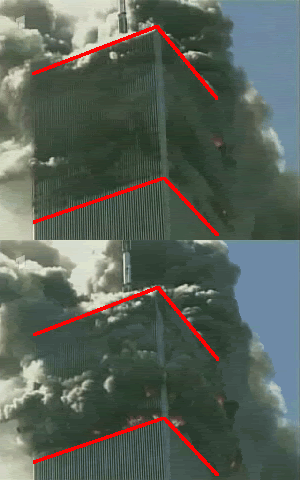
I'm asking for analysis that shows the upper sections disintegrating faster than the lower, not just links to the videos themselves.

WTC1_redLines.gif
 
TruthSeeker1234 perfectly illustrates my point of why CT'ers get this wrong.
As shown in my previous post. His lower line is incorrect.
 
Last edited:
Listen, I don't like Truthseeker1234 better than the next guy, but he has a valid point. The upper section had to of disintegrated before the lower section in the initial stages of the collapse. It is a scientific fact supported by the evidence. If you can present evidence to the contrary please, feel free to do so.
 
Listen, I don't like Truthseeker1234 better than the next guy, but he has a valid point. The upper section had to of disintegrated before the lower section in the initial stages of the collapse. It is a scientific fact supported by the evidence. If you can present evidence to the contrary please, feel free to do so.

I think there is some legitimate debate on the specifics of the collapse here, but you're going to have to better explain and support your position.
 
Listen, I don't like Truthseeker1234 better than the next guy, but he has a valid point. The upper section had to of disintegrated before the lower section in the initial stages of the collapse. It is a scientific fact supported by the evidence. If you can present evidence to the contrary please, feel free to do so.
I don't have a position either way, but I don't find TS's animated Gif convincing. On what science do you base your claim?
 
Listen, I don't like Truthseeker1234 better than the next guy, but he has a valid point. The upper section had to of disintegrated before the lower section in the initial stages of the collapse. It is a scientific fact supported by the evidence. If you can present evidence to the contrary please, feel free to do so.
TS' .gif is flawed in its presentation. The discussion at hand is the rate of disintegration of the upper section in comparison to the lower section. By limiting what he shows to the time-frame prior to the lower sections collapse he is attempting to suggest that the upper section is disintegrating at rate N where N>0 and the lower section is collapsing at rate 0. However, this falsely implies that even after the lower section began collapsing its rate of collapse was R where N>R>0. He is not supporting that implied assertion with any evidence. For all we know, after the lower section began collapsing it was at rate R where R>N>0 and R=N^2 or some such.

His image is intentionally misleading and is a red herring in the discussion of the overall ratio of disintegration rates between the upper and lower sections.
 
Gravy; said:
I don't have a position either way, but I don't find TS's animated Gif convincing. On what science do you base your claim?

The upper section was less rigid than the lower. The plate for both the exterior and core was getting thicker. Unless the lower section peeled out of the way for the upper section on it way down (which we discussed at PhysOrg, most agree the conservation of momentum prevents this from happening). You've got video evidence of the free standing core, how did the upper section pass through the core without being destroyed? The only way this can occur is if the upper section was deflected sufficiently so that it never made contact with the core. This of course is highly improbable, the process of deflection would destroy the upper section, again because of the increasing plate thickness. You've got the Cosgrove recording as well, which seems to indicate the upper section was destroyed almost immediately (this is a stretch, hard to say for sure why the recording ended). The cloud of dust does obstruct view for most of the decent, but most of the video evidence does not clearly show an upper section riding above the collapse wave. Instead it would appear that approximately 2-3 seconds into the collapse (of either tower) the upper sections are completely consumed in the process of destroying the lower. The physics of it, purely theoretical, would suggest that every floor destroyed in the lower section would destroy one in the upper. Imagine if you will, just two floors colliding. One moving, and one stationary. The upper floor may have a higher COR (coefficient of restitution) due to its higher kinetic energy and momentum, but only slightly higher. This would mean that (approximately) 90% of the upper floor is destroyed and 100% of the lower. In the next collision, you have 1 destroyed floor + 90% destroyed and 10% intact colliding with a slightly stronger fully intact floor. The physics would again suggest that a percentage of energy that goes into destroying the next lower floor would go into destroying the upper intact floor as well. What amount is hard to say, but certainly some. Based on Greening's calculations, you need approximately 4 floors of mass to sustain global failure. Thus until 4 floor are commuted, the upper and lower sections probably contributed equally. That means if the break occurred at the 96th floor, the first collision is the 96th and 95th. Both floors are commuted and become Zone B. The next collision is the 97th floor and the 94th floor, separated by two floors of commuted mass (96,95) in Zone B. The 94th floor is destroyed, Zone B is further commuted and a certain amount of energy goes into destroying floor 97 of the upper section(and the 10% of intact floor 96). What percentage of floor 97 that is commuted is hard to say, lets say its only 50% for purposes of this Gedanken. This means in the next collision you have half of the intact 97th floor colliding with the 93rd floor, separated by 3.5 floors of commuted mass (94,95,96 and 1/2 of 97). It is in this collision that you finally get enough mass to sustain global collapse. Again a certain percentage of the energy goes into destroying the upper section. Maybe only 50% of the remaining 97th floor gets destroyed, leaving 25% intact. This is where it gets tricky though because you now have enough commuted mass in Zone B to sustain global collapse. What happens beyond this point I think is the most important part. Does the commuted Zone B have enough energy to destroy the next lower floor? And what percentage of floor 97 remains intact until the next collision? I think, from the video evidence, the upper section continues to get destroyed at about half a floor per destroyed lower floor. This means that in another 20 or 30 floors down only the truss hat is left. The truss hat then takes a substantial beating from the core and is most likely destroyed. (it may have been deflected and survived, who knows) I really think that the free standing core precludes the assumption that the upper section remained intact
 

Back
Top Bottom