• Quick note - the problem with Youtube videos not embedding on the forum appears to have been fixed, thanks to ZiprHead. If you do still see problems let me know.

Need Help with Iron Microsphere Quotes

Hey Dave! I've favorited the video, etc... but can you please give the thing a proper title? May I suggest something attractive to truther moths, such as 'Iron microspheres prove Thermite?'

thx

AE

ps just realized I've neglected to change my avatar. Must put on to-do list :)

Got 'er done, thanks!
 
.....

Anyway, there is no excuse for Dr. Harrit never trying his reaction in an inert atmosphere. If he had and he got the same kind of reaction, it would be a much more compelling story.

You would think by now Dr. Harrit would have done this test to answer this persistent question.


And published his results.
 
R Mackey, thanks for a pedagogical answer that makes total sense.

1. One thing was new to me. You said that the "magnetic nature" was inconsistent with nanothermite if I understand you correctly. Would you explain that. Would nano not be magnetic, or... ?

2. About the presence of Al and/or Si, does the relative amount of each compared to Fe and O give a hint of what the substance is or what is it is not?

3. Chris Mohr's experiment I am not familiar with. Is that mentioned here in the forums?

4. Are you or either persons in here professionals within chemistry or would I have had the same knowledge as you if I had chemistry in high school?

5. About the issue of Harrit et al. not testing in an inert atmosphere, I went through the report again, and I could not determine what kind of atmosphere he tested in at all. So how do we know for sure that he did not test it in an inert atmosphere? Can we conclude that solely from him not mentioning it?

Again, I really appreciate everyone here, having patience with my questions. I need to get facts straight for our website before cocluding anything and in order to confront Harrit properly and with the relevant questions.

Cheers
Steen
 
About the presence of Al and/or Si, does the relative amount of each compared to Fe and O give a hint of what the substance is or what is it is not?

That and the presence of plate-like crystals associated with the iron oxide strongly suggest that the Al and Si are from kaolinite.

Are you or either persons in here professionals within chemistry or would I have had the same knowledge as you if I had chemistry in high school?

There are professional chemists among us, along with professionals in various fields that give us occassion to work with some of the materials in question. Even a kid who collects rocks and minerals should be able to see what is wrong with Jones' assement of the paint chips based on the microscopic examination.
 
R Mackey, thanks for a pedagogical answer that makes total sense.

1. One thing was new to me. You said that the "magnetic nature" was inconsistent with nanothermite if I understand you correctly. Would you explain that. Would nano not be magnetic, or... ?

2. About the presence of Al and/or Si, does the relative amount of each compared to Fe and O give a hint of what the substance is or what is it is not?

3. Chris Mohr's experiment I am not familiar with. Is that mentioned here in the forums?

4. Are you or either persons in here professionals within chemistry or would I have had the same knowledge as you if I had chemistry in high school?

5. About the issue of Harrit et al. not testing in an inert atmosphere, I went through the report again, and I could not determine what kind of atmosphere he tested in at all. So how do we know for sure that he did not test it in an inert atmosphere? Can we conclude that solely from him not mentioning it?

Again, I really appreciate everyone here, having patience with my questions. I need to get facts straight for our website before cocluding anything and in order to confront Harrit properly and with the relevant questions.

Cheers
Steen

Hi Steen! Welcome to the Forum!

Disclosure to all others: Steen and I have privately chatted about the Harrit e.al. paper about 2 months ago.

To chime in with some answers:
1. I fail to see R.Mackey's point - owing perhaps to my poor understanding of magnetism. Thermite (whether nano or not) contains iron oxide. It is generally assumed that this would be Fe2O3 in its alpha-phase which is weakly antiferromagnetic, but there is no principal reason why other iron oxides couldn't also be a part of it. Jones's red-gray chips are most likely paint on spalled, oxidized steel, so again we'd expect alpha-Fe2O3 to dominate, but would also expect other phases (Fe3O4, FeO...) with different magnetic properties. The paint that Harrit e.al. present in their Fig. 2-11 contains alpha-Fe2O3 (rhombohedric hematite crystals are visible) below micron-size. So in terms of chemistry, crytalization and magnetism, the iron oxides in their chips is not really distinguishable from the iron oxides in generic thermite.

2. Absolutely yes. Fig. 7 in Harrit e.al. consistently shows Si peaks that are slightly higher than the Al peaks, Since Si also has a slightly higher atomic weight, this means that in all 4 chips (a)-(d), there is practically the same number of Al and and Si atoms. Fig 10 shows an XEDS map of several element. It reveals no particular correlation of C and O to anything else, but that Al and Si map each other very well. Also, we can see that areas rich in Al and Si correlate with those regions where we see these peculiar platelets in the BSE image. Fig 11 finally reveals that the thin platelets indeed have this signature of Al=Si but no Fe, along with lots of O, whereas Fe is assocuated mainly with O, and all other elements are considered by the authors to be the effect of a beam not focussed enough. Taken together, it would seem that Al and Si are bound with each other and O - i.e. we are looking at an aluminium silicate with equal amounts of Si and Al. Kaolinite happens to be such an aluminium silicate: it has the sum formula Al2Si2O5(OH)4. And surprise surprise: Kaolinite not only has a chemical composition that matches Harrit's XEDS data perfectly, it also looks exactly like, and has the same typical size as, the platelets and stacks of platelets that Harrit sees, too, in Figures 5, 8, 9 and 10.
(Note: C is always present in the XEDS data; that's because the pigments are, as Harrit correctly comments, embedded in an organic matrix that is just everywhere in the samples and around the pigments; H can't be detected by XEDS, that's why it is absent fromn the spectra)

3. Yes. Chris used "my" thread "Origin of the paint..." to inform us about the progress of his efforts to have red-gray chips independently tested by a competent lab. He finally decided on a lab in Atlanta Georgia and an experimenter by the name of Jim Milette. Jim has access to dust samples that were collected east of the WTC a few days after the collapses, and that were already the subject of a paper about environmental hazards, that Jim co-authored in 2002. The focus back then was on substances that may pose a health hazard, such as asbestos. Since that study wasn't interested in how the towers collapsed, they did not go into any details about, for example, particles of iron oxide or paint, simply because neither is a significant hazard.
In that thread, Chris also organized financial support - the test will cost US$1000.
Chris Mohr will give Jim Milette the go-ahead this week, after hopefully the last checks are in to add up to those 1000 dollars.

4. The Almond and Sunstealer have both extensive professional experience with the kind of material analysis of the kind that Harrit e.al did, but both are not really active here any longer. I believe they still read our threads now and then.
Ivan Kminek, I understand, is a chemist, or chemistry student, at a university in thhe Czech Republik. His background I believe is more organic chemistry - polymers and such stuff, not so much material physics or the anorganic chemistry of pigments.
All others, myself included, I believe are more or less amateurs with regard to chemistry, although some may have had a chemistry course or two at university as part of their science or engineering education.

5. I don't have a link handy, and am too lazy to search now, but we have read a reply by Harrit where he defended the choice of doing the DSC under air with the (moronic) observation that the towers weren't CDed under Argon. Note however that the DSC results that went into their paper were obtained by Jeff Farrer, probably at or near Brigham Young University in Utah, where he is a university lab manager. Note too that Jeff admitted in his AE911T interview that he had never worked with a DSC before and "quickly learned" it fromn someone right before running his tests. I don't remember if Jeff is on record with regard to the atmosphere he used.
I think it can be construed from the paper that they did the DSC test with atmospheric oxygen present. On p. 28: "One possibility is that the organic material in the red layer is itself energetic". The usual mode for organic materials to be "energetic" is for them to burn with external oxygen. The exception are monomolecular substances that make conventional high explosives - a possibility they surely would have mentioned in that context if they knew that no extra O was present.

 
Oystein: , just for your record (since we should perhaps know better each other):cool: Although I consider myself sometimes as an "eternal student", I'm 58 years old and I've been working as a polymer/organic chemist in Czech Academy of Sciences for almost 25 years (with one eleven years long "break" when I have been forced to feed my family as an editor of family magazine).
In a Web of Science (I'm not sure if it is freely accessible), there is a record that I have published 45 papers in peer-reviewed polymeric and organic chemistry journals with h-index 13 (about 9 citation per one paper).
Of course it is not so important here, but pls do not consider me as a student anymore, I'm definitely not so young (and fresh):rolleyes:
 
Last edited:
Hi guys

Recently, I burned some steel wool live on tv (local Danish network) to challenge the claims of Harrit et al. and Harrit responded by e-mail with what I shall translate here:

"The experiment done by Steen Svanholm is the opposite reaction of the thermite reaction. He burns iron powder that ignite when the temperature is is high enough. Burning is by definition a reaction with the oxygen in the air. The process that Svanholm demonstrates is:
iron + oxygen produces ironoxide

Within chemistry this type of reaction is called an oxidation.

The particles he points to after the experiment are ironoxide and they are not round.

The thermite reaction is the exact opposite:

Ironoxide + aluminum produces aluminumoxide
Within chemistry this type of reaction is called a reduction.

The particles found in the dust from WTC contains elementary iron.

Many of them also contain aluminum and silicon. This is characteristic to iron-rich spheres produced in the thermite reaction.

Svanholm would have flunked the chemistry exam in high school if he had made a fool of himself in this manner."

What are you guys' opinion about his response?

Regards
Steen Svanholm
911facts.dk

And now, working backwards, some comments on your original question:

Harrit said:
The experiment done by Steen Svanholm is the opposite reaction of the thermite reaction. He burns iron powder that ignite when the temperature is is high enough. Burning is by definition a reaction with the oxygen in the air. The process that Svanholm demonstrates is:
iron + oxygen produces ironoxide

Within chemistry this type of reaction is called an oxidation.

The particles he points to after the experiment are ironoxide...
This is correct so far. You have oxidized steel and produced iron-rich microspheres. That is as far as the steel-wool-experiment can take you: That there is at least one other, mundane, process by which iron-rich microspheres can be produced. This refutes any truther argument that "iron-rich microspheres can only be explained by a thermite reaction because only a thermite reaction reaches temperatures above the melting point of iron".
There are, in fact, many processes that can produce iron-rich microspheres.

Harrit said:
The particles he points to after the experiment are ironoxide and they are not round.
I think he errs here. I haven't seen the particles that you point to, Steen, but I have seen Dave Thomas' video where he does in fact show spheres after burning steel wool that weren't there before.

Harrit said:
The thermite reaction is the exact opposite:

Ironoxide + aluminum produces aluminumoxide
Within chemistry this type of reaction is called a reduction.
This again is correct. Only problem is: Harrit still needs to prove that a thermite reaction happened anywhere...

Anyway, if his argument is "my iron microspheres came fromn a different process than Steen's microspheres", then he is of course right, but you hopefully never claimed that Harrit's microspheres were produced by burning steel wool with a lighter.

Harrit said:
The particles found in the dust from WTC contains elementary iron.
This is questionable. First of all, finding elemental iron in the dust is in itself not proof for a thermmite reaction, and whatever may have been found in the dust has not been connected by Harrit or anyone else to the supposed active thermitic material in the red-gray chips. It is simply unknown, for any sphere found already in the dust, what it originated from. If they take the >5% iron-rich microspheres quote from the RJ Lee report serious and assume only a thermite reaction can create such spheres, then quickyl you have to posit the burning of several tons of thermite before and during the collapse. Of which there is no corroborating evidence.

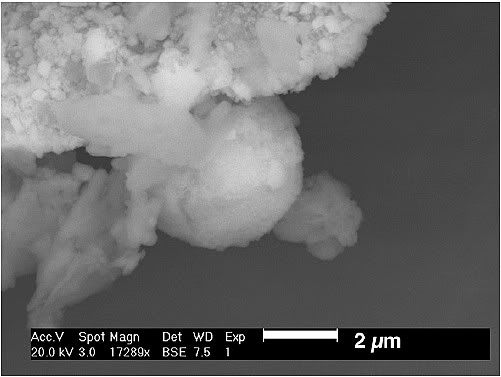
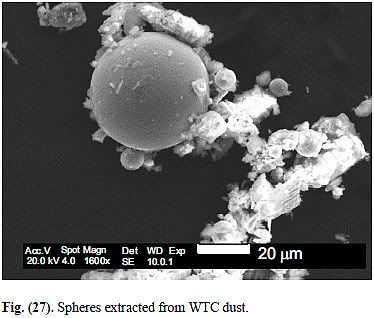
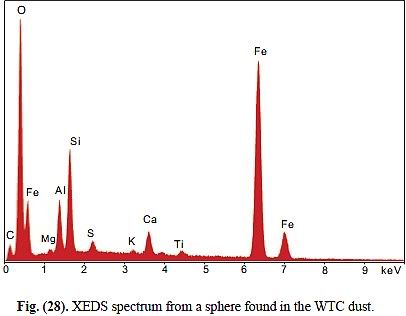
Now let's look at Harrit's own data. In Fig 27, he presents a sphere that was extracted from the dust (i.e. was not produced by burning chips) - it is a random sphere, they could have taken any of millions I guess. With all the possibility of picking a sphere with a particularly high Fe-content. Let's see what the data holds. Here is the sphere (plus some other freckles of dust):
ActiveThermiticMaterial_Fig27.jpg

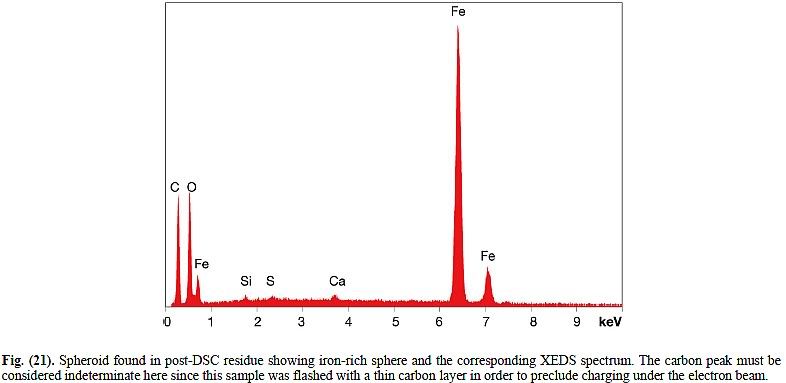
And here is it's XEDS spectrum:
ActiveThermiticMaterial_Fig28.jpg

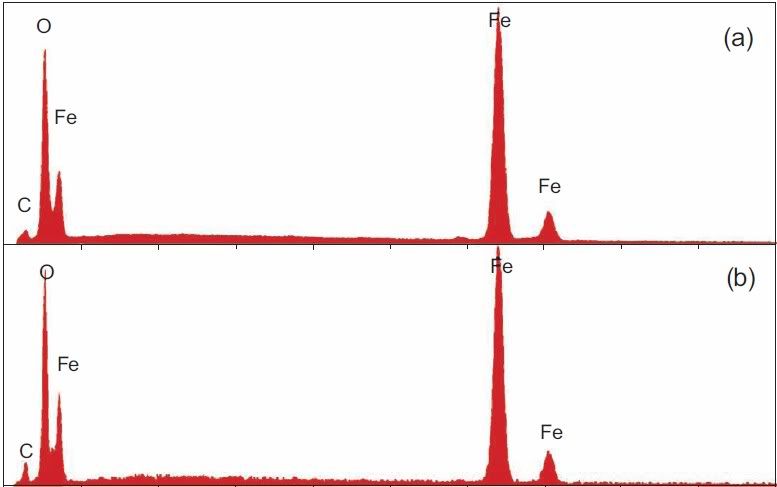
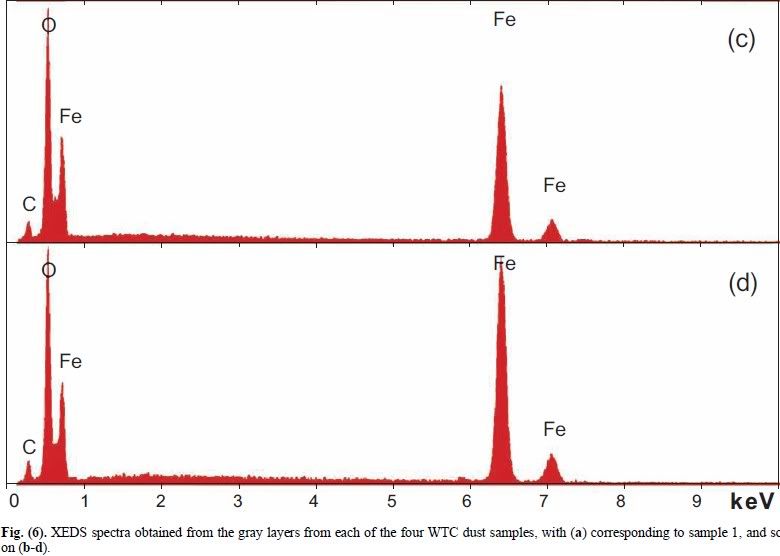
The higher Fe-peak is about 85% the height of the O peak. Compare this to Fig. 6 which shows the gray layer before any ignition:
ActiveThermiticMaterial_Fig06_ab.jpg

ActiveThermiticMaterial_Fig06_cd.jpg

In these spectra, Fe peak is between 70% and 120% of O peak. So it seems that the pre-ignition gray layer has more fe relative to O than the dust sphere. And how do Harritr e.al. describe the chemical composition of the gray layer? Page 19: "The gray layer was found to consist mostly of iron oxide"
Since the gray layer is "mostly of iron oxide", and since that sphere has relatively more O, it stands to reason to say that it also "mostly of iron oxide" rather than elemental iron.


Now on to microspheres that resulted from ignition of chips. The most extreme case seemed to be this:
ActiveThermiticMaterial_Fig21_1.jpg

ActiveThermiticMaterial_Fig21_2.jpg

We do not know what the characteristics were of this particular chip before it was destroyed in the DSC test, so it would be invalid to compare it to chips (a)-(d) or any others. Credit the sloppy work of Harrit e.al.
In the text, they say that "A conventional quantitative analysis routine was used to estimate the elemental contents. In the case of this iron-rich spheroid, the iron content exceeds the oxygen content by approximately a factor of two, so substantial elemental iron must be present".
I don't know... what do they mean by "elemental contents"? Proportions by weight or by atom count? If the former, then a Fe:O ratio by mass of 2:1 means about 4:7 by mols, which means we are looking at Fe2O3 with some O still to spend.
Anyway, since we don't know what was in that chip before the DSC procedure, we can't know if any iron was reduced. What we do know is that they flashed that probe with a thin carbon layer, and that carbon can reduce iron oxide. So even an experimental error is not totally implausible, given the fact that Jeff Farrer had never done DSC tests before.

Harrit said:
Many of them also contain aluminum and silicon. This is characteristic to iron-rich spheres produced in the thermite reaction.
It is not surprising at all that they would find Al and Si post-ignition when they found aluminium silicate pre-ignition. It would be more surprising if the Al and Si would just vanish.


Harrit said:
Svanholm would have flunked the chemistry exam in high school if he had made a fool of himself in this manner
Maybe, and you bet that Oystein will flunk almost every conceivable chemistry exam, but Harrit will flunk together with us. In fact, he flunked already by publishing that crap paper.
 
Oystein: , just for your record (since we should perhaps know better each other):cool: Although I consider myself sometimes as an "eternal student", I'm 58 years old and I've been working as a polymer/organic chemist in Czech Academy of Sciences for almost 25 years (with one eleven years long "break" when I have been forced to feed my family as an editor of family magazine).
In a Web of Science (I'm not sure if it is freely accessible), there is a record that I have published 45 papers in peer-reviewed polymeric and organic chemistry journals with h-index 13 (about 9 citation per one paper).
Of course it is not so important here, but pls do not consider me as a student anymore, I'm definitely not so young (and fresh):rolleyes:

Oops :o
Well at least no one can accuse me of inflating your credentials to strengthen an argument from authority :D
Thanks for the clarification.

I made another, smaller, blunder when I claimed that The Almond wasn't really active here any longer. In fact, The Almond replied already in this thread a couple of days ago, on the previous page!
 
R Mackey, thanks for a pedagogical answer that makes total sense.

You're welcome. Just to supplement Oystein's comments:

1. One thing was new to me. You said that the "magnetic nature" was inconsistent with nanothermite if I understand you correctly. Would you explain that. Would nano not be magnetic, or... ?

Nanothermite, being a precision material, should contain only Fe2O3 and no other oxides of iron. Those oxides should also exist in "beads" approximately 10 nm across or smaller, as described in Dr. Tillotson's papers. These "beads" would be distributed more or less uniformly. Such a construction would be weakly antiferromagnetic. However, because it's in such small pieces, it cannot form large magnetic regions and will be very weak indeed. Compared to ordinary materials, it would not be magnetic enough to notice without careful measurement.

2. About the presence of Al and/or Si, does the relative amount of each compared to Fe and O give a hint of what the substance is or what is it is not?

Sure does. Others are better suited to comment on this, however.

3. Chris Mohr's experiment I am not familiar with. Is that mentioned here in the forums?

Chris Mohr has contracted a scientist to perform more focused testing on dust samples from the World Trade Center. Unsurprisingly, the Truthers have decided not to provide him with any of their samples. There's a long thread on it on the front page of the Forum -- I don't remember when the talk of this experiment started, but it's towards the end. You might want to just search for Chris Mohr's posts or PM him directly.

4. Are you or either persons in here professionals within chemistry or would I have had the same knowledge as you if I had chemistry in high school?

I have approximately two years of college chemistry (inorganic, organic, and biochemistry) but I am speaking as a generalist. I have no unusual qualification in chemistry. Still, it's more than enough to handle Truther claims.

5. About the issue of Harrit et al. not testing in an inert atmosphere, I went through the report again, and I could not determine what kind of atmosphere he tested in at all. So how do we know for sure that he did not test it in an inert atmosphere? Can we conclude that solely from him not mentioning it?

It would not be correct to conclude testing in air without them commenting, but Dr. Harrit and Dr. Jones have been asked, and when asked, they did state that their calorimetry was tested in air, not in an inert atmosphere.
 
Again, thanks to everyone for detailed explanations. I think I got enough work with so far.

About Chris Mohr's experiment, it was mentioned that several in here helped covering the expenses. If funds are still needed, I may be able to support a bit too, so I'd like to know if you have an international account number: Iban and Swift codes?

Kindly,
Steen
 
Again, thanks to everyone for detailed explanations. I think I got enough work with so far.

About Chris Mohr's experiment, it was mentioned that several in here helped covering the expenses. If funds are still needed, I may be able to support a bit too, so I'd like to know if you have an international account number: Iban and Swift codes?

Kindly,
Steen

Chris Mohr told us a few days ago that, after adjusting his own contribution by US$5, we reached the required US$1000 precisely.

Chris asked the lab guy, Jim Milette, if he had access to some other materials of interest, such as paint from floor joists, or WTC bulk concrete, and if Jim does actually find these thing on store somewhere, we might decide to spend some more money on a follow-up study. So hold your cash for the moment!
Method of payment was: Those in the USA sent Chris a check via mail, and those outside send money through PayPal to someone in the USA, who then wrote a check, or increased the amount on his own check accordingly. That's because Chris doesn't use PayPal, but it is probably the easiest and cheapest methof for most of us to transfer money oversees.
 
Oops :o
Well at least no one can accuse me of inflating your credentials to strengthen an argument from authority :D
Thanks for the clarification.

I made another, smaller, blunder when I claimed that The Almond wasn't really active here any longer. In fact, The Almond replied already in this thread a couple of days ago, on the previous page!

Hallelujah! Someone still reads my word-salad posts! If I may be permitted to expound, I'm a bit of a lurker, but I still do poke my head in for any threads that could use some sciency stuff.

I've been working in the materials research industry for about 7 years now as a research engineer specializing in the X-ray analysis of building materials. Every few days, the boss comes into my office, hands me two wads of something, and asks me to find the differences between the two. I've had extensive experience doing analysis of dust, dirt and ash using scanning electron microscopy and X-ray microanalysis techniques. I do quite a bit of work that's exactly like what RJ Lee does, but I don't do it on their scale.

I can also say that the hardest thing I have to do is look at a microscopic bit of stuff, and determine what the parent material is. This is infuriating with dust samples, since the range of possibilities is essentially a tiny bit of everything on earth, organic and inorganic. When I come across a material, I know what its major inorganic constituents are, but then I have to do endless amounts of research to carefully narrow down the list of possibilities. I search mineral databases, the McCrone Particle Atlas, research papers, polymer journals, and half a dozen other resources. It's a lot of work!
 
Hallelujah! Someone still reads my word-salad posts! If I may be permitted to expound, I'm a bit of a lurker, but I still do poke my head in for any threads that could use some sciency stuff.

I've been working in the materials research industry for about 7 years now as a research engineer specializing in the X-ray analysis of building materials. Every few days, the boss comes into my office, hands me two wads of something, and asks me to find the differences between the two. I've had extensive experience doing analysis of dust, dirt and ash using scanning electron microscopy and X-ray microanalysis techniques. I do quite a bit of work that's exactly like what RJ Lee does, but I don't do it on their scale.

I can also say that the hardest thing I have to do is look at a microscopic bit of stuff, and determine what the parent material is. This is infuriating with dust samples, since the range of possibilities is essentially a tiny bit of everything on earth, organic and inorganic. When I come across a material, I know what its major inorganic constituents are, but then I have to do endless amounts of research to carefully narrow down the list of possibilities. I search mineral databases, the McCrone Particle Atlas, research papers, polymer journals, and half a dozen other resources. It's a lot of work!

Couldn't you do a couple of simple experiments some time? Something along the lines of
- find a bit of old steel with red primer
- knock some of the paint off with a hammer
- look at it to see if it contains iron oxide and some organic vehicle
- heat it on a hot plate till it burns away
- look again for microspheres
- measure their iron content

Snap a few photos of what your doing, maybe with a nice greeting to JREF on a paper card so we know you took those pics...


:D
 
Hi, Oystein,

I think that now is better to wait until some results from Jim's research are out.

- As I remarked in "your microsphere thread", different paints containing iron oxide could provide quite different results. Namely iron oxide pigment particle size can play a quite important role, as for behavior of samples during heating under air and formation of microspheres - I think).
- Remember experiments of Henryco: he didn't find any microspheres in burned red chips (perhaps they were different from chips burned in Bentham paper, but... who knows).
- We should also remember that according to Sunstealer, microspheres are formed basically from gray layers during heating of red-gray chips. So, potential Almond's samples should contain such gray layers of oxidized steel.
I think that experiments on some accidental primer can easily bring more confusion than clarification, if no microspheres are found.

But, if Almond agrees, why not? It could be fun:cool:
 
Last edited:

Back
Top Bottom