• Quick note - the problem with Youtube videos not embedding on the forum appears to have been fixed, thanks to ZiprHead. If you do still see problems let me know.

Natural selection

Because if an event is wholly determined by previous events then it is not "random" except in layman's terms.

That has been the argument all along: whether there is evidence that the environment divides the phenotypes within a population into two distinct groups, one in which all the individuals who possess those phenotypes always reproduce and the other in which none of the individuals who possess other phenotypes ever survive. If that is truly the case, evolution by natural selection is a mathematically deterministic system. If that is not the case, evolution by natural selection is a mathematically stochastic system.
 
Er... "stochastic", if I remember correctly, implies that it IS deterministic, just not known. Non-deterministic is also called "random".

You remember incorrectly. "Stochastic" means "random"* in so far as they share a common mathematical definition. "Chaotic" means "deterministic but sensitively dependent on initial conditions".

*which means "non-deterministic" in so far as "deterministic" is the opposite of "random" in their mathematical deifnitions
 
Last edited:
If Darwinistic theory is right how come it is the weak and oor that tend to breed and propagate the most whereas the rich and healthy are a minority and have few offspring?
Well there's no reasonable doubt that the theory of natural selection is correct. An insurmountable confluence of evidence is available for you to investigate. It includes direct observation of evolution and speciation in action both in the lab and in the wild, molecular evidence in DNA and the ability of the theory to make accurate predictions.

Nothing in your "how come" example even if demonstrated to be true is actually in contradiction to the well understood model of evolution.

Light heartedly as a new father I have to say that it's hardly surprising for anyone who's looked at the cost of childcare these days, that people with more children are poorer. I don't know about less healthy though. The idea that less healthy people have more children is new to me unless you're referring to the poverty brought about by caring for more children and the link between health and socio economic status.

I have a new catchphrase for such issues which I'm attempting to work into as many conversations as possible.

"Who told you that and why the heck did you believe them?"

Any lets just accept that this is true anyway and move on.

If you study the wide gamut of organisms you find a variety of tenable survival strategies. You will note that what is important in natural selection is not how many offspring you have but how many survive to reproduce. Some like the frog, spawn hundreds or thousands of offspring in order to increase the chance that some at least, will make it. Others invest far more time and effort into ensuring that each and every one of their children has the best chance possible. The limiting factor being that that in order to make this work you can only have as many offspring as you can afford to care for.

There are balances. You can offer a lesser amount of care of care or care for a more limited duration to slightly more offspring.

There are two contemporary changes that are affecting our population levels. Firstly is the increased carrying capacity of the earth due to technological breakthroughs and the availability of cheap energy. This means that the resources of the earth can feed far more people than at any time in history. The result is an increasing population. Then you have the socialisation of care. Not only that we are social animals who share responsibility for our tribe but that the same technological advantages that increased the earths carrying capacity have increased the effectiveness and range of our caring. Smallpox which once killed 300 million is wiped off the face of the earth. Other childhood diseases are to follow. Where once one in ten children didn't see their fifth birthday, and childbirth was one of the riskiest things a woman would be likely to do, we now expect every pregnancy to result in a happy healthy mother and baby. Culturally mankind looked to their children as their retirement plan. A large family would look after you in your old age. You would produce as many children you could support as an investment into your future. You would expect many of them to die.

Such cultural habits don't go away overnight. You can't just introduce the concept of family planning and expect everybody to adopt it straight away. Some people will continue to have as many children as they can. And when others supplement them in the burden of caring for them they can have a lot of children even if they aren't wealthy.

But why are people who are wealthier having less children? Well if this is indeed the case, and I know plenty of exceptions, but if it is the case it doesn't violate natural selection. In fact there may even be a plausible Darwinian explanation. A creature's wealth is as much their legacy as their offspring. (yes other animals can have wealth too) By reducing the number of offspring who inherit their wealth they keep it intact. That wealth may do as much to ensure the success of their line as any genetic legacy. It may be that human behavioural evolution has experimented with both survival strategies (more offspring and reduced care or fewer offspring and increased care) perhaps it has found that the former strategy is effective when times are lean but when times are good the latter strategy is most effective. It's an interesting but untested hypothesis I just put out there.

Some might view our caring for the less well off as an unnatural subversion of Darwinian mechanisms. Others might point out that as we are natural then so is everything we do. What is certain is that one strategy will prove more effective than the other and will thus produce more offspring in the very very long term. As such those offspring are more likely to inherit however much of this behaviour was genetic in origin from those "more sucessful" ancestors and natural selection will have happened.

Others make the mistake of second guessing evolution and deciding what traits should be selected. They attempt to stop those with less money, power or success from reproducing or those from a certain ethnic background. They confuse what has happened (evolution) with what should happen. Evolution is a fact. It's how the variety of life we see around us was designed. However it's a shoddy way to organise society. Evolution as a design system has many flaws and limitations. As an intelligent species we can do better.
 
Belz...-

Do Newton's laws of motion accurately describe how objects on the millimeter- to kilometer-scale move?
 
No, we're talking about how mathematics is reflected in reality and reality is reflected in mathematics.

Then why should I care if you use "mathematical definitions" or not ?

Deterministic: caused wholly by previous states.
Random: some random effects affect the outcome.

What's wrong, there ?
 
If Darwinistic theory is right how come it is the weak and oor that tend to breed and propagate the most whereas the rich and healthy are a minority and have few offspring?

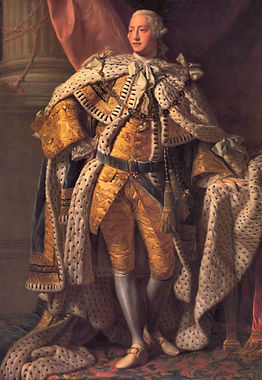
What does wealth have to do with genetic fitness:

262px-George_III_in_Coronation_Robes.jpg


Anyway, some wealthy people do seem tohave bred a lot...

Genghis Khan's legacy? The Mongol warlord may have left his imprint on the world's DNA

It appears that Genghis Khan left a mark on more than history: His influence may persist in the DNA of men today. According to an international team of geneticists, about 1 in 12 men in Asia--and therefore 1 in 200 men worldwide--carry a form of the Y chromosome that originated in Mongolia nearly 1,000 years ago. Today's unusual prevalence of this chromosomal variant is most likely the result of Genghis Khan's military success, the investigators say. Even more provocatively, the researchers suggest that Genghis Khan himself had this particular version of the Y.
 
Then why should I care if you use "mathematical definitions" or not ?

Deterministic: caused wholly by previous states.
Random: some random effects affect the outcome.

What's wrong, there ?

Those are the mathematical definitions. What has been argued most frequently is that evolution is not random by other definitions of "random" when the question asked was how evolution was not random by the mathematical definition.
 
Belz...-

Do Newton's laws of motion accurately describe how objects on the millimeter- to kilometer-scale move?

Huh ?

You asked:

Why are we talking mathematics and not reality, again ?

I was merely asking you if you thought Newton's laws of motion which provide a mathematical description to our intuitive notions of motion on the mesoscale (i.e., not too big and not too small) were faithful the reality of motion on the mesoscale.
 
You were the one who claimed that "random" meant "acausal". Are you retracting that definition now?

No. I never said that "random" meant "acausal" - just that a consequence of anything that is truly random is that it must be without cause.
 
No. I never said that "random" meant "acausal" - just that a consequence of anything that is truly random is that it must be without cause.

You are therefore contradicting yourself quite nicely. If "anything that is truly random is that it must be without cause", randomness must in part be acausal, as you yourself have claimed before:

Randomness IS acausal.

Randomness is necessarialy acuasal.
 
Lemon does not mean fruit.

Now, you're purposefully obfuscating. "Random" and "acausal" do not have to be one in the same for "random" to mean "acausal". That is part of why it is essential to define your terms as precisely as possible, because very few words in the English language have just one meaning.
 

Back
Top Bottom
