Native American myths/traditions support Bigfoot? A critical look.

Quod Erat Demonstrandum

manofthesea said:
As expected, you presented nothing to back your claims.
You can not back them. You try to hide this fact behind ad homs and lies.

Your off-topic evasions/obfuscations attempts and ad homs will be ignored from now on. But only these. Myth twisting and misinterpreations will not.
 
Deceptus Ad Nauseum

As expected, you presented nothing to back your claims.
You can not back them. You try to hide this fact behind ad homs and lies.

Your off-topic evasions/obfuscations attempts and ad homs will be ignored from now on. But only these. Myth twisting and misinterpreations will not.

Show proof that Kennewick Man predates Clovis or remove the claim.

Your weak attempts to deceive are apparent to everyone. Mui woo.
 
There is No Atlantis

The case for Atlantis was closed back in the 1930's with the discovery of this embossed Minoan cup depicting Plato's famous Atlantaean bull hunt:


It was found on the island of Crete.
 
Prove that Kennewick Man and Luzia predate Clovis or remove the claim.

Comprende?
Ah, yes. I see.

You were the one who associated Kennewick Man to the Ainu in Japan. Not me. I never heard of them. I just came across the Kennewick Man's website and it stated the original scientist who observed the skull stated that it resembled a neanderthal. And that further study was halted. I then stated that his DNA profile was posted at NPS and you said it was not. You then proclaimed Kennewick Man was Ainu.
 
Last edited:
Insiduous Woo, the Second Worst Kind

Ah, yes. I see

I've discussed Kennewick Man on occassion in the past and possible connections with the Ainu of Japan


Kennewick Man may have been from the same stock as the Ainu. His people may have followed shellfish harvesting routes from Japan up the coastlines along to North America. We know that KM's remains showed genetic drift indicating that his stock had been established for at least some thousands of years. It's conjecture but it at least has some basis in fact.

It is no small wonder Native Americans resist study of artifacts and remains.
 
Mots, "Peking (or Beijing) man", "Neanderthal", "Cro-Magnon" and "Flores man" (among others) are terms exclusively related to a specific specimen?

If you want to discuss in depth OT subjects such as the relationships between paleoindians, Clovis and Kennewick man, or possible templates for the Atlantis myth, start a new thread or bump an old one. I am absolutely sure it would be an excelent opportunity for you to learn a lot about these subjects.

manofthesea said:
It is no small wonder Native Americans resist study of artifacts and remains.

Oh, I can understand that. Specially when I see how some bigfoot and cryptozoology enthusiasts misinterpreted and distorted the original meanings of their myths, arts and even their remains -and this is not restricted to North America. I bet some could come to the point of saying Kennewick man may actually be a bigfoot... I would not be surprised if some others would even do or propose worse things.
 
Mots, "Peking (or Beijing) man", "Neanderthal", "Cro-Magnon" and "Flores man" (among others) are terms exclusively related to a specific specimen?


.

Yes. They were termed for the first specimen discovered. Such as the discovery in Neander Valley. Subsequently, more specimens were discovered at these sites.
 
Oh, I can understand that. Specially when I see how some bigfoot and cryptozoology enthusiasts misinterpreted and distorted the original meanings of their myths, arts and even their remains -and this is not restricted to North America. I bet some could come to the point of saying Kennewick man may actually be a bigfoot... I would not be surprised if some others would even do or propose worse things.

Seeing as how the bible and the teachings of Jesus have been reinterpreted, it's understandable that native myths are subject to the same treatment.

Kennewick Man is still a mystery. That discovery was only very recent. It is very easy to assume that much bigger misidentifications have been made in the past 500 years since Euros landed here. 200 years when dealing with the Pacific Northwest. Lewis and Clark (and the lady who led them, Sacajaweya) only 'discovered' the area around 1800.

Such as science's propensity to term any 'misshapen' skull as "board flattened". That is why I keep insisting that all native skulls that have been analyzed to be reanalyzed, whether through pictures or actual physical study.

Ciao.
 
Don't Frequent Woo Sites

The following is a reference list of websites that are factual and concise.

Sports - Foxsports
Science (all fields) - Livescience
Archaeology - Archaeologyinfo
Environment - globalwarminglife
Adventure - Explorersweb (the anti-Americanism does get tiring)
Honorable Mention - everestnews
Activism - greenpeaceusa
Human Migration - NationalGeographic (Genographic Project)

Enjoy the enlightenment!
 
Last edited:
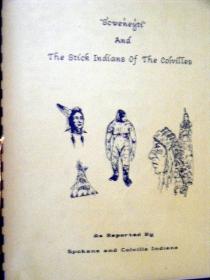
I just received my first bigfoot book, "They Walked Among Us" - Scweneyti And The Stick Indians Of The Colvilles. I'll need just a little time to digest this magificent find.


I ordered it from biblio.com, specialists in rare books.
 
An Authentic Relic

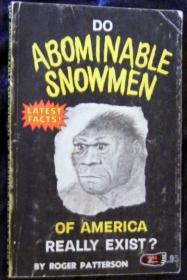
I also received Roger Patterson's "Do Abominable Snowmen Of America Really Exist?". While quickly glancing at the Table Of Contents, I noticed a subchapter entitled "Story by Teddy Roosevelt". Absolutely fascinating. It strikes me as a "most authoritative" reference concerning the behavior and the exact physical ramifications of having an encounter with an aggressive male sasquatch.


I think that I may need a new 'hutch' (old stereo cab.) to house these precious insights and revelations. :)
 
Applied Hyper-Freudianism

I even ordered that crackpot's book, Manlike Monsters.

Yipes. She equates everything to sexual origins. That's right out of the 60's. Perhaps that type of analysis has as it's basis a brand of 'Leary-anism'.
Or she's just identifying a "Chicks dig bigfoot" desire in herself.
 
So I've been somewhat absent from the board of late with a combination of real life and computer issues. Before that though, the bigfooter pamphlet that MOTS referenced, "They Walked Among Us" - Scweneyti And The Stick Indians Of The Colvilles, got me into a bit of an internet investigation that resulted in what I thought were some interesting results. I have not yet decided how interesting the results actually are as I haven't been able to give them the amount of attention I would like to.

The document that MOTS shared with us is a piece that carries the scholarly subheading "Bigfoot: The Interaction of Unknown Hominids with American Indians as reported to Dr. Ed Fusch, Anthropologist, 1992."

It is in fact a very brief piece in which Fusch makes a concerted effort to dress a small bit of pseudo-science as disciplined research. He interviews an extremely small number of people and references many unfounded claims without the slightest reservation. Fusch puts gobs of salad dressing on a miniscule amount of salad. Nevertheless, I did my best to verify the pertinent information and found some interesting results. First of all, Fusch details that this Scweneyti that is featured is regarded by the Colvilles as being a singular entity; Cain, the firstborn son of biblical Adam and Eve. For the murder of his younger brother "sentenced by God to forever wander and roam about the Earth until Doomsday, that he could be heard but never seen, and was never again to commit murder."

This Morman connection to the bigfoot mythology has been detailed before, such as in this post by member Atomicmysterymonster:

http://www.internationalskeptics.com/forums/showthread.php?postid=3124892#post3124892

In looking into the culture and traditions of the Colville Indians the first thing I sought was to consult the language. Though the Colvilles are in fact a combination of various separate tribes, their common language was Salish. Here is a diagram of pre-contact Salishan language distribution:

http://upload.wikimedia.org/wikipedia/commons/d/d0/Salishan_langs.png

Searching out Salish language resources I found this site:

http://salishworld.com/

Here, as I've done before with other indigenous languages, I consulted a Salish dictionary for terms that might correlate to bigfoot. Here is the dictionary:

http://salishworld.com/Salish_Dictionary.htm

http://salishworld.com/Selish Dictionary_online.pdf

To my immediate surprise, unlike previous cases, I found an entry for 'bigfoot' which is listed as 'Scwene' as in the Scweneyti that Fusch discusses. I had honestly expected to find no such reference. When I made this thread I seriously doubted that any native groups put any traditional claim to the bigfoot mythology. Further examining the dictionary I checked for various terms such as 'giant', 'monster', 'gorilla', 'monkey', 'wild man', and other terms which might help me find some linguistic connections. 'Monkey' came up as 'monqi' and 'gorilla' came out as translating to 'big monkey'. Nothing was very helpful. I tried then to further understand how the Colvilles regard bigfoot and found this recent tribal newsletter referencing Fusch's work fifteen years prior:

http://tribune.colvilletribes.com/archives/2005/october2005/default.htm

Here is Fusch's site referencing the bigfoot figure erected by the tribe:

http://www.prospectored.com/bigfoot.htm

I also found this a listing for a book entitled 'Legends of Scwene' but was unable to find any information on its contents:

http://store.peoplescenter.net/legends-of-scwene.html

At this point I find myself in a bit of a muddle. I haven't been able to give the matter the attention I would like to and maybe if I did I could clear it up quick. Where it stands now is that...

1) The Colvilles are a tribe created from intervention of Anglo-Americans.

2) The Colvilles have traditions regarding bigfoot but they are biblical in their origins.

3) I do not have enough information on legends regarding 'Scwene'.

4) Salishan is a widely dispersed group of languages well beyond the territory of the Colvilles. A Salish language resource seemingly outside of bigfoot proponent influence has a specific entry for the creature.

5) I have been trying to consult language resources for various other indigenous groups who's territory is within areas traditionally associated with bigfoot and have found nothing. A major factor in this is the sad fact that many of the languages I seek to consult are extinct, nearly extinct, and/or very poorly documented.

I would very much appreciate the assitance of some of the members who've contributed previously with research in this thread as I find my own research to be limited and lacking.

What is bigfoot to the Salish?

 
...To my immediate surprise, unlike previous cases, I found an entry for 'bigfoot' which is listed as 'Scwene' as in the Scweneyti that Fusch discusses. I had honestly expected to find no such reference. When I made this thread I seriously doubted that any native groups put any traditional claim to the bigfoot mythology. Further examining the dictionary I checked for various terms such as 'giant', 'monster', 'gorilla', 'monkey', 'wild man', and other terms which might help me find some linguistic connections. 'Monkey' came up as 'monqi' and 'gorilla' came out as translating to 'big monkey'.
What strikes me from the rest of your post is this reference to monkey and gorilla.

There has never been monkeys or gorillas in North America. I could find no reference even to fossils of monkeys in North America (except in cryptozoological webpages), so this makes me wonder how these words where introduced into to the Salish language?

I realise this seems to be a nit-picking type of criticism, but I have an uneasy feeling that a native language would have words for animals that they would never have encountered in their history in the lands they lived in....... until Western influence?

It makes me then wonder about the validity of any Salish "monkey" or "gorilla" references as to being supporting evidence for bigfoot/monkey relationships.

Sorry to have chopped so much of your fine post kitakaze, but that particular point jumped out at me immediately.
EHocking, I would think about the same things when looking at that dictionary's entries on such things as 'blonde hair' or 'bible'. The thing that I thought about was whether or not I'm looking at the modern Salish word for a modern Western idea when considering bigfoot. With 'monkey' as 'monqi' it's obvious that we're seeing a loan word for an unfamiliar thing. For 'gorilla' we see the Salish word for 'big' in front of 'monqi' so the etymology isn't vague.

What I really need to find is what is 'scwene' and how it separates from the Morman Cain biblical traditions. I suspect as in every other case that if I could find that, I'd find something very mythical and not everyday animal at all.
 
Not a nit-picking or post-chopping. I thought of the same thing.

The Salish should not have had their own terms for gorilla or monkey. They had to get both from visiting outsiders.

Gorilla

NOUN: The largest of the anthropoid apes (Gorilla gorilla) native to the forests of equatorial Africa, having a stocky body and coarse, dark brown or black hair.

ETYMOLOGY:
New Latin, from Greek Gorillai, a tribe of hairy women, perhaps of African origin.

WORD HISTORY:
Two traditions of exploration come together in the history of the word gorilla, which also illustrates how knowledge of the classics has influenced scientific terminology. Dr. Thomas S. Savage, an American missionary to western Africa, first scientifically described the gorilla in 1847, giving it the New Latin name Troglodytes gorilla. In doing so he was using his knowledge of Greek literature, in which there exists a fourth-century b.c. translation of a report written by Hanno, another visitor to western Africa. This Carthaginian navigator, who voyaged before 480 b.c., went as far as Sierra Leone in his explorations. In the Greek translation of his report he tells of seeing Gorillai, the name of which he allegedly learned from local informants and which he thought were members of a tribe of hairy women. In fact they were probably the same creatures that Thomas Savage described about 24 centuries later.

From here.

The Salish would be expected to be totally isolated from all of this. They could only work with the term gorilla after being intentionally presented with it and its definition. If they were told that it was a "big monkey", they would have also then needed a definition for "monkey". Then the modifier "big" would need placement into the range of monkey sizes (you can't be a big monkey unless you are bigger than other monkeys) of which they would be totally unfamiliar.

The vast majority of all possible Salish (excluding moderns) would have lived their entire lives (birth to death) without seeing any primate other than their fellow humans. This does not even address the distinction between monkeys and apes.

When did they start to use or understand the term gorilla?
 

ISF - Join now!

Every member here is approved by hand. No bots, no spam, just people who care about evidence and honest debate.

Membership is free!

Create your free account

Back
Top Bottom