Status
Not open for further replies.
Wikipedia continues to list him as "acting" and I can find nothing about a senate confirmation hearing.

Here are a few links from the Department of Justice website in which he is referred to as "Acting Associate Attorney General." The earliest is from March 2018 and the latest is from September.

If I was wrong about the 2 years, I'm sorry, but the bottom line is that he's still not confirmed by the Senate and thus, like Whitaker, probably should not be holding his current job since the Senate has been in session for a very long time.

Under the most common interpretation, Panuccio was legal in his position as Acting Associate Attorney General.

The Vacancies Act says that when an office becomes vacant, the first assistant temporarily fills in that office in an acting capacity. Panuccio was the first assistant to the Associate Attorney General, so he became the Acting Associate Attorney General. The Vacancies Act says that the President could instead appoint someone who meets certain criteria (such as being an officer for at least 90 days at a certain pay grade). But in this case Panuccio just shifted into the acting role.

Whitaker was also appointed to the Acting Attorney General position under the Vacancies Act. In this case the President appointed him instead of him shifting up into the position, but it is essentially the same thing.

The reason that there is a difference in terms of Senate confirmation is because there is a difference between a “principal officer” and an “inferior officer”. In the case of a principal officer, there is a Constitutional conflict with the Vacancies Act.

The Appointments Clause of the Constitution says that the President appoints all officers with the advice and consent of the Senate. However, it also says that for inferior officers Congress may make laws allowing the offices to be filled by the President or the courts or the head of a department. One such law is the Vacancies Act. That means that an appointment made under the Vacancies Act is only Constitutional if either (1) the person being appointed has been confirmed by the Senate, or (2) the appointment is for an inferior officer.

The Constitution doesn’t say what an inferior officer is. However, if Attorney General is considered an inferior officer, it is difficult to imagine what the framers of the Constitution would consider a to not be inferior. The courts have not established a test and have dealt with the question on a case-by-case basis, but have established some guidelines.

In the DOJ, the principal officers are generally considered to be the Attorney General and Deputy Attorney General. That means Associate Attorney General is an inferior officer. Therefore, Congress can pass a law such as the Vacancies Act allowing the President to fill that office without advice and consent (although that law only allows such appointment to be temporary).

The Constitution authorizes Congress to establish a law (such as the Vacancies Act) that permits the President to appoint an inferior officer (such as Associate Attorney General) without advice and consent. The Constitution does not allow that for principal officers (such as Attorney General). Therefore, Panuccio’s appointment is constitutional while Whitaker’s is not.

(I don’t know what is going on with Panuccio right now. In mid-September DOJ switched from calling him Acting Associate Attorney General back to Principal Deputy Associate Attorney General. There doesn’t seem to be an Associate Attorney General. Perhaps his time limit in the acting position expired and nobody has been appointed to fill Associate Attorney General.)
 
No legitimate reading of the law or reality could result in a determination that the AG is anything but a "principal officer." The AG is responsible for all federal law enforcement and 7th in the line of succession to be president.
 
Last edited:
No legitimate reading of the law or reality could result in a determination that the AG is anything but a "principal officer." The AG is responsible for all federal law enforcement and 7th in the line of succession to be president.

The argument is that an "acting" Attorney General is not a principal officer.

Under the Succession Act, only officers appointed with advice and consent of the Senate are in the line of succession.

The Vacancies Act limits what an person in a acting position can do. They can only perform required, nondelegable actions.

The Vacancies Act designates who performs the functions of an office while the President nominates and appoints a person to that office with the advice and consent of the Senate. The Act stipulates certain requirements for that person, but those requirements do not include that the person has served in an advice and consent position.

The acting person could not have been appointed to "that office" with advice and consent because the whole point of the Vacancies Act is to fill the position while a new person is being confirmed. It can be argued that a person in an acting position is not actually the officer and is only an inferior officer acting in limited capacity, and therefore is not subject to the advice and consent requirement of the Appointments Clause.

Whether or not that argument should hold is a difficult question.
 
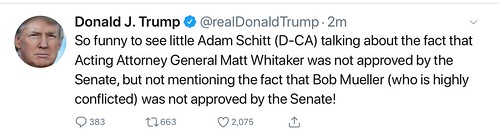
44125250380_5fae5a3a13.jpg
 
I thought the misspelling was clearly intentional.
It probably was. I suspect Trump's on something with early morning Tweets. Even if he doesn't drink, that doesn't mean he doesn't take something else. He's less inhibited at times (I digress).

But now that Schiff slapped back, now Trump has to show it wasn't a typo and he doesn't have to take it back. Hasn't he done that over and over when anyone backtalks him?
 
Is that common for this type of matter?

Yes and No. It is not unusual for the Supreme Court to prioritize a case that has a significant impact on the country. An example is the ruling on the 2000 election recounts. But that rarely happens because cases usually have to go through the lower courts first.

The Supreme Court primarily has appellate jurisdiction. That means they review cases that have been decided in lower courts. The Constitution only authorizes original jurisdiction (where the Supreme Court hears the case for the first time) in limited circumstances, which are generally where there is no other court that could handle the case. That is usually where one State is suing another State where there is a conflict of state laws. Very few cases originate in the Supreme Court.

In this case, things are a bit unusual. Last year a guy filed a case in federal court against Attorney General Sessions. He claimed that the Federal law (enforced by the Attorney General) that bans a felon from owning a gun is unconstitutional because it violates the 2nd Amendment right to bear arms. He lost the case. He appealed to the Supreme Court.

His request is still sitting with the Supreme Court waiting for them to decide if they will hear the case. Sessions is named as the defendant in his capacity as Attorney General, but he is no longer Attorney General. When something like that happens, the court usually just replaces the person's name with the name of the successor of that office. However, the court can only do that if there is a clear successor.

The guy that filed the cases claims that the Supreme Court cannot switch the name to Whitaker because it is not clear that he is the lawful successor. Therefore, he has asked the Supreme Court to determine who the lawful acting Attorney General is so that they can change the name of the defendant on his pending request for appeal.

It is not a direct case concerning of legitimacy of Whitaker as acting Attorney General, but that issue is presented to the Supreme Court through this sort of back-door question of procedure in handling an appeal on an otherwise unrelated case.
 
WTF?

Trump said:
It [Mueller investigation] isn't an investigation of me. But as far as I'm concerned I like to take everything personally because you do better that way.
 
Things can be obvious without being proven.

Trump and the GOP give us examples of that on a daily (hourly?) basis.

For example, it's pretty obvious that Trump's claim he answered all the questions from Mueller by himself is patently false, but we can't know it.

If we'e going to be pedantic anyway, it depends what you mean by "know".
 
Status
Not open for further replies.

Back
Top Bottom