• Quick note - the problem with Youtube videos not embedding on the forum appears to have been fixed, thanks to ZiprHead. If you do still see problems let me know.

Ed Moving On is coming.

Like this for example. If you have a relatively small amount of fire 800 feet up in a building and then the building collapses extinguishing and breaking up the burning material in the fall ejecting it outward in all directions on the way down, and then you have 70 some stories worth of structural debris in between the basement and the debris that had been on fire, I do have to wonder how that could possibly have extended itself into the sub levels of the building and resulted in molten metal burning for weeks.
Russell, is this a hallmark of controlled demolition? Can you find a controlled demolition that results in fires burning for weeks?

And before you suggest thermite/thermate/super-thermite(ate) bear in mind that these substances burn rapidly and anything heated by them would be back to room temperature within an hour or 2.

You're dead wrong about a "relatively small fire", the fires were massive and uncontrolled. Please don't pull out that quote from the fireman on the 78th floor, the lowest floor affected. The floors above were raging infernos, causing many to leap to their deaths rather than burn to death.

Frankly Russell, I'm surprised you have so much information that is factually wrong (such as the small fire comment above) after all the time you've been involved in researching 9/11. Please, consider your sources. 9/11 conspiracy sites are full of quote mining, opinions of "experts" who really aren't, factual mistakes and outright lies.

Now, the fires burning for weeks? Absolutely consistent w/ a building that was involved in a raging inferno that collapses w/ a large quantity of fuel (office equipment, paper, furniture, etc) available to burn. It does not in any way, shape, or form resemble what is seen after an explosive demolition.
 
Gravy,

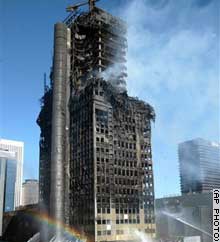
For a high rise fire that is relatively small. Please don't make me post all of the other high rise fire photos here including Madrid that have multiple floors completely gutted and burned for hours.

I know you are "protecting" the lurkers but it just isn't so. Did that fire survive the 800 foot fall? Do you want me to link you to the videos of the collapse?

Instead, take a shot at explaining the hot dust cloud and the fire extension. Did the fire in the photo heat 1/4 of NY?

Russell
 
Wildcat,

Listen to what the firefighters said themselves about what was left. Look at the debris pile for yourself.

Yes - it is not an "ordinary" demolition. Will you link me to an ordinary high rise fire that had molten metal burning for weeks so I can reconsider? I am not currently aware of that happening.

Besides none of them have collapsed into a basement!

Russell
 
Gravy,

For a high rise fire that is relatively small. Please don't make me post all of the other high rise fire photos here including Madrid that have multiple floors completely gutted and burned for hours.

I know you are "protecting" the lurkers but it just isn't so. Did that fire survive the 800 foot fall? Do you want me to link you to the videos of the collapse?

Instead, take a shot at explaining the hot dust cloud and the fire extension. Did the fire in the photo heat 1/4 of NY?

Russell
Russell, have you ever seen the WTC in person? Do you have any idea how big of a building that is? Each side of it is ~200 feet long. In that pic gravy posted, you're looking at a massive fire, and you won't find a bigger one occurring in a high-rise anywhere else.

And please post the Madrid fire pics, people here will be happy to point out to you that the steel section of that building failed completely. But the Madrid Windsor Tower was primarily a concrete core. Concrete is not nearly as vulnerable to fire as steel is, so the Tower stood even as the steel failed completely.
 
Brainache,


You can see the leap there.

You can also watch the collapse and the fire does not survive. Look at those forces. That burning material was snuffed and ejected for 800 feet.

Fire doesn't just run down an elevator shaft with fire shutters and hit the bottom and trickle across the garage floor igniting a car. Sorry. Where was the evidence at the street level or the lobby of a basement fire? Did firefighters report fires in the basement? No. They and others reported explosions in the sub levels.

Russell

Don't know why you conclude that the fires were snuffed. As I understand it the central core of the building failed first, dragging the rest down with it. It surely would have been hot enough to continue burning as it hit the ground.
There is also the little matter of all of that kinetic energy being converted to heat when the rubble hits the ground.(I just wanted to sound clever by saying "kinetic energy", did it work?)
 
Russell,
I won't join in what sometimes (just in force of numbers) appears to be a pile-on, and I didn't really even mean to distract you. I work the opposite side of the clock from you guys, so when you're able to post, I'm doing company stuff, and vice-versa. Ergo, I'm sort of a seagull... zoom in drop a few tidbits, make too much noise, then zoom out again.
I didn't mean to take time from the serious folks here who do so much work I admire. My point was that I respect these people a lot. When they said that the "voice of reason" from LC was coming over, I sincerely expected more in the way of evidence. I can see that you're lettered and intelligent, but I can't see how, if you were to enumerate your theories and evidence and counted the "opinions" and "feelings" and "common sense", you can yet continue the windmill tilting. As someone posted earlier today, there's just not a shred of actual evidence for the variations of "The Truth" that are being espoused.

Ignore this message - I, like others here, just have an overwhelming need to over-explain myself*, sometimes. There are more important points under discussion here, and others with far more knowledge of the topics than I have.

(*I worked on 1 WTC for 10 years, watched the whole thing live, and lost a number of acquaintances and business associates that day. My reactions tend to be more visceral than intellectual.)
 
Kent,


Some of that professor level stuff just confounds me. I can refer to my firefighter experience though in some basic matters.

Like this for example. If you have a relatively small amount of fire 800 feet up in a building and then the building collapses extinguishing and breaking up the burning material in the fall ejecting it outward in all directions on the way down, and then you have 70 some stories worth of structural debris in between the basement and the debris that had been on fire, I do have to wonder how that could possibly have extended itself into the sub levels of the building and resulted in molten metal burning for weeks.

I did think about the whole fuel theory too. I guess we would have to know how much fuel was consumed in the impact. Then we would have to try and figure out how any portion of it remained pooled up enough to run down the center shaft. Also, if you were to try and create a continuous stream of fluid from the impact floors to the sub levels how many gallons would that take? If it caught fire then it would consume itself on the way down and would require more than our initial formula.

So we really would in my opinion have to have a pretty good amount of fuel that remained pooled and wasn't ignited or vaporized that found its way to the center shaft. Then my next question is would it have been able to flow past the fire shutters there? But if we were to forget all of that and just somehow imagine enough fuel from the aircraft did remain pooled and was in fact able to create an approximately 800 foot stream of fire trail to the basement, what did it ignite and why in all of the ground level video do we not see smoke or evidence of a basement fire in the lobby? And this happened twice??

I think it was in the movie I linked for the WTC7 section too that somebody was talking about the heat in the dust cloud chasing them down the street. I believe I have heard that a couple of times now. So I am trying to figure out now if you had a fire 800 feet up, and the building collapses and extinguishes the fires (which you can see in the footage) and the burning materials are broken up and ejected evenly outward on all four sides, where did the heat come from?

I mean all of the original heat was obviously rising - right? So all of the air in the building below the impact would be normal temperature - right? All of the materials in the building, the concrete and the steel would also be at near ambient temperature or maybe even a little cooler if the building was air conditioned - right? Obviously all of the air around the building would be whatever temperature it was that day. You can see when the building falls the air currents appear to draw some air down but mostly no matter what, all the air being pushed around is not heated by anything. It is just whatever temperature it was. Where did the heat come from?

It wasn't heat from the relatively small fires that had fallen 800 feet and been extinguished was it?

Explosives generate heat though.

But I only have a GED so I don't get to write papers and stuff.

Russell
Russell, I believe you're making an improper assumption with your argument. It would not require either jet fuel or explosives/incendiary device to maintain the underground fires. Instead, the debris itself becomes the fuel to maintain the fire. Carpet, desks, paper, anything flamable kept the fires raging underground for months. Each time they cleared a section of the charred debris away, the oxygen starved fire would flare up again. So, indeed, the fires raging in the tower carried down to the basement of the WTC through this flamable debris and continued burning for several months.

ETA: Damn you WildCat, not only are you faster than me, your explanation is better as well...
 
Last edited:
Wildcat,

Listen to what the firefighters said themselves about what was left. Look at the debris pile for yourself.

Yes - it is not an "ordinary" demolition. Will you link me to an ordinary high rise fire that had molten metal burning for weeks so I can reconsider? I am not currently aware of that happening.

Besides none of them have collapsed into a basement!

Russell
So what explosives cause a fire to burn for weeks Russell? What other building w/ such a massive fire collapsed into such a massive debris pile?

The WTC was unique in that regard. There aren't any high-rises of the scale the WTC was (and certainly not one so engulfed), so you're going to come up empty looking for a comparison.
 
I'll leave this thread alone until tomorrow, I'm going to my alma mater's (NIU) homecoming game. They found a suitable patsy to knock the stuffing out of (Temple), and it's going to be one big drunk fest... :D
 
Wildcat,

Listen to what the firefighters said themselves about what was left. Look at the debris pile for yourself.

Yes - it is not an "ordinary" demolition. Will you link me to an ordinary high rise fire that had molten metal burning for weeks so I can reconsider? I am not currently aware of that happening.

Besides none of them have collapsed into a basement!

Russell

Hi Russell

Know what a force triangle is and how to resolve one?

This is not a trick question, but an attempt to find out if you have any qualifications to talk about building collapse.
 
Wildcat,

Yes I have seen the WTC.

Have you ever fought fires or had high rise training?

First of all firefighting operations were ongoing. They believed they could extinguish it or they would not have been in there. Second, they would not have been in there if they assessed ANY possibility of a collapse. That is THE first consideration of an IC. There was NO precedent of this in history. NYFD is the best at this topic.

Notice the dark smoke of an oxygen starved fire as well.

Then you want me to believe it happened 3 times in one day? With molten fire in all 3 basements? No way.

That fire is deceptive in that photo. If you want to learn about it I will tell you. Notice on the left where floors had actually burned out from consuming the fuel load. The fire on the right may look "massive" to the untrained eye but it is only lapping up the side of the building making it look like multiple floors are burning.

Notice for a mostly open office space floor system the rest of the windows are not showing flame on that floor? Imagine that there is a decent sized combustible fire going in there. Notice the wind and smoke direction. The leeward side has a "draw" to it. The fire has moved to the air and is likely only burning to that degree right there. The NYFD firefighters would have gone in there with two 1 3/4" lines and knocked that down in a couple of minutes. Maybe a 2 1/2".

Ask somebody else if you don't trust me.

Russell
 
Bob,

Russell, I believe you're making an improper assumption with your argument. It would not require either jet fuel or explosives/incendiary device to maintain the underground fires. Instead, the debris itself becomes the fuel to maintain the fire. Carpet, desks, paper, anything flamable kept the fires raging underground for months. Each time they cleared a section of the charred debris away, the oxygen starved fire would flare up again. So, indeed, the fires raging in the tower carried down to the basement of the WTC through this flamable debris and continued burning for several months.

Please document this. Show me where office materials are even shown in the debris pile. I can show you comments about the shock of the firefighters on how everything was pulverized. Show me in the fire sciences where ordinary combustibles (especially ones coded for high rises) can reach temperatures any where near the temperature to create molten steel. Then tell me it was smothered and did this?

russell
 
You guys study fires. I have to get my day started. Remember fire needs fuel, oxygen, heat and a chemical chain reaction. In the absence of oxygen you need an oxidizer (hint) in something that creates its own chemical chain reaction.
http://www.firesafe.org.uk/html/miscellaneous/firetria.htm


The melting point of steel (Fe) is 2500 F


http://www.newton.dep.anl.gov/askasci/eng99/eng99172.htm


CLASS A: Ordinary combustibles or fibrous material such as wood, paper, cloth, rubber and some plastics.​


-Extinguish ordinary combustibles by cooling the material below its ignition temperature and soaking the fibers to prevent re-ignition. Use pressurized water, foam or multi-purpose (ABC rated) dry chemical extinguisher. DO NOT USE carbon dioxide or ordinary (BC-rated) dry chemical extinguisher on Class A fires.


CLASS B: Flammable or combustible liquids such as gasoline, kerosene, paint, paint thinner and propane.​


-Extinguish flammable liquids, greases by removing the oxygen, preventing the vapors from reaching the ignition source or inhibiting the chemical chain reaction. Foam, carbon dioxide, ordinary (BC-rated) dry chemical, multi-purpose dry chemical, and halon extinguishers may be used to fight Class B fires.


CLASS C: Energized electrical equipment, such as appliances, switches, panel boxes and power tools.​


-Extinguish energized electrical equipment by using an extinguishing agent that is not capable of conducting electrical current. Carbon dioxide, ordinary (BC-rated) dry chemical, multi-purpose dry chemical and halon* fire
extinguishers may be used to fight Class C fires. DO NOT USE WATER EXTINGUISHERS ON ENERGIZED ELECTRICAL EQUIPMENT.


CLASS D: Certain combustible metals, such as magnesium, titanium, potassium and sodium. These metals burn at high temperatures and give off sufficient oxygen to support combustion. They may react violently with water or other chemicals, and must be handled with care.​


-Extinguish combustible metals such as magnesium, titanium, potassium and sodium with dry powder extinguishing agents specially designated for the material involved. In most cases, they absorb the heat from the material, cooling it below its ignition temperature.
 
Last edited:
pic55437.jpg


Inferno01.jpg


Part of the structure collapsed. But if you look at the top of the tallest part where it was the hottest, you can still see the crane being supported. That's a fire.
 
Here is the flaw I find in the WTC 7 - must have been CD arguement.

Apart from WTC 1&2, there is very little, if any, examples of complete building collapse, to go by, particularly in terms of video surveillance or witness testimony.

So watching a building come down, my question is...

How else was the building suppose to come down. Show me an example of a skyscraper that collapsed without the aid of Controlled Demolition. Then show me how it differed in its collapse from WTC 7, and then I might become curious. Otherwise, your only reference for how a building would look when it collapses is from CDs, so it is an unfair comparison.

In other words, find me ONE example of a SKYSCRAPER that is verified as not having been brought down by CD, that has a collapse that looks different than the collapse of WTC 7, otherwise the comparison to CD is useless, as it is the only point of reference.

TAM
 
Bob,


Please document this. Show me where office materials are even shown in the debris pile. I can show you comments about the shock of the firefighters on how everything was pulverized. Show me in the fire sciences where ordinary combustibles (especially ones coded for high rises) can reach temperatures any where near the temperature to create molten steel. Then tell me it was smothered and did this?

russell

http://webdocs.nyccouncil.info/attachments/71349.htm?CFID=1356598&CFTOKEN=43745493
Mr. Gilman’s Statement continued:

Further, the six-story pile of rubble that came to be known as “Ground Zero” was a continuing source of irritating and possible harmful air contaminants in lower Manhattan for months. Underground fires resulting from the residual jet fuel and combustible materials associated with the World Trade Center -- plastics and other materials from computers, carpeting, and furniture – continued until about mid-December 2001. Because these underground fires had a limited oxygen supply, the fires did not burn efficiently. Rather, the smoldering nature of the fires produced copious amounts of smoke, partially oxygenated hydrocarbons, and other products of incomplete combustion, all potentially producing adverse human health impacts.
I also couldn't find the original article, but I did manage to find this article from The People's Daily in China which is a reprint of the original article.

http://english.people.com.cn/200112/20/eng20011220_87119.shtml

The fires were fueled by almost everything inside the towers, from documents to office furniture. As demolition and rescue crews toiled to clear the debris air pockets would open, allowing fresh oxygen to cause hot spots to flare up.
 
You obviously didn't read my WTC 7 paper. Try page 75.

You may know something about firefighting, but your posts here show that you know nothing about the WTC fires.

I saw the photos on page 75. Did the collapse start on that side of the building?
 
Here is the flaw I find in the WTC 7 - must have been CD arguement.

Apart from WTC 1&2, there is very little, if any, examples of complete building collapse, to go by, particularly in terms of video surveillance or witness testimony.

So watching a building come down, my question is...

How else was the building suppose to come down. Show me an example of a skyscraper that collapsed without the aid of Controlled Demolition. Then show me how it differed in its collapse from WTC 7, and then I might become curious. Otherwise, your only reference for how a building would look when it collapses is from CDs, so it is an unfair comparison.

In other words, find me ONE example of a SKYSCRAPER that is verified as not having been brought down by CD, that has a collapse that looks different than the collapse of WTC 7, otherwise the comparison to CD is useless, as it is the only point of reference.

TAM

focus01.jpg
 

Back
Top Bottom