You really need to go back and see what was said and what I was answering.
You mean change the planet's destiny again, don't you? The whole AGW hypothesis is based on humans changing the planet's destiny.
Correct - I was referring to a generic ability to change the planet, but AGW is a good example. The removal of forests is another, along with building dams, changing watercourses and lowering water tables. They're all changing the planet - whether for ultimate good or harm isn't established, in most cases.
Of course it's prudent to seek answers to potential threats once you've verified that they are threats. That's my whole point. Once you recognize a potential threat, you really need to verify that it is real. Unless avoiding it takes little or no effort at all that is. I don't think that's what many AGW spokespeople mean by "action now" though and I'm more afraid of them making a horse's breakfast of things than I am of AGW right now.
But if you actually have a look at that "action now", most of it isn't that drastic and if some of them turn out to not work, or even be harmful, I'd rather err on the side of trying to help rather than sitting and waiting until [metaphorically-speaking] the sun goes out.
If I look at what harm might ensue from the proposed reductions in carbon output, I don't see anything as harmful as continuing to allow exponential growth. It's not a particularly apt parallel, but there are similarities - what happened to London's air when enforcement of reduced smoke output was commenced? It improved very quickly. I just can't see greener fuels and lower carbon emissions as being likely to harm anything.
In fact,
this old thread just occurred to me as a good comparison. Opponents of "green" electrical generation manage to come up with all sorts of spurious - and incorrect - assertions to support their case.
No. I expect math, mathematics, fancy countin',... You get the idea. Math is the language of science. No math, no science.
Now that's actually entirely wrong. As I see it, most of science came first and the maths second. From Archimedes in his bath, through Newton, Curie and Einstein, the discoveries and breakthroughs usually came before the maths which showed what was happening. I agree that what you're asking for would be immensely helpful, but to hold back until the algorithm is written down might not be a luxury we can afford.
Why do you think they've built the CERN collider? To confirm what we already know from maths, or to observe results to apply maths to?
How did you guess who I was?

I pray a lot!
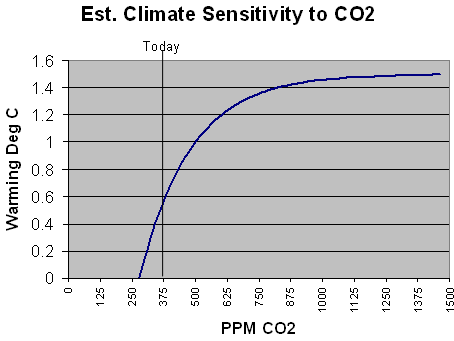
It wouldn't surprise me a heck of a lot if AGW was establised as fact sometime in the future. Like I said in a different post, the hypothesis is intuitively logical. What makes me doubt it is the fact that, for such a simple hypothesis, nailing the math down is taking a heck of a long time.
The mathematicians have all been co-opted by economists to find why the sub-prime crisis is spreading like a virus?
That's a good question but I don't think of AGW as that tough to characterize. Science has mathematically described systems that are as or more complex than increased insulation. But, suppose for one moment that AGW is actually occuring but you can't quantify it, how would you know your best options at solving the problem. Suppose CO2 was not the predominant driver for AGW and it was actually some other man-made factor (your choice). How would you measure your progress at counteracting AGW?
Even if no one "proves" AGW, there must be some method of measuring progress. Do you agree?
I do, but one of the biggest problems is the time frame we have to deal with. As humans, we expect immediacy, since we live for such a [geologically] incredibly short time, while it might take 500 years for changes to the climate to become apparent.
I'd be the first to admit that this is a highly inexact science. Crikey, the El Nino/Southern Oscillation was discovered only 80 years ago.
Seems to me there are three options:
Do nothing and act like the three wise monkeys.
Panic and stop all carbon emissions, dig up all the roads and plant trees instead.
Look for what might be happening and ways to fix any perceived problems.
It appears that most AGW proponents are doing #3. They're going to make mistakes, yes, but I don't think any are likely to be life- or planet-threatening.