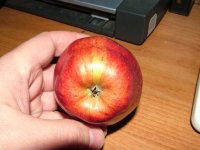
Here's an example of an apple chimera that shows less dramatic color imbalance and where you can see the apex of the fruit. You'll notice that you can see the sepal, the tip of what was formerly the petal, and how the fruit is 1/5th of the color change:
[qimg]http://fruitforum.files.wordpress.com/2008/01/reduced-red-millers-_322fea.jpg[/qimg]
In this one, again we see a less dramatic color imbalance, and not a true 1/2 of the apple but, if you look carefully, 2/5th's shading looking at the sepal lines. One of the "sections" may have grown slightly larger than the others making it appear that it is half, when it really isn't. But, the demarcation and coloring is much more subtle and the line separating the color imbalance much more natural appearing.
[qimg]http://fruitforum.files.wordpress.com/2008/01/apple-4-001.jpg[/qimg]
(images from "FruitForum")
Same thing in this one... Again, notice the sepal lines and that it's not truly half of the apple.
[qimg]http://web.ukonline.co.uk/suttonelms/th_gala-chimera4.jpg[/qimg]
Now, go back and look at the dramatic color demarcation in the almost cartoonish version that was submitted for our review in the OP.
Someone's taking the piss.
Based on this I'm willing to change my opinion to it probably being real. As Lucky says, those pictures show that real chimeras are expected to look very similar to the apple in question. Given that this sort of thing clearly occurs relatively often (as in enough to be a well established phenomenon), I see no reason to doubt this particular case.
Yes, I am leaving out the possibility that a perfectly half-and-half red/green apple would not be sold the public.
As already noted, apples like that will almost certainly not be sold to the public. Even now that EU regulations on "ugly" fruit and vegetables have been relaxed, there will almost certainly be problems with a fruit that cannot be labelled as a specific variety.
And actually, if these were 1 in a million you'd have to cull out something close to 50 million metric tonnes of half-and-half apples every year.
Well, see below for the one in a million part, but I have no doubt millions of tonnes of apples are culled every year. Most of them will go to making apple juice and other things that don't care what the apple looks like.
1 in a million is not such a rare thing.
I think the focus on the exact probability is rather pointless really. Sure, it's almost certainly not actually something that happens every million apples. So what? Clearly it does happen, and this is likely to be one such case. The phrase "one in a million" is commonly used to mean "very unusual", and is almost never meant to be taken literally. It's not a case of ignorant journalism, it's simply people using regular colloquial speech rather than detailed scientific language in a "this fruit looks just like a thingy" kind of article.
Last edited: