Two-Ball Feature
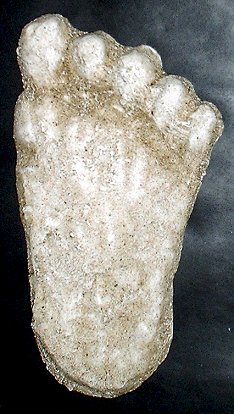
Another erroneous impression is the two-ball theory that is supposed to be characteristic of their feet. I find no field evidence to support this concept as a general physical trait! What I do find occasionally in tracks associated with flexing of the toes (hourglass), are two bulges on the medial side of the foot. The first is normal, the second (posterior) is principally the result of flexor action of the big toe when combined with instep plantar padding and furrow directly behind the first metatarsal during the weight-bearing phase. Bear in mind the same powerful muscular skeleton action is taking place in the foot to form an hourglass imprint with one exception. Soil resistance in this area during weight bearing causes a downward pressure against the contracted flexors of the big toe, located on the medial side of the longitudinal arch, forcing the loose plantar padding behind the furrow to project laterally when it comes in contact with the soil. The result is a second bulge! I would like to point out that, in weight bearing (when the toes are flexed), all of these movements become much more powerful when the ankle is forcibly extended by the tendon of achilles. This is particularly true of the peroneus because of its pulley action with the cuboid bone.
Dr. Grover Krantz gives a different version. He suggests that the two-ball feature is the result of flat feet and changes in the length of the foot's segments. He states: Given a totally flattened foot, all structures that would have constituted the arch will be firmly pressed against the ground. Behind the ball of the foot is the next bone projection, the near or proximal end of the first metatarsal. The metatarsals are the longest bones in the fore foot. If this region is to be relatively shortened, the base of the first metatarsal must be moved forward. Given a sufficient shortening of the bone, its two ends will be in the proper positions to form the double ball as seen in many Sasquatch footprints (Krantz 1972a:96). Krantz also suggests changes in the length of the foot's power and load arm as well as weight bearing being more toward the center of the foot. I find no field evidence to support this.