
• Quick note - the problem with Youtube videos not embedding on the forum appears to have been fixed, thanks to ZiprHead. If you do still see problems let me know.

March for Science 2017

Science education, because it's there.

Sure, one may simply decide to climb a mountain 'because it's there'. But there are rather more compelling reasons for teaching 'real' science which in my own experience (not necessarily typical) is not happening. I refer to the ability of physical, chemical and biological systems to self-organize, which to many might seem counter-intuitive, indeed at odds with the 'laws of nature'.

To take one simple example: how many science courses take the example of snowflakes to convey the principle of self-organization. Not only are the flakes all six-sided, though complex and non-identical, but they are formed from water vapour by cooling, i.e. removing, not adding energy. If a simple physical/chemical system involving one of the simplest molecules in nature, H2O, can self-organize to generate complexity and do so without needing an energy input, then is it any wonder that life forms could have arisen purely on the same basis of self-organization?

The explanation for self-organization is generally complex for each given system, but simple to grasp in principle, namely that the multi-proton atoms derived form nucleosynthesis in long dead stars come equipped with an equal number of negative electrons to balance the charge of the positive protons in the nucleus. But those electrons are required to occupy ordered orbitals (aka quantized 'energy levels') around the nucleus which makes atoms ready to interact with other atoms so as to adopt via 'chemical reaction' a preferred re-configuration that is energetically-more favourable for the given circumstances (temperature, pressure, concentration etc). Thus we have the phenomenon of self-organization', maybe better described as self-reorganization which can express itself as GREATER rather than less complexity, arrived at SPONTANEOUSLY (with so many folk imagining through faulty or deficient science education that to be somehow prohibited by the laws of nature, which is most definitely not the case, provided the total entropy change for system AND SURROUNDINGS is positive).

Was anyone here ever taught in their science lessons at school that spontaneous self-organization of atoms and molecules - with INCREASE in complexity - occurs freely in nature with no thermodynamic barriers bar the total entropy rule, and is indeed happening all the time (like each time snowflakes fall from the sky)?
 
(much snipped)

Was anyone here ever taught in their science lessons at school that spontaneous self-organization of atoms and molecules - with INCREASE in complexity - occurs freely in nature with no thermodynamic barriers bar the total entropy rule, and is indeed happening all the time (like each time snowflakes fall from the sky)?

I was, but without the loaded terms. "Spontaneous self-organization" was just "stable arrangement." "Complexity" wasn't around, but probably because it hasn't yet been well defined and I haven't seen a scale yet where "increase" means much of interest.

Snowflakes then were the same - water crystals. Pretty, yes - but no big deal.

I must admit we didn't have the excitement level I read in that post. Science was not a continuous round of being gobsmacked. It was more like trying to figure out the instructions to a very strange machine.
 
I was, but without the loaded terms. "Spontaneous self-organization" was just "stable arrangement." "Complexity" wasn't around, but probably because it hasn't yet been well defined and I haven't seen a scale yet where "increase" means much of interest.

Snowflakes then were the same - water crystals. Pretty, yes - but no big deal.

I must admit we didn't have the excitement level I read in that post. Science was not a continuous round of being gobsmacked. It was more like trying to figure out the instructions to a very strange machine.

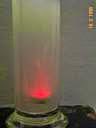
Care to guess what common gaseous element is in the jar, glowing red in the dark?

preparation+singlet+oxygen.jpg


Would you believe it if I told you it was oxygen, molecular oxygen, O2? It's phosphorescing (glowing in the dark).

Its electrons are in a slightly different state from ordinary oxygen - the singlet rather than triplet state, which makes it especially reactive chemically. It's just as well that the air we breathe is 21% oxygen in its triplet state. A mere 1% of singlet oxygen would be quickly fatal.

(The singlet oxygen above is being generated by reacting chlorine gas, Cl2, with alkaline hydrogen peroxide, H2O2).

At one level it's detail, maybe interesting maybe not. But it conveys an important principle about the natural world - the electrical nature of atoms - with their cloud of orbiting electrons - can produce truly amazing effects, ones that one would never predict from 'first principles'. Atoms are like miniature batteries - a powerhouse of stored energy- originating from some long dead star..

Yet there's an underlying order. Do schools succeed in getting across the mix of wonder and pattern-finding that is - or should be- science? I doubt it somehow, even now...
 
Last edited:
Of course I’m thrilled that concepts like skepticism, rationality, hard evidence-based facts, and scientific rigor are back in the forefront of our public discourse.

Of course I’m bothered by the growing use of phrases like “Alternative facts.”

You know what I’m not though? Angry about any of this in any special way or on a level that I haven’t been literally my entire adult life.

Back when the whole “Alternative facts” things took off I said “Congratulations general public you now know what being a skeptic / rationalist has always been like” and that thought has not exactly went away in the last few months. As bad as watching the intellectual landscape has been for the last few months has been for me it hasn’t exactly been new. It’s not even that unique in anything but its scope.

Do people understand this is how it’s always been? “Holy smokes! People denying reality is bad!” Gee thanks. It’s not like that is exactly the point a lot of people have been trying to get across for a long time now.

There is just something… distasteful about a bunch of people coming out of the woodworks to defend intellectual standards as if it just suddenly started to matter now. And I am sorta getting tired of people treating science and rationality as some sort of fan club they can just drift in and out of.
 
At one level it's detail, maybe interesting maybe not. But it conveys an important principle about the natural world - the electrical nature of atoms - with their cloud of orbiting electrons - can produce truly amazing effects, ones that one would never predict from 'first principles'. Atoms are like miniature batteries - a powerhouse of stored energy- originating from some long dead star..

Yet there's an underlying order. Do schools succeed in getting across the mix of wonder and pattern-finding that is - or should be- science? I doubt it somehow, even now...

I'm with you generally, but there's a danger lurking in the words I've highlighted. Over the years I've been paying attention, the popular sort of science has skewed more and more toward entertainment - exactly those attributes you mention. It is expected to deliver "amazing effects" and "wonder."

Satisfying this craving for the new and the exciting has the potential to influence the subjects we pursue and how we go about tackling them. A "product" designed to spark interest in the laity isn't necessarily going to be the product we ought to be pursuing.

Science that drifts from the plain and simple search for truth is in danger of becoming the chew toy of politics and fashion. Sport-science and science-tainment, those aspects that inspire our sense of wonder have the potential to mislead in dramatic ways. The enterprise driven by emotion is always in danger of being driven too far and too fast in the direction of inspiration rather than understanding, toward the headline instead of the plodding data collection and double/triple checking, toward what we see emerging as poor science, too quickly published, too little scrutinized and too wrong.
 
Is that supposed to constitute evidence? How do you know it was the protests and demonstrations which were effective, rather than the rest (riots, armed patrols to keep an eye on the cops, etc)?
I don't really. I didn't actually expect anyone to dispute that minor aside to my main point.

I guess you got me. Well done.
 
Would it be an over-exaggeration to suggest that science has become a 21st century turn-off, there being no remaining 'natural curiosity' as regards the natural world and how it operates? The 'science marches', welcome as they were, were not in fact an attempt to promote science, more probably a protest against our increasingly anti-science culture ,typified by (dare I say it?) the strident anti-climate-change lobby, probably with a few other touch-a-raw-nerve issues thrown in, especially State-side. like ... (too many to list, but we all know the usual suspects where science collides with religion).

I blame dumbed-down mass media intially, then smart-phone accessed social media etc etc for diverting interest from THINGS entirely to people (celebrities and would-be celebrities).

It must be 50 years or more since the media ran in-depth articles on unexplained natural phenomena.

Oops. There I am, showing my age. It's a changed world. Fluff rules OK?
 
Maybe it just got too complicated. I have an education, but I'll be damned if I could tell you why axions make a good candidate for dark matter, or the details of why Wilczek got the Nobel (2004) for discovering them (in 1978). It can't be dumbed down enough for me to grasp the essentials.
 
Get the Trump Administration to start talking about Bigfoot.

If it will defer any investigations or advances good for us it certainly will!!!!

Comic books about trumpf are headed out in June/July (just been through the really thick book of new ones on the way to ordering)!!!
 
Critical thinking should be taught very early on. I'd never even heard of it until I signed up for the class in college. That is not good. You are not taught to question anything in school now that I think about it.

It's overrated. Rote is useful early on.
 
Care to guess what common gaseous element is in the jar, glowing red in the dark?

[qimg]http://2.bp.blogspot.com/-wpIpE7sBQxg/U6ALRpWdkFI/AAAAAAAACU8/1oxCqhlQNx4/s1600/preparation+singlet+oxygen.jpg[/qimg]

Would you believe it if I told you it was oxygen, molecular oxygen, O2? It's phosphorescing (glowing in the dark).

Its electrons are in a slightly different state from ordinary oxygen - the singlet rather than triplet state, which makes it especially reactive chemically. It's just as well that the air we breathe is 21% oxygen in its triplet state. A mere 1% of singlet oxygen would be quickly fatal.

(The singlet oxygen above is being generated by reacting chlorine gas, Cl2, with alkaline hydrogen peroxide, H2O2).

At one level it's detail, maybe interesting maybe not. But it conveys an important principle about the natural world - the electrical nature of atoms - with their cloud of orbiting electrons - can produce truly amazing effects, ones that one would never predict from 'first principles'. Atoms are like miniature batteries - a powerhouse of stored energy- originating from some long dead star..

Yet there's an underlying order. Do schools succeed in getting across the mix of wonder and pattern-finding that is - or should be- science? I doubt it somehow, even now...

Depends on how much money they put into materials for the classes involved and what standards they decide need to be met and what they decide is dangerous even when it isn't if done right!!!!! And, other than advanced/AP/really great labs, the mix of wonder and pattern finding is more textual then doingable.
 
Science is not primarily about critical thinking, valuable though that aspect of its MO may seem today, given the daily onslaught of fake news, pseudoscience etc.

Science is primarily about furthering our understanding of the natural world in which we live - both on a global and universal scale.

The methods of science involve a lot of self-discipline - learning, sometimes painfully, to separate fact from fancy.

But let's not lose sight of the real goal of science - to understand the world into which we have been born - curiously but tellingly with no useful handed-down 'book of words' with which to make sense of its many bewildering and challenging aspects. We live and (hopefully) we learn...
 
Depends on how much money they put into materials for the classes involved and what standards they decide need to be met and what they decide is dangerous even when it isn't if done right!!!!! And, other than advanced/AP/really great labs, the mix of wonder and pattern finding is more textual then doingable.

The demonstration of a phosphorescent, light-emitting form of oxygen gas is absurdly simple. It require a couple of easily obtainable chemicals (domestic bleach, plus hydrogen peroxide - though possibly more concentrated than the sort one buys at one's high street chemist).

Simply mix them together, then switch out the lights.

I can understand why your ordinary everyday science teacher would avoid doing the experiment. Quite apart from needing to pull all the blinds down to to block out the light, better for the entire class to see phosphorescence of singlet oxygen, there's the impossibilty of providing an explanation that is really university-level (bonding v anti-bonding molecular orbitals).

I say the explanation can wait. Merely say singlet oxygen is a variant of ordinary oxygen in which the electrons that bond the two oxygen atoms together are in an exceptionally high energized state, one that gradually reverts after an hour or so to common triplet oxygen as we know it.

Just make clear that energized states (e.g. singlet oxygen) exist that we do not usually encounter in our ordinary everyday lives - which is just as well. We live in a (potentially) dangerous world, one which needs understanding before it can (optimistically) be tamed.

The world was not designed entirely for human convenience. We have to take it as we find it, endeavouring to find means of curbing its tendencies to 'doing its own thing'.

There's nobody 'up there' looking after us. We have to seek our own solutions to a comfortable existence - and survival as a species.
 
The demonstration of a phosphorescent, light-emitting form of oxygen gas is absurdly simple. It require a couple of easily obtainable chemicals (domestic bleach, plus hydrogen peroxide - though possibly more concentrated than the sort one buys at one's high street chemist).

Simply mix them together, then switch out the lights.

I can understand why your ordinary everyday science teacher would avoid doing the experiment. Quite apart from needing to pull all the blinds down to to block out the light, better for the entire class to see phosphorescence of singlet oxygen, there's the impossibilty of providing an explanation that is really university-level (bonding v anti-bonding molecular orbitals).

I say the explanation can wait. Merely say singlet oxygen is a variant of ordinary oxygen in which the electrons that bond the two oxygen atoms together are in an exceptionally high energized state, one that gradually reverts after an hour or so to common triplet oxygen as we know it.

Just make clear that energized states (e.g. singlet oxygen) exist that we do not usually encounter in our ordinary everyday lives - which is just as well. We live in a (potentially) dangerous world, one which needs understanding before it can (optimistically) be tamed.

The world was not designed entirely for human convenience. We have to take it as we find it, endeavouring to find means of curbing its tendencies to 'doing its own thing'.

There's nobody 'up there' looking after us. We have to seek our own solutions to a comfortable existence - and survival as a species.

I may have misled not purposely, the problem is the limited number of chemicals we are allowed to use in public schools are rather limited for safety and cost reasons - stronger than otc H2O2 for example. My third year before retirement we managed to get a small supply of sodium but that got removed after the first year of it's presence. NOTE: I have a wonderful three volume set of truly impressive labs I could have done absent the limitations.
As a technicality, we also had students being put in physics and chem who could not do the necessary math thanks to guidance councilors having to fit kids in some science class.

But, what the hell - we also had kids who had level 1 scores (the lowest except inability to get passing on the tests) simply put in classes they could not handle because they had to be in school but..............It was idiocy/incompetence but testing as it is now done is what they now do.
 
Last edited:
I think it's fantastic that these marches were so big, but I seriously doubt the ability of protests and demonstrations to actually change anything.

Back in the 60s and 70s, sure. They were new and unusual and they shook people up and got stuff done. But in today's post-Occupy world, it's pretty clear that no matter how many people turn out, no matter how clever the signs, those in charge will just ignore them.

Nowadays it's all cargo cult protests anyway. Used to be, these kinds of actions were done to get the change-makers to pay attention and make changes. Now, it's like people think the act of protest itself is the change-maker.
 
Nowadays it's all cargo cult protests anyway. Used to be, these kinds of actions were done to get the change-makers to pay attention and make changes. Now, it's like people think the act of protest itself is the change-maker.
Yes, because the change-makers have stopped paying attention.

"Oh, another protest? Must be Thursday."
 
I may have misled not purposely, the problem is the limited number of chemicals we are allowed to use in public schools are rather limited for safety and cost reasons - stronger than otc H2O2 for example.


In this case, once you get above 35% concentration in the US, you have to start worrying about DHS regulations, since it can be used to manufacture IEDs. You have to have more than 400 pounds on hand (approx. 43 gallons) before a security screening of the facility is required, so it's not really something schools have to worry about, but it probably makes it harder to find suppliers willing to ship non-manufacturing use quantities. The company that I work for makes several peroxide-based cleaning products, and we deliberately stay at 31% for our raw materials to avoid going through a screening and having to implement the DHS' anti-theft security requirements.
 
In this case, once you get above 35% concentration in the US, you have to start worrying about DHS regulations, since it can be used to manufacture IEDs. You have to have more than 400 pounds on hand (approx. 43 gallons) before a security screening of the facility is required, so it's not really something schools have to worry about, but it probably makes it harder to find suppliers willing to ship non-manufacturing use quantities. The company that I work for makes several peroxide-based cleaning products, and we deliberately stay at 31% for our raw materials to avoid going through a screening and having to implement the DHS' anti-theft security requirements.

One can buy 9% H2O2 over-the-counter (aka 30 vol, i.e. capable of generating 30 times its own volume of oxygen), but a quick literature search confirmed my hunch that a much higher concentration of H2O2 (30%) is needed to generate singlet oxygen in sufficient amounts to see the red glow.

Curiously the article only gives warnings about the hazard of the co-reactant (chlorine gas), failing to mention that 30% H2O2 is capable of producing serious chemical burns in a matter of seconds! Splashes in the eye don't bear with thinking about!
 

Back
Top Bottom