Ed Maartenn100 general theories of physics and philosophy.

Deleted, Rule 6

  • Deleted

    Votes: 1 100.0%
  • Deleted

    Votes: 0 0.0%

  • Total voters
    1
Status
Not open for further replies.
You must also consider that my idea is based on logic deduction.
Space and time are one. You cannot seperate it.
ergo: a difference between clocks (a difference between the flow of time), means a difference in the observation of space/length. (f.e. lengthcontraction and timedilation in special theory of relativity)

When you 'observe' a different clock outthere, (gravitational timecontraction or timedilation), you must observe something different with space too. Because spacetime is one.

With 'expanding space' that's the case: huge massive objects are going away from each other, gravity between them decreases, so the hypothetical clocks between them ticks faster. = gravitational timecontraction.

Whenever we see 'expanding space' due to the socalled 'expansion of the universe', we know that there are faster ticking clocks.

And: 'faster clock' is relative to a clock which ticks less faster, hence in a region of stronger gravitational potential.

The amount of 'faster flow of time' outthere, also depends on your timeflow in your field of gravity.

The logical conclusion is: your flow of time determs what you observe outhere about space.


That's pure logic deduction.
Hilite by Daylightstar
No Maartenn100, your idea is based on utter and complete stupidity, meaning, you clearly know nothing and refuse to learn anything.
 
I want you to give counterarguments on my logical deduction, because that's the core of my reasoning:

Space and time are one. You cannot seperate it.
ergo: a difference between clocks (a difference between the flow of time), means a difference in the observation of space/length. (f.e. lengthcontraction and timedilation in special theory of relativity)

When you 'observe' a different clock outthere, (gravitational timecontraction or timedilation), you must observe something different with space too. Because spacetime is one.

With 'expanding space' that's the case: huge massive objects are going away from each other, gravity between them decreases, so the hypothetical clocks between them ticks faster. = gravitational timecontraction.

Whenever we see 'expanding space' due to the socalled 'expansion of the universe', we know that there are faster ticking clocks.

And: 'faster clock' is relative to a clock which ticks less faster, hence in a region of stronger gravitational potential.

The amount of 'faster flow of time' outthere depends on your timeflow in your field of gravity.

The logical conclusion is: your flow of time determs what you observe outhere about space.

So, the amount of observed space-expansion depends on your clock. It depends on your position in the gravitational fields.
 
Hilite by Daylightstar
No Maartenn100, your idea is based on utter and complete stupidity, meaning, you clearly know nothing and refuse to learn anything.

So, you claim that when two massive objects are going away from each other due to the socalled expansion of space, there is no gravitational timecontraction of hypothetical clocks between them? Where do you base your conclusion on?

Gravity makes clocks run slower.
So, less gravity: more timecontraction.

But not 'just timecontraction'. An amount of timecontraction, relative to your flow of time of your clock.
So, an amount of space-expansion relative to your clock and your idea of space...
 
Last edited:
So, you claim that when two massive objects are going away from each other due to the socalled expansion of space, there is no gravitational timecontraction of hypothetical clocks between them? Where do you base your conclusion on?

Gravity makes clocks run slower.
So, less gravity: more timecontraction.

But not 'just timecontraction'. An amount of timecontraction, relative to your flow of time of your clock.
So, an amount of space-expansion relative to your clock and your idea of space...
Hilite by Daylightstar
"So you claim" and "your conclusion" :big:


Would you like to point out where I make any such claim?
 
To make the logical deduction more clear:

When two massive objects are going away from each other due to the socalled expansion of space, there is a gravitational timecontraction of hypothetical clocks between them.


But not 'just gravitational timecontraction'. The amount of timecontraction is depending on your flow of time of your clock.
You take your clock as a standard for 'an amount of timecontraction somewhere else'.
So, the amount of observed space-expansion is also relative to your clock and your idea of space...
 
Last edited:
To make the logical deduction more clear:

When two massive objects are going away from each other due to the socalled expansion of space, there is a gravitational timecontraction of hypothetical clocks between them.


But not 'just gravitational timecontraction'. The amount of timecontraction is depending on your flow of time of your clock.
You take your clock as a standard for 'an amount of timecontraction somewhere else'.
So, the amount of observed space-expansion is also relative to your clock and your idea of space...
HIlite by Daylightstar
What does that even mean?
 
With gravitational timedilation it's exacty the same thing.

Your timeflow of your clock as an observer is the measure for the amount of gravitatational timedilation you will 'observe' somewhere else. F.e. when you are observing a black hole.
So the amount of curvature of space you observe outthere is determened by your time flow of your clock.
 
On the contrary: we, observers, see the 'same' image of a galaxy as a different configuration of pixels from totally different moments in the past.
That is not what I meant. I meant you see people's faces from all different perspectives: profiles, straight on, from behind, etc. Just like with galaxies.

Edit-Nevermind, i just learned something new from Ziggurat. It's a fascinating concept, learning. You should try it.
 
Last edited:
My prediction is: when you are closer to a black hole, you will not observe the black hole as we observe it over here. Because the difference in timeflow is smaller. So your idea of the curvature of space outhere will be different then ours. So you will not see the same curvature of space, because the difference with your clock is smaller.
 
Last edited:
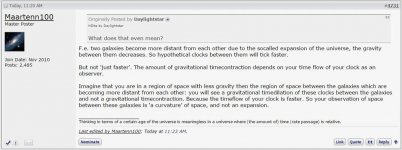
F.e. two galaxies become more distant from each other due to the socalled expansion of the universe, the gravity between them decreases. So hypothetical clocks between them will tick faster.

But not 'just faster'. The amount of gravitational timecontraction depends on your time flow of your clock as an observer.

Imagine that you are in a region of space with less gravity then the region of space between the galaxies which are becoming more distant from each other: you will see a gravitational timedilation of these clocks between the galaxies and not a gravitational timecontraction. Because the timeflow of your clock is faster. So your observation of space between these galaxies is 'a curvature' of space, and not an expansion.
HIlite by Daylightstar
The gravity between them? What does that mean? Where between the two galaxies are these hypothetical clocks situated? Why would you require more than one clock?
 
I want you to give counterarguments on my logical deduction, because that's the core of my reasoning:


I think we have been over this before but as you wish....


You must also consider that my idea is based on logic deduction.

Space and time are one. You cannot seperate it.
ergo: a difference between clocks (a difference between the flow of time), means a difference in the observation of space/length. (f.e. lengthcontraction and timedilation in special theory of relativity)

Well, don't forget general relativity.


When you 'observe' a different clock outthere, (gravitational timecontraction or timedilation), you must observe something different with space too. Because spacetime is one.

And in general relativity that is space-time curvature.

With 'expanding space' that's the case: huge massive objects are going away from each other, gravity between them decreases, so the hypothetical clocks between them ticks faster. = gravitational timecontraction.

Hypothetically, but realistically if something in that 'between space' was gravitational bound to either of those moving masses it would move with them. So the gravitational influence of those moving masses is already minimal in that inbetween space. In other words the space-time there is already essentially flat.


Whenever we see 'expanding space' due to the socalled 'expansion of the universe', we know that there are faster ticking clocks.

Actually the relativity of time is independent of the metric expansion of space. Meaning you would have faster and slower clocks even if space wasn't expanding. Also the expansion effects objects that are not gravitational (or otherwise) bound so the space-time between them is already essentially flat.


And: 'faster clock' is relative to a clock which ticks less faster, hence in a region of stronger gravitational potential.

The amount of 'faster flow of time' outthere depends on your timeflow in your field of gravity.

No space-time doesn't get flatter than flat and the gravitational field you are in can only affect your clock

The logical conclusion is: your flow of time determs what you observe outhere about space.

So, the amount of observed space-expansion depends on your clock. It depends on your position in the gravitational fields.


That's pure logic deduction.


If I recall correctly the rate of expansion depends on the vacuum field energy density not on your local gravitational field strength. Again your local gravitational field affects your local clock.
 
Last edited:
No space-time doesn't get flatter than flat and the gravitational field you are in can only affect your clock

It expands. You will see an expansion when the clock ticks faster outthere.
 
My prediction is: when you are closer to a black hole, you will not observe the black hole as we observe it over here. Because the difference in timeflow is smaller. So your idea of the curvature of space outhere will be different then ours. So you will not see the same curvature of space, because the difference with your clock is smaller.

I would like to draw the attention to Maartenn100 horrendous editing habit.
The above quoted post initially read as quoted by me in this post.

Screenshot of that initial content of Maartenn100's post is attached to this post.
 

Attachments

  • Post4731_a.jpg
    Post4731_a.jpg
    62.9 KB · Views: 13
The man said:
Maartenn100 said:
The amount of 'faster flow of time' outthere depends on your timeflow in your field of gravity.
No space-time doesn't get flatter than flat and the gravitational field you are in can only affect your clock

'Flatter then flat' means: observing expansion.

You can only compare clocks. But you, as an observer, will see your clock always as a standard. Somewhere else time goes faster or slower. You are the standard for the amount of gravitational dilation or gravitational contraction of time of another clock, isn't it?

So, you have also a particular idea, locally, of the flatness of space.
Wherever you are, you will measure unexpanding or uncurved space, locally in your own vicinity.
Because you have your local ruler for flatness of time (and space): your own clock.

That's how I see relativity.

Flatter then flat = the observation of expanding space.
 
Last edited:
The man, in my idea you have a personal ruler for flatness of space.
Because you use your own clock as the standard for a normal timeflow too.
So, wherever you are, as an observer, locally everything is always flat.

Cfr: special theory of relativity: in your own ship, the laws of newton works just fine, for you as an observer. Even when you go, relative to earth, near the speed of light. You as an observer see Earth contracting. The observed distortions of space and time are somewhere else.

In general relativity I would say: your idea of space and time locally is flat. The curvature or expansion is always somewhere else.

The amount of curvature (timedilation and spacecurvature) is always depending on the difference between your location and the location you observe outthere.
 
Last edited:
You can only compare clocks. But you, as an observer, will see your clock always as a standard. Somewhere else time goes faster or slower. You are the standard for the amount of gravitational dilation or gravitational contraction of time of another clock, isn't it?

So, you have also a particular idea, locally, of the flatness of space.

No. Gravitational time dilation is caused by differences in gravitational potential. It is not caused by the local curvature. For example, gravitational time dilation is stronger at the center of the earth than at the surface of the earth, because the center of the earth has a lower gravitational potential, but space is less curved there than at the surface of the earth (gravitational "force" is weaker).

When will you accept the fact that you simply don't know what you're talking about?
 
In general relativity I would say: your idea of space and time locally is flat.

Not quite. The tangent space is always flat, which means that you can approximate a finite region as being flat if that region is small enough. But this is just the same as saying that a curve looks straight if you zoom in enough.

The amount of curvature (timedilation and spacecurvature) is always depending on the difference between your location and the location you observe outthere.

Nope. That's now how curvature works in general relativity. Curvature is defined as a local quantity.
 
Status
Not open for further replies.

ISF - Join now!

Every member here is approved by hand. No bots, no spam, just people who care about evidence and honest debate.

Membership is free!

Create your free account

Back
Top Bottom