• Quick note - the problem with Youtube videos not embedding on the forum appears to have been fixed, thanks to ZiprHead. If you do still see problems let me know.

Luke Mitchell and the murder of Jodi Jones

reasonable doubt and the DNA

Thank you for some clearly written summaries. I know that you are not saying that Steven Kelley is the murderer (and neither am I--there are other reasonable suspects). However, if he were the murderer, it is odd that he would take part in the search for the same reason that you gave for Luke Mitchell. With respect to Mr. Kelley's DNA and semen, what I can say is that if I had been on the jury, it would have alone given me reasonable doubt that Luke Mitchell was the murderer.
 
Why am I still up?

My logic says I am extremely suspicious of Mr Kelly. If you follow the logic of what Sandra Lean is saying, and I do, the absence of Luke's DNA in association with Jodi's body is virtually incredible if he had carried out that brutal murder. But then that point surely applies to everyone else whose DNA wasn't found on the body! I think there was one other profile which wasn't Steven, I need to look that bit up again, and then of course there was James Falconer's used condom near the body. But if we're looking at a huge unlikelihood of the murderer's DNA not being on Jodi's body, well, go figure as they say.

I appreciate there are a lot more factors than that, but goose and gander sauce. If John Ferris or Mark Kane (the defence's two favourites) did it, where is their DNA?

Also, Steven was simply part of the search party. He didn't suggest going over the wall. Left to his own devices he would have continued west along the path with Janine. Indeed, at the point when Luke met up with the other three, at the junction of the paths, there had been some discussion initiated by either Steven or Janine suggesting that they should actually go and look down Lady path, and it was Alice who swayed the decision to go along Roan's Dyke path (back along, in Luke's case).

So I'm looking at Steven Kelly with a very jaundiced eye right now.
 
Before starting on Luke's own account of his movements and his alibi I think we need to drill down a bit more into the Andrina Bryson evidence, and also another alleged eyewitness sighting later in the evening.

I am simply gobsmacked that the time needed for Mrs Bryson to go and look at the house seems to have been airbrushed from the narrative. Her original story was that she drove first to the supermarket, did the shopping, loaded it into the car, then drove to Easthouses where there was a house for sale she was interested in. This wasn't an arranged viewing, she just wanted to take a look at it from the outside. She got a bit lost trying to find the house, but found it, had a look, then drove back home. It was quite clear at that time that she had seen the couple at the eastern end of Roan's Dyke path on her way home, after she'd looked at the house, not on her way to the house.

She said she got home, unloaded the car, put away the shopping, and started to make the tea. Then her phone rang and she took a call. She estimated the call came in about half an hour after she got home, at about 6.20. In fact the call was logged on her phone as 6.17, so she was about right. That would put her return home at about 5.45 to 5.50. She originally said she saw the couple at the path about five or ten minutes before she got home, which is about right for the drive from there to her house. This puts the time of the sighting at about 5.35 to 5.45, without any need to reference the supermarket checkout time.

The till receipt time of 4.45 (and 31 seconds) tallies with Mrs Bryson's own estimate of what she did, giving her 30 to 35 minutes for the actual shopping in the store (she in fact estimated 35 to 45 minutes) and about an hour in total for the drive to Easthouses (12 to 17 minutes each way), the search for the house for sale, time to look at it, and then the drive back home again. If the bank statement time of 4.32 (and 45 seconds) is used instead, this cuts the time for the actual shopping to only 20 minutes maximum, including queueing up for the till and ringing up the purchases. I suppose it depends on how much she bought, but the till receipt tallies better with her own recollection of how the time went.

However, why does it matter? If you take 13 minutes off the time spent in the supermarket, all this does is add 13 minutes to the time spent looking for and looking at the house for sale, because it doesn't affect the timing of her return home. It moves her arrival in Easthouses 13 minutes earlier, but it doesn't change her departure time. And yet it was on her way out of Easthouses that she was supposed to have seen the couple at the end of the path!

Using the bank statement time for the completion of the supermarket shop instead of the till receipt gets her arrival in Easthouses to about 16.53, which is exactly the time the prosecution needed Luke to have been seen at the end of the path with Jodi. But that's not when Mrs Bryson said she saw the people at the path!

Bear in mind that Mrs Bryson was driving her car, with two children in it, one of them only a two-year-old. She didn't stop to scrutinise these people, she simply noticed them as she drove past. The layout of the road is important here. If you're driving south from Easthouses on the road in question, the end of the path is at a fairly sharp bend. In fact at that point the path appears to continue on in a south-west direction while the road makes a fairly sharp left turn to continue in a south-east direction.

https://goo.gl/maps/bXJREZafGbzEsHyr5

Note that a driver coming from this direction is pretty much looking straight up the path for a few moments, and Mrs Bryson would have had a reasonable view of anyone standing at the path entrance, although only for a couple of seconds. (Zoom in to the path itself here. https://goo.gl/maps/sNUEqCb9Uw3fQkVB8) This is what Mrs Bryson originally said she saw. She wouldn't have had much time to see the couple, and she would obviously have had to concentrate on the left-hand bend in front of her, but it's a reasonable enough story.

Now look at it from the other direction, driving north towards Easthouses.

https://goo.gl/maps/eYqPxmuHt7PPmxRB6

It's a bit different, isn't it? There's an indication of an entrance there, maybe, but an entrance to what? You can't see. Mrs Bryson didn't know Easthouses at all well. If she had seen a couple of people standing under that tree, how could she have known they were at the end of a footpath at all? It simply doesn't compute.

There's no possibility that anyone could be mistaken about which direction they were driving in when they noticed something at that spot. You're either driving south, when you have a left-hand bend in front of you and you can see right into the footpath, or you're driving north, when you have a right-hand bend in front of you and you can't even see that there's a path there. Even when you're right alongside the path entrance, driving north, you can't see that it's a path, as here. https://goo.gl/maps/MqJo8eNVTcnHazsKA You actually have to go past the entrance and twist back to see the path!

Not only that, in court the suggestion was put to Mrs Bryson that the male that she saw was as much as 10 yards into the path. This is all quite confused as she originally said she saw both people together at the entrance to the path, nevertheless she seemed to accede to the suggestion that the male was some little way into the path, facing towards the girl who was at the entrance. Even more bizarrely there was a suggestion that she'd seen the male move down the path - which is completely impossible whichever direction she was driving in as she couldn't have had the path in sight for long enough to see this happening. However, the point is that it would only have been possible for her to see into the path, to see that the male was 10 yards down the path (wherever that suggestion came from), if she was driving south. It's impossible for someone driving north to see into the path at all.

In order for Mrs Bryson to have seen anyone at that path at 4.53, she must have seen this when she was driving north, towards Easthouses, before she went to look at the house for sale. But driving north you simply can't see what she is supposed to have seen. Driving south, you can see it (although to clock that much detail in the couple of seconds as you drive past is quite a feat), but if she saw this when she was driving south then the time was about 5.40, not 4.53.

So what the hell was Donald Findlay (more on him later) thinking about, in court? All he had to say was, Mrs Bryson, which way was your car facing when you saw these people? Was the bend (you should have been concentrating on, two children in the car and all that) a right-hand bend or a left-had bend? Could you actually see into the path itself when you noticed the two people?

If she actually saw them on the way to the house viewing then that is not what her original account said, so how come she originally thought she was driving south towards a left-hand bend then revised her story so that she was actually driving north towards a right-hand bend? And how come she even realised there was a path there, let alone acceded to the suggestion that one of the people was as much as 10 yards down the path, when a driver travelling north can't see the path at all? And yet that's what we have to believe if the sighting was 4.53.

If she made the sighting as she drove south, as everything seems to suggest and indeed only a southbound driver could possibly see into the path or even realise there was a path there in the first place, then the time of the sighting was about 5.40. The prosecution case relied on Jodi having been killed at 5.15.

 
Last edited:
I think that completely kills the Andrina Bryson sighting. It's so damn simple and so damn obvious it's difficult to believe this just slid past, but having seen similar things happen in other cases (including Lockerbie, which is relevant because it was the same bloody QC prosecuting in both cases), I have to believe it's possible. I haven't seen this point made by anyone previously, even Sandra Lean only mentions that the entrance to the path is on a fairly sharp bend in the road.

The only thing is, Sandra Lean doesn't mention where Andrina Bryson lived at the time, or where the supermarket was. However the end of the path, in Easthouses Road, is to the south (or south-east) of Easthouses village. If Mrs Bryson was driving on that road going home from viewing the house for sale, then she must have lived somewhere south to south-west of Easthouses. Ditto as regards the supermarket. If she drove past the end of the path on her way from the supermarket to Easthouses, she must have been coming from the south or south-west. Somewhere like Newtongrange makes sense. There's a small supermarket near Newtongrange station that fits the bill, although I don't believe that station was open in 2003 (it's on the Borders Railway, which wasn't reopened to passengers until 2015), but that's not really relevant. If Mrs Bryson didn't live somewhere like Newtongrange, the whole thing gets a lot more complicated.

But really, the directionality kills it even before you get on to the huge discrepancies in the descriptions of the people Mrs Bryson said she saw. She described a male in his early 20s of medium build with very thick sandy brown hair sticking up in a clump at the back. She said he was wearing a green fishing-style jacket with a lot of pockets and matching trousers. Luke was a skinny 14-year-old with thin, straight blond hair. He himself said he was wearing a green bomber jacket (over a black t-shirt) and baggy jeans, with distinctive light-coloured snowboarding boots, and that's what he was wearing when the people who actually knew him saw him at Newbattle just before six. The prosecution wanted him to be wearing a heavy parka, but they couldn't persuade Mrs Bryson that she'd seen a parka.

The female Mrs Bryson described was of indeterminate age, wearing a plain navy-blue hoodie and lighter blue boot-cut jeans. Her hair was described as very dark. Jodi had mid-brown or auburn hair. She was wearing a baggy black hoodie with a very distinctive orange logo on the back, and very baggy black trousers.

Sandra Lean mentions that there's a school (Newbattle High School) not far from where Mrs Bryson saw the two people - I think it's the school Dr Lean's own two daughters attended at the time. There was an end-of-term concert on at the school that night, and at around 5.40 people would have been starting to head back to the school to help with the set-up. The Newbattle High School uniform included a fairly plain navy blue hooded top. The two people seen by Mrs Bryson were never traced, but of course the police weren't going to try to trace them, were they? And since the case was all about them being seen at 4.53, anybody who had been at that spot at 5.40 wouldn't necessarily have thought there was any connection.
 
Last edited:
I realise I am benefiting from being able to look at a large-scale OS map to see where all this is. There are maps in Sandra Lean's book but they're black and white reproductions taken from Google Maps and they're almost illegible.

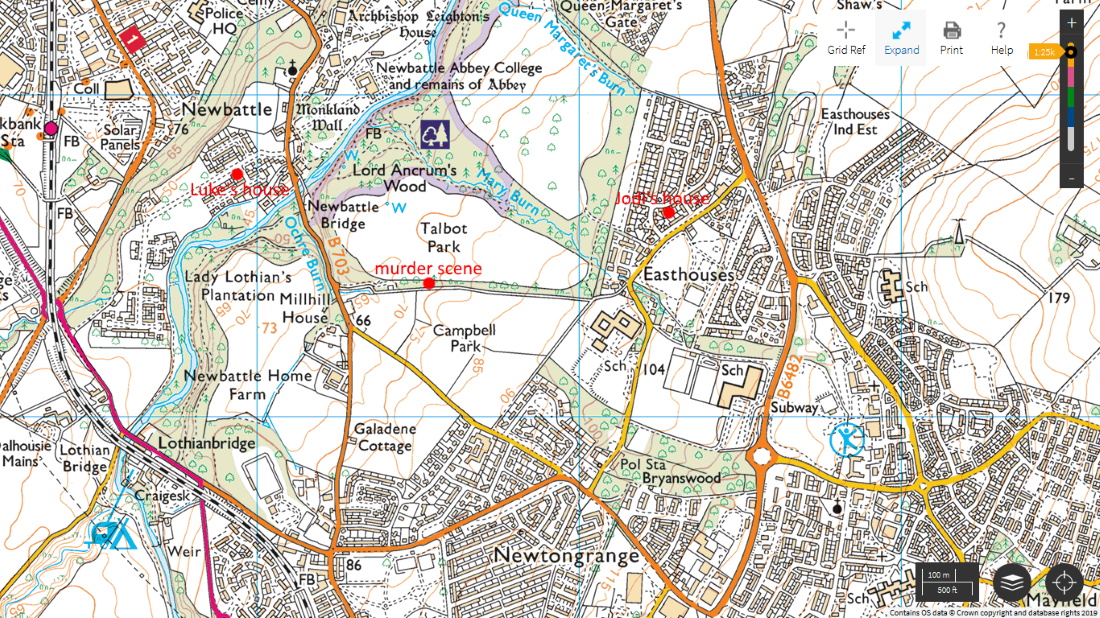
Here is the OS map of the area to aid comprehension. I have added points for Luke's house and Jodi's house. These are not exact as I only have street names not numbers and in particular that entire group of houses where Luke lived has the same street name (Newbattle Abbey Crescent). However it's close enough and gives a decent idea of the distances involved.

Roan's Dyke path runs west to east across the middle of the area shown. The murder scene is again approximate but close enough. The grid lines are 1 km squares.

map1.jpg
 
Last edited:
Now look at it from the other direction, driving north towards Easthouses.

https://goo.gl/maps/eYqPxmuHt7PPmxRB6

It's a bit different, isn't it? There's an indication of an entrance there, maybe, but an entrance to what? You can't see. Mrs Bryson didn't know Easthouses at all well. If she had seen a couple of people standing under that tree, how could she have known they were at the end of a footpath at all? It simply doesn't compute.


Actually it's even worse than I realised when I wrote that. Look again at the north-facing view of the corner, linked in the quote. "Under the tree" is wrong. The tree is in the grounds of the house that's almost out of frame on the left. The entrance you can see here isn't the entrance to the path at all, it's the paved driveway of the house. The narrow path entrance is just past the lamp post, this side of the brown close-boarded fence. You literally can't see it, even in this view, and if there were a couple of people standing right in front of it you'd see even less.

Not only that, the Streetview van has been on the southbound carriageway when that shot was taken, which gives a more favourable angle for seeing the path entrance. The only view I can find of the corner taken when the Streetview van seems to have been on the northbound side of the road (although it's more like the middle) is this one. https://goo.gl/maps/n5SDXZEbegc8cze58 (Remember, Yank comrades, we drive on the left here.)

Where's the path? The pale grey area is the driveway of the house. The path entrance is between the lamp post and the brown close-boarded fence. At this angle it's invisible. Again, put two people standing just the other side of the lamp post, and how could anyone who wasn't intimately familiar with the road and the path possibly have any idea there was a path there at all? (And that shot was taken in March when the trees and the beech hedge were bare. The June shot I linked to originally shows a lot more foliage, making the path even less appreciable.)

Mrs Bryson wasn't familiar with Easthouses. She didn't know the area. She got lost trying to find the house for sale. She was driving a car at perhaps 25 mph along that road, a car with her two young children in it. She was approaching a blind right-hand bend, and you'd imagine most of her attention would have been on the road. The two people standing by the lamp post weren't doing anything in particular. It's categorically impossible for her to have realised the people standing there were actually at the entrance to a path at all, let alone (as she was later drawn into stating) that she saw one of them walk ten yards down the path away from the road.

Unless there is some way I'm not aware of whereby Mrs Bryson's route from the supermarket to the for-sale house took her southbound on that road, she could not possibly have seen what she claimed to have seen at 4.53. The view she claimed to have had is only appreciable from a car travelling south, and as I understand it she was travelling south on her way home from the house viewing, not on her way to it. At about 5.40. Which is what she originally told the police.

There has got to be something I'm missing here. But what?
 
You know, Rolfe, I sometimes think you missed your true calling. You'd have made a marvelous barrister (ETA: or advocate, I see they're called in Scotland). :)
 
Last edited:
Nah, I would have made a terrible lawyer. I can't abide arguing for the sake of winning an argument rather than to establish the actual truth.

Even if there isn't a simple explanation for what I noticed here, it's of no practical use. It's not new evidence. That's the whole problem with the law. It's far more concerned with procedure and protocol than with establishing objective truth and righting wrongs.
 
You know, I suspect these white houses to the north of the path at the Easthouses end might be newer than 2003. That might just have been an open field at the time of the murder. It's also possible the roundabout is new since then. But I don't think it makes any real difference, it's the angle of the path to the road that's important. The only difference would be that the close-boarded wooden fence probably wasn't there and it would have been something like an ordinary wire-stranded field fence. But it wouldn't have made the path any easier to see.

I appreciate that the perspective from the Streetview camera can be very odd. However moving around and looking at different angles, and checking different time spots, usually clarifies matters. It could be deceptive though. My car is in for repair at the moment but when I get it back I might pop up to Easthouses and have a look at the actual location. It's only about 20 miles away.
 
Last edited:
Anyway, what about the other eyewitness sighting, which was back in Newbattle, to the west of the path?

This second sighting was important to the prosecution because it placed Luke closer to the western end of the path than he admitted to going in the early evening, and that he was lying about having remained in or close to Newbattle Abbey Crescent until after six o'clock.

This sighting was reported by two women, sisters-in-law, called Lorraine Fleming and Rosemary Walsh. They were again driving along a road, this time the B703 Newbattle Road, which bounds the western end of Roan's Dyke path. They were driving north, downhill towards Newbattle Bridge, and the path entrance would have been on the right.

Mrs Walsh said she arrived at Miss Fleming's house between 5.20 and 5.25, to collect her to go shopping. They drove down the hill past the end of the path, and Miss Fleming "pointed out someone standing by a wooden gate about 10 to 15 yards past the entrance to Roan's Dyke path."

The only gate I can see in the oldest Streetview image (2009) is on the left side of the road and is metal, but that doesn't really matter, let's assume that's where the women saw this person. The time of this sighting was said to be between 5.45 and six o'clock. If this is going to be represented as being Luke it would have to be a lot nearer 5.45 than 6.00, because Luke was definitely seen by witnesses who knew him by sight just before six o'clock, sitting on the low wall at the end of Newbattle Abbey Crescent, about 500 yards further along the road. That's about a five-minute walk, so Luke couldn't possibly have been close to the end of the path much after 5.50 if he was 500 yards away before six o'clock. Miss Fleming did estimate 5.45 for the sighting. (Quick note. It's 400 yards from the end of the path to Newbattle Bridge and another 100 yards from the bridge to the junction with Newbattle Abbey Crescent.)

This person is a slightly better shot at describing Luke than Mrs Bryson's but that's not saying much. The women got the age and build about right, but repeatedly said this youth had dark hair. (Sandra Lean says that a mistake in the hair colour was unlikely because it was a bright and sunny evening, but at quarter to six that gate would have been in the shade of the trees to the west of the road so that doesn't entirely compute.) The clothes are a problem though. This time something is described that might be a parka, jeans, and dark footwear. When Luke was seen sitting on the wall less than 15 minutes later he was wearing his green bomber jacket with the orange lining and distinctive light-coloured boots.

There's another odd wrinkle to this. The two women also said they saw a jogger on Newbattle Road, two hundred yards further on from the entrance to the path, running towards the bridge (that is the same direction as they were driving) away from the path entrance. They assumed the jogger would have run past the youth they saw standing by the gate. However, they were wrong about this. The jogger was traced, and she had never been south of the bridge. She had run north-east along Newbattle Abbey Crescent (the long street with the series of cul-de-sac housing developments where Luke lived) to the junction with Newbattle Road, where she turned left, away from the bridge. This was a regular training route for her and she was sure of it. She was also checking her times, and believed she was at the junction of Newbattle Abbey Crescent and Newbattle Road (exactly where Luke was sitting, but there is no record of whether she saw him) between 5.40 and 5.45.

So the two women must have seen the jogger north of the road junction, which is 150 yards north of the bridge, not 200 yards past the end of the path, which would be about 200 yards south of the bridge.

This introduces an intriguing possibility. If the two women were mistaken about the position of the jogger, as they were, putting her at least 350 yards further back (south) along Newbattle Road than she actually was - and possibly more than that - could they equally well have been mistaken about where they saw the youth loitering on the left-hand side of the road? Could they have driven past the end of Newbattle Abbey Crescent, seen Luke there, then passed the jogger some little way further up Newbattle Road, but in retrospect moved the whole thing back some 500 yards? (And simply got the hair colour and the jacket and the footwear flat wrong.)

If that was Luke, at the end of Newbattle Abbey Crescent, at about 5.45, he couldn't have been the murderer, as there simply isn't enough time for everything to happen and for him to get back to that spot only 30 minutes after the killing. Of course the police didn't want that to be the case, they wanted Luke that 500 yards closer to the scene of the crime and somewhere other than where his own statement placed him, so they weren't going to pursue that one.

Whether or not this is a possibility, it's clearly not a reliable sighting of Luke. The women didn't see the youth's face. Later, when Luke's picture was in all the papers they were telling each other "that's him!", but the statements describe not seeing the face because of the youth's hair.

It's worth pointing out that according to the two women this person wasn't walking along the road, he was "leaning on the gate". If that was Luke, half an hour after murdering Jodi and intent on covering up the crime, that's an extraordinary way to behave. The confirmed sighting of Luke just before six also described him as just hanging around.

So that's it. Actual probative value, zero.
 
Last edited:
Tremendous work Rolfe, thank you.

Are there key issues that make Steven Kelly somewhat implausible as the perpetrator?
Could it be a truly random attack as seems possible in the West Memphis 3 case?
 
Sorry, I've been talking with Chris by PM rather than posting in the thread.

First, Sandra says the anomaly about the direction of travel was noted and there is some bizarro-land explanation involving Mrs Bryson turning around and driving south on her way to look at the house. I need to get more details on this because it's insane. I now know where she lived and which supermarket it was and the whole thing is extremely peculiar.

There's no doubt that the simple direct route from anywhere in Easthouses to Mrs Bryson's house would go south down Easthouses Road. It seems that Mrs Bryson originally said she had seen the couple at that time. It's anybody's guess which route she might have taken to drive from the supermarket (the Co-op in Gorebridge) to Easthouses but it's a hell of a stretch to get her southbound on Easthouses Road at that point. The thing is, she came forward only the following day. You don't forget which route you drove as quickly as that, especially not if you realise it might be relevant to a brutal murder.

I'm sceptical about a stranger murderer. If Jodi for some reason had gone into the woodland strip of her own volition, it's a funny place for a mad slasher to be lurking I'd have thought. On the other hand I believe Janine when she said that Jodi wouldn't have gone over the wall with someone she didn't know. And the wall, even with the broken part, is too high to force her over. Of course that break in the wall isn't the only way into the woodland strip, there are other ways. We're assuming she was walking on the path to meet Luke when she was accosted, but that may not be the case.

I need to read more about Steven Kelly. Sometimes it's implied that his DNA might have got there by washing-machine transfer but other times it's stated flat out that his semen was on her t-shirt and bra. He was Janine's boyfriend. So far as I know he hasn't murdered anyone else! I wonder how common it is for someone who has committed a murder like that not to do it again even if they're not locked up?

I just can't get past the fact that his was the DNA that was found. The experts all say it would be extremely unlikely that the murderer's DNA wasn't on the body unless he'd been wearing a full set of overalls and maybe even a mask. So right now I'm wondering why it can't be him, and never mind the fairy-stories about "innocent transfer".
 
Luke's fingernail scrapings

"He co-operated fully. She checked for any injuries, and saw an abrasion on each of Mitchell’s shins. The more recent was between 24 and 48 hours old. Mr Findlay asked: "There were no injuries that had the appearance of being received in the previous 12 hours?"

Dr Hiremath said: "No."

She added that she had taken fingernail scrapings from Mitchell, which would be submitted for analysis to test for blood or other material." Scotsman
EDT
I realize now that I posted at least a portion of this before. However, it raises the question in my mind of who did have injuries in that time period. There is an article at the Sunday Times that indicates that scrapings were taken from Jodi, but it is behind a paywall.
 
Last edited:
From the article

Although many of Jodi’s clothes were torn off in the frenzied attack, there was no sign of a sexual assault. Jodi fought her attacker and fingernail scrapings, possibly containing tiny pieces of the attacker’s DNA, have been taken from her body. Her clothes, including her distinctive baggy blue top, have been sent for analysis in the hope that they will yield hairs, particles of skin or stains left in the struggle.
 
A serious difficulty with this case is that only Luke appears to have been treated as a suspect the whole way through. Right at the start, when the police arrived on the path where the search party were gathered, they separated Luke from the other three. They bundled him into a police car or van and whisked him off to the police station even before his mother caught up with what was going on. By the time she reached the police station he had already been stripped and put into a paper suit and all his clothes confiscated.

Meanwhile the rest of the search party was taken to a different police station, treated in a much less aggressive manner and allowed to go home without their clothes being taken or any intimate examination or sampling. Since both Alice and Steven had been over the wall and Alice actually touched Jodi's body then their clothes ought also to have been taken and their bodies sampled for evidential purposes in case they had picked up something significant. It was some time later (a week?) before they were asked to hand over the clothes they had been wearing and mostly these had been washed. There also seems to be some confusion over what Steven was actually wearing at the time.

And I was going to write a lot more but I got sucked into Twitter, as one does. Later. :slp:
 
Professor Busuttil

Here is a link to a forum in which this case was discussed in 2011. There are some newspaper articles which are quoted and linked. For example from the Telegraph:

"Donald Findlay QC, defending, asked if Jodi's injuries suggested she had "fought literally to the death". Prof Busuttil said: "Indeed so, yes." Mr Findlay pointed out that when a doctor examined Mitchell, "not a bump, scratch, bruise or abrasion" was found which could be linked to the time Jodi died. "That is so," agreed the professor."
 
Thanks for that link Chris. One thing I picked up from that is that they did run a "special defence of incrimination" at the appeal, but based on Mark Kane and James Falconer, not Steven Kelly. It seems to have been rejected because no trace of either man's DNA was found on Jodi's body. But there was no trace of Luke's DNA on Jodi's body either. And because Falconer had given an "innocent explanation" for the presence of the condom nearby. But Luke gave innocent explanations for everything they accused him of, and they just didn't believe him.

I had wondered why they didn't run a special defence of incrimination against Steven Kelly, but it may be that there wasn't enough evidence. Of course if Steven lied to the police about his whereabouts and the police simply believed him, that would make it difficult. Hard to disprove an alibi years later if the police didn't check its veracity at the time.

What is often not appreciated about a special defence of incrimination is that it is not necessary to prove that the person did it, or even to prove that the evidence against the other person is stronger than the evidence against the accused. All that is necessary is to prove that there's a non-negligible chance that the person did it, which is (officially) deemed to demonstrate reasonable doubt and so justify an acquittal. But it's probably harder to do it at appeal than at the primary trial.
 
too many suspects

At the discussion board to which I linked, Sandra wrote, "His story would also involve him having had to step over the body twice, without noticing it."

Northern Lights quoted the Edinburgh News in part:

"The former drug user, who was on a course for recovering drug users near where Jodi's body was found in 2003, reportedly handed in an essay titled Killing a Female in The Woods to his course tutor three weeks before the murder.

It is reported he was also a regular visitor to the woods where Jodi was killed, and on the day after the murder he had scratches on his face and arms but could not remember how he got them."
 
I'm not sure yet about the stepping over the body part. It depends on what time Falconer was there, and what time Jodi was actually killed. The simple deduction for time of death is only a little bit later than the police time. She left her house to walk to Newbattle to meet Luke, and the actual time of leaving was a minute or two after five o'clock. However this was too late for Luke to have been the killer and the police pushed her time of leaving back to about ten to five, and manipulated Mrs Bryson's evidence to corroborate that. At least, that's how I read it at the moment.

The police assumed she had walked (with Luke) along the path towards Newbattle and in the course of that journey he persuaded her to climb the wall into the woodland strip and then attacked her. However Luke says he never left Newbattle, and he was waiting there for her to arrive. In this scenario she walked along the path alone. Since she never arrived at Newbattle, and there is no witness to her having been anywhere else in the vicinity after she was seen leaving home, logic says that somehow she encountered her murderer on the path or in the woodland strip at that time. That would put the time of death around 5.30.

However there is no forensic evidence corroborating that time of death. It's not impossible she went somewhere else before starting to head for Newbattle. In that case we'd be looking at a later time of death. It's not that good a theory because she knew Luke was waiting for her. But on the other hand she didn't have a phone on her to tell him if something else had come up, and she was a 14-year-old girl. I say this because, supposing Falconer wasn't involved at all, and genuinely saw nothing while he was in the wood, we have to consider that there was nothing to see at that time. I don't yet know how sure we are about the time he was there, either.

The condom was found fifty yards from Jodi's body and none of Falconer's DNA was on the body itself, so logic seems to suggest that at the very least he wasn't the sole perpetrator of the murder.
 

Back
Top Bottom