• Quick note - the problem with Youtube videos not embedding on the forum appears to have been fixed, thanks to ZiprHead. If you do still see problems let me know.

Lockneed breakthough in fusion reactors.

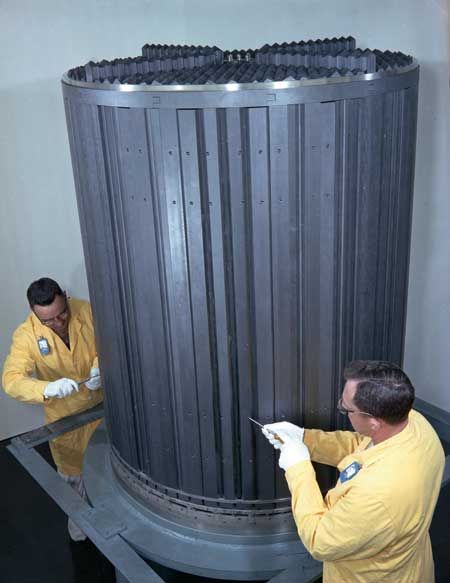
I think the implication is like a smaller version of a fission reactor core.

[qimg]http://i106.photobucket.com/albums/m269/macdoc/MSRE_Core-2_zps71c1eb3a.jpg[/qimg]

http://en.wikipedia.org/wiki/Nuclear_reactor_core

Without the radiation shielding - nukes could be quite small. It is really the scale down aspect I find the most intriguing

Cooling tho is another issue.

Fusion systems produce a lot more neutrons and gammas than fission systems. A fusion system generally requires more shielding than a fission system and tends to create a lot of waste due to the high neutron fluxes generating a lot of hot isotopes in the structural and operational materials of such reactors. You don't have a lot of "waste" in the fuel system, but you have a lot more waste in the structural and operational materials system. By some calculations, a fusion system is only good for about five years then it will have to be carefully deconstructed in a sealed environment to separate out the "hot" isotopes and a new core and heat exchanger will have to be installed. There are aneutronic fusion systems but this doesn't appear to apply to the Lockheed system.
 
Last edited:
Fusion systems produce a lot more neutrons and gammas than fission systems. A fusion system generally requires more shielding than a fission system and tends to create a lot of waste due to the high neutron fluxes generating a lot of hot isotopes in the structural and operational materials of such reactors.

Wait, what... wasn't it the opposite ?
 
Wait, what... wasn't it the opposite ?

I do not think so. Fusion produces a lot of neutrons which contaminate anything close by. But the products of the reaction themselves are not radioactive. On the other hand only a small amount of fuel (measured in grams not kilograms) is used so not sure how serious a problem neutrons would be in a fusion reaction.
 
I do not think so. Fusion produces a lot of neutrons which contaminate anything close by. But the products of the reaction themselves are not radioactive. On the other hand only a small amount of fuel (measured in grams not kilograms) is used so not sure how serious a problem neutrons would be in a fusion reaction.

More than you could ever want to know about such things here:

http://fusedweb.pppl.gov/faq/section2-energy/part2-enviro.txt

Radioactive waste in a fusion reactor can be minimized by choosing special structural materials which can withstand neutron bombardment without becoming highly radioactive. Two strong candidate "low-activation materials" are vanadium and silicon-carbide. Vanadium will be tested as a structural material on the TPX tokamak to be built at Princeton. If either vanadium or silicon carbide is used as a structural material, the radioactive inventory of a fusion reactor will be much less than that of a fission reactor with comparable power output. In fact, with a low-activation fusion reactor, one can wait ten or so years after shutdown, and the fusion reactor will be 1,000 to 1,000,000 times *less* radioactive than the fission reactor. The material in the fusion reactor will actually be less radioactive than some natural minerals, particularly uranium ores, and it would conceivably be safe to *recycle* the fusion reactor structure into a new fusion reactor, with little permanent waste at all. In these circumstances one must compare the problems and hazards posed by permanent *chemical* wastes from manufacturing and operating other energy sources with the problems and hazards posed by fusion energy.
 
I do not think so. Fusion produces a lot of neutrons which contaminate anything close by. But the products of the reaction themselves are not radioactive. On the other hand only a small amount of fuel (measured in grams not kilograms) is used so not sure how serious a problem neutrons would be in a fusion reaction.

Compare units not weight.

One mole of fusion fuel is a few grams (4-10 depending upon fusion scheme).
One mole of fission fuel is around a quarter of a Kg (dependent upon metal used).

Each unit gives off an approximately similar amount of neutrons, and this comparison doesn't include the gamma emission considerations.
 
More than you could ever want to know about such things here:

http://fusedweb.pppl.gov/faq/section2-energy/part2-enviro.txt


I wouldn't call the information in this quoted section "wrong," but it is more than a little misleading and, being generous, more than a little "overly optimistic" in presentation.

I support Fusion (and Fission) power, and many of my own resources tend to post optimistic pictures for such, but it would be disingenuous and counter-productive, IMO, to fawn over such technologies without presenting a realistic perspective of the downsides of such technologies along with the potential upsides.

FUSION AS A FUTURE POWER SOURCE: RECENT ACHIEVEMENTS AND PROSPECTS
http://www.worldenergy.org/wec-geis...pers/18th_Congress/downloads/ds/ds6/ds6_5.pdf

picture.php

According to this reference, fission and fusion power systems produce roughly the same order of magnitude of radioactinide wastes (volume) though they both tend to contain much higher amounts of short and mid-term "Hot" isotopes. For Fission products many of these isotopes have much longer half-lives, meaning that they remain problematic for thousands/tens-of-thousands of years (unless they are "burnt" in other types of reactors). Fusion spawned actinides tend to be very "hot" but, much shorter half-lived isotopes. so while over the course of 50 years the Fusion radioactinides may lose 2.5 orders of magnitude (~1011Sv -> 108.5Sv) from their initial strength, the rate of decline slows considerably after that taking some 500 years or so before they drop to the level of coal ash, which is considered by many experts to be a dangerous and radioactive waste product.

The point here is not that fusion is undesirable or unnecessary, merely that it comes with its own problems and is not an energy panacea. Special materials can extend the useful lives of fusion systems, but they add expense and do not even double the life. A sealed mine where trailer mounted units could be parked for 50-100years would reduce the hazards of ultimately deconstructing and cleaning-up or recycling the cores and neutron absorbing tritium breeder systems. Or, like fission waste, a system could be set-up to separate out the shorter half-life actinides and "burn" them, but these are additional issues that need to be considered and discussed in association with such systems, not something that should be swept under the carpet or left unacknowledged by those promoting these technologies for more widespread application.

 
The interesting figure is coal ash and that does not include the other heavy metals and contaminents that site piled up washing into the water table.

I find it ironic the anti-nuke crowd don't quite get that coal plants are radioactive sources entirely unregulated for that aspect.
 
Last edited:
The interesting figure is coal ash and that does not include the other heavy metals and contaminents that site piled up washing into the water table.

I find it ironic the anti-nuke crowd don't quite get that coal plants are radioactive sources entirely unregulated for that aspect.
That being so, I've sometimes wondered about the fact that steel from the German vessels scuttled in Scapa Flow in 1919 can be used as "low background" metal. These ships had been propelled by burning coal for many years. See http://en.m.wikipedia.org/wiki/Low-background_steel
 
Last edited:
The interesting figure is coal ash and that does not include the other heavy metals and contaminents that site piled up washing into the water table.

I find it ironic the anti-nuke crowd don't quite get that coal plants are radioactive sources entirely unregulated for that aspect.

Fully agreed, even if we locked the doors on every coal-fired power plant in the nation today, they would leave a massive, toxic and radioactive mess behind that will take centuries to address (and this doesn't even begin to look at the externality costs of purging the fossil carbon from the environment).

Take a look at those emission amounts, for the coal ash, they are listing something in the range of 7x10⁷ Sv.
100rem=1 Gray = 1 Sievert = 1 joule/kilogram, a sievert represents the equivalent biological effect of the deposit of a joule of radiation energy in a kilogram of human tissue.
By comparison the average chest x-ray = 0.004 rem (0,00004Sv)
Epidemiological studies on populations exposed to radiation have shown a significant increase of cancer risk at doses above 100 mSv (0.1 Sv).
 
Last edited:
I wouldn't call the information in this quoted section "wrong," but it is more than a little misleading and, being generous, more than a little "overly optimistic" in presentation.
<SNIP>
Thanks, Trakar.

I thought someone might say that about the info on the site I quoted. :D

I was going to note that it was from 1994 but figured there would be someone here who was somewhat more up to date. :cool:
 
Thanks, Trakar.

I thought someone might say that about the info on the site I quoted. :D

I was going to note that it was from 1994 but figured there would be someone here who was somewhat more up to date. :cool:

No harm or foul intended on either side, I'm sure (BTW, I have nothing but respect and admiration for the Princeton Plasma Physics Laboratory).
 
I'm TOTALLY skeptical about Lockheed's announcement. Given the track record of controlled-fusion development, I'll believe it when I see it.

There's also the problem of fueling a fusion reactor. One needs nuclides that have a low atomic number to keep their electrostatic barrier from being too high, and one needs fairly common ones, ones whose extraction will not consume more energy than fusing them will release.

Deuterium, H-2, is about 10-4 of the Earth's surface's hydrogen. If one can get 1 MeV per deuteron, then extracting it ought to cost less than 100 eV per hydrogen atom.

Here is how much energy that one can get:
Nuclear Fusion, Nuclear fusionWP:
H-2 + H-2 -> He-3 + n + 3.27 MeV
H-2 + H-2 -> H-3 + p + 4.03 MeV
H-2 + H-3 -> He-4 + n + 17.59 MeV
H-2 + He-3 -> He-4 + p + 18.3 MeV

Deuterium alone isn't that good because fusing it has only a small probability of making He-4, which is much more tightly bound than H-3 or He-3. But the raw materials for He-4 have big problems. H-3 is radioactive with a half-life of about 12 years and He-3 is very rare. One could make H-3 and He-3 by irradiating lithium with neutrons, however.
 
Something with a few more details that also came out this month:

http://en.wikipedia.org/wiki/Dynomak

I have no idea of its feasibility, but it seems more open to inspection of the claims than the Lockheed version.
Considering the modest nature of current claims, no inspection is required.
Current results as of the Innovative Confinement Concepts Workshop in 2014 show performance of the HIT-SI high Beta spheromak operating at plasma densities of 5E19 m-3, temperatures of 60 eV, and maximum operation time of 1.5 ms. No confinement time results are given. At these temperatures no fusion reactions, sustainment, alpha heating, or neutron production is expected.
 

Back
Top Bottom