Lockerbie: London Origin Theory

Maybe the steel frame joined the two other pieces together. If this was the case, the Thomas and Coursey were probably positioned on app. the same height. The Thomas on top of the tourister and the Coursey on top of the Carlson and McKee. We will see. For the moment this is speculation.


I'm trying to get the relevant pictures. Hopefully tomorrow.

I was thinking maybe the Coursey on top of the Tourister and the Thomas on top of whatever was on top of the Bernstein suit carrier - possibly Walker. Bearing in mind that the blast was very much coming from the left. I thought perhaps one of the four cases I listed above was on top of the Tourister, and the other three were stacked on top of the suit carrier. But you're right, the luggage on top of the back row could be in the frame too.

Sorry, this makes no sense. In order to fill the second layer on the back row completely handles have to point to the left or right.


My own thought was that the containers were too narrow to take three cases abreast, in that orientation, so they'd have continued with the loading pattern in the same orientation as the other vertical stacks.

However by the time you get up to the level of the top of the upright cases, the container is indeed wider, with the overhang having opened out. So possibly you're right. I think it would require the angle to the left of the Carlsson case to be filled with holdalls first though.

In that case we don't know. Sidhu said he put the cases on top of the upright row flat. I don't think he said anything about which way round he put them.

http://www.vetpath.co.uk/lockerbie/faiday17.pdf

Rolfe.
 
Last edited:
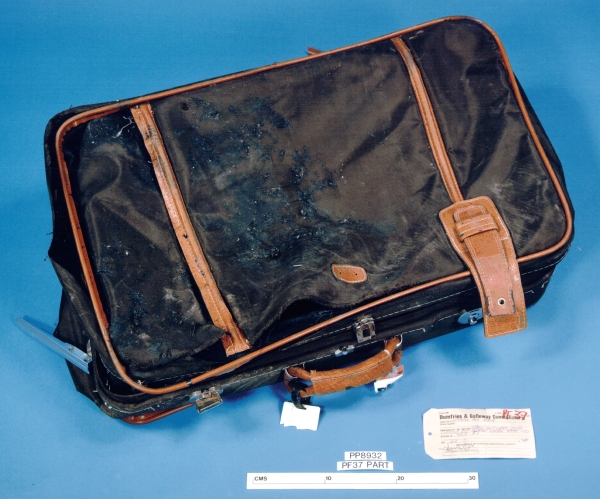
Bits of the tourister were found in the McKee. See Hayes notes in post #758


Oh, I had overlooked that. Not unexpected. Unfortunately he doesn't say whereabouts in the case these bits were found. I suspect near the top.

Rolfe.
 
LittleSwan, how far do you think this takes us? I appreciate we haven't seen the photographs yet, but unless there's something extraordinarily surprising there, I can't see how the evidence of explosive interaction with so many Frankfurt-origin bags can possibly be consistent with the Coyle case having been on the floor of the container and blasted down from above.

I suppose this doesn't, in itself, prove a bottom-level explosion. You could still argue that the bomb could have been on the second layer and the Coyle case on the third. However, in the context that there is now no evidence to counter Sidhu's claim that he didn't move the original cases, and that no fragments have been recovered that are consistent with an innocent case which was under the bomb, and that the case which was seen in that position was the mysterious brown Samsonite, it's really unarguable I think.

I know you're a stickler for absolute accuracy and absolute certainty though, so I would appreciate your thoughts.

Rolfe.
 
At the Fatal Accident Inquiry Mr Bedford is asked, " Were there any people other than you and Mr Kamboj who could have put suitcases in container AVE4041 to your knowledge?"

"YES, SIR."

" Who were those persons?"


"ANYONE THAT WORKS IN THE AIRPORT"


[ my CAPS ]
 
I'd like to know more about what Kamboj and Parmar were doing while Bedford was on his break. Hopefully I'll get the right day of the FAI transcript within the next few days. With any luck someone asked them.

But you're right, that is one hell of an admission, and not contradicted by any of the other baggage handlers either. And everybody just ignored it and blamed poor Malta, where you'd practically have to be Sue Storm to get anything past their system.

Rolfe.
 
I know you're a stickler for absolute accuracy and absolute certainty though, so I would appreciate your thoughts.

No, I'm not but I don't feel comfortable drawing conclusions by looking at not-so-good pictures and second-hand information.

"ANYONE THAT WORKS IN THE AIRPORT"

Airport security.... it's a good idea.:D
 
Last edited:
Do you want the good news or .... the even better news?

I have the photos, and all the forensics reports from both Hayes and Feraday. Or so I'm told. Actually I have a memory stick in my pocket. I'll look at it when I get home.

That's the good news. The even better news is that I have a promise of the results of the Indian Head tests, within a few days I hope. (My contact says he actually had a video of the Indian Head tests, which he describes in very scathing terms, but he doesn't know where it is now. But he does have the results.)

My contact is working on a completely separate line of inquiry, which has led him to evidence indicating that the bomb was introduced at Heathrow, and the midnight break-in was part of it. I can't get my head round most of that, but there's a thing. When you're on the right track, different lines of inquiry tend to start pointing in the same direction.

Rolfe.
 
No, I'm not but I don't feel comfortable drawing conclusions by looking at not-so-good pictures and second-hand information.


I know what you mean. I'm in a slightly different place on this. JFM is currently trying to get the Scottish authorities to appoint an independent body to investigate our allegations - which are several, but include the allegation that the bomb was introduced at Heathrow, that the original investigation deliberately turned a blind eye to that in 1989, and that when the Crown realised in 1999 that this was what had happened they stuffed a few critical pieces of evidence down the back of the sofa and made up a fictitious story about the Heathrow suitcases having been moved to allow them to proceed with the prosecution of two innocent men.

So for my purposes, these do not need to be definite conclusions. Definite conclusions are good, but very plausible assertions will do. It is for the independent body doing the investigating to decide what can and can't be definitely proved form the evidence.

As such, a plausible assertion that the condition of PD/889 indicates a floor-level explosion (dammit, Hayes even indicated that on the sketch, himself), and that the condition of the Frankfurt interline luggage indicates that the Coyle suitcase was blasted upwards from underneath, will do nicely.

In fact, neither of these things have to be certain at all, in the end. They merely have to be reasonably possible. Because, if they are possible, there is nothing at all to suggest that Sidhu should be called a liar when he repeatedly said he didn't move that luggage.

Airport security.... it's a good idea. :D


Yes. The management of Luqa airport knew that. They also did something about it. Which resulted in, among other things, a lost luggage rate that was a fraction of that being turned in by other airports. Wilfred Borg spent hours on the stand at Zeist explaining what a good system they had, and how they had proof there was no extra unaccompabied item on KM180 that morning.

Then at the end, when asked if he could then say that it was absolutely impossible to circumvent that system, he had to say (obviously) that nothing was that perfect. Of course nothing is that perfect. I could think of about three ways to circumvent it myself. But I cannot think of a way in which it could be done, and then leave behind no evidence that it had been done at all. No matter, the judges just said, OK, it could have happened then, thank you Mr. Borg.

Meanwhile everyone is lining up to admit that Heathrow security was essentially non-existent. Worse even than Frankfurt, which itself was nothing to get excited about. And nobody pays a blind bit of attention.

Rolfe.
 
Last edited:
Hell's bells, I have too much stuff here. LittleSwan, you better ask for a leave of absence or call in sick or something.

I'm not sure how to get all this to you. There's more than can reasonably be transferred via the internet, or by email attachment I suspect. In total there is 1 Gb of data on the stick. I'll have to try to be selective and pick out the most important things for starters.

Oh, and that bloody photograph 65 only has the part of JDG/2 which is the Thomas suitcase. The other two bits are missing. We need a photo of the whole of JDG/2, don't we.

(That last I know because John sent me the photos just about an hour ago. I've just sort of scanned round the memory stick with my jaw on the floor.)

Rolfe.
 
Last edited:
LittleSwan, I tried picking out the really relevant files from the stick, and zipping them. Still close to a gigabyte. I think the pictures are high-resolution. It would take 7 or 8 hours to upload by ftp. Not sure how to play this. The stuff is absolutely stellar - exactly what you want.

I also got these eight photos by email from John. I've resized them so we can discuss them in the thread.

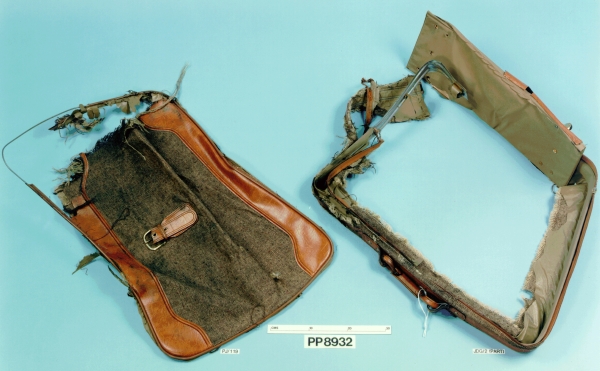
Photo 63, Coursey. [full-size file]

63coursey.jpg


Photo 65, Thomas [full-size file]

65thomas.jpg


Annoyingly, that is only part of JDG/2, the Thomas part. We can see the Coursey part in the previous picture. Presumably the third piece is that wire-like part of the Coyle case, but so far I have no photograph of all three parts of JDG/2 in their original, associated form.

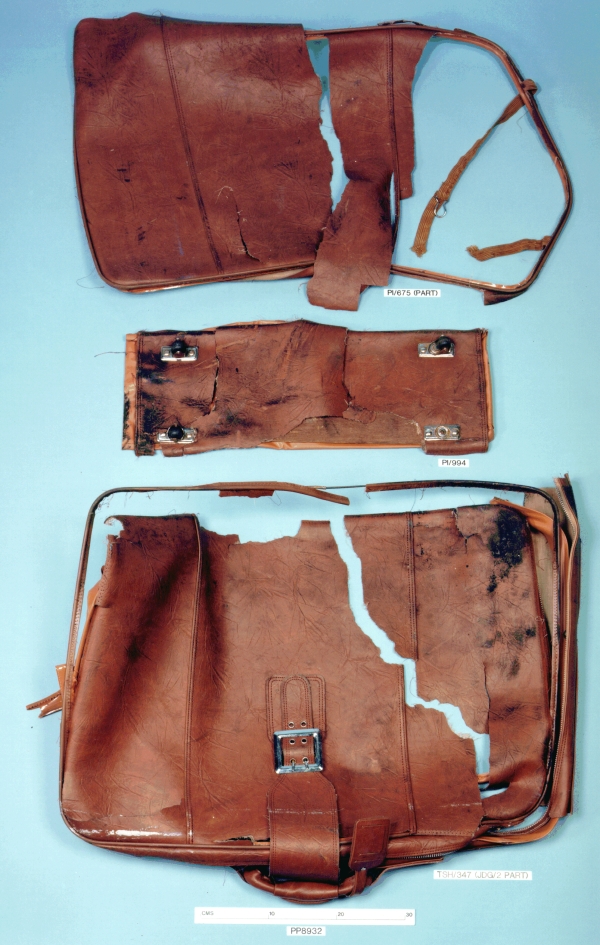
Photo 69, Carlsson. [full-size file]

69carlsson.jpg


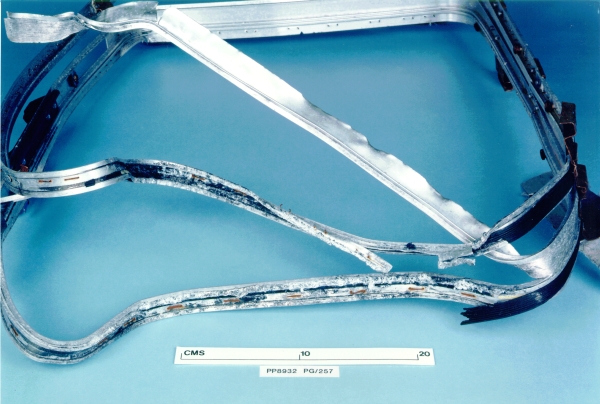
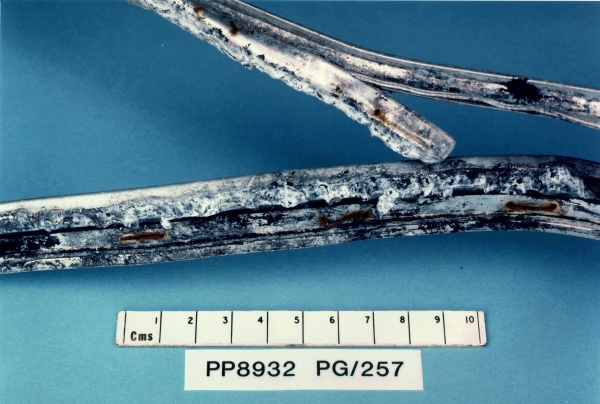
Photos 70 and 71, Carlsson in ever-greater close-up. [full-size file] [full-size file]

70carlsson2.jpg


71carlsson3.jpg


This is very interesting indeed. Clearly, it was right behind the bomb exactly where Bedford said he put it. At first sight I'd say it's ambiguous as to the level of the explosion, but in my view it's exactly consistent with the bomb suitcase being the lowest one in the front stack, but its left-hand side being raised up into the angle. LittleSwan will doubtless critique this biassed assessment! :) (I have even more detailed thought about how I think the bomb suitcase impacted with this thing, but I'll wait and see if LittleSwan comes up with the same thing or not.)

Photo 73, said to belong to George Williams, according to John. [full-size file]

73williams.jpg


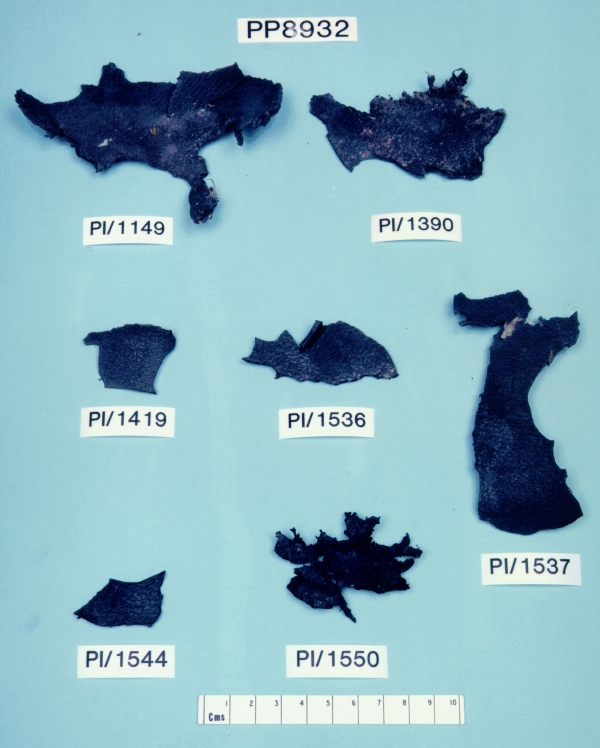
This is the group of fragments LittleSwan thought might be more of PD/889, the McKee case. I still think he's right. How could they have identified such tiny fragments to anyone? (We need to check up on how that was done.) And the material is very consistent with the McKee case, and there should be some smaller bits of McKee case as there are with the Carlsson case and the Coyle case.

If this is really all that remained of one case, it's anomalous. Why so few pieces, when there was so much of the Coyle case and the primary suitcase? If this is another case, it's a candidate for a second "secondary suitcase", although it was specifically stated in court that there was no secondary suitcase.

I will be interested to see what LittleSwan thinks about this.

Photo 85, Schauble. [full-size file]

85schauble.jpg


Photo 88, Walker. [full-size file]

88walker.jpg


I was going to upload the full set of Hayes's notes as well, but the system promptly announced more than an hour's worth of upload. Not tonight anyway. This is clearly a problem.

Rolfe.
 
Last edited:
Interesting stuff

(I have even more detailed thought about how I think the bomb suitcase impacted with this thing, but I'll wait and see if LittleSwan comes up with the same thing or not.)

I know what you mean (the bending pattern of the frame?) Well, start measuring then.:)

Photo 73, said to belong to George Williams, according to John.

No, see my post #767

The Schauble case is intriguing me. What you see is molten, partially charred plastic. The suitcase itself doesn't look severely damaged. I still think this one was on the third or fourth layer above the blue tourister. Resolution is poor, so I can't see any blue bits on it.

This is clearly a problem.

Maybe it's possible to use an uploader (for example Zeta-uploader)
 
Last edited:
Yuk, I'm a zombie. The reason I was posting so late last night is that we had a sudden fall of snow yesterday afternoon/early evening, and the roads were bad. As I neared the top of the brae on the way home, having passed several vehicles (mainly lorries) that couldn't make it up the hill, I came upon an accident that had only just happened. There had been a more-or-less head-on crash, and the two cars were completely blocking the road.

Nobody was seriously hurt, thanks to air bags and a safety barrier at the side of the road, but it took over two hours to get an ambulance to the rather shocked elderly passengers and get the road cleared. Two hours I spent with a slightly hysterical grandmother in my car, telling her that nothing mattered so long as nobody was seriously hurt and all the usual stuff. (She and her husband had been visiting their daughter in London, and their son had flown down to take the wheel and drive his parents home. Four hundred miles, then in the dark and the snow only ten miles from home, he was going just a wee bit too fast and touched his brakes at the top of the hill, and bang.)

Well, let's hear it for winter tyres, because as soon as one smashed car was out of the way I just put mine into gear and drove home. I think half the stuck cars were well and truly stuck by then, having been stationary in falling snow for two hours. But I got home really, really late, with that memory stick burning a hole in my pocket, and the rest is history.

Rolfe.
 
Interesting stuff

I know what you mean (the bending pattern of the frame?) Well, start measuring then.:)


When I saw the first of the three pictures I thought, is that not more like a second-layer explosion? Then I saw the second one and it became a lot clearer.

The case has certainly been in exactly the position Bedford said he put it, behind the left-hand side of the bomb suitcase, right behind the bomb. (John's email contained some sarcastic remarks about Patrick Haseldine's assertions that case actually contained the bomb. Patrick is (a) complete looney-tunes, and (b) unaware of these photographs. And he'd probably just declare they were all faked if he saw them.)

My interpretation of that bending is this. I believe the bomb suitcase was originally resting near the bottom of the Carlsson case, but not absolutely flat on the floor. That is consistent with the theory that the bomb suitcase was on the bottom layer but had slipped a couple of inches or so to the left during the flight (or had originally been placed partly within the overhang).

The force of the explosion has forced the handle-side of the bomb suitcase obliquely UP against the side of the Carlsson case, bending it progressively inwards, until the contact has been disengaged as the hull ruptured and the luggage began to fall away.

Does that fly with you?

No, see my post #767


Ah, yes, I see, John has simply repeated the erroneous attribution I found in the reconciliation notes. So if it wasn't Williams, and obviously it wasn't, what was it? I think it has to be the small stuff from PD/889, exactly as you postulated.

The Schauble case is intriguing me. What you see is molten, partially charred plastic. The suitcase itself doesn't look severely damaged. I still think this one was on the third or fourth layer above the blue tourister. Resolution is poor, so I can't see any blue bits on it.


Have you clicked on the link to the full-size file? That has pretty good resolution, and I think I can see blue bits. In fact, I think I can see blue deposit on a good half of the flat surface of the lid. Unless the black has become discoloured to blue in the explosion. Except - it really is awfully blue, and there's some on the tan leatherette trim as well. If I'm right about that, then that case (lid-down) was flat on top of the Coyle case without any doubt.

Hell's bell's, LittleSwan, the closer I zoom, the more it looks like a blue deposit on top of the black fabric, in the most damaged parts. I know it's not that badly damaged, but the explosion seems to have dissipated fairly locally, and that blue is extraordinarily striking. However, if the Schauble case was right on top of the Coyle case, I'm not quite sure how the wire frame part of the Coyle case managed to get mixed up with the Thomas and Coursey cases.

Please have a look at the .tiff file and tell me what you think.

ETA: Having re-read Hayes's evidence, I note he says the Schauble case was olive-green, although I have to say it looks black to me in the photo. And he does not mention a blue deposit over the lid. So I suppose that must be discoloration of the very dark olive green to blue. Odd, though.

One thing I think we have to bear in mind is how far to the left the explosion was, even in relation to the luggage in the left-hand stack. Given that the explosion was right into the overhang, it's perfectly possible that even left-hand-stack items are going to show damage as if from a blast coming at them from the left-hand side.

Maybe it's possible to use an uploader (for example Zeta-uploader)


I've sent you a PM. I think we just do the FTP transfer, if you're amenable to a biggish FTP download.

Rolfe.

 
Last edited:
Yuk, I'm a zombie. The reason I was posting so late last night is that we had a sudden fall of snow yesterday afternoon/early evening, and the roads were bad. As I neared the top of the brae on the way home, having passed several vehicles (mainly lorries) that couldn't make it up the hill, I came upon an accident that had only just happened. There had been a more-or-less head-on crash, and the two cars were completely blocking the road.

Nobody was seriously hurt, thanks to air bags and a safety barrier at the side of the road, but it took over two hours to get an ambulance to the rather shocked elderly passengers and get the road cleared. Two hours I spent with a slightly hysterical grandmother in my car, telling her that nothing mattered so long as nobody was seriously hurt and all the usual stuff. (She and her husband had been visiting their daughter in London, and their son had flown down to take the wheel and drive his parents home. Four hundred miles, then in the dark and the snow only ten miles from home, he was going just a wee bit too fast and touched his brakes at the top of the hill, and bang.)

Was their luggage stacked correctly in the boot with a Brown Samsonite on the bottom?
 
You're obviously thinking of Hafez Dalkamoni's Ford Cortina, when it was stopped by the police in Neuss in October 1988. An understandable confusion.

Rolfe.
 
Last edited:
[Undelete, as it were....]

Nope, sorry, I still think the Schauble case was on top of the Coyle case. It's got multiple penetration marks over the greater part of the surface of the lid, indicating that it was lid-on to the blast, and that whatever was between it and the blast more or less disintegrated. Yes, it's more damaged on one side than the other, but the blast was coming from the extreme left-hand side anyway. I'm more surprised that the damage to the Coyle case isn't more obviously asymmetrical.

I'm just utterly confused about the colour. The photogaph looks to me like a black canvas suitcase with tan leatherette trim, which has a pronounced blue deposit all over the most damaged parts of the lid, including on some of the tan leatherette trim. But here's Hayes's version.

Thomas Hayes said:
This is an olive green canvas softshell suitcase. [....] The suitcase [....] was constructed from a woven olive green canvas cloth backed with soft black plastics with a simulated leather finish and lined with a black cloth. The suitcase was trimmed with tan-coloured simulated leather and a similar soft handle [....]. The top surface of the suitcase lid, base and left-hand edge bore explosion damage, showing evidence of minor disruption, penetration holes, blackening and extensive deposits of partially carbonised fibrous materials.


If that is olive-green, it's hellish dark olive-green, and he still must have better eyes than I have. Or there's something very strange about the colour reproduction on that photograph. And if that blue colour isn't from a case that was heat-blasted against it, where did it come from?

ETA: It's Hayes's "extensive deposits of partially carbonised fibrous materials" that I'm talking about, it seems. They're BLUE, man.

Rolfe.
 
Last edited:
A couple of extra thoughts here.

I wonder if the bit of the Coyle case that was part of JDG/2 might have been the largest piece, not the piece I originally thought it was? I note that the parts of JDG/2 which are included in the Thomas and Coursey photographs are identified as such, but there is nothing labelled as JDG/2 in the Coyle photograph. Nevertheless the largest piece, although it has "PG/193" written in by hand, is labelled "TSH/346" on its printed label. The part of JDG/2 which is in the Coursey photograph is also identified as "TSH/347". I hope we can get a photo of JDG/2 as it was when they decided to give it a number of its own. (I don't know when that was, it's slightly odd that it's not a P number.)

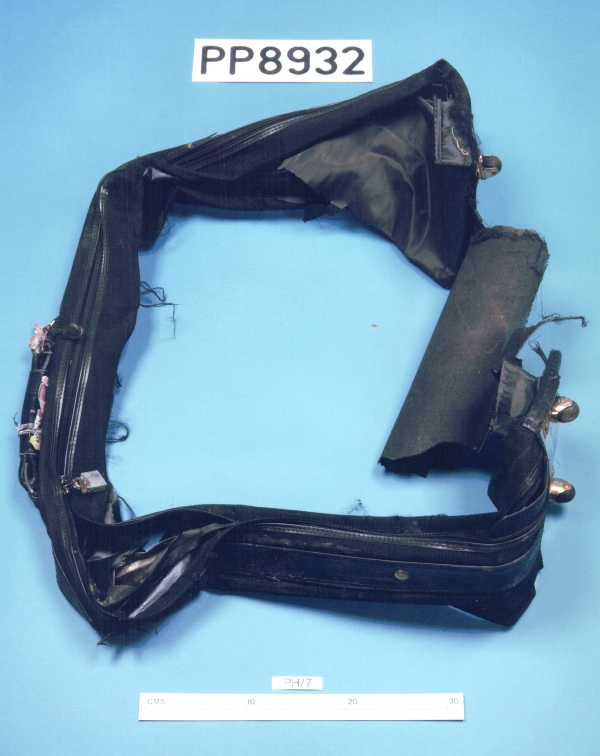
The Carlsson case. The way it is twisted makes it less easy to gauge the height of the bomb suitcase in relation to its side panel, although once you realise where the corners originally were it can be seen that the damage does actually start at the bottom. However, that lining panel shown at the top of the picture. It looks to me like the lining of the hinge end of the suitcase, which has been a discrete panel of fabric. The way that is blast-damaged at one side sure as hell looks like the result of a bottom-layer explosion to me.

Rolfe.
 

Back
Top Bottom