Rolfe
Adult human female

LittleSwan, I've been asked, "prepare a list". What can you think of that would be useful?
Rolfe.
Rolfe.


Q The first of these is 4.2.1, described as an American Tourister, tan softshell suitcase.
And could we have on the screen -- you can close 49 and open photograph 59.
The report tells us that the three recovered pieces of the suitcase are shown collectively in photograph 59. And the first item that’s referred to is PG/43.
A Yes, sir.
Q And we see it as the bottom item in the photograph?
A It is correct, sir.
Q Would you read the report on that item.
A “PG/43, labelled as the remains of brown case powder-marked name tag, L. Bennett.
[2378]
“This is the major part of one side and the frame of a tan-coloured softshell suitcase. It is clear that the suitcase originally measured approximately 610 millimetres by 430 millimetres by 150 millimetres and was fabricated from a soft tan-coloured plastics, having an external simulated leather finish, lined with a woven unpatterned orange fabric adhering to the plastics skin. To the front edge of the suitcase was fixed a metal tag printed with an American Tourister logo. To the soft plastics handle was attached a Pan Am plastics identification label on which was printed “Mr. Lawrence Bennett 02242971W.” The suitcase was extensively disrupted and bore evidence of explosion damage. Some blackening had occurred on the left-hand edge and on the undersurface of the base with localised sooty deposits.”
Q The next item is PH/88. Is that the item that we see at the top of the photograph?
A It is, sir.
Q What does the report say about that?
A “PH/88, labelled personal belongings and remains of brown leather suitcase.
“Firstly this is the major part of one side of a tan-coloured softshell suitcase. The half-portion of suitcase measured 610 millimetres by 410 millimetres [2379] and was of indeterminate depth. It was constructed with a tan-coloured soft plastics skin having a simulated leather finish and was secured on three sides by a circumferential metal zip fastener. The suitcase portion was torn along the length of its base and bore evidence ofslight explosion damage with localised areas of blackening. The construction and explosion damage to this part of the suitcase matched that of PG/43 (above) sufficiently closely to conclude that the two parts originated from the same softshell suitcase.”
Q If I could just interrupt you there to ask you whether you can, by reference to the
photographs, or if you prefer we can go to your notes -- are you able to say anything about the direction of the blast with respect to this suitcase?
A It’s possible that in my notes I have a note of --
Q Could we then, perhaps, go to your notes at E23.
A Yes. In my notes relating to PH/88 --
Q Sorry, before I ask you to continue, could we have that on the screen, please. It’s
Production 1497. If we could enlarge on the sketch.
I think on the sketch the case is drawn with the base to the bottom and the top of the case to the [2380] top of the sketch.
A It is, sir.
Q And what have you indicated by way of blast direction?
A Yes. I was of the opinion that the blast direction came from the lower right-hand corner.
Q If you return to the report now. I think the second part of PH/88 referred to shoes or
boots, and some other items of clothing?
A It did, sir. It does.
Q Move on to the next item, which is PI/989. And if we can go back to photograph 181/59, please. Is 989 the item that we see in the centre of the photograph?
A Yes, it is, sir.
Q Read what it says about that.
A “PI/989, labelled bottom of brown suitcase with burn marks thereon.
“This is a large fragment from the rear edge of a disrupted brown plastics softshell suitcase. The dimensions of the fragment were 580 millimetres by 210 millimetres, and it was constructed from a soft brown plastics with a simulated leather finish reinforced with a
wooden panel. A slight blackening was apparent at one end, indicating an explosives involvement. [2381] Comparison of the construction of the fragment, its colour, pattern and lining material, with the plastics suitcase side PH/88, showed a very close match. A good physical fit of the two items at one location leaves no doubt that the two fragments were originally part of the same suitcase.”
Could we have photograph 62 on the screen, please.
And the report tells us that the three recovered pieces of this suitcase are shown in this photograph, the first of which is PSI/6. And that’s the larger item to the right-hand side?
A It is, sir.
Q Read the report, please.
A “PSI/6. This is the major part of one side of a severely disrupted tan-coloured plastics softshell suitcase. It measured approximately 685 millimetres by 510 millimetres by 150 millimetres and consisted essentially of the front and side edges and base. It was constructed from a tan-coloured soft [2386] plastics with a simulated leather finish, lined with an integral black woven fabric. The suitcase was fitted with a soft plastics carry handle, a side-fitted carry strap, a securing strap and buckle, and a circumferential metal zip fastener. A metal tag affixed to the closing strap bore the proprietary logo “Flight Time.” A short length of pink-coloured wool was tied around the right-hand end of the carry handle. “Detailed examination showed evidence of explosion damage localised to an area of the left-hand edge of the item where the soft shell had been violently disrupted and blackened, and the steel supporting rod distorted with its semi-rigid brown plastics covering severely disrupted. From an area of the soft shell to the left of the carry handle were recovered several small fragments of severely heat-affected rigid plastics which were embedded in the soft shell. These fragments were collectively raised as item PT/44 and comprise:
“A, a fragment of plastics from the primary suitcase.
“B, four fragments of maroon plastics from the American Tourister suitcase.
“C, two fragments of pink sheet plastics.”
Q The next item is PK/1133. Do we see [2387] that towards the left-hand side of
photograph 62?
“PT/44 (a), fragments of plastic recovered from a damaged suitcase psi/6.
“This consists of a single grey plastics fragment with a bronze plastics surface similar to that of the hardshell of the control suitcase, DC/90. This fragment measures approximately 5 millimetres by 3 millimetres by 2 millimetres.
Q The next item is PK/1133. Do we see [2387] that towards the left-hand side of
photograph 62?
A We do, sir.
Q What does the report say?
A “PK/1133. This is a fragment of tan-coloured flexible sheet plastics with a simulated leather finish backed by a layer of strongly adhering woven black cloth closely similar in its material construction to that of the softshell suitcase remains PSI/6. The fragment, which measured approximately 300 millimetres by 480 millimetres, was braced across its centre by a strip of similar plastics material. The fragment showed evidence of an explosion involvement bearing superficial widespread blackening and minor disruption along one of its torn edges and at one end of the bracing strip. The underside was relatively unmarked. The extent of the explosion damage was also consistent with the fragment having originated from the softshell suitcase PSI/6.”
Q And the next item is PK/850. Is that the small -- or part of it a small item that we see in
the photograph?
A Yes, sir.
Q What does the report say about that?
A “PK/850. This is a fragment of soft brown sheet plastics with a simulated leather finish [2388] and a woven black fabric lining. The fragment had overall dimensions of 70 millimetres by 50 millimetres and was blackened and disrupted to a degree consistent with an explosives involvement. The fragment matches, in colour, pattern, texture, thickness, lining, and degree of explosion damage, that of the suitcase remains PSI/6. It is concluded that PSI/6, PK/1133 and PK/850 were originally all parts of the same suitcase.”
Q The next item of luggage in this section is 4.2.4, tan softshell suitcase with a brown lining.
Could we have photograph 63 on the screen.
The report tells us that there are three recovered pieces, the first of which is TSH/347. Is that the item that we see at the bottom of the photograph?
A Yes, it is, sir.
Q And what does the report say about that?
A “TSH/347. This is one side panel, securing hasp, handle and part of the edge of a severely damaged tan softshell suitcase. The suitcase measured approximately 740 millimetres by 535 millimetres by an indeterminate height and was constructed from a soft tan-coloured plastics with a simulated leather finish, lined by a dark brown foamed plastics cushioned, light brown cloth. It was secured [2389] by a circumferential metal zip fastener and a plastics hasp and buckle. The construction of the side panel was found to match closely that of the suitcase fragment PI/675. An address label fitted into a tan plastics holder secured to the handle was marked Willis L. Coursey, 307 Cresham, San Antonio, TX78218. The suitcase was considerably disrupted showing evidence of explosion damage along its right-hand and bottom edges where there were areas of blackening and transient heating. The following were removed from the area of explosion damage and collectively identified as PT/47.
“A, 13 fragments of thin plastics.
“B, a fragment of red/brown plastics from the American Tourister suitcase.
“C, some burnt fibres.
Q The next item is PI/675. Do we see that in the top of the photograph?
A Yes, we do, sir.
Q And what does the report say about that item?
A “PI/675. This is the tan-coloured side panel and supporting frame from a seriously disrupted softshell suitcase. The item measured approximately 710 millimetres by 510 millimetres and was constructed from materials closely similar to those of TSH/347. A [2390] large portion of the panel was missing and the remainder was severely torn and detached from its frame. Evidence of slight explosion damage and blackening was located at one corner of the frame. Included with this item were one black/white/red cloth bag which was slightly damaged and blackened, and four books/magazines and assorted miscellaneous items damaged by explosion and/or impact.
Q And the third item is PI/994, which we see in the centre of the photograph?
A We do, sir.
Q What does the report say?
A “PI/994. This is the wood reinforced rear edge panel from a disrupted suitcase. Its overall dimensions were 590 millimetres by 210 millimetres, and it was covered with a sheet of soft brown plastics with a simulated leather finish. Three castors remained fitted to the panel. Minor explosion damage was localised to an area of blackening and slight fabric disruption at one end of the panel. Comparison of the plastics soft shell (colour, pattern and lining), rivet structure and disposition, and the degree and location of explosion damage, showed a very close match with the suitcase remains TSH/347. The match was sufficiently close to conclude that PI/994, PI/675 and TSH/347 were [2391] all originally part of the same suitcase.”
The next item of luggage in this category is 4.2.5, a tan softshell suitcase, black lining.
Could we have photograph 64, please.
And the first item to which reference is made in the report is PF/431, is that the large item that we see in the right-hand side of the photograph?
A It is, sir.
Q And what does the report say?
A “PF/431, labelled as one suitcase containing men’s cosmetics, two boots right, underwear.
“A, this is the major part of a disrupted tan-coloured softshell suitcase. It measured approximately 635 millimetres by 430 millimetres by 180 millimetres and consisted essentially of a lid and three sides. It was constructed from a tan-coloured soft plastics material with a simulated leather finish and with an integral black woven fabric backing. The suitcase was lined with flexible thin black sheet plastics and was fitted with a soft plastics carry handle, a securing strap and buckle and a circumferential metal zip fastener. A short length of red wool was tied to the metal support hasp at the left [2392] hand edge of the carry handle. To the suitcase’s reinforced baseboard were fitted four external brass coloured studs. A white paper label, which was affixed to the soft shell below the carry handle, bore the partly decipherable legend written in blue ink which appears to read “From: Susan Costa -- via Maccallona, Republica Di San Maseno -- Italy. “Detailed examination showed evidence of explosion damage localised to an area of the left hand edge of the item where the soft shell had been violently disrupted and blackened and the steel supporting rod distorted with its semi-rigid brown plastics covering disrupted. From this area of the soft shell were recovered several small embedded fragments of severely blackened and heat-affected semi-rigid plastics, which were given the identity PT/45. These
included:
“A, four fragments of red/brown plastics from the American Tourister suitcase.
“B, a fragment of blue foam plastics.
“C, some fragments of soft brown plastics.”
Q I think then there were some items of clothing, which we needn’t, I think, deal with at this stage.
And can we go on to PK/2270. And do we see [2393] that that’s the other -- I think two
items together towards the left-hand side of the photograph 64?
A Yes, sir.
Q What does the report say about these?
A Of PK/2270, this consists of two fragments of soft sheet plastics comprising:
“A, two layers of tan-coloured plastics having a simulated leather finish with a woven black cloth backing. This was a 140-millimetre by 120-millimetre reinforced section torn at its stitched border from the corner of a softshell suitcase. The fragment bore superficial blackening and evidence of transient heating of its outer surface.
“B, one irregularly shaped fragment of similar sheet plastics, measuring approximately 240 millimetres by 120 millimetres, damaged in a comparable manner but with localised small patches of heavier sooting and carbonaceous deposits. Both of the above fragments are closely similar in their construction to the remains of the softshell suitcase PF/431.”
Q Now, the next item of luggage is 4.2.6, brown fabric softshell suitcase. Could we have
photograph 65 on the screen, please.
The report tells us that there were two [2394] recovered pieces of this suitcase, which we see in the photograph, the first of which is PJ/119.
A Yes.
Q Do we see that that’s the one to the left-hand side of the photograph?
A We do, sir.
Q Would you read the passage, please.
A “PJ/119. This is the major part of one side of a severely disrupted softshell brown hessian suitcase. It measured approximately 760 millimetres by 560 millimetres and had a material construction closely matching that of JDG/2 (a) (below). Clear evidence of explosion damage was localised to the area of its left-hand edge, where the steel supporting rod was distorted and its semi-rigid brown plastics covering severely blackened and disrupted.”
Q The next item is JDG/2, now renumbered as PG/31. Do we see that item to the right in
the photograph?
A Yes, we do, sir.
Q What do you say in the report?
A “This item comprises the remains of three different suitcases, as follows:
“A, this is the centre frame portion from the body of a softshell suitcase. The frame measured [2395] 760 millimetres by 560 millimetres and had a depth of approximately 215 millimetres. To the steel frame was attached remnants of the soft shell of the suitcase, which was a cream and dark brown woven hessian material with light brown plastics simulated leather trim and carry handle. To the rear of the item was attached a wood-lined baseboard fitted at one end with two transit wheels. The remains of a circumferential brown plastics zip was attached to the top edge of the body of the suitcase. The suitcase was lined with a flexible light brown thin plastics sheet bearing a fine diagonal cross-hatch pattern. The disrupted suitcase body was devoid of its base and lid and showed clear evidence of a close explosives involvement along its left-hand edge. The remnants of frayed hessian in this area were severely disrupted and blackened with a number of projectile penetration holes apparent. From the area of the carrying handle, the following fragments were removed and collectively identified as PT/43:
“A, one magnesium fragment from the primary suitcase frame.
“B, a fragment of pink plastics.
“C, two fragments of thin black plastics.
“D, a fragment of cardboard and tape.” [2396]
Q Does the report then go on to identify the two other parts of suitcase that comprise this
production?
A It does, sir.
Q And I think it sends us to later stages in the -- or perhaps later and earlier stages in the report?
A Yes, sir.
Q It sends us firstly to a severely damaged steel frame from the body of American Tourister softshell suitcase, and also the badly disrupted and lightly explosion-damaged topside and body frame of a softshell brown suitcase. And that was removed and identified as TSH/347.
And I think we looked at that just a little ago, didn’t we --
A Yes, sir.
Q -- in section 4.2.4.
Now, the next item of luggage is 4.2.7, a light brown nylon suitbag.
And if can you close all the open images and open photograph 66.
And the item that’s referred to in the report is PI/1038, being the single item recovered in respect of this bag: What do you say in your report about that? [2397]
A Of PI/1038: “This is one light brown nylon canvas suitbag with a dark brown leather handle and trim. The bag, which measured 610 millimetres by 530 millimetres in its folded condition, was empty and essentially intact apart from a section of its side edge trim which had been torn away along a stitched edge. The bag showed evidence of minor explosion involvement in one corner where localised carbonised deposits were fused to the bottom edge.”
Q And the next item, 4.2.8, “Encore by Airway” brown softshell suitcase. Could you close that image and open 67.
The report tells us that the single recovered piece of this suitcase is shown in this photograph 67 and is identified as PH/417. What does the report say about this?
A Of PH/417: “This is a damaged, tan-coloured softshell suitcase. The suitcase measured 735 millimetres by 510 millimetres by 200 millimetres and was constructed from a soft tan-coloured sheet plastics with a marbled simulated leather finish backed with a foam plastics cushioned black cloth canvas. The suitcase was lined with a partly adhering sheet of black material backed with a thin grey foam plastics. The bright metal locking catch plate bore the impressed [2398] legend “Encore by Airway.” The suitcase was disrupted, with its base and one half of the lid missing, a fractured wooden end board, some cuts and some abrasions. The remainder of the skin was essentially intact apart from one small but pronounced area of explosion damage seen as blackening and minor disruption of the left-hand corner of the front edge.”
Q And the next item of luggage, 4.2.9, is a brown nylon holdall. Close that image and open 68, please.
And the report tells us that the single item or single recovered piece of this holdall is shown in photograph 68, and it’s PG/149. Would you read the report, please.
A “PG/149. This is part of a brown nylon holdall. The holdall, which measured 510 millimetres by 360 millimetres by approximately 200 millimetres deep, was devoid of one of its major side panels, but otherwise intact. One side of the holdall, adjacent to the fitted carry strap, bore minor explosion damage with patchy deposits of carbonised material fused to the nylon fabric.”
Q The next garment -- not garment, but item of luggage, is 4.2.13, a grey nylon suitbag.
Could we have photograph 75 on the screen, please.
The report tells us that the single recovered piece of this suitbag is shown in photograph 75 as PK/2158. Would you read the report, please.
A “PK/2158. This is one flimsy grey nylon canvas suitbag fitted with black canvas carry handles and a black plastics zip fastener. The bag, which measured 530 millimetres by 500 millimetres in its folded condition, was empty and intact. The bag showed evidence of a minor explosion involvement, bearing large areas of light carbon deposits on one side interspersed with spatters of partly carbonised debris [2416] adhering strongly to the canvas surface.”
Q Move on now to the next item of luggage, which is 4.2.15, described as a blue canvas
bag. Could we have photograph 78, please.
The report tells us that three of the four recovered pieces of this canvas bag are shown collectively in photograph 78. The first item that’s referred to is PK/23. And do we see that at the top of the photograph?
A Yes, sir.
Q What does the report say about it?
A “PK/23. This is part of a mid-blue lightweight canvas bag. The fragment of material measured approximately 1400 millimetres by 225 millimetres and had a thin soft black plastics lining bearing an embossed fine diamond pattern. The fragment possessed a substantial black plastics zip and was held together by stitched black thread and reinforced at its edges by woven black cloth piping. At the extremities of the fragment was clear evidence of a severe external explosive disruption with transient heat effects, charring, penetration, and partially carbonised deposits.”
Q The next item is PK/2114. Do we see that at the bottom of the photograph?
A Yes, sir. [2432]
Q And what does the report say about it?
A “This is part of a mid-blue lightweight canvas bag. The fragment of material was found to measure approximately 320 millimetres by 310 millimetres and had a construction closely similar to that of PK/23. It appeared to be a corner portion from the same bag as PK/23. One edge was extensively damaged by an external explosion, showing severe disruptive penetration, transient heating, charring, and partially carbonised fibrous deposits.”
Q The next item is PI/1231. And do we see that in the centre of the photograph?
A Yes, sir.
Q What does the report say about it?
A “PI/1231. This is part of a mid-blue lightweight canvas bag. The fragment consisted essentially of a woven black canvas carry handle attached at either end to a remnant of mid-blue canvas having a construction closely similar to that of PK/23. It appeared to be the handle from the same bag as PK/23 and PK/2114. Along one edge was clear evidence of a severe external explosive disruption with transient heat effects, charring, penetration and partially carbonised fibrous deposits. The remnant of canvas at one end of the handle was extensively damaged by an [2433] external explosion, showing severe disruptive penetration, transient heating, charring and partially carbonised deposits.”
Q The fourth item, of which there is no photograph, is PT/52 (a). What does the report say about it?
A PT/52 (a). “This consists of one charred and convoluted fragment of blue woven material measuring approximately 35 millimetres by 15 millimetres. The material is similar in all respects to that noted in item PK/23.”
Q The next item of luggage is 4.2.16, a blue softshell suitcase. Could you close existing
images and open photograph 79, please.
The report tells us that two recovered pieces of this suitcase are shown in this photograph, of which the first is PI/1086. And is that the larger item that we see?
A Yes, sir.
Q What does the report say about that?
A “PI/1086. This is the body of a severely disrupted navy blue softshell suitcase devoid of its base and lid. The item measured approximately 660 millimetres by 480 millimetres by 200 millimetres and was constructed from a navy blue nylon-like canvas [2434] lined with athin glossy black plastics sheeting and trimmed with a light blue soft sheet plastics with a simulated leather finish. The suitcase was severely damaged with fracturing of its wooden baseboard and distortion of the supporting steel body frame. The suitcase bore evidence of explosion damage along its left-hand edge where a section was considerably disrupted with blackening and deposits of carbonised material.”
Q And the next item is PG/197. Is that the smaller item in the photograph?
A Yes, sir.
Q What do you say about that?
A “PG/197. This is part of the plywood reinforced base from a wheeled softshell suitcase. The rectangular shaped fragment of 3-ply plywood, which measured 230 millimetres by 200 millimetres by 4.65 millimetres was cleanly fractured across one end. To the other end was fitted, by means of four 11 millimetre diameter corner rivets, a 169 millimetre by 47 millimetre rectangular brass finished plate. Symmetrically attached at either end of the plate was a brass fitment housing a spherical black plastics castor. Trapped between the brass plate and the plywood sheet were remnants of a black thin sheet [2435] plastics and a soft grey plastics material with a simulated leather finish and an open weave black material backing. While no clear evidence of a close explosive involvement was observed, when this item was offered up to the explosion-damaged suitcase fragment, item PI/1086, it was readily apparent that their construction details matched in all significant respects. The remnants of black plastics sheet attached to PG/197 also provided a precise matching physical fit with the sheet plastics comprising the base of item PI/1086. It was concluded that item PG/197 originally formed part of the same suitcase as item PI/1086.”
Q Moving on to the next item of luggage, it’s 4.2.19, described as a Land’s End Lighthouse green canvas holdall. Could we have, after you close that image, photograph 84 on the screen. The report tells us that the single recovered piece of this holdall is shown in the photograph. What do you go on to say in the report?
A “PF/157. This is a green canvas holdall and contents. The holdall which measured 510 millimetres long by 280 millimetres diameter is fabricated from a soft green nylon-type canvas and fitted with navy blue cloth canvas carry handles and navy blue plastics piping and zip fastener. It bears the legend “Land’s End Lighthouse” as a proprietary logo and the initials “Ken” darned in wool. The holdall is damaged by an explosion at one end, being disrupted, heat affected, punctured by holes and bearing carbonised deposits.”
Q I think you then go on to describe some contents of that bag, which I don’t think is
necessary to deal with.
And if we move onto the next item, which is 4.2.20, a green softshell suitcase. Could you close [2441] that image, please, and bring up 85. And the report tells us that the single recovered piece of this suitcase is shown in this photograph. It’s PF/37. What does the report say about it?
A “PF/37. This is an olive green canvas softshell suitcase. The suitcase was found to be tightly packed with a quantity of undamaged clothing which was removed and separately bagged. The suitcase measured 710 millimetres by 430 millimetres by 200 millimetres and was constructed from a woven olive green canvas cloth backed with soft black plastics with a simulated leather finish and lined with a black cloth. The suitcase was trimmed with tan-coloured simulated leather and a similar soft handle and fitted with two base wheels and a side-fitted bright metal drag handle. Attached to the handle was a broken rigid plastics label with integral strap and buckle. On the label was printed the legend “JOHANNES ... KAPELLB ... 7407 ROTTENB ....” The top surface of the suitcase lid, base and left-hand edge bore explosion damage, showing evidence of minor disruption, penetration holes, blackening and extensive deposits of partially carbonised fibrous materials. A self-tapping screw, shown in close-up in situ in photograph 86, was found to be embedded at the centre of the left-hand [2442] decorative strip of tan simulated leather stitched to the lid of the suitcase.”
Q Could I interrupt you there and ask that this photograph 86 be put on the screen. Do we see there the screw to which reference is made in the report?
A Yes, we do, sir.
Q You go on, I think, to record in the report what you did, so far as the screw was concerned.
A Yes. “This screw, together with the bulk of the deposited material.” I think there must be an omission here; it was raised as PT/32. And this comprised:
“A, a screw from the Toshiba RT-SF16 cassette mechanism.
“B, a black plastics fragment from the Toshiba RT-SF16.
“C, a fragment of plastics from the primary suitcase.
“D, a quantity of fibres and plastics, some with diamond pattern thereon.
“E, a magnet fragment from the Toshiba RT-SF16.
“F, a fragment of cardboard, red/blue, white/blue.” [2443]
Q Could we go back to photograph 85, please. You had said that the screw, which we saw in close-up on photograph 86, was found to be embedded at the centre of the left-hand decorative strip of tan simulated leather stitched to the lid of the suitcase. Are we able to see that in this photograph?
A We are just about able to make it out, sir, yes, in the position you indicated.
Q Thank you. You can close that now, please. We shall move on to the next item of luggage, which is 4.2.21, a black hardshell briefcase. Could we have photograph 87 on the screen, please. The report tells us that a single recovered piece of this briefcase is shown in this photograph, and it’s PI/7. What does your report say about it?
A “PI/7. This consists of one black briefcase. The case, which measured 470 millimetres by 330 millimetres by 130 millimetres overall, was constructed from a rigid black plastics with a simulated leather finish and fitted with internal partitions, a hinged lid, chrome-plated locks, and a black plastics handle. A considerably disrupted white paper self-adhesive label affixed to the exterior of the lid bore the legend “Medical instrument res ...,” and the typed name “T-omas Wal-er.” The case was empty [2444] of contents and was rather battered with broken locks and hinges. Its right-hand end was inwardly bowed, the lid in particular showing severe disruption across its width. The corner of the case also bore a quantity of partially carbonised fibrous material which had violently impacted and penetrated the narrow gap between the metal reinforcing rim and the plastics hard shell.”
Q The next item of baggage is 4.2.22, a black nylon canvas suitcase. Close the present image and open 88, please. And the report tells us that the single recovered piece of this suitcase is shown in this photograph as PH/7. Will you read what the report says.
A “PH/7. This is the fabric edges and the centre frame with attached handle from a black softshell suitcase. The suitcase frame, which was distorted by a violent sideways impact, measured approximately 660 millimetres by 483 millimetres. It was constructed from a
woven black nylon canvas possessing a black thin-sheet plastics backing. The suitcase was equipped with a circumferential black plastics zip fastener, a plywood reinforced black plastics simulated leather covered base, and four [2445] rubber-shod castors fitted to a pair of brass finished mounting plates. The suitcase had apparently suffered considerable disruption with its top and bottom side panels torn away at their stitched periphery. The plywood reinforced base had been shattered and one corner of the frame folded by a violent side-on impact with a localised disruption of the black simulated leather trim. Deposits of partially carbonised and fused debris, including fragments of blue foamed plastics, were recovered and identified as PT/65.”
Q Thank you. Now, if we move on to the next item of luggage, it’s 4.2.23, described as Atlantic khaki nylon suit bag. If you close the present image and open 89.
The report tells us that the single recovered piece of this suit bag is shown in photograph 89, and it’s PD/868. What does the report say about it?
A It says of PD/868: “This is an Atlantic brand khaki-coloured nylon canvas suit bag. The bag, which, when folded, measured 530 millimetres by 610 millimetres, was empty of contents and essentially intact apart from the localised disruption of one lower corner where the stitching was torn and the surface blackened. Partially carbonised superficial deposits were located at this corner extending along the [2446] outward-facing edge of the side panel to the central carry handle.”
Q And are we able to see that in the photograph?
A Yes, I believe we can.
Q The next item is 4.2.24, American Tourister, red soft canvas bag. And could we close this image and open photograph 90, please.
The report tells us that the single recovered piece of this canvas bag is shown in photograph 90, and it is PD/761. Would you read the report, please.
A Of PD/761: “This is a burgundy-coloured canvas holdall and contents. The bag, which measured 610 millimetres by 300 millimetres by 330 millimetres, was constructed from a woven canvas material and equipped with a number of zip fasteners, a shoulder strap, and a pair of reinforced canvas carry handles. A metal tag bearing the proprietary logo “Safari II” was affixed to one side of the holdall. An owner’s identification tag was secured by means of a short chain to one of the handles. This tag, which on one side bore the proprietary logo “American Tourister,” retained a card upon which was written the legend “Mrs. Matthew S.Coyle, 62 Seiter Hill Road, Wallingford, Conn., 266-6034.” The holdall was [2447] relatively intact, although one end showed evidence of an explosives involvement. At this end, the plastics piping reinforced edge seam was disrupted and the burgundy canvas lining stitching were torn. An area of sooting and partially carbonised fibrous deposits adhered strongly to the canvas. The remainder of the outside of the bag, which was torn in places,with small areas of minor blackening, was impregnated with khaki-coloured deposits of soil.
One of the holdall’s five plastics stud feet was missing, and its inside was in a dirty state andbore indications of dried, spilled liquid contents. The holdall’s contents included a shoulder bag, footwear, various papers, and other personal possessions, all of which were relatively undamaged.”
Q I wonder if you could now be shown from the same production photograph 395. Can you see on the photograph the police reference code DM/52?
A Yes, sir.
Q Could you read on the section dealing with your examination.
A Can I have it back on the screen, please.
Q I beg your pardon. Go back to page 1.
A “This consists of a grey hardshell suitcase measuring approximately 53 by 43 by 18
centimetres (21 by 17 by 7 inches). The suitcase possesses two metallic lock mechanisms between which is mounted a grey plastics handle upon a metallic embellishment bearing the manufacturer’s identification ‘Samsonite.’ There is a white paper label adhering to ...”
Q If we could turn over the page to page 2. Mr. Feraday, would it be easier to look at the
hard copy. I think you may have been shown this --
A I was shown it earlier, but I don’t have a copy here. There is a white paper label adhering to [3371] the underside of the suitcase which bears the airline identification `Northwest’ and the handwritten name and address for `George W. Williams,” et cetera. The suitcase, which is shown in photograph 395, is virtually undamaged apart from two small indentations to its rigid shell.”
That being so, we know what was arrayed behind the bomb suitcase and the Coyle case. Carlsson - PD/889 - Berstein 2 - Gannon. Do any of these have blue foamy bits in them? Not as far as I am aware. Would we expect blue foamy bits in them, if the Coyle case had been under the bomb? I rather think we would, don't you?
The Thomas case (#5) is interesting. I don't fully understand the discription but it, seems to me that the steel frame of the blue tourister was found in it
If this is true, the Thomas case was on top of the blue tourister, no doubt.

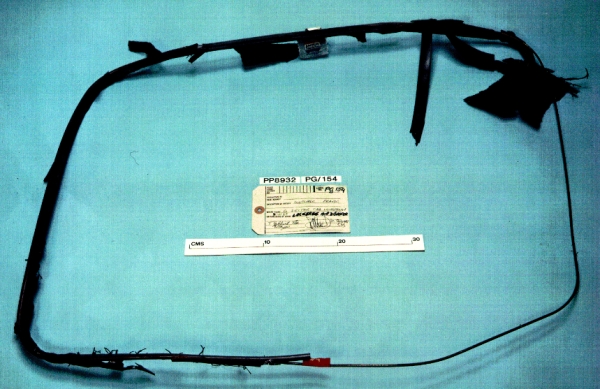
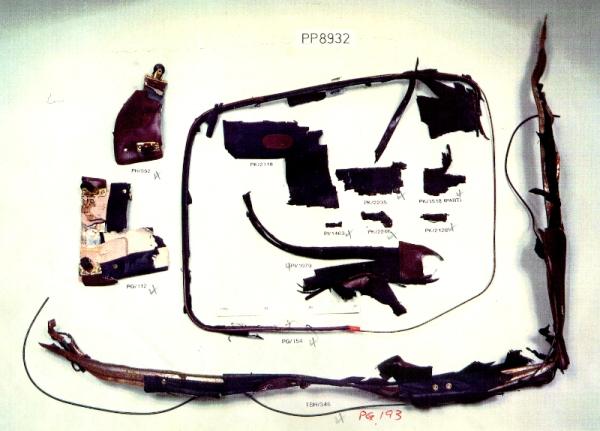
However, there are two other items referred to as being part of the same "item" as the frame of the Thomas suitcase. One of these was a fair-sized chunk of the Coursey case, which is described in detail under that item (your no. 3).
They were lying flat. Sidhu said so in his FAI testimony. I don't think he said which way the handles were, but if you imagine doing it, the handles would probably end up at the front.
PD/889 is an enigma, because the police interfered with its contents before it was sent to RARDE. We don't know what might have been blasted into the contents originally, which is a pity.