Lockerbie: London Origin Theory

Nobody is expecting or relying on these people remembering where they put each and every case. However, they did remember sufficient detail about what they did that afternoon for it to be possible to work out where the important cases probably were.
I disagree, the handlers would have been petrified about being questioned and would have pretty much agreed with anything.

So these men knew that flight was something to be remembered before they dealt with anything else.
What?
They cant be expected to remember accurately something they would have paid hardly any attention to doing.
airplane-luggage-and-travel-bags.jpg

Do you think these guys will be able to remember the order in which they stacked these?
 
The Gannon case

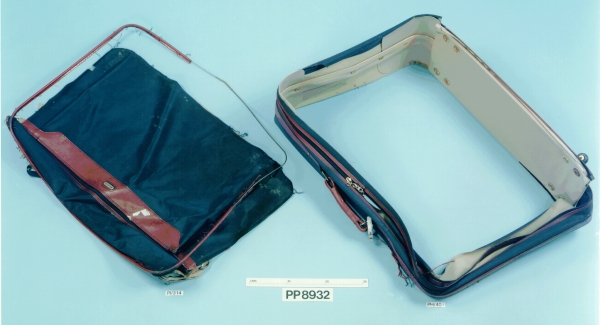
A “PH/401. This is the body of a navy blue canvas softshell suitcase devoid of its base and [2436] lid. The suitcase portion measured 710 millimetres by 535 millimetres by 230 millimetres and was constructed from a woven navy blue canvas backed by cream-coloured flexible sheet plastics. The suitcase was fitted with maroon plastics simulated leather trim and carry handle, a plastics zip fastener, a wood reinforced baseboard and castors. The suitcase showed evidence of explosion damage concentrated along its right-hand edge where there was general blackening and deposits of carbonised material. Further blackening was evident on the right-hand facing edge of the handle’s D-shackle and also upon a length of plaited string and a white plastics strap which were attached to the handle
and its D-shackle.”

A “PI/314. This is one side of a disrupted navy blue softshell suitcase. The suitcase side panel measured 760 millimetres by 510 millimetres by an indeterminate height and was constructed from a [2437] soft navy blue woven fabric backed with a cream-coloured flexible sheet plastics. It was trimmed with a soft maroon sheet plastics having a simulated leather finish and lined with a beige fabric-coated thin sheet plastics. This construction was found to be closely similar to that of the suitcase body PH/401. Affixed to the side panel was a proprietary logo bearing the legend “Samsonite.” A portion of a white paper label adhered to the maroon plastics trim and bore the printed legend “AN AM.” The panel was disrupted around its periphery, with an almost complete detachment of the maroon plastics covered supporting steel rod. Evidence of explosion damage was observed at one corner of the lower edge as an area of damage and blackening which extended between the blue fabric and its lining. A neighbouring length of the maroon plastics that covered the supporting rod was blackened with part of it missing.”
 
Last edited:
I disagree, the handlers would have been petrified about being questioned and would have pretty much agreed with anything.


I've read all their police statements. They appear perfectly comfortable relating their memories of that afternoon. And contrary to your assumption, they most certainly didn't "agree with anything". Most of the statements are simply their accounts of what they remember of the afternoon. Where specific points are put to them, usually asking them if they remember something one of the other staff members had mentioned, they quite often disagree.

What?
They cant be expected to remember accurately something they would have paid hardly any attention to doing.
http://ethicsalarms.files.wordpress.com/2012/09/airplane-luggage-and-travel-bags.jpg?w=300&h=200
Do you think these guys will be able to remember the order in which they stacked these?


Yes. They do the same job every day, and they have a system. They will be able to tell you which order they put the cases on the trailers, because they always do it the same way. Every time.

OK, I'm less sure about these trailers, because they're only moving stuff between the terminal building and the aircraft. But the process we're talking about here is the packing of a container to be loaded on to the aircraft. They absolutely had a system, which they adhered to, and which they were able to describe to the police.

Even in your example, I think we would be justified in concluding that the cases on the bottom of the trolley were placed there bfore the ones on top of them.

Rolfe.
 
Last edited:
The Gannon case


Silly me. I followed the wrong page number and got the Coyle case. Didn't track the 2436 reference.

And yet Taylor said, about the same evidence, "The distribution of the explosion damage is “rather peripheral” and there is no suggestion that this case was in contact with or in very close proximity to the improvised explosive device case." Where did he get that "rather peripheral" bit from?

Taylor was just trying to point out that the damage wasn't consistent with its having been under the bomb of course, but it sounds as if the case was fairly close to the bomb suitcase. There seems to be more explosion damage than on the Bernstein suit carrier, for example.

Hopefully John will send on photograph 80 so we can see this for ourselves. I think, if PD/889 was next to the Carlsson case, that the Gannon case will have been next in line, which puts it in the centre of the presumed row of five at the back. This explosion damage "at one corner of the lower edge" sounds as if it might be another indicator of a bottom-level explosion.

Rolfe.
 
Last edited:
My goodness, that's some great and new primary evidence Rolfe! And, well, you folks are certainly moving on a pace here! Fantastic stuff.

From a quick skim over the new details, it certainly appears that Mr Bernstein suit carrier was folded at the middle and the top-end badly burnt and severely torn and ripped. The handle completely blown off and evidence of substantial scorching. If there's also portions of the primary suitcase and Ms Coyles blue tourister embedded in this, then it is a a very persuasive argument that this carrier case was potentially Bedford's 'other' suitcase. The colour is certainly as Bedford initially stated "perhaps similar" to the other one he described as a "brown or maroon samsonite", and the size would take adequate floor-space in the container.

The only difference is that the handle would have closest to the bomb suitcase, facing left, and not facing the rear of the container as Bedford had recalled. Of course, it was the bag other than the Samsonite that he remembered less clearly and was clear about that from the beginning.

I agree with Rolfe that McKee's suitcase looks a very likely candidate for being next in line, after Carlsson's, loaded at the left-side rear of AVE4041, handle up, and its corner in probable direct contact with the bomb suitcase - which must have been on the bottom layer of luggage.

It almost seems so obvious now. A brief discussion, and seeing McKee's case and the concentrated area of damage should have been yet another massive indication. There's even arrows for goodness sake! I know Sidhu wasn't called, and so the Zeist court could infer that the bags might have been moved, but this...

So how did the defence miss yet another open goal?

Details and photo's of Gannon's case may well reinforce this whole scenario if the damage to his case is concentrated in a similar area, but less disruption, to McKee's suitcase. That would leave Berstein's saddle-bad/hold all was on the outer end, and the suit bag had been pulled to the front.

That's immediately alongside Bedford's brown samsonite with the bomb.
 
Last edited:
The handle completely blown off and evidence of substantial scorching. If there's also portions of the primary suitcase and Ms Coyles blue tourister embedded in this, then it is a a very persuasive argument that this carrier case was potentially Bedford's 'other' suitcase.


I was wondering about the bit of the Coyle case embedded in that handle, and musing as to whether that was consistent with the suit carrier being on the same level as the bomb. Being devil's advocate for a minute, you could argue that it was more consistent with the bomb being on the second layer and the Coyle case being alongside the suit carrier.

Nevertheless, I'm not seeing anything else that suggests that, and I go back to an earlier suggestion we were making about the bomb suitcase having slid to the left a bit, thus elevating the left-hand side to the Claiden level of the explosion. If that happened, it's possible the Coyle case didn't entirely go with it, and its right-hand side slumped down a little into a small gap between the bomb suitcase and the suit carrier. Thus allowing a bit of that case, as well as a bit of the bomb suitcase, to become embedded in the handle.

It's the best I can do, because I really do not believe the Coyle case was on the bottom layer.

Rolfe.
 
So how did the defence miss yet another open goal?


It's a good question, but I have a small amount of sympathy. They had far less time than we've had to assimilate all this, and although they had all the evidence we've been dragging out piecemeal, that must have been quite overwhelming. They had to worry about Edwin, and the Goben memorandum, and Abu Talb, and all the other important things like the Gauci identification and PT/35b as well as a huge amount of stuff that now seems to us to be mere padding and distraction.

I also think they were far too keen to admit the possibility that Sidhu moved these suitcases, so they could claim he put the Bedford case back on top of the Coyle case. I agree that is such a cracker of a possibility that it should have been enough reasonable doubt to get an acquittal. However, reading Sidhu's FAI testimony in detail, it was dishonest.

Some bright spark (Miss Larracoechea?) asked him to explain, IF he had thought the case flat at the front wasn't suitable for that position, maybe too small or something, what would he have done with it? He said, he'd have chucked it on top of the row at the back. So if he had moved that case, it would have been in "some more remote corner of the container". Or at least, potentially high enough not to have been seriously involved in the explosion. He would not (as we thought he would) have put it back on top of the Coyle case.

This makes slightly better sense of the universal aversion to calling Sidhu. The prosecution knew they had to get those cases moved, or at least the front one(s). They didn't dare call Sidhu, because he had been so firm in his testimony that he didn't move them. The defence weren't thinking too clearly. They were being bombarded by forensics reports saying the explosion was on the second layer. Rather than think through, WHY don't the prosecution want to fix that case on the bottom layer, they seized the opportunity to claim it might then have been moved to the second layer. Thuis they couldn't call Sidhu either, because he would have explained that it was not possible for that to have happened. The left-hand Bedford case was either still on the bottom, or it was somewhere in the upper back of the container, possibly on top of the Carlsson-PD/889-Gannon array.

Why do they play these games? Seek the truth, and deal with it, you bampots.

Rolfe.
 
OK, I'll give it a go.

The forensics people were lining up to declare the bomb suitcase had been on the second layer of luggage. It was known that the case on the bottom was loaded in the interline shed at Heathrow, before the feeder flight landed. This raises the tricky question of, what was under the bomb suitcase?

None of the six known Heathrow interline items was damaged in the way a suitcase under the bomb would inevitably have been damaged. There was no other stray item of luggage recorded as having been routed to that container at Heathrow. Not only that, there was no possible non-feeder-flight candidate for that position among the damaged suitcases recovered on the ground. The damaged suitcases were either known, legitimate Heathrow interline items (all ruled out as having been under the bomb) and known, legitimate Frankfurt online items.

The obvious answer, that despite what forensics were saying the bomb suitcase was after all the one on the bottom, was unacceptable, because in that case they had two innocent men in jail and the people of Libya had been subjected to eight years of punitive international sanctions that had killed thousands of people, on a false premise. So they had to find some other way.

In fact only one of the Frankfurt online suitcases was damaged in a way that was consistent with its having been loaded flat against the bomb suitcase. They had to co-opt that for the bottom position. Leading to the question, in that case, what was on top of it? Or not - nobody asked that one.

One piece of the bomb suitcase showed traces of the Coyle suitcase adherent to the outside. There was no particular reason this couldn't have been due to its having been under the Coyle suitcase, but since they didn't have another scenario they went for it.

Rolfe.
 
Thanks for taking the time to post that Rolfe but to be honest I am still at a total loss as to your conclusions, in fact Im not sure you actually have a conclusion in mind ,and with that I will just dip in every now and again to see if any progress is being made.
At the moment its like Abbott and Costello doing "who's on first". :(
 
Last edited:
More information.

The Gannon suitcase.

Gannon.jpg


The damage isn't as obvious on the photo as in Hayes's description, but I can see it. The side of the case that would have been nearest the bomb seems to be missing.

The lock of the bomb suitcase. In Bernstein's holdall.

holdall2.jpg


Where the hell was that holdall, to get more damage than PD/120 even though it should have been at the far side of that case, and to get the bomb suitcase lock in it even though it wasn't directly behind it?

Rolfe.
 
What do you think about the possibility of Bernstein's holdall being on the extreme right of the row on the back, beyond PD/120, even though the holdall was noted to have some explosive damage and PD/120 wasn't?

Well...forget it.

This ugly thing is confusing me.
 
Me too. However, this is the real world, not a detective story. This really happened. Michael Bernstein, Nazi hunter, really did fall to his death from 31,000 feet above Lockerbie. His luggage was definitely in AVE4041 and was definitely within a short distance of the bomb. And we know from the arrival time of his BA flight from Vienna that his luggage would have got to the interline shed around 4.15, give or take.

So where was that holdall? In the real world, there is a real answer.

All the baggage handlers agreed that holdalls would be placed in the overhang area. Bedford said if there had been a holdall he would have placed it to the left of the Carlsson suitcase. But there wasn't. It would appear from that, that he treated this saddlebag thing as a suitcase.

Sahota thought there was a holdall in the angle. However he only glanced into the container and this has not been thought to be very reliable. Also, you're already pushing it trying to make five items (including the saddlebag thing) form a complete row across the back. If you don't have that, you don't have enough luggage to do it.

I also think a holdall to the left of the Carlsson suitcase would have been significantly more damaged than the saddlebag. It would have been more or less directly behind the IED. Also, the angle between a holdall in that position, the IED itself, and the suitcase lock, doesn't suggest such a holdall would be a likely candidate to receive the lock.

To the left of PD/899, right of the Gannon case? If so, could the lock have gone right through PD/899 and into the saddlebag? I have no information as to what else might have been found in the saddlebag. Are all these little pieces lock? I suspect some of them may be bits of the actual bomb suitcase. Or of PD/899?

Is it possible the bomber started panicking a bit after he'd decided to move the suit carrier down to the front right of the container, realised he had to rearrange the back row to disguise the fact that he'd taken an item from it, and ended up moving the saddlebag to a different position in the row?

Rolfe.
 
Last edited:
Yes, sure, this is the real world.

What would you do if you were the loader? You have loaded the Carlsson case and three other suitcases: McKee1, Gannon and McKee2. Then suddenly this ugly amorphous thing shows up. Where would you put it? I think I would squeeze it in the largest gap between two suitcases.

I don't know, but I don't think this holdall was in the overhang or on the extreme right of the back row.
 
Where would you put it? I think I would squeeze it in the largest gap between two suitcases.
Thats why you are not a baggage handler, these guys have an elaborate system in place that they all adhere to and are able to recollect perfectly how they stack each item of luggage.
These guys have photographic memories and can remember where each individual bag went on each plane.

Me, Im no baggage handler either, I would have stuffed it between two cases as well to stabalise the load.

But thats me.
 
Last edited:
Yes, sure, this is the real world.

What would you do if you were the loader? You have loaded the Carlsson case and three other suitcases: McKee1, Gannon and McKee2. Then suddenly this ugly amorphous thing shows up. Where would you put it? I think I would squeeze it in the largest gap between two suitcases.


That's not how I read the situation, although of course it's not impossible. (John suggested something like that, too.)

These guys had a system, and they weren't inclined to over-exert themselves. Moving a suitcase already positioned is a waste of energy, and they only did it when they really had to rearrange stuff. They tried to position it in the first place so that they wouldn't need to move it again.

Bedford described his system, which was to start at the left and work towards the right as the luggage arrived. He's packing the container as he expects it to be loaded on the flight. He wouldn't be leaving gaps to fill in later, he'd be placing the cases next to each other - in contact with each other.

So, he's placed four cases (or possibly five, depends if the suit carrier showed up with the saddlebag, or a little before or after it). Then this weird object shows up, and to be honest I still don't have a real grasp of what it looked like when it was all together and packed. I think there are two possibilities, going by what he and everyone else said about the system or packing these containers. He either decides it's a suitcase and puts it next in line on the right, or he decides it's a holdall and puts it to the left of the Carlsson case. It was quite a fat little thing, I think. I don't see him prising a gap for it between PD/899 and the Gannon case - not only did he say he didn't do that, why would he do it?

I don't know, but I don't think this holdall was in the overhang or on the extreme right of the back row.


I don't think so either. But these are the two places Bedford might reasonably have put it.

It's showing too much explosion damage for the extreme right, as far as I can see, and physically I can't see how the bomb suitcase lock could have got into it in that position. Claiden did make the point (about the radio PCB chip) that he had long given up predicting where anything would end up in an explosion, but realistically, that would require one hell of a weird ricochet.

I bear in mind that Sahota thought there was a holdall in the overhang, but against that there are a number of points.
  1. Bedford himself was quite consistent that there was nothing he classed as a "holdall" among that luggage. He could have misremembered, but....
  2. In order to have the back row appear complete, as all three baggage handlers stated that it was, you need a minimum of five suitcases. To get that, you need that thing to be treated as a suitcase. If you put it in the overhang, you're trying to fill the back row with only four items and it can't be done.
  3. Anything to the immediate left of the Carlsson case would have been more severely blast-damaged than that, as far as I can see. There are several holdalls from the feeder flight that fit the bill.
  4. Just as with the extreme right position, the angle is all wrong for the lock to end up in the saddlebag.
I think it has to have been between PD/889 and the Gannon case. The question is, how did it get there? I don't think Bedford put it there, and both Sahota and Sidhu denied moving any of these cases. They had no reason to swap the order of the items in the back row, anyway.

It's one more thing that suggests someone was playing silly buggers with the back row. I think it's something that happened when Bedford was on his break, because that's the time we know unexplained things happened to that container. After his return, all the evidence indicates the arrangement did not change.

There's no readily obvious reason for it, but I think it's something the bomber did. Maybe he pulled the saddlebag out as the first thing he tried in the right-hand flat position, then realised it wasn't big enough and its conspicuous pattern drew attention to the rearrangement of the luggage. Then he pulled out the suit carrier, and that fit the bill a lot better. He then leaned over to the back to spread out the remaining items to fill the space, and ended up putting the saddlebag back in the middle of the row rather than at the end.

It's pure guesswork, but I think it must have been something like that. We don't know what someone high on nervous tension would do in that situation. He'd want to get the bomb bag positioned and out of there as fast as he could without drawing attention to himself, but he'd also want to leave the container arranged in such a way that it looked natural and the bomb bag would be unlikely to be moved again. Who knows? I'm open to other suggestions.

Rolfe.

 
Last edited:
Well, the damage to Gannon’s bag is not quite as expected. It’s a pity we can’t really see its underside and any potential burning or pitting. And the other side of his suitcase, completely gone, that might have been a good indicator of its final position in 4041. Was it just blown off, blasted off, shredded to bits, or come away in the free-fall from 31,00ft?

So, one side panel is missing, and the other in the photo appears almost completely detached from its frame. The lower end of the case, in both sections, has experienced more damage than the top side for sure. The end where the castors are has more damage, and the side panel is completely detached at its lower side and still attached at the top. Barely, but still attached.

However, the extent of the damage seems more consistent with pressure and force, as opposed to burning. Again, it a pity the other side is completely absent, but what we have appears to imply this suitcase was actually at the end of the back row, furthest away from the explosion. Clearly its badly ruptured and some suggestions of relatively minor (compared to the others) immediate damage from the explosion – scorching or burnt. But, perhaps the other missing panel was just blasted to smithereens?

According to the statements of Bedford, Sahota and Sidhu, and the reconstructions carried out in Jan ’89, this diagram represents the best idea of the layout of the bags in 4041 before the Frankfurt luggage was added. The spacing of the back row bags would be slightly more spread out to cover all the floor space all loaders say was taken:

So, where are we? Thanks to Caustic Logic for this diagram of AVE4041 proposed below.

Bedford_arrangement_2.jpg


Back row L to R: Carlsson, McKee, McKee, Bernstein and Gannon.

Front row L to R: Bedford’s unknown suitcase, Bernstein’s suit-carrier (Handle to left no back).

Does that fly? Well, all this is pure speculation of course and the any damage sustained in the immediate aftermath of the explosion, as the container broke free of the hold, the aircraft disintegrated, and the subsequent fall from 6miles up, is simply impossible to conclude with any certainty at all. Perhaps the damage on some of the cases – smashed and chucks missing – came about as a result of the subsequent fall rather than the initial explosion.
 
I don't think that flies exactly. Thanks for dredging up Caustic Logic's diagram by the way. We need a better one that's more to scale at the back, but it'll do for now.

The only suitcase of the five that was recorded as having no explosive damage at all (merely "contamination") was PD/120. That one has to be the right-hand one.

PD/899 must have been to the right of Carlsson's given the extent of the damage.

The Bernstein saddlebag thing seems to have been next in line, because that puts it at the right angle to get the lock of the bomb suitcase. Surprisingly little visible damage, but that seems to be the pattern of the explosion - only the cases very close indeed were really blown to bits.

Then Gannon. I don't see how the lock could have gone through the Gannon case and out the other side into Bernstein's - we have one of the sides. I think the structure of that case was weakened by the explosive blast, and it came to bits either on the way down or on the ground - probably on the way down, as the other side wasn't found. I doubt if it was blasted to bits though.

Then PD/120.

Carlsson - PD/889 - Bernstein - Gannon - PD/120

That's my current thinking on the matter, given all the information we now have. It's the position of both Bernstein items that's the anomaly. The suit carrier flat at the front when Bedford would have placed it in the row at the back, and the saddlebag in between two of the Larnaca items, which arrived about an hour and a half earlier.

Rolfe.
 
Last edited:

Back
Top Bottom