
Lockerbie: London Origin Theory

Thank you Rolfe.


Bernstein's suit carrier intrigues me. It does not appear to me to have been handle-up at the time of the explosion. Visualising it folded back up, it seems to me that the handle side has been closest to the blast.

What we see on the Bernstein suitcase are signs of high velocity impact of hot (molten plastic?) particles. Surprisingly, there isn't very much sooting or charring of the suitcase material itself. I agree that the handle wasn't up at the time of the explosion and that the handle-side was closest to the blast.

Bedford indicated that both front suitcases were loaded with the handles to the back, but he doesn't seem to have paid a lot of attention to the right-hand one. I wonder if that suit carrier could have been placed to the right of the bomb suitcase with the handle to the side? This is just speculation, but I'm trying it on to see if it fits.

Don't worry, it is good to keep an open mind. Maybe the Bernstein suitcase was the one on the right of the primary suitcase. We will see.

The McKee suitcase doesn't show signs (I don't see them) of high temperature blast phenomena (no charred plastic, no black rugged edges). The edges of the fractures are rather clean. I think most damage to this suitcase was caused by mechanical action (the pressure wave caused by the explosion and/or the impact to the ground).

The Carlson suitcase adsorbed most of the blast. I agree it was the suitcase on the very left of the back row. And if it was not, it was the second secondary suitcase below or above the bomb suitcase.:p

Another interesting suitcase is the suitcase of Johannes Schauble. It is a possible candidate for the suitcase on the right site of the blue american tourister.
 
Q
Mr. Feraday, there is really just one matter I would like to ask you about. I wonder if you could be shown on the screen Production 182 at page 1. Could I ask you to read from the paragraph commencing with the words, “In section 4.2.11 ...”
A It says: “In section 4.2.11 of our joint report (page 35, photograph 73) we identified seven fragments of rigid grey plastics as all originating from the same explosively damaged suitcase. These fragments bore the Lockerbie production numbers PI/1149, PI/1390, PI/1419, PI/1536, PI/1537, PI/1544, and PI/1550. We have been asked to compare these seven fragments with a grey hardshell suitcase marked as Lockerbie Production No. DM/52 which was received together with the seven stated fragments on 16 March [3370] 1992. The comparisons detailed below make reference to a booklet containing five photographs numbered 395 to 399 (inclusive).”
Q I wonder if you could now be shown from the same production photograph 395. Can you see on the photograph the police reference code DM/52?
A Yes, sir.
Q Could you read on the section dealing with your examination.
A Can I have it back on the screen, please.
Q I beg your pardon. Go back to page 1.
A “This consists of a grey hardshell suitcase measuring approximately 53 by 43 by 18 centimetres (21 by 17 by 7 inches). The suitcase possesses two metallic lock mechanisms between which is mounted a grey plastics handle upon a metallic embellishment bearing the manufacturer’s identification ‘Samsonite.’ There is a white paper label adhering to ...”
Q If we could turn over the page to page 2. Mr. Feraday, would it be easier to look at the hard copy. I think you may have been shown this --
A I was shown it earlier, but I don’t have a copy here. There is a white paper label adhering to [3371] the underside of the suitcase which bears the airline identification `Northwest’ and the handwritten name and address for `George W. Williams,” et cetera. The suitcase, whichi s shown in photograph 395, is virtually undamaged apart from two small indentations to its
rigid shell.”
Q Now, item DM/52, do you recall examining that item? If not, perhaps you could be shown Label 394.
A I’m sure I did, but I can’t at this stage -- you know, it doesn’t stick out in my mind as anything unusual. I’m sure I examined it, otherwise I wouldn’t be writing this.

.....

The pictures are in "Various bits". What is the provenance of these fragments, the McKee case"? Or do we have a mystery case here? PI/1550 was (very) close to the explosion.
 
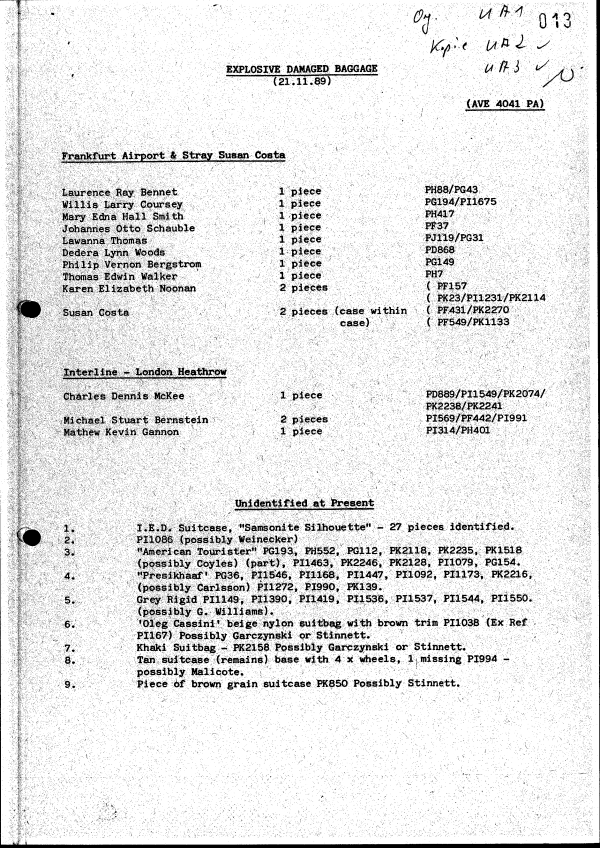
This might help. I'm not sure it was their last word on the subject, but it mentions the important pieces.

Damaged luggage.jpg


Rolfe.
 
What we see on the Bernstein suitcase are signs of high velocity impact of hot (molten plastic?) particles. Surprisingly, there isn't very much sooting or charring of the suitcase material itself. I agree that the handle wasn't up at the time of the explosion and that the handle-side was closest to the blast.

Don't worry, it is good to keep an open mind. Maybe the Bernstein suitcase was the one on the right of the primary suitcase. We will see.


That's not what I was expecting. I was expecting to find one of the six legitimate Heathrow interline items with damage to one side, fairly evenly distributed. That was why Buncrana drew my attention to the McKee case, because he at first thought it fitted the bill. However the pattern of damage isn't right.

The maroon Bernstein case seems anomalous. Bedford was clear that the back-row cases were all placed handle-up. Bernstein's case does not appear to have been handle-up. This suggests it was moved, making it a good candidate for the case I postulate was moved by the bomber. And according to Bedford it was in the right place to have been moved by the bomber - the right-hand end of the row.

I'm not so concerned by its not being a hardshell, because Bedford didn't really seem to look at it very carefully compared to the other one. Bear in mind Sidhu thought he recalled the front cases as soft-sided ones. He also, for what it's worth, seems to have thought the two front cases were the same colour (though I wouldn't press the point). Bernstein's case was also maroon.

It does seem odd, though, that it would have been placed handle-side towards the bomb rather than side-on.

The McKee suitcase doesn't show signs (I don't see them) of high temperature blast phenomena (no charred plastic, no black rugged edges). The edges of the fractures are rather clean. I think most damage to this suitcase was caused by mechanical action (the pressure wave caused by the explosion and/or the impact to the ground).


You've read what Hayes wrote about it? "Clear indications of explosives involvement" and so on. He was actually looking at the thing. Why would he write that if it wasn't true? He wasn't that big a idiot.

The Carlson suitcase adsorbed most of the blast. I agree it was the suitcase on the very left of the back row. And if it was not, it was the second secondary suitcase below or above the bomb suitcase.:p


It was agreed in court that there was only one "secondary" suitcase which had been loaded flat against the bomb suitcase. This is a very damaging point for the Crown. If the Coyle case was below the bomb, what was above it? If the Crown could have presented another case as being a candidate for that position, I think they would have done so.

It would have been even better for them if they had been able to present the Carlsson case as having been below the bomb. Carlsson (Heathrow interline) below and Coyle (Frankfurt online) above would have suited their little scenario very well. No attempt to argue that point.

Anyway, the sides of the Carlsson case aren't nearly as smashed as they would have been if it had been under the bomb, in my opinion.

My approach is to take each case as being in the position Bedford said he put it, and then look to see if the damage is consistent with its having been in that position. Carlsson's and McKee's damaged case seem to fit perfectly. I'm not going to start postulating any of the Heathrow items were anywhere other than where Bedford said they were, unless there is good reason to think otherwise. Bernstein's maroon case is so far the only one where good reason seems to exist.

Another interesting suitcase is the suitcase of Johannes Schauble. It is a possible candidate for the suitcase on the right site of the blue american tourister.

I haven't really looked at the Frankfurt interline items, because we have no way of knowing where Sidhu put any of them.

Rolfe.
 
That's not what I was expecting. I was expecting to find one of the six legitimate Heathrow interline items with damage to one side, fairly evenly distributed. That was why Buncrana drew my attention to the McKee case, because he at first thought it fitted the bill. However the pattern of damage isn't right.

?? If this Bernstein suitcase contained part of the lock of the IED suitcase it was most probably on the back row.

The maroon Bernstein case seems anomalous. Bedford was clear that the back-row cases were all placed handle-up. Bernstein's case does not appear to have been handle-up. This suggests it was moved, making it a good candidate for the case I postulate was moved by the bomber. And according to Bedford it was in the right place to have been moved by the bomber - the right-hand end of the row.

Why should the bomber have moved this suitcase?. In order to confine the IED suitcase?

You've read what Hayes wrote about it? "Clear indications of explosives involvement" and so on. He was actually looking at the thing. Why would he write that if it wasn't true? He wasn't that big a idiot.

To me it isn't clear at all: I don't see it on the pictures. This is exactly why I don't like to draw conclusions by looking at pictures.

It was agreed in court that there was only one "secondary" suitcase which had been loaded flat against the bomb suitcase. This is a very damaging point for the Crown. If the Coyle case was below the bomb, what was above it? If the Crown could have presented another case as being a candidate for that position, I think they would have done so.

What is the provenance of the 7 fragments (PI/1550 etc)? If it's not McKee's suitcase, we have a candidate for a second secondary suitcase. Maybe this is a "loose end" in the investigation.

If it is McKee's on the other hand, I'm convinced that his suitcase was explosion damaged.

Anyway, the sides of the Carlsson case aren't nearly as smashed as they would have been if it had been under the bomb, in my opinion.

With all respect, you don't know how much of a secondary suitcase will survive a explosion of app. 450 gram SEMTEX. It's impossible to draw this kind of conclusions on the basis of the number and appearance of the fragments found. I think a huge amount of suitcase fragments were never found and are still lying in the fields around Lockerbie.
 
?? If this Bernstein suitcase contained part of the lock of the IED suitcase it was most probably on the back row.


I don't know which of the two Bernstein suitcases was said to have had the lock in it. It was a single line in a single memo, and having seen the condition of the two cases I am wondering if it was a mistake. I hope I might be able to get clarification on that.

Why should the bomber have moved this suitcase?. In order to confine the IED suitcase?


That was my thought. That right-hand case had to be something. In fact both front cases had to be something. Three separate people saw them there.

There should only have been six cases in the container. There were at least seven. There must have been. What was the seventh? You get three guesses, but only the first one counts. Could there have been an eighth? Can't wholly exclude it, but what the hell could it have been? Trawling through all the baggage records reveals no candidate. And all the pieces of blast-damaged luggage were attributed to either legitimate, identified luggage, or the bomb suitcase.

I speculate. The bomber has packed the case with the IED down one side, asymmetrically, with the intention of placing the case flat, with that side as far into the angle as it will go. He finds the container sitting with all the cases upright in a row along the back. What to do? He can place the bomb suitcase flat at the front, in more or less the desired position, but it looks a bit lonely there - conspicuous, even. And there's nothing to stop the case sliding to the right. So he takes one of the cases from the row at the back and places it to the right of the bomb suitcase, and spreads out the remaining cases at the back to conceal the fact that there's a case missing.

To me it isn't clear at all: I don't see it on the pictures. This is exactly why I don't like to draw conclusions by looking at pictures.


Some conclusions can be drawn, however. We can see where the damage to the case is. Bedford described placing that case in the row at the back. Wherever it was, it was one of the cases in the container before the feeder flight landed. We've seen pics of all the cases Bedford put in the row at the back, except Gannon's case, which was described in court as having only "rather peripheral" explosion damage.

So, which were the two cases that must have been behind the bomb suitcase? Carlsson's for the left-hand one. None of the others is sufficiently damaged to have been the next one in the row, only the damaged McKee case. (This is why I doubt the memo saying the lock of the case was in one of the Bernstein cases. Helluva weird ricochet, that.)

Bedford's evidence is entirely consistent with that case having been upright, behind the bomb suitcase. The damage we see is consistent with its having been in that position, and there isn't another candidate for that position. And Hayes, who saw the actual suitcase, says the damage was caused by the explosion. I submit that alternative explanations are verging on special pleading.

If you do accept that much, and I think it is more than reasonable to accept that much, which level was the bomb suitcase on?

What is the provenance of the 7 fragments (PI/1550 etc)? If it's not McKee's suitcase, we have a candidate for a second secondary suitcase. Maybe this is a "loose end" in the investigation.

If it is McKee's on the other hand, I'm convinced that his suitcase was explosion damaged.


According to that memo I posted above, these fragments were part of a suitcase belonging to George Williams, a Frankfurt boarder.

If that damage to McKee's case was not caused by the explosion (even though Hayes said it was), can you tell me which case was behind the bomb suitcase, next to Carlsson's?

With all respect, you don't know how much of a secondary suitcase will survive a explosion of app. 450 gram SEMTEX. It's impossible to draw this kind of conclusions on the basis of the number and appearance of the fragments found. I think a huge amount of suitcase fragments were never found and are still lying in the fields around Lockerbie.


That first is true. I am basing my conclusions on the conclusions of the forensics investigators, and on the assumption that they would not have overlooked reasonable interpretations of the evidence that would have provided far better support for their preferred scenario than the interpretations they presented. It would have been massively to their advantage to have shown that the Carlsson suitcase had been under the bomb. However, they agreed that it wasn't.

Obviously, not every piece of suitcase was recovered. The fields around Lockerbie were stripped bare by fingertip searches, but they couldn't get to material caught up in the canopy of the trees in the Newcastleton and Kielder forests. Are you suggesting that another suitcase originating in the Heathrow interline shed which was very close to the bomb managed to disappear completely, even though they found over 20 pieces of both the bomb suitcase itself, and of the Coyle case?

Rolfe.
 
According to that memo I posted above, these fragments were part of a suitcase belonging to George Williams, a Frankfurt boarder.

No, this was ruled out by Feraday at trial.

Mr. Feraday, there is really just one matter I would like to ask you about. I wonder if you could be shown on the screen Production 182 at page 1. Could I ask you to read from the paragraph commencing with the words, “In section 4.2.11 ...”
A It says: “In section 4.2.11 of our joint report (page 35, photograph 73) we identified seven fragments of rigid grey plastics as all originating from the same explosively damaged suitcase. These fragments bore the Lockerbie production numbers PI/1149, PI/1390, PI/1419, PI/1536, PI/1537, PI/1544, and PI/1550. We have been asked to compare these seven fragments with a grey hardshell suitcase marked as Lockerbie Production No. DM/52 which was received together with the seven stated fragments on 16 March [3370] 1992. The comparisons detailed below make reference to a booklet containing five photographs numbered 395 to 399 (inclusive).”
Q I wonder if you could now be shown from the same production photograph 395. Can you see on the photograph the police reference code DM/52?
A Yes, sir.
Q Could you read on the section dealing with your examination.
A Can I have it back on the screen, please.
Q I beg your pardon. Go back to page 1.
A “This consists of a grey hardshell suitcase measuring approximately 53 by 43 by 18 centimetres (21 by 17 by 7 inches). The suitcase possesses two metallic lock mechanisms between which is mounted a grey plastics handle upon a metallic embellishment bearing the manufacturer’s identification ‘Samsonite.’ There is a white paper label adhering to ...”
Q If we could turn over the page to page 2. Mr. Feraday, would it be easier to look at the hard copy. I think you may have been shown this --
A I was shown it earlier, but I don’t have a copy here. There is a white paper label adhering to [3371] the underside of the suitcase which bears the airline identification `Northwest’ and the handwritten name and address for `George W. Williams,” et cetera. The suitcase, whichi s shown in photograph 395, is virtually undamaged apart from two small indentations to its
rigid shell.”
Q Now, item DM/52, do you recall examining that item? If not, perhaps you could be shown Label 394.
A I’m sure I did, but I can’t at this stage -- you know, it doesn’t stick out in my mind as anything unusual. I’m sure I examined it, otherwise I wouldn’t be writing this.
Q And in effect, should we understand from what you’ve written that DM/52 was a control sample against which you were to compare the seven fragments referred to in section 4.2.11 of your report?
A I don’t know whether it was a control sample or whether it was just something they wanted me to compare it with. I just know it was a comparison exercise.
Q And reading on in page 2, do we then see the conclusions you reached on undertaking that comparison?
A Is that -- [3372]
Q Starting with “In particular.”
A Would you like me to read it?
Q Yes, please.
A “In particular, we have compared the surface pattern, colour, and materials of one of the largest of the seven fragments (PI/1537) with those of the suitcase (DM/52), as demonstrated in photograph 396. We find that, 1, the colours of the fragment and the suitcase are essentially similar, allowing for the fact that the fragment PI/1537 is blast affected; two, at anything other than a close inspection their surface patterns are relatively
similar; both samples possessing a pseudo-leather surface; and three, their materials of construction are entirely different. We have cut a section through the top left-hand corner of the suitcase DM/52 to reveal that it is constructed from a thin magnesium alloy base with a surface covering of grey plastics possessing a pseudo-leather finish. This metal/plastics
laminate is of approximately 1.3 millimetres thickness. In contrast, the seven explosively damaged fragments are constructed entirely of grey plastics with a pseudo-leather finish, and are of approximately 2.8 millimetres thickness. The edge curvature of fragment PI/1537
appears to be greater than that of the suitcase DM/52 indicating that [3373] the fragments originated from a larger sized suitcase than DM/52. Hence, whilst the colours and surface patterns of the seven fragments and of the suitcase DM/52 are sufficiently similar to be considered as possibly originating from the same manufacturer, it is clear that the fragments
and the suitcase are of entirely different construction, materials and size.”

The fragments have the same color and leather look as McKee's suitcase.
 
Last edited:
Sorry, this was a cross-post. I'll go back and read your previous post now.

Bear in mind that we aren't speculating blind as far as the Heathrow-origin luggage is concerned. We know how it was arranged, as a row of suitcases, handle-up, across the back, and two flat at the front. We know the entire floor area of the container appeared to be covered, and there were no suitcases not in contact with the floor. Three different witnesses testified to that, and these witnesses also testified that they didn't disturb that arrangement. We also know roughly which order the suitcases in the back row were loaded.

We know that four cases across the back could not fully cover the floor area, and five only just manages it. We also know that the three people who saw the container all loaded more than six items when they did their trial loadings.

The first question is what were the two flat cases at the front and how did they get there? The left-hand one as the bomb suitcase and the right-hand one as one of the row (of six) at the back moved down to minimise the chance of that being moved is one answer which so far completely accounts for all known facts. Do you have other possible answers that don't involve industrial-strength special pleading, or discounting parts of the evidence?

The next question is, in what order were the cases in the row at the back? Bedford's evidence says Carlsson's case was on the left, and the condition on recovery of Carlsson's case seems entirely consistent with this. Bedford's evidence puts the three Larnaca cases next. Only one of these three cases was recovered showing sufficient damage consistent with its being next in line to the Carlsson case, and that is PD/899. If PD/899 was not in that position, what was?

Again, we have one answer to this question which entirely accounts for all the evidence. PD/899 is the Larnaca case Bedford placed to the left of Carlsson's case, and it wasn't moved. The damage we see on it which was stated by Hayes to be due to the blast impacting on it was indeed caused by exactly that. I really don't see how you can look at these photos and declare that Hayes was wrong. You may be able to declare you're not certain he's right, but that's a very different matter. I repeat, if PD/899 was not in that position, and that damage was simply caused by it landing corner-down on a rock, what suitcase was in that position?

And finally, if we accept that PD/899 was placed next to the Carlsson case by Bedford, and remained there, on which level was the bomb suitcase?

Rolfe.
 
No, this was ruled out by Feraday at trial.

[snip transcript]

The fragments have the same color and leather look as McKee's suitcase.


OK, I see what you're saying. Where are you going with it? Is McKee's suitcase missing bits that these fragments would fill in? Do you know where Beckett was going with that line of questioning?

Rolfe.
 
OK, I see what you're saying. Where are you going with it?

PI1550 originates from a position very close to the explosion. It has the same morphology as for example PI1487 from the IED suitcase. You can't just ignore it.

If it is from the McKee everything fits in your scenario. If it is not, there is a problem.
 
Did the investigators and/or the court come to any conclusions about it? If it was a part of the McKee suitcase I don't know why they wouldn't have said so, as they weren't trying to claim the McKee suitcase wasn't blast-damaged.

At the same time, a piece of an unidentified non-bomb suitcase would have been very desirable from their point of view. But they don't seem to have tried to maintain that, either.

Do you have any feel for where Beckett was going with that lot, or was he just trying to muddy the water?

Rolfe.
 
These seven pieces are all pretty small. Given how much seems to be missing from PD/899, and the fact that the finish is very similar, I don't see any reason why they can't have been part of it. Indeed, the three extra bits we're shown attributed to PD/899 can't be all there was - there must have been smaller bits as well.

If the forensics guys didn't attribute them firmly elsewhere, then I don't see why not. I just don't see why they didn't make that connection themselves.

Rolfe.
 
I just don't see why they didn't make that connection themselves.

Rolfe.

I don't see why either.

Let's move to the Indian Head tests. The following excerpt is from Leppards book (page 141):

"The investigators at Indian Head concluded: The IED and location used in Test number 5 are the most consistent of the five tests conducted compared to the actual damage indicated by the recovered components of AVE4041 PA"

In the absence of pictures, experimental data, etc. the words "most consistent" are meaningless. So, where is the evidence for an IED suitcase in the second layer? I think there is nothing.
 
There seemed to be two strands to it. One was this height business, claiming that it was 10 inches, or you seemed to think 13.5 inches, when the bomb suitcase was only 9 inches deep. The other was a claim, I think by that guy Cullis, that there had been something underneath the bomb suitcase, shielding the base of the container. Caustic Logic was quite taken by that but I couldn't really see it. The container base is so beat up it's like Mystic Meg reading a palm.

They really went for it though. That was the entire thrust of the FAI argument. Bomb was definitely on the second layer, Sidhu didn't move the Heathrow cases, there was no Heathrow case on the second layer, therefore bomb from feeder flight. I can't see it myself, not to 100% certainty anyway.

It really seems to be a balance of probabilities argument, at best. And how can you completely rule out the suitcase on the bottom layer on a balance of probabilities argument, when it can't be reconciled to a proven innocent item of luggage? Even if they think there's only a 10% chance the explosion was on the bottom layer, that suitcase is still in the frame.

I now think the condition of PD/889 makes it a 100% chance of the bottom layer. I simply can't see another explanation for that damage. It's the only one of the five post 2 pm cases that could have been next to the Carlsson case, and something was next to the Carlsson case. That being so, that is explosion damage and the explosion was in the floor-level case in front of it.

Check. Mate.

By the way, what do you think about the Bernstein suit carrier? Bear in mind it had to be either handle-up in the row along the back, or the right-hand one of the front pair. I don't think the damage is consistent with handle-up at the back. Odd though it seems, I'm going for it being the one in front, but with the handle to the left.

Rolfe.
 
Last edited:
My current hypothesis about the luggage arrangement goes like this.

Carlsson - McKee PD/889 - Gannon - McKee PD/120 - Bernstein holdall - Bernstein suit carrier

That's my best shot to date about the order Bedford placed them in. That's correct for the order of arrival of the three flights involved. I think that was the row at the back when he went off on his break.

Enter the bomber, looking to place his suitcase flat, with the IED into the overhang section. Sees the row of six and nothing flat. Is a bit thrown by this but presses on regardless, laying the bomb suitcase flat at the front with the IED to the left. He's concerned this looks a bit conspicuous and hurriedly grabs the end case on the row at the back, dragging it down to lie beside the bomb suitcase. It just happens to be more or less the same colour and the same make too. He's trying to get away as fast as he can so he doesn't pay attention which side the handle of the second suitcase is situated, and in pulling it down it just happened that the handle was to the left. He may have reached over and spread out the row at the back a bit, though.

An hour later Sidhu adds the Frankfurt luggage on top, putting Patricia's case right on top of the bomb suitcase and one of Karen's holdalls in the overhang beside/above it. The container is loaded on the 747 like that.

During the flight, which was turbulent with a 90 m.p.h. crosswind, the plane banks in such a way that the shiny convex hardshell slides further into the overhang section, moving the bomb itself past the vertical struts, and rather above the flat-measured height of the suitcase. That last part if I can't persuade anyone that the centre of the explosion was actually 6 or 7 inches up and within the main volume of the container.

The ice-cube capacitor is triggered after 8 minutes of ascent, takes 30 minutes to charge, and the IED goes off at 7.03 pm over Lockerbie.

That's my best effort so far. Feel free to take pot shots at it.

I explain the memo saying the lock of the bomb suitcase was found in one of Bernstein's cases as a mistake. By that hypothesis it should have been in PD/889. But then PD/889 was interfered with at Dextar by the police, and no log kept. Hmmmm. Don't know.

I explain Bernstein's holdall apparently having some explosion damage while PD/120 (which by this arrangement was to its left) having none as an effect of hot particles or something reflecting off the vertical right-hand-side of the container on to it. I'm totally making this up, I have no idea. But something very close to this did actually happen and somehow the laws of physics must be placated.

Rolfe.
 
Last edited:
By the way, what do you think about the Bernstein suit carrier? Bear in mind it had to be either handle-up in the row along the back, or the right-hand one of the front pair. I don't think the damage is consistent with handle-up at the back. Odd though it seems, I'm going for it being the one in front, but with the handle to the left.

Rolfe.

I'm at work now, so this is a quickie.

As I said before, the Bernstein suit carrier show signs of high velocity impact of hot particles. I doesn't show signs of charring. This means it was relatively close to the bomb, but not very close. The damage is certainly not consistent with handle-up in the back.

It wasn't on the row along the back in the position to the very right (to far away from the IED). If it was on the back row it would have been somewhere between the McKee PD889 and the Gannon. However, I know this is unlikely, because the Bernsteins did arrive relatively late. In Ashtons book it is said that both Bernsteins did arrive during Bedfords tea break.

I agree with you, the Bernstein suit carrier probably was the case to the right of the IED. It doesn't show the fracturing I would expect with hard shelled case, because it's a compressible item. During the explosion the handle was pointing to the left. Bedford said the handle was pointing to the back, but maybe he said that because he didn't see a handle at the front.
 
By the way, what do you think about the Bernstein suit carrier? Bear in mind it had to be either handle-up in the row along the back, or the right-hand one of the front pair. I don't think the damage is consistent with handle-up at the back. Odd though it seems, I'm going for it being the one in front, but with the handle to the left.

Rolfe.

I'm at work now, so this is a quickie.

As I said before, the Bernstein suit carrier show signs of high velocity impact of hot particles. I doesn't show signs of charring. This means it was relatively close to the bomb, but not very close. The damage is certainly not consistent with handle-up in the back.

It wasn't on the row along the back in the position to the very right (to far away from the IED). If it was on the back row it would have been somewhere between the McKee PD889 and the Gannon. However, I know this is unlikely, because the Bernsteins did arrive relatively late. In Ashtons book it is said that both Bernsteins did arrive during Bedfords tea break.

I agree with you, the Bernstein suit carrier probably was the case to the right of the IED. It doesn't show the fracturing I would expect with hard shelled case, because it's a compressible item. During the explosion the handle was pointing to the left. Bedford said the handle was pointing to the back, but maybe he said that because he didn't see a handle at the front.
 
I'm at work now, so this is a quickie.


Me too, but I don't start my lecturing till 11.

As I said before, the Bernstein suit carrier show signs of high velocity impact of hot particles. I doesn't show signs of charring. This means it was relatively close to the bomb, but not very close. The damage is certainly not consistent with handle-up in the back.


My feeling exactly. As regards "not very close", bear in mind that the IED was right at the far end of the bomb suitcase from where we're suggesting this case was positioned. I think that may explain the lack of more severe damage.

It wasn't on the row along the back in the position to the very right (to far away from the IED). If it was on the back row it would have been somewhere between the McKee PD889 and the Gannon. However, I know this is unlikely, because the Bernsteins did arrive relatively late. In Ashtons book it is said that both Bernsteins did arrive during Bedfords tea break.


Michael Bernstein's incoming flight arrived at a time when his luggage might have made it to the interline shed before 4.15, or it might not. It would depend on how quickly Whyte's Airport Services got the finger out as regards transporting the interline luggage across to the shed.

One relevant point here is that Kamboj actually remembered taking the suit carrier off the carousel and x-raying it. However he was adamant that he didn't put any luggage into the actual container. To me that suggests it arrived before Bedford went off, and Bedford loaded it.

Another relevant point is that Bedford described "one or two" cases ready and waiting before 2 o'clock, then another "four or five" coming in after that, before 4.15. There was in fact only one waiting before 2 o'clock, and that is Carlsson's case. Then there were three from Larnaca, then the two Bernstein cases from Vienna. If Bedford hadn't loaded the Bernstein cases, he would only have loaded one, then three. That doesn't really fit with his memory of "one or two" followed by "four or five".

Finally, even if the suit carrier was flat at the front, the holdall definitely wasn't. Bedford and Sidhu differed slightly in their description of the two front cases, but neither of them was anywhere close to that tan thing with the weird little brown pattern on it. The holdall must have been in the row at the back, which again suggests Bedford put it there.

I agree with you, the Bernstein suit carrier probably was the case to the right of the IED. It doesn't show the fracturing I would expect with hard shelled case, because it's a compressible item.


If it wasn't in the back row, and I don't see how it can have been given that pattern of damage, that's the only possible position for it. I had expected more pronounced damage for the case in that position, but again, the IED was right at the far end of the bomb suitcase, and as you say the soft material would absorb the blast and not tend to fracture the way a hardshell would. (Gannon's case, which I think was third from the left at the back, was also a softshell of course, and also seems to have had relatively superficial damage.)

During the explosion the handle was pointing to the left. Bedford said the handle was pointing to the back, but maybe he said that because he didn't see a handle at the front.


I was very very suprised to see the damage on the handle side of that case, because I had fully expected it to be on one side of whichever case was in that position. Actually, Bedford said the handle of that case was to the back while Sahota thought it was to the front. I wonder if neither of them even thought about it being to the side, as they knew baggage handlers didn't load cases like that.

I'm not sure about the width/height ratio of the thing because it's hard to figure it out from the photo of the unfolded article. It might have been relatively close to square, which would make it less obvious which way round it was. The bomb suitcase was also relatively close to square, for a suitcase, of course.

I'm imagining the positioning of the luggage after the bomb suitcase was placed in the container, but before anything was placed in the right-hand position. I suppose if you just reach over and grab the handle of the right-hand case in the row at the back, it could easily fall into place at the front with the handle at the left.

Rolfe.
 
Last edited:
This lock thing is annoying me. I saw it mentioned in an article that the lock was found in "one of the suitcases on the back row". Then I found the reference in one of the collection of assorted memos I have. Just said the lock of the bomb suitcase was found in one of Michael Bernstein's suitcases. However, that was a compilation of stuff, not a primary examination note. That's the only place I came across it.

It makes sense the lock would be found in one of the back row items, because we know by way of several different reasons that the bomb suitcase was loaded flat with the handle to the back. In particular, parts of the hinge end of the case were found in luggage in the adjacent container. So it's likely that the lock would go the other way and into one of the cases at the back. However, which one?

If we accept the Zeist evidence that the Gannon case shows relatively superficial explosion damage, then there are only two candidates. We have photos of the two Bernstein items and PD/120, and none of them have the sort of holes in them that might have allowed something the size of that suitcase lock to penetrate. There's only PD/889 and the Carlsson case.

In terms of position, it's PD/889 all the way. The Carlsson case was too far forward to be in the line of fire from the known position of the explosion. Also, the Carlsson case was completely split apart, so if the lock had gone that way it would probably have fallen free.

However, we have Hayes's examination notes for PD/889. Not a word about suitcase locks. (Not even the one missing from PD/889 itself, come to that.) He describes the contents of the suitcase being presented separately in a poly bag, not very explosion-damaged. The account of the policemen in the SCCRC report explains this. While the suitcase was at Dextar, they were asked to interfere with it and remove sensitive CIA papers, supposed to relate to the Beirut hostage negotiations. Presumably the non-sensitive contents were then bundled up in the poly bag and kept with the case they had come from. But not, apparently, including the lock of the bomb suitcase.

So where was that bloody lock found? Was it actually picked up loose, and a legend arose that it had been in Bernstein's case? What's going on here?

Hayes's notes might reveal more. I hope to be able to get the whole set rather than just the piecemeal pages I have so far.

Rolfe.
 
I hope to be able to get the whole set rather than just the piecemeal pages I have so far.

According to his own book, mr. Ashton has access to a truckload of interesting stuff.
 

Back
Top Bottom