Lockerbie: London Origin Theory

I've been thinking about this. It's probably an unnecessary complication, but the container was unattended again after Bedford went off duty, wasn't it? What's the chances of the bomber coming back and arranging the cases to his liking?

Speculation. He wanted the bomb suitcase on the second row to get it right innto the overhang. Your diagrams have shown that placing was spot-on perfect. So he brought two cases, one being innocent, so as to have one spare to go under the bomb one. Just in case there was nothing else in the container, or nothing he could plausibly move. And as I said, carrying two cases probably looks more natural than one, for someone in baggage-handler's clothing.

Fairly good chance, I think. Might've been a blond-blue Lebanese Christian named Khaisar. He plays it cool. In the right uniform, he could have cut a bolt the night before and emptied his giant "tool box" before leaving and reurning the next afternoon in a new costume. Could have hung around for hours maybe. I'd jog over and check it right when I saw 103A landing. 'Still lower outboard, and I'm outta here.'

The placement Bedford reported puts the cases across the whole front, where I imagine toes like to go as people reach in and fill the container. The movement to precise bomb placement from there is a natural fit with justmaking space. Maybe the terrorist just knew that and wanted to show how smart he was. Abu Elias actually built the bomb, it seems, and only had Khreesat solder two wires. Why? This is actually a similar question, so, hmmm....

I'm still not sure why they didn't find the remains of the innocent but presumably unaccompanied bag with the rest of the damaged stuff. And I suppose that applies no matter what theory we apply to the exact arrangement of the bags. So this isn't a perfect explanation, for sure.

Rolfe.
And as I've said, they might have. Some chunks were bleached, some still copper brown. One brown chunk was 11 inches long. 450-680 grams with nothing but clothes and radio case in between? Maybe, but...

Sorry I never responded to this good post before. Also got a few technical updates (next post)
 
My attempt to clarify the relevance of the 38-minutes after takeoff detonation:
http://lockerbiedivide.blogspot.com/2010/03/thirty-eight-minutes.html

Main points here: Dr. Rainer Gobel of BKA, is talking about only the timer circuit, not the altimeter-timer combo, when giving the spread 35-45 minutes to detonation.
"When the neccessary operating height has been reached the fall in pressure connected with it will start the timing mechanism, and when the delay period has elapsed the detonator will be activated. […] The time delay of the electronic component fluctuates over a wide margin since the structure of the circuit is relatively simple. Time delays between 35 and 45 minutes were measured." [Leppard, p 11-12]
This is all from the BomBeat Khreesat and dalkamouni had on arrest. A similar timer on the Sanyo monitor IED yielded a 30-35 min range, and enough of one of the destroyed radios was left for Gobel to report:
“[T]he accompanying capacitor is of the same value as in 1 and 2, but has however, jumped out of circuit. […] it can be assumed from the remains of the circuit that the time delay was in the same region as 1 and 2." [p 144]
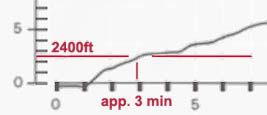
If that's right, it's not the problem I first suspected. Gobel found the alitide/pressure rigger at about 950 milibars, Leppard says, equivalent to 2400 feet. By the altitude profile in the AAIB report, that level was passed about two minutes after wheels up. Cabin, hold, and outside pressure should not be much different that low or early, right?
alt_detail_2400.jpg

So about 36 min after altitude.

Khreesat said something relvant to the variability within one unit (that is, from test-to-test):
Ed Marshman said:
Khreesat advised that the times are not exact and the time changes depending upon how long the timers have been tested after last being used. They usually reset to zero after a day. He used to test the timers three times in a row before installing the timer in a device. He found that in each test the time decreased. When this happened, he put the timers aside, and the next day when he tested them, they would run for the same time as when he had first started them.

And then, I made a video about the baggage arrangement, basically, but with some attempted 'oomph.' Couldn't afford a narrator, so... (cringe)
http://www.youtube.com/watch?v=UeLRsDSk500

All for now
Adam
 
I'm forgetting the details, but didn't the expert at Camp Zeist put a wider window of probability on it, and the 38-minute spot was still comfortably within that window?

Rolfe.
 
I'm forgetting the details, but didn't the expert at Camp Zeist put a wider window of probability on it, and the 38-minute spot was still comfortably within that window?

Rolfe.

and we cross paths again. Fraid I'm not geting... hold on...
I think Gobel was the expert there as well, and testified to the 35-45 spread. Somehow Leppard got a bit more detail in his book (likely got half wrong too). But yeah, 36 minutes for the timer, after the early trigger level, fits fine. Each capacitor timer unit thing (??) was different. The one in thee tuner tended shorter than the one in the BomBeat they took in. Forgot to add Khreesat explains that, too:
Kreesat via Marshman said:
The timers were made by the Fatah group in Damascus. He first saw these timers at the PFLP-GC camp in Syria and four of them were good, so he took them to use. One of the timers was a half-hour timer, one was forthree-quarters of an hour, and one was for one hour. Khreesat does not recall what time the fourth timer was set for. None of the timers were for more than one hour.
I know it's a lot, don't worry if you can't absorb it all personally. Just adding another E to the JREF, and it's such a long eeeeee now I've given up waiting for the final F. :D I leave you all to your devils.
 
For all those who care and don't, I haven't stopped looking into the evidence for the PA103 bomb first leaving the ground at London. So far nothing I've seen has changed my mind, and still no one here has been able or willing to help. It fizzled here but it continues elsewhere.

I see what Rolfe's been up to and i fully excuse her from this talk - rockin' it in the new non-US politics forum on Scots-UK issues and such. I've been meaning to pop in there , as I realize it's a big time, but first...

Made an adjustment with better info on the suitcase size - it was nearly square, 22x26in. Here's the placement Bedford describes then, done with silhouette 4000 cases that size
Bedford_arrangement_2.jpg

So my visualizing post had to be updated:
http://lockerbiedivide.blogspot.com/2010/01/visualizing-bedford-story.html
Still a good fit.

My thing about brown and gray material... big oops. The case was made of gray plastic, with only a copper skin. Dr. Hayes' descriptions I found later are much better. The bleaching issue might still apply, but not as clearly as I suggested.

More interesting is the giant fragment PI/911 that Dr. Hayes once felt was on the container floor well beneath the explosion. 10.5 by 11 inches, lined inside with delicate fabric. I think it's a decent clue that the Bedford cases were stacked right around the blast zone. Anyone else? What's up with the blue specks?
http://lockerbiedivide.blogspot.com/2010/05/monster-of-newcastleton-forest.html
 
I just need a bit of a break from this topic. Let what I've learned collate itself.

That schematic looks rather better. If you look at the photos of the mockups shown in court, the cases are quite big as regards the dimensions of the container.

I just think the London origin is so much a front-runner that I don't think it's necessary to have figured out exactly what happened. In real life, silly little details and minor coincidences can have a disproportionate effect on how things pan out, and there may have been some little detail we simply can't guess. It's the only scenario, after all, which has someone on the ground when Maid of the Seas is being loaded, and in a position (potentially) to influence the positioning of these cases.

Unless someone can come up with something else from another airport, I'm a Heathrow fan.

I'm just intrigued by the Erac printout apparently showing an item coming off KM180, and Megrahi being right there at Luqa when KM180 was boarding. Which is a topic for another thread.

Rolfe.
 
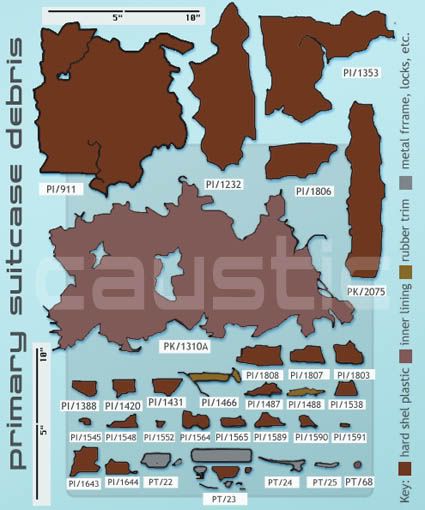
Regarding that fragment PI/911, this is really interesting. Here's my own tracing of the suitcase debris, as visible in some photos online.
Suitcase_Fragments_watermark.jpg

We can see numerous large pieces, including 20" uninterrupted fabric lining. The darker shaded area of backdrop is the size of the suitcase, 22x26". Clearly this doesn't show more than one such case, and in fact less than one. But so many large pieces and then really small ones. What accounts for the asymmetry if the explosion happened in the center of the case rather than above it?

Dr. Hayes at first felt that PI/911 (upper left) was
"Apparently the lower side of a suitcase, compressed and fractured in a manner suggesting it was in contact with a luggage pallet's base and subjected to explosive forces from above."

The bomb case was early on decided to be on the second layer and NOT touching the base.

Q What was it about the item that suggested to you that it was in contact with the luggage pallet's base and subjected to explosive forces from above?
A On the assumption that it might have been part of the suitcase containing a bomb, firstly the residual size of the fragment, which is quite large, and also the fact it appeared to have been supported in some substantial way by a relatively immoveable surface.


Yet his official report of much later noted something that would rule this out:
<i>“Small flecks of a blue foamed plastics material with a cross-hatch-patterned blue plastics skin were found strongly adhering to the simulated leather surface. This finding indicates that at the moment of detonation of the explosive device, this bronze suitcase was in direct contact with one containing a foamed blue plastics material. The items recovered from PI/911 were removed and raised collectively as item PT/42. “</i>

So... did he fail to notice the suitcase bits when he looked at it in January 89 and decided it was against the aluminum floor? Or did these flecks appear later to turn the secondary Bedford bag into the primary one?

It's alright, folks. Don't answer that question.
 
Last edited:
Great thread, everyone!
I have been examining some political aspects to PA103, and the motivational angle.

Andrew Killgore, in this March 2010 article;

http://www.wrmea.com/component/cont...er-look-at-the-destruction-of-pan-am-103.html

blabs on about a possible Mossad motivation, but;

The fascinating part of the article seems to come at the bottom, in the 'comments' section, where Richard Marquise, Patrick Haseldine, and Jim Swire go keyboard -to-keyboard.
Following that is an intriguing note posted by Patrick Haseldine asking 'Why Libya?" An interesting theory about Bernt Carlsson, the Assistant Secretary-General of the United Nations and UN Commissioner for Namibia, is among other ideas floated.

I think the specifics detailed in the thread are great- don't stop, but I haven't seen much linkage to the external factors regarding motivation, and how that affected the modus operandi.
 
Perhaps some one can explain whether I have my facts straight regarding the PA103 debris storage.
Was Section 41 (the nose area) stored at Roger Windley's junkyard in Tattershall, Lincolnshire, U.K.? I think the main fuselage and wings were all stored at Farnborough, Surrey, U.K. where an attempt was made to reconstruct the plane in order to analyze what had happened when the IED exploded.
If the above is correct, what was the reason for the separation of the nose from the rest of the aircraft? Not just after the crash, but current reconstructive analysis has Section 41 completely separating from the rest of the fuselage and striking the ground first.
 
In this thread, it has been shown that a hole was blown in the fuselage of the Boeing.
Call me naive, but if a hole was blown in the side of the aircraft, why did the nose (Section 41) separate from the section right aft of it (Section 42)?

I recall United Airlines Flight 811, on February 24, 1989, fly out of Honolulu which had an entire cargo door blow out, resultant sudden decompression, and that aircraft landed safely.

Could someone compare the explosive blast of the PA 103 flight with the effect of the cargo door flying off?

I'm just trying to wrap my thoughts around why the complete destruction of the Pan Am aircraft occurred, given a 450g block of explosive directed the blast outward. The United Boeing 747 landed safely after an area the size of a door blew off, suddenly decompressing the aircraft.

If this was dealt with in another thread, please point me there.

Thanks in advance.
 
Have you been through Robert Black's blog on the subject? Patrick Haseldine is a regular contributor and he has an idee fixe about Carlsson. No evidence, though. I've seen nothing to suggest Carlsson's presence on the flight was anything more than coincidental.

Have you read the Air Accident Investigation Bureau report on the crash? I think it's required reading before questioning the official version of the details of the breakup of the aircraft. The chances of this being some mega-conspiracy with scores or hundreds of people aware that evidence was being covered up or manipulated are negligible.

However, if you've got a case to put for the AAIB report being falsified, it's probably a topic for a new thread, as this thread is about the possibility that the bomb got past security at Heathrow rather than Malta or Frankfurt. I know there are a number of theories around this proposition, so it could be interesting to examine it.

There is another thread where some of the concepts have been dealt with, but it got pretty long, and Longtabber PE derailed it quite a lot. Also, it was really about the timer rather than the explosive as such. So, help yourself! :D

Rolfe.
 
Last edited:
Have you been through Robert Black's blog on the subject? Patrick Haseldine is a regular contributor and he has an idee fixe about Carlsson. No evidence, though. I've seen nothing to suggest Carlsson's presence on the flight was anything more than coincidental.

Have you read the Air Accident Investigation Bureau report on the crash? I think it's required reading before questioning the official version of the details of the breakup of the aircraft. The chances of this being some mega-conspiracy with scores or hundreds of people aware that evidence was being covered up or manipulated are negligible.

However, if you've got a case to put for the AAIB report being falsified, it's probably a topic for a new thread, as this thread is about the possibility that the bomb got past security at Heathrow rather than Malta or Frankfurt. I know there are a number of theories around this proposition, so it could be interesting to examine it.

There is another thread where some of the concepts have been dealt with, but it got pretty long, and Longtabber PE derailed it quite a lot. Also, it was really about the timer rather than the explosive as such. So, help yourself! :D

Rolfe.

Thanks. I appreciate the reading prerequisites. I have taken a look at the AAIB report previously, but thanks for providing the link for those that have not.

I'm not even hinting at any sort of conspiracy regarding PA103, in any way, shape or form. This thread seems to have dealt specifically with the blast location, characteristics, and resultant damage vis-a-vis the size of the charge, and I took off from there.

I appreciate the narrow scope of this thread regarding PA103, and mistakenly thought the questions asked were somewhat relevant.

It wasn't my intention to derail.

Now, back to the regularly scheduled luggage placement thread.
 
No, no, it's not a derail. It's just that there are so many different aspects of this affair that it's useful to deal with them on a thread-by-thread basis. I think for the purposes of figuring out if the bomb was infiltrated at Heathrow, we've been working on the assumption that it was indeed 450g Semtex placed as described. The idea that it wasn't, is a big enough subject to merit a dedicated thread, in my opinion.

Have you come across Charles Norrie's theories? He's convinced there were two bombs, apparently because the AAIB report refers to there being only one IED, which of course implies there was a second bomb which wasn't an IED.... :oldroll: And he thinks the IED was attached to the luggage container, not in a suitcase.

Then we have de Braeckeleer, who believes the bomb was attached to the airframe, not in a luggage pallet.... And so it goes on. A lot of it is blatant conspiracy theorising, but it would be interesting to hear any firm evidence supporting any of it.

Rolfe.
 
I'm not even hinting at any sort of conspiracy regarding PA103, in any way, shape or form.
Something makes me wonder, but, taking you at your word... why not?

Welcome to the discussion, SW. You seem to pose yourself as having studied the issue quite a bit.

In this thread, it has been shown that a hole was blown in the fuselage of the Boeing.
Call me naive, but if a hole was blown in the side of the aircraft, why did the nose (Section 41) separate from the section right aft of it (Section 42)?
It seems that way to me, a hole about the size of a dinner plate roughly 25" from where container AVE4041 was blown outward. Why would the plane fall apart after that? I'm no expert, but this animation makes perfect sense.
http://www.youtube.com/watch?v=j5naaWe3nLI
Decompression, loss of aurodynamic slip-through ability (???), increasing wind turbulence, and a chain reaction.

To delve further into this would probably be a derail and I won't be paty to it unless it's in a new thread.

I'm just trying to wrap my thoughts around why the complete destruction of the Pan Am aircraft occurred, given a 450g block of explosive directed the blast outward. The United Boeing 747 landed safely after an area the size of a door blew off, suddenly decompressing the aircraft.
Could be. Was that event at 31000 feet? If it's worth continuing with, new thread.

Now, back to the regularly scheduled luggage placement thread.

Well, it's the London origin thread, but luggage placement has been my personal interest for a while.

The other things about this theory that could be discussed:
- Bomb placement - how DID it come to be just 25" from the plane's skin? Pure chance for sure?
- The Break-in at Terminal 3 - covered-up until after the 2000 trial. Allows for possible bomb introduction during down hours.
- The 38-minutes after takeoff detonation, matching a Khreesat bomb loaded at Heathrow.
- The complete lack of evidence for the bomb coming from anywhere else.

Great thread, everyone!
I have been examining some political aspects to PA103, and the motivational angle.

Andrew Killgore, in this March 2010 article;

http://www.wrmea.com/component/conte...an-am-103.html

blabs on about a possible Mossad motivation, but;

The fascinating part of the article seems to come at the bottom, in the 'comments' section, where Richard Marquise, Patrick Haseldine, and Jim Swire go keyboard -to-keyboard.
Following that is an intriguing note posted by Patrick Haseldine asking 'Why Libya?" An interesting theory about Bernt Carlsson, the Assistant Secretary-General of the United Nations and UN Commissioner for Namibia, is among other ideas floated.

I think the specifics detailed in the thread are great- don't stop, but I haven't seen much linkage to the external factors regarding motivation, and how that affected the modus operandi.

I heard that was a good discussion but I haven't read it. Kilgore for one knows nothing except his own agenda. Just tried to read the comments, too much Haseldine. His theory makes only the tiniest bit of sense, not enough to bother with. Kill Carlsson and also 190 Americans? And then to exactly mimic Iran's revenge the way the Libyans are alleged to have?

There are different schools of disinformation (or something to the same effect) plaguing the quest for truth here. IMO, the most prevelant and destructive has been the "drug swap theory," which has obscured the London origin evidence up until roughly now. Since it helps set-up the London evidence as well as question the dominant CT paradigm of the past, I should link to my recent article on the issue.
http://lockerbiedivide.blogspot.com/2010/05/drug-swap-theory.html

What do you think, SW? Where did the bomb get on? Was it inside container 4041 with the luggage, or was that evidence faked do you think?
 
...it was indeed 450g Semtex placed as described.
To be a liiiittle more precise, no one knows, and estimated vary. I've seen 312 cited, etc. The Indian Head tests, run by people I don't trust (Feraday, Thurman, and Bell on one project? Yikes!). But their results suggested anything from 450g at the low end to 680 at the high end would be consistent with the damage.

I think there's room to wonder about two bombs, if not two proper detonations. I'm also totally not an expert.

Have you come across Charles Norrie's theories? He's convinced there were two bombs, apparently because the AAIB report refers to there being only one IED, which of course implies there was a second bomb which wasn't an IED.... :oldroll: And he thinks the IED was attached to the luggage container, not in a suitcase.

Evidence from misread semantics

Then we have de Braeckeleer, who believes the bomb was attached to the airframe, not in a luggage pallet.... And so it goes on. A lot of it is blatant conspiracy theorising, but it would be interesting to hear any firm evidence supporting any of it.

Rolfe.[/QUOTE]

De Braeckeleer has some great article on details of the case, but thhis oddball argument is based on math which i can't verify without some courses and a tutor. Yet it makes no sense. And he's a scientist by profession, he says, so to fail in your special field raises questions. Like Mebo failing at MST-13 analysis, or British investigators missing all the London intro clues...
 
I've never seriously doubted the thesis that the bomb was relatively small, but happened to tear a hole in the fuselage at just the right spot for decompression and aerodynamics to pull the plane apart. I can't see the AAIB investigators being entirely bent or mistaken to that extent. I'm kind of with the judges in feeling that the Mach Stem calculations don't really call the entire thesis into question in any case. And the pictures of the reconstructed plane were all over the TV at the time, showing what was supposed to have happened. It didn't seem that incredible. I can also imagine that a similar explosion might not cause a plane to break up, depending on the exact circumstances of placing, altitude, weather and so on. Maid of the Seas was flying into a 90 mph gale, I think.

The possibility of two small IEDs in adjacent suitcases, so that the explosion of one triggered the other and they appeared to be a single expolsion (which I think is Caustic Logic's idea) doesn't necessarily conflict with these observations though.

Caustic Logic said:
IMO, the most prevelant and destructive has been the "drug swap theory," which has obscured the London origin evidence up until roughly now.


Be fair, Paul Foot's 2001 report features it pretty prominently.

Rolfe.
 
Be fair, Paul Foot's 2001 report features it pretty prominently.

Yeah, it's petered off over time. Foot's booklet was better than average by a stretch, but still came across ambiguously on London vs. Frankfurt. Then Manly came forward (just too late to make the cut for Foot) and it started shaping up from there, but AFAIK no one else has championed the evidence in a book or video or any other form more solid than some internet articles, so it remains pretty obscured.

I wanted to return to an argument Buncrana was making earlier that I downplayed and I'm not sure why.

If the PLFP, or the Iranians, had someone working airside at Heathrow in any capicity, sympathetic to their 'revenge mission', although preferably someone with baggage loading knowledge, I really don't think it would be difficult at all to slip them a suitcase, triggered with the bomb, with the instruction to place it as late as was possible in the loading procedure into a container that will be as close to the planes outer fuselage as possible. If the Iranian Airlines gate was also adjacent to 103's, then access to the Pan Am flight loading containers and with the appropriate knowledge of how these would be loaded, would be dare I say, pretty uncomplicated to insert the suitcase containing the bomb.

This does make sense. If the Libyans could have agents working a civilian airport on Malta for terror purposes (and I agree it's possible), then why not Iranian agents at Heathrow? Perhaps Abu Elias was not so directly involved, but used his expertise to decided the best way to circumvent airport security and get the best placement is hand it off to someone who already works at the airport.
 
Well, was it?

Rolfe.

Oh, well, I think so. I read it somewheres, next to or near, but don't know the airport layout enough to say where means what so I didn't bother sorting it out.

On support, let's see: Wikipedia says this:
Iran and the London angle

Towards the end of the bombing trial, lawyers for Megrahi argued that the PA 103 bomb could have started its journey at Heathrow, rather than at Luqa Airport in Malta. The Boeing 747 that was destined to carry the 259 passengers and crew on the London-New York leg had arrived from San Francisco at noon on December 21, 1988, and stood unguarded on the tarmac for much of the period before PA 103's passengers began to board the aircraft after 17:00 (scheduled departure 18:00). The Iran Air terminal in Heathrow was adjacent to the Pan Am terminal, and the two airlines shared tarmac space. The lawyers invoked the 1990 Scottish Fatal Accident Inquiry and the evidence it heard that the baggage container AVE 4041, into which the bomb suitcase had been loaded, was left unsupervised at Heathrow for about forty minutes that afternoon.

I hate that "left alone 40 minutes" line. It wasn't unsupervised, Kamboj was watching it. And it's what happened in that time that matters - the introduction of cases matching the presumed bomb bag.

Anyway, Wikipedia's not the best source, but Carl Davies' book says this:
During one of my interviews with Bollier, he told me that the Iran Air terminal was next to the Pan Am terminal at Heathrow

Well that doesn't sound good either.

Gareth Peirce, better:
Since the trial, evidence new to the defence but known from the start to the police has surfaced of a break-in at Heathrow in the hours before the disaster. The Fatal Accident Inquiry, which didn’t have this knowledge, had made a finding in 1991 that Pan Am 103 was ‘under constant guard at Heathrow’. Iran Air’s hangar at Heathrow was next to Pan Am’s.)

A side-note, Der Spiegel, citing one Abolghasem Mesbahi as “a credible witness” and reported his story:
“The bomb had been loaded in single pieces at Frankfurt airport into an aeroplane to London. The head of Iran Air at Frankfurt at that time, a secret service man, had smuggled them past the airport controls. They had then been assembled in London and put on the Pan Am clipper.”
Ooh, ooh, that explains everything! :rolleyes:

That's the closest the credible and London-hinting Foot gets to confirming any proximity. So, I'm not as clear that there's anything to it. Just being at the airport might be plenty, I don't know. I'm sure if there were a will there'd be a few ways.
 
I think Gareth Pierce is simply compiling from the same sources we are using, so I wouldn't give her article any special credibility. Remember, she's an English solicitor who only came into the frame very recently, and this case was Scottish. And I wouldn't trust Bollier to tell me the time of day. However, the proximity of the airlines does seem to have reasonably wide currency among fairly credible commentators, and not to have been contradicted.

Rolfe.
 

Back
Top Bottom