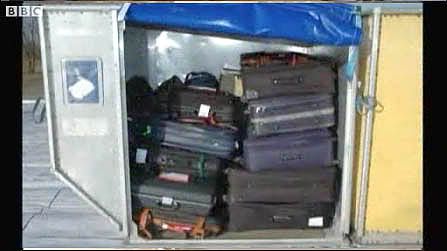
Lockerbie: London Origin Theory

Hmmm... That's my main thought. I wish I had more time today.

Now I'm thinking if a bomb bag were slipped in as not interline, how does it get to that shed unless someone puts them there? It could be after finding them sitting somewhere or knowing more than that. I was visualizing the simplest - an employee (not proper insider) is co-opted for a one-time deal, money paid to get the "drug" bags on board.

It gets easier yet if we take the regular drugs route notion speculated for Fraknkfurt and make it happen at Heathrow...

CL, could you double-check what you've done there? It just seems to me the finding of the court, from Bedford's evidence, was that the mystery bag was originally seen in the container very close to the location of the actual explosion - hence the theory that it had been "moved to some far corner of the container", to explain the fact that it wasn't among the damaged items.
I'm just goig off what Baz said for placement. But Claiden did say aft (front side when loading) and outboard, and there was that calculation shwing 25 inches (or less) from the hull, so it had to be near that spot, on the sloped floor. It is pretty near where the Bedford bag were placed, but not near enough that it could be there without being rearranged.

By the way, there's a detailed description of the state of the floor of AVE4041 in the AAIB report. It wasn't missing, it was heavily bent downwards under the explosion so that it hit off the floor of the cargo container and split.
Indeed, "guillotined" Claiden says, as well as "sandbagged." I was wondering if by floor they meant the main flat stretch or also the sloped part that would have been actually under it. I need to study it some more before I even know what they're saying fully.

Buncrana, the diagrams are helpful and thanks for the index. You may note in figure F4 that floor panel drawing does't seem to include the sloped floor. but does show major damage right under the Bedford bags location! F3 is the same in photo, first I've seen of the floor. Again, square with no sloped section. Ossum stuff.

Ah, F6 covers that potion - the left side recpvered (severely distorted out) and put in place. Of the other half, one small bit from the middle (??) was found, dangling from the frame in the photo. Okay, so there's damage on both floor panels, all centered in that corner. Further work is needed.
 
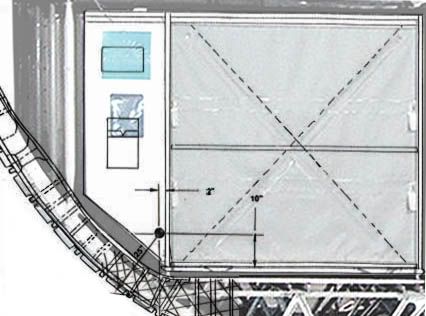
Thank you Buncrana for the PDF. This appendix F is amazing. Combined with Claiden's testimony, we can really see what's going on. Figure F-13, Wow.
AVE4041F13.jpg

:tseek:
25" this way means on the floor, the sloping part, almost right on the dividing beam. So it's 10" above the main floor over there that it wasn't even on? Is that anywhere near as lame a dodge as it's seeming to me?

And as I guessed, about 60% of the lower panel of the outboard end (the sloped floor), the half the bomb bag was resting right on by their own figure F-13 was not recovered or identified (that shaded yellow below, AAIB report fig F-6). Except ... a piece called AI 100 "provisionally" felt to from the smack middle of that ("e" below), with no references or anything to match it to.
AVE4041F6A.jpg

It corresponds with a spot right under the bomb, but I would guess it really came from somewhere else and, on a closer look, showed no signs of direct explosives exposure.
 
Last edited:
Update - apparently the LD3 model can be used as well in a 747. The AAIB appendix, in the schematics posted by Buncrana above, it's shows as a LD3 model, and the dimension are indeed off from what I've been working with. Same wiki as above then, dimensions
(base width / overall width _ depth _ height)
156 / 201 × 153 × 163 cm
(61.5 / 79 × 60.4 × 64 in)
I noticed a mismatch with that figure 13 - the overhand drawn there didn't match my graphics, it didn't hang out as much.

And what was reflected in the graphics above was
(base width / overall width _ depth _ height)
156 / 234 _ 153 _ 163 cm
(61.5 / 92 _ 60.4 _ 64 in)
So the flat floor pane is the same, but the outboard (sloped) portion and overall container is shorter than shown here by 13 inches.

I'll work that back into the stuff I was just doing wrong and pop back later.
 
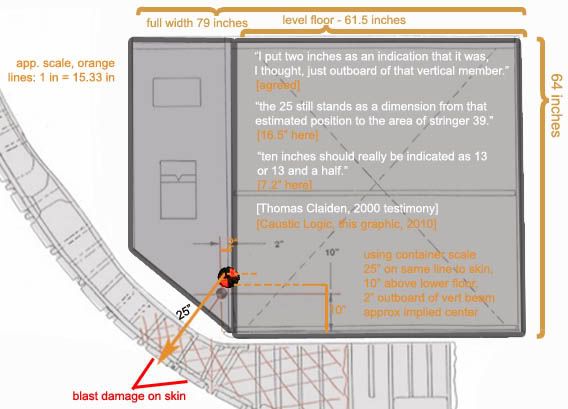
That Figure 13 showing the 25"/10"/2" nexus is puzzling.
AVE4041F13photocomp.jpg

First I used my planar surface graphics theories on a photo of a LD3 container face loaded in a cross section of a similar fuselage. Skewed so the most points possible matched, it all matches. This confirms the graphic is accurate per container-fuselage distance given the same type of bracing system.

It's the little numbers attached to those distances that are a bit wrong. I'm not sure if the numbers or the diagram is more accurate, or if I'm wrong, and it's not a big deal any of those ways. But using the LD3 proportions, image scaled so 1"=15.333", all approximate but that spot to the skin on that line is 16.5-17 inches, not 25, and the 10 is about 7.
AVE_4041_IED_loc_side.jpg

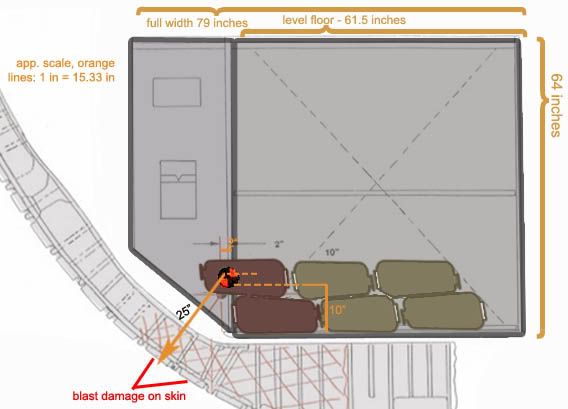
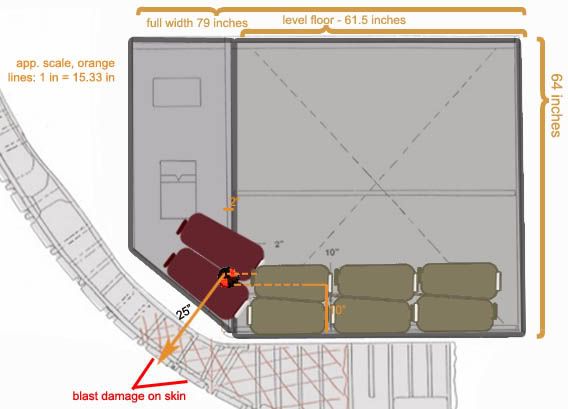
Anyone can do analysis better than that, feel free. Claiden is confusing me, on days 10 and 11 of trial, correcting the 10 the wrong way it seems to me, to 13, but affirming the 25. But I'm calling it somewhere near there, around my larger red target. The 2" thing is good reasoning - see figure F-9 - the blast was from within that outboard portion, but other clues say not very far within. That tends to mean low, like floor-ish. Considering again the thickness of the bags, roughly, we're at level one or two, depending. It seems to me this is what Claiden is seeing:
AVE_4041_IED_loc_1.jpg

But something this might also work:
AVE_4041_IED_loc_2.jpg


Two brown hardside samsonites, if not matching then close, seen <i>right next to there at floor level</i>, they're moved ... somehwere else ... and a single alleged third brown samsonite hardshell winds up just to the left and barely above where they had been before moved.

It's Possible! Wow! And that's it. No more credulity to spare.

And with such an obvious, dangerous, embarrasing solution being that evident from Bedford's story plus this damage - it's remarkable the crown never saw fit to dig through the recovered luggage and display these two bags and put the whole thing to rest? BOTH Bedford bags, the 2/3 of the IED-style items ever allegedly in that corner of AVE4041 just - vanished.

Only the one made up on computer paper was recovered.

Zeist Guys said:
[25] It was argued on behalf of the accused that the suitcase described by Mr Bedford could well have been the primary suitcase, particularly as the evidence did not disclose that any fragments of a hard-shell Samsonite-type suitcase had been recovered, apart from those of the primary suitcase itself. It was accepted, for the purposes of this argument, that the effect of forensic evidence was that the suitcase could not have been directly in contact with the floor of the container. [...] It is true that such a rearrangement could have occurred, but if there was such a rearrangement, the suitcase described by Mr Bedford might have been placed at some more remote corner of the container, and while the forensic evidence dealt with all the items recovered which showed direct explosive damage, twenty-five in total, there were many other items of baggage found which were not dealt with in detail in the evidence in the case.

A pretty good summation of this weak reasoning can be read here:
 
Only one of the two "mystery bags" Bedford saw was a brown Samsonite though, wasn't it?

I'm curious to know where the bags were seen by him in the container, compared to where the explosion happened. I'm also curious to know how the container would be stacked - how many bags in each dimension? There were 40-something altogether.

Rolfe.
 
Only one of the two "mystery bags" Bedford saw was a brown Samsonite though, wasn't it?

I don't know why we have this "Beford bag" singular thing, or why he singled out one for mention (which one?) other than a thought this (one of 'em) was THE primary suitcase, warping the recall. Bedford, Jan 9 1989:
They were hard suitcases, the type Samsonite make. One was brown in colour, and the other one, if it wasn't the same colour, it was similar.

That reads to me as if they were the same model and apparently the same color. He almost seems to be second-guessing the impression they were a matching set. Quite coincidental I'd think if coincidental. I don't know if he ever clarified that under questioning anywhere.

I'm curious to know where the bags were seen by him in the container, compared to where the explosion happened. I'm also curious to know how the container would be stacked - how many bags in each dimension? There were 40-something altogether.

Rolfe.

As for the loading details, here's all I have ATM for placement:
Jan 9 statement: "Lying on their sides in front of the other suitcases, handles pointing towards the back of the tin, were two suitcases." [day 44, p 6463-65]

Fatal Accident Inquiry: "Q Where was that tin when you saw it?
A In the front of the container, lying down
Q Again in relation to the photograph that we have looked at in Production 42, photograph 1, can you point to where that case was when you saw it?
A Just there?
Q Indicating the left-hand case which is lying flat on the floor in the
front of the container?
A Yes, sir.
[...]
Q With regard to the suitcase that you saw lying down flat to the left side of the container, I would like you to think back as best you can. Could that suitcase have been a blue suitcase with a maroon or brown trim?
[day 44 pages 6482-85]

Later loading is addressed too, with handlers who filled 4041 from the feeder questioned. That may be day 44 as well, looked tedious and I wouldn't expect any concrete clues. I'll have to read those sometime ... I doubt we can pin down just how it was loaded - it sounds idiosyncratic and variable from person to person or even bag to bag. Blue ones first, one layer at a time, front-to-back, half this way and half turned the other...

We know about where the bomb was (presuming the CONTAINER wasn't faked ... probably not) and so where the bags were first placed is most important to establish, and next most any clues as to where they might be moved.

It's a total puzzle thing and I have a headache by now. So I'll take a break. Anyone else want the microphone for a bit?
 
Last edited:
This breakdown really is excellent Mr Logic! So, it would seem the most likely position of the case was on the bottom layer given the extensive damage to the contianer floor? Not conclusively, but on balance, not to mention the gauging of measurements, unless the suitcases were either slimmer than we assume or weighted down by cases above crushing them down onto the base? Then possibly 2nd from the bottom? yes.

If I were a betting man, I'd wager on the floor, resting just about on the angle of the container.

And we have Carlsson's Tourister which was officially determined to be next above the bomb bag? Only with slight damage if I remember.

Bedford was told by Kamboj that he had put the 2 bronze/brown suitcases in the container at the time, although later denied, it would seem to me that there would be no reason for the all bags to be rearranged if both men at the time accepted they had been placed there by one of them. I'll check the transcript again later, but didn't Bedford state the bags (anywhere between 5 and 8 bags) he had initially placed on their spines, were now also lying flat in the container with the two extraneous cases he observed after returning from his break?

The container is then taken out of the build-up shed and filled up with the interline baggage arriving from Frankfurt. Quite why the Judges performed the leaps of logic in order to have these cases then all rearranged in such a manner that it could not be Bedford's two unknown cases is anyones guess, but given the vague evidence already presented that the case must've been put on at Luqa, then they had to find a way I suppose.

Court Evidence Primary Suitcase Debris

As none of the one or two bronze or brown Samsonite cases claimed to have been seen by Bedford were recovered from the scene, except for these shattered remnants, I think it is possible that this court production said to be from the primary suitcase is in fact the 2nd Bedford case, and the primary suitcase was completely obliterated, while Carlsson's case was merely in the container which housed the bomb suitcase.
 
Alright, we are getting somewhere now.

As far as the explosion center, the AAIB said it was 25" from the hull, abd Baz says 15" from the container's outboard wall. Considering 10 or maybe 12 inches maximum between container and fuselage, this is reasonable.

Excellent diagrams, though now I need to throw a spanner in the works.

Testimony of Chris Protheroe Day 10 at the Zeist trial summary here. He outlines to the trial the effects of the "Mach Stem" blast effect.

He wrote the section of the AAIB report that originally puts the explosion centre at 25" fom the skin of the fuselage - as per the AAIB diagrams.

He revises this in court - saying he miscalculated and the explosion centre is 12" from the fuselage skin.

Can you adjust the diagrams of the loaded cases so that they are 12" from the skin of the aircraft? Does that even fit?
 
Sorry if I've seemed overly-terse or summary as of late. That was a real headache, but my mood's better now. I've been a little strong on the two bags front, but that's in case it is true and we've been missing it so far. I think it's an important distinction.

This breakdown really is excellent Mr Logic! So, it would seem the most likely position of the case was on the bottom layer given the extensive damage to the contianer floor? Not conclusively, but on balance, not to mention the gauging of measurements, unless the suitcases were either slimmer than we assume or weighted down by cases above crushing them down onto the base? Then possibly 2nd from the bottom? yes.

Thanks, mate. First, the inches I'm working with are theirs - the 25" is from a math formula (Mech Stem, right?) and I don't touch math usually. I'd suspect it was a bit less than that, but NOT the revisionist 12" of Protheroe and Bollier. Say... 19"? The 10" up dimension seems spurious, I think from a hole in the next container over being 10" up? The 2" could be just one, or 2.5, but over zero. I would guess all in all their figure 13 location is about right, even though the numbers attached are a bit off.

Clearly it was low. See figure 9 where the structural metal is worst damaged at the very bottom, so THAT looks like layer 1. Blast damaged, direct contact, about as low as possible. The floor directly under the position, chunks of both level and sloped panels, was all unrecovered/unidentified. It could be fractured away from indirect force or obliterated with direct force. My money's on the latter. What it cannot be, clearly, is analyzed to support this key plank of the ruling:
"the effect of forensic evidence was that the suitcase could not have been directly in contact with the floor of the container."

That being: "the first thought that came to mind -- and it's very difficult to prove it from that alone, or prove it, indeed -- but the first thought was that that surface had been protected, and I presumed by a piece of baggage, part of a piece of baggage, or whatever, but something that did not allow the direct effects of an explosion to actually impinge upon that surface."
T. Claiden, day 44 p 1512

What surface? UNLESS they got that info from AI 100, the letter e in figure 6 above.

If I were a betting man, I'd wager on the floor, resting just about on the angle of the container.

If I were a betting man as well, we'd be getting no money from each other. Hey, anyone want to be me on this?

And we have Carlsson's Tourister which was officially determined to be next above the bomb bag? Only with slight damage if I remember.

OoC, para 25: It was submitted that there was evidence that an American Tourister suitcase, which had travelled from Frankfurt, fragments of which had been recovered, had been very intimately involved in the explosion and could have been placed under the suitcase spoken to by Mr Bedford.

:confused:

I do have to admit that Carlsson's bag being in such close proximity starts to make Mr. Haseldin'e musing seem at least of tangential importance.

---
 
Excellent diagrams, though now I need to throw a spanner in the works.

Testimony of Chris Protheroe Day 10 at the Zeist trial summary here. He outlines to the trial the effects of the "Mach Stem" blast effect.

He wrote the section of the AAIB report that originally puts the explosion centre at 25" fom the skin of the fuselage - as per the AAIB diagrams.

He revises this in court - saying he miscalculated and the explosion centre is 12" from the fuselage skin.

Can you adjust the diagrams of the loaded cases so that they are 12" from the skin of the aircraft? Does that even fit?

That does not fit. Bollier loves it, says bomb was outside the container. Whatever math Protheroe did for whatever reason, I dunno but it can't trump Beddford's bags, inside the container. I'm going for between 12 and 25. Anyone able to actually check the math?
 
Do we have any more than Patrick's say-so for what happened to Carlsson's suitcase?

The official evidence has the American Tourister underneath the bomb bag and badly damaged. That suitcase came from Frankfurt. Then we have Patrick's story that Carlsson's sister was shown a very badly damaged suitcase which was alleged to have been her brother's, but which she didn't recognise. She was allegedly told it had been under the bomb bag.

I think the name of the owner of the Tourister is known. I don't even know if we have independent confirmation that Carlsson's luggage was even in AVE4041. If it was, it must have been among the stuff Bedford loaded, because he didn't come off PA103A as far as I know.

How does all that square with this mock-up, by the way?

Newsnight_Wyatt_test_2.jpg


Would that have been how it was loaded?

Rolfe.
 
For me, what this is all about is trying to figure out how the explosion was arranged to be so close to the skin of the aircraft. If the same result would have been achieved with the bag anywhere in the container it's not so important, but we're led to believe that if the bag had been at the other side, the hull would not have ruptured.

Did the terrorists realise this? Did they fondly imagine that the explosion would have the desired effect anywhere in the container, and the placing was pure evil luck? Jibril wasn't exactly an amateur at this, and his group did hit an airliner at an earlier date than limped home with a hole in a luggage compartment. I find it hard to believe that any terrorist group wouldn't have researched this and worked it out. I understand there are formulas you can use to calculate the volume a particular amount of explosive would destroy.

To get the expolsion close to the skin, three approaches are possible. A shaped charge attached to the aircraft itself, a similar thing attached to the baggage container, and a suitcase positioned just right.

Bollier and de Braeckeleer favour the first idea. They pick up on the Mach Stem Effect calculations and say the explosion was outside the luggage container. But I can see why the judges hand-waved that away. The damage to the container definitely suggested the explosion was inside it. And how the bloody blue blazes did someone manage to place a bomb on that plane while it was at Heathrow, for all of about six hours on a busy afternoon? These calculations can't be that accurate, and they have to take into account the other evidence.

Sabotaging the container seems even less likely to me, however hard Charles promotes the idea. How long would the bomber really have to do this, after the containers were labelled up for the flight? Even if he just sabotaged a Pan Am container at random, not caring which flight or when, it's difficult to believe such sabotage would go unnoticed on such a flimsy item. And then again, I don't think the container shows the sort of damage you'd expect if the Semtex had been applied directly in contact with the frame.

I think it has to be a suitcase, almost certainly one of the Bedford suitcases. My main question is, how did it get into that position? Just pure luck? Or was the original placing as described by Bedford already more or less there?

Rolfe.
 
Last edited:
Do we have any more than Patrick's say-so for what happened to Carlsson's suitcase?

The official evidence has the American Tourister underneath the bomb bag and badly damaged. That suitcase came from Frankfurt. Then we have Patrick's story that Carlsson's sister was shown a very badly damaged suitcase which was alleged to have been her brother's, but which she didn't recognise. She was allegedly told it had been under the bomb bag.

I think the name of the owner of the Tourister is known. I don't even know if we have independent confirmation that Carlsson's luggage was even in AVE4041. If it was, it must have been among the stuff Bedford loaded, because he didn't come off PA103A as far as I know.

I've got no inside info on that. I thought it was substantiated as his bag, maybe, but maybe it wasn't.

How does all that square with this mock-up, by the way?

[qimg]http://i133.photobucket.com/albums/q62/chainsawmoth/127-911/Newsnight_Wyatt_test_2.jpg[/qimg]

Would that have been how it was loaded?

Rolfe.

We just can't know. With the number of different ways, chances are it was different from that arrangement. But it might have been like that. Day 44, I think, might explain it...

For me, what this is all about is trying to figure out how the explosion was arranged to be so close to the skin of the aircraft. If the same result would have been achieved with the bag anywhere in the container it's not so important, but we're led to believe that if the bag had been at the other side, the hull would not have ruptured.

Did the terrorists realise this? Did they fondly imagine that the explosion would have the desired effect anywhere in the container, and the placing was pure evil luck? Jibril wasn't exactly an amateur at this, and his group did hit an airliner at an earlier date than limped home with a hole in a luggage compartment. I find it hard to believe that any terrorist group wouldn't have researched this and worked it out. I understand there are formulas you can use to calculate the volume a particular amount of explosive would destroy.

This is a thorny one. I don't want to say anyone at the airport would knowingly place a bomb to destroy the plane, but anyone told it needed to be on the outboard panel would have to suspect that's what they were doing, or be pretty dense.

Previously I've been visualizing the placement Bedford reported as on the far left of the flat portion, but is it possible by "left side" he meant way to the left, like on the sloped floor? I don't think so, but if Kamboj didn't scoot them over there, then who did and why?

Luck is possible, but it seems stupid to rely on it for something this important. It could be they remained about there, being close enough - the placer could be told "left side" and perhaps not understand what this means re: fuselage - it's just the side the "New York guys" will be looking on for the drug bags. It's also quite possible he was told to get it in early, since they'd be looking on the bottom layer. Bottom and left will largely do it. And if they were shifted up on the outboard panel afterwards, I'd call that extra luck well before considering a whole second inside helper.

Sorry I don't have more to say here, but I'm putting together the container damage evidence relative to the Bedford bags
http://lockerbiedivide.blogspot.com/2010/02/forensic-elimination-of-bedford.html
A couple things: This is what Claiden seems to think happened - it was both "on" the main level floor, AND 2" outboard of its edge. His figure 13 location image, bags to rough scale, narrow ends, both placed by Mr. Kamboj and later only stacked one on the other and slid left.
F13_claiden_overhang_theory.jpg

Thomas Claiden said:
“…it seemed more reasonable to me that had the centre of such an explosion been, let's say, in the suitcase above the one on the floor, but was overhanging the edge of that suitcase -- which, from the geometry of the container, I think, is quite likely […] rather the device, wherever it was in that suitcase, was totally or partially overhanging the edge of the lower suitcase, then it seemed more reasonable to me that we would see the damage we have, where the edge member would be exposed directly to the underside of a suitcase containing the device, whilst the lower suitcase protected the surface from blast effects…” [day 11, pp 1516-17]
His figure 4 does seem to complicate things a bit - well, actually the damage to the base edge does so. It tends to indicate a center of force a little further forward of the position I thought.

And finally, as we can see, a Bedford suitcase could quite easily have come to be on a second layer, and have been in direct contact with the floor that wasn't examamined or even considered a floor. It's the "lower panel" of the "overhang section."

Can anyone else with the transcripts dig a bit on that "AI 100"? What the heck did he decide on that for? Again, that's the label "e" in figure 6:
AVE4041F6A.jpg
 
Last edited:
Excuse my ramblings and regurgitating of the events and conclusions regarding Heathrow.

Bedford stated he had seen two hardshell suitcases, Samsonite style, and of brown or bronze colour. Although he could not be absolutely certain of the colour at Zeist, he had made his initial description of the cases and their colour on Jan 9th 1989, and therefore one would expect rather more clarity from his memory 2 weeks after the event as oppose to 11 years. Bedford had placed anywhere between 5-8 suitcases, on their spines, into the container AVE4041 in anticipation of the arrival of 103a from Frankfurt. The two additional hardshell suitcases as related to in his statement of Jan 9th, had been seemingly introduced into the container in the baggage build up area while he had taken a break and left the container and it's contents under the supervision of Kamboj who, with the supervisor driver/loader Crabtree, would be responsible for loading the baggage into the container and then onto the Maid of the Seas .

Bedford claimed, on his return from his break, that Kamboj had stated he had placed the two extraneous suitcases into container 4041, altering Bedford's initial loading of the cases on their spines, as all the baggage were now lying flat on the container floor. In addition to all this, Bedford initial statements given to the anti-terror police on 9th January 1989, seemed to match the forensic scientists associated with the AAIB report assessments of the exact placement required for the bomb to cause maximum damage with the amount of explosive which was restricted when contained within a radio/cassette player.

Baggage loaders at Heathrow acknowledged, once a container was partially loaded in the build-up shed, rearrangement of baggage within that container to accommodate additional luggage from other flights was a common occurrence, as would be quite possible with the arrival of 103a.

However, neither Bedford, Kamboj or Crabtree have at any point recollected this being done with container AVE4041, after leaving the baggage build-up shed and before it was loaded onto 103 at Heathrow. No evidence was presented, during the statements taken in Jan '89, or at Zeist, that rearrangement of AVE4041 had occurred prior to it's loading onto 103.

Once again however, where there was absolutely no evidence, the judges accepted this rearrangement must have occurred given that the primary suitcase, containing the Toshiba bomb, had arrived via Malta/Frankfurt, and was not one of the suitcases observed by Bedford. And again, the assertion made by the prosecution, and concluded by the judges was that the culprit was relying on luck and chance that the primary suitcase surreptitiously loaded at Malta and passing through Frankfurt's airport and security would be unwittingly loaded into just the correct position to cause the precise damage required in order to trigger the disintegration of Maid of the Seas less that an hour after it left Heathrow.

This is simply irrational and absurd.

Given that the remnants of one hardshell suitcase recovered from the crash was determined to be the primary suitcase, and it had according to the prosecution, arrived via Malta/Frankfurt, it is therefore apparent that TWO other suitcases, observed by Bedford but judged to have been rearranged in the container, and of a very similar variety, and from the same luggage container, were never recovered. So, aside from the pieces of the primary suitcase recovered, absolutely no partial remnants, badly damaged pieces or any debris whatsoever has ever been recovered which would account for the suitcases which Bedford claimed had been introduced after he had started loading container and the judges asserted had been repositioned in AVE4041.

Also, given we only have the debris of one hardshell Samsonite recovered, is it possible (and I've heard it suggested before) that there may have been 2 devices which went off in the hull of 103? That is, both of the suitcases observed by Bedford. This would certainly cut down on the chances of both bags being rearranged in such a manner neither would penetrate the fuselage? Theye are not being x-rayed or examined and therefore whether one or both of them is irrelevant in terms of risk of discovery, but certainly increases your chance of successfully bringing down the aircraft significantly.

Now Kamboj later denied he had told Bedford he had place the two hardshell suitcases into the container after being initially loaded by Bedford and while he was on his break. This change of view from Kamboj is completely understandable given the possible implications that this admission would have had for himself. Clearly this admission, if judged to also have been the actual bomb suitcase, would also do no favours for the Heathrow authorities, and as the significance of these lax loading procedures at a UK airport together with the knowledge of the warnings and the Neuss arrests, ultimately the UK government would face growing questions and criticism.

If it is accepted that, on balance, and given the need by the bombers to have the exact location of the suitcase a requirement of a successful mission, the suitcases observed by Bedford fulfil these requirements. It follows that Kamboj could be seen as a number of things. At worst an accomplice to the bombing, at best wholly incompetent in his duty in introducing the baggage while not properly examined, or even not securing the container and allowing the primary suitcase to be introduced without his knowledge. The very fact that Kamboj did not simply disappear from his Heathrow job, and was also available for the court case at Zeist 11 years later, would suggest that although it could be determined he had been incompetent and party to allowing the bomb bag into AVE4041, thus 103, he was not a knowing accomplice to the actual bombing.

The break-in would allow the introduction of the primary suitcase to the secure airside area and possibly delivered to a Heathrow accomplice or secured somewhere where it would not be discovered for the following 18 hours. The bags are then brought to the outer area of interline shed, where the bags were unsecure according to Crabtree, and introduced into container 4041 in precisely the position the culprit knew was essential for the bomb to succeed. It was from that point, with the knowledge that 103a was arriving and the extremely tight schedule to be met by the baggage handlers in loading 103, they relied on it not be moved any significance distance within the container which it had just been placed.

Whether this would be accomplished due to in large part to the lackadaisical attitude of Kamboj or the overall half-assed security which existed at Heathrow, and the baggage build-up area, I am inclined to believe both are instrumental into the facilitating the bombs insertion on 103.
 
Last edited:
Can anyone else with the transcripts dig a bit on that "AI 100"?

I'll try some digging on that later, if you have the whole bundle of them in the .tar file the easiest way to go digging for exact phrases is with winRAR.

Open tar file with rar click "find" and then put whatever phrase you are looking for in the "string to find" section.

"AI 100" only ever appears in testimony on day 11.
 
The break-in would allow the introduction of the primary suitcase to the secure airside area and possibly delivered to a Heathrow accomplice or secured somewhere where it would not be discovered for the following 18 hours. The bags are then brought to the outer area of interline shed, where the bags were unsecure according to Crabtree, and introduced into container 4041 in precisely the position the culprit knew was essential for the bomb to succeed. It was from that point, with the knowledge that 103a was arriving and the extremely tight schedule to be met by the baggage handlers in loading 103, they relied on it not be moved any significance distance within the container which it had just been placed.

That makes a *lot* more sense than any bag arriving from Malta via PA103A.
 
That makes a *lot* more sense than any bag arriving from Malta via PA103A.


Of course, it still begs the imponderable question, why 103?

Why wait the 18 hours after the break-in, not only increasing the likelyhood of detection, but that given the breach to airside facilitating your possession of the said bomb, security would also presumably be more vigilant in that immediate aftermath?

If your target is the US, why not choose any number of flights that were both an American carrier and destined for a US city on that day?

Was the knowledge that the McKee team were booked on that flight seen as an added incentive to target that particular flight? Or perhaps UN comissioner Carlsson?

Or were the group planning the bombing aware that 103 was being also used in an covert operation involving controlled drugs opertaions which would present the investigators, especially British, US and Germans with a huge problem to explain?
 
Buncrana, your post 34 was pretty awesome. I agree with almost all your facts and sentiments. I hadn't read about Crabtree yet, but here's another interesting bit on how Kamboj came to be alone with the container, again laced with denials:
In cross-examination Mr Davidson asked the witness if he recalled having a break that afternoon and on his return to the shed Mr Palmer [sic] left for the day. He said he did not.
It's Parmar. Did Kamboj urge him to go home? It whittled the Pan Am/Alert crew down to two, and when Bedford went on break and it was down to only Kamboj, that's when the bags were placed.

By him, perhaps not, but who else would be able to walk in without standing out even more? If I had an insider, I'd use him and say "put it on the left-side floor" and hope he didn't put 2+ together until after the plane came down. And then it's clear he'd do nothing but deny it.

As far as re-arranged luggage, I don't think that happened at that time:
Bedford said:
"I went to see Peter Walker in baggage build-up leaving Camjob in interline. I returned about 4.40 p.m., Camjob told me two further suitcases had arrived for PA 103 which he had put in the tin. I looked inside the tin and saw the suitcases that I had put in the tin still in the same position. Lying on their sides in front of the other suitcases, handles pointing towards the back of the tin, were two suitcases. They were hard suitcases, the type Samsonite make. One was brown in colour, and the other one, if it wasn't the same colour, it was similar. In size, they took up the remaining base area of the tin. [day 44, p 6463-65]
LTBU daily report, 25 Aug

Ambrosia: thanks for checking it's only in Day 11. I think I checked the whole day and it wasn't specified what AI 100 was used for. It has no place there and seems a stupid piece to even expect to find, considering his own finding about IED placement.

I agree the break-in makes sense in happening during down hours, and well enough before the bombing that people may have been on gaurd that morning and even afternoon, but feeling it was a false alarm by 6pm. That's a smart thing to do. It also fits with the earlier distraction of Frankfurt, mentioned in the Helsinki warning AND indicated by the Autumn Leaves thing - keep people focused one time or place, only to get the bomb in elsewhere or later.

As for why 103 was targeted, I have a hard time accepting a willful sacrifice or a terrorist bent on killing McKee. If this flight was younger than usual, due to the few young kids and numerous college students, that might make it appropriate as revenge for IA655, huh?
 
Last edited:
Oh, and to help get this awesome thread into page 2 territory, allow me to add, as I had forgotten, that it seems utterly stupid now to suspect the bomb came from anywhere else. Considering how important, nay necessary this placement was, the blind luck needed from sending it interline is unacceptable. You'd need someone at Heathrow rearranging it after it came in from wherever, IF it wasn't stopped first.

And if you've got someone at Heathrow, then why not just hand the bags to them?

Is this a bit scary? Isn't Sulkash Kamboj a real person? Was he ever adequately quesioned? What does it mean for us and the forum to be discussing this? Is he going to sue us for libel or something? Will "they" just cancel the Internet to keep this discussion from going forward into the 3-D world? It's nerve-wracking.
 
Yes, indeed, thanks to Buncrana for that summary.

I hadn't realised both bags Bedford saw probably fitted the description of the bomb bag. I was misled by all that stuff about one of them maybe being blue. I'm also realising the container is smaller than I had been imagining. Possibly smaller than it appears in Caustic Logic's diagrams. Look at that mock-up to see how few suitcases actually fit on the floor area available.

So Bedford's initial statement indicated that one or both of the mystery suitcases were pretty much in the position of the bomb bag when he saw them? That's what I had surmised from the court judgement. I'm now a bit hazy about just when the interline bags were shifted to be placed flat, though. I thought they were still on their spines when Bedford knocked off, but Buncrana thinks they were flat by then?

The oddity is the conclusion that the suitcase under the bomb bag was one of the Frankfurt ones. If that is accepted, it suggests a fair bit of rearranging when PA103A was unloaded, because otherwise all the Frankfurt bags would have been on top of the Heathrow ones. I know they had reasons for believing the Tourister was in that position, but I wonder just how well-founded that conclusion actually is? If it wasn't for that, the whole sequence plays out virtually perfectly.

I've always felt that Kamboj was the person in a questionable position. And no, I don't think speculation is libellous - and that's all we're doing, we're not accusing him of anything. He was the x-ray operator, as far as I recall. I don't see how he could have been part of the terrorist gang - if he had been, he'd have vanished in the following 11 years. And I agree, it's hard to see how someone not part of the gang could have been bribed to put these suitcases in exactly that position. However, could someone - Kamboj for example - have been bribed simply to be looking the other way for five minutes? Or he could simply have been dozy and inattentive - except I think the terrorists wouldn't want to leave the placement of the suitcase(s) down to the chance of getting a dozy operative at the crucial moment.

It does seem as if whoever put these suitcases in the container did position them in the crucial spot. That, I think, is key. Yes, it's always possible they might be moved when the Frankfurt baggage is added, but on the whole probably not, and that seems like a chance worth taking. Certainly far more reasonable than sending a bag merrily on its way from Malta or even Frankfurt, to be placed anywhere at all. Were they moved again, or weren't they? Depends on whether the story about the Tourister being underneath is reliable, and I have some doubts about that. But even if there was some rearrangement, there's no reason the bomb bag(s) would have been moved to a safe position. I think, if there was rearrangement, that unfortunately the crucial bag simply wasn't moved sufficiently.

Rolfe.
 

Back
Top Bottom