• Quick note - the problem with Youtube videos not embedding on the forum appears to have been fixed, thanks to ZiprHead. If you do still see problems let me know.

Lambda-CDM theory - Woo or not?

Status
Not open for further replies.
Maxwell's equations treat the magnetic field as a full and complete continuum, without beginning and without end, not a discrete "lines" that "reconnect".

You are inventing the continuity condition out of thin air.

Maxwell's equations treat the magnetic field as a vector field. Do you know what a vector field is? (a) Every point in space has a unique vector magnitude and (b) if the magnitude is nonzero at any point in space, the field at that point has a unique vector direction.

Do you know what a field line is? It's a particular way of adding up vector field directions from any initial point. Field lines cannot meet or cross in the special case where both (a) the divergence is zero and the magnitude finite, and (b) the field magnitude is nonzero, i.e. where the direction is well defined. If someone told you that field lines can never cross, they were wrong. It is often true that field lines don't cross, because those two conditions ((a) zero divergence and (b) nonzero magnitude) are often met. But when these conditions are not met, crossing field lines do not violate any "continuity" or "smoothness" or anything of vector calculus, and they do not violate Maxwell's Equations.

So, those "cannot cross" conditions are met often but not always. Electric fields, for example, are not divergenceless, so they fail condition (a). Indeed, electric charges always cause electric field lines to cross. (Oh noes!)

Saddle points in electric or magnetic fields, where the field magnitude goes to zero, fail condition (b). There is one point where the magnitude is zero and the field direction is undefined, and at this point the field lines---which, remember, are a particular and well-known sum of vector directions---always cross. There is no "continuity condition" stopping them. There is nothing in Maxwell's Equations stopping them.

All of your insistence to the contrary has been ignoring the actual content of Maxwell's Equations, the actual definition of field lines, and the actual reason (zero divergence, nonzero magnitude) that they *often* seem not to cross. Please stop repeating it.

(Note for people other than MM: "field line crossing" has a well-defined mathematical meaning which we may as well mention. A field line is a particular sort of definite integral over a vector field. Like all definite integrals, it has a different value depending on the starting point. You can say "I want to calculate the field line which begins at point {1,1}", or "... which begins at {10W, 43N}" or whatever. The integral starts by evaluating the field direction at point p. Let's choose an infinitesimal vector ds pointing in this evaluated direction. The integral then evaluates the direction at point (p+ds), picks a new vector ds', and evaluates the direction at (p+ds+ds'). This is unique and reversible; if I had chosen to start at (p+ds+ds') and integrate *backwards*, my first evaluation would have me stepping to (p+ds+ds' - ds') and then to (p+ds+ds' -ds' -ds) I would find myself back at p. The line passing through p, p+ds, p+ds+ds', etc., is called a "field line".

Let's look at the second point, p. How many field lines cross through this point? Well, if I integrate forwards I get to p+ds; if I integrate backwards I get to p-ds. That's a field line crossing through my location. Is it possible to have a second field line, say running from p+dX to p to p-dX? It looks like the answer is "no". If I'm sitting at p, and I evaluate the integral, we think we already know that it will take me to p+ds and not to some other point p+dX, right? So that extra field line, the one passing through p+dX, cannot pass through p ("crossing" the p+ds line) ... if, as we have said, the step away from p necessarily goes to p+ds. BUT what happens if the field magnitude at p is zero? If the magnitude is zero at p, then the direction ds is undefined. If the field is zero at p, then any direction is a valid one to step in in the field line integral. You can step to p+dX, or to p+ds, or to p+dq, or anywhere you want. And some, but not all, of these paths will be reversible. The "backwards" steps from p+dX and p+ds may both point back to p. That means that the line passing through p and p+dX is a valid field line, and the line passing through p and p+ds is another valid field line, and these field lines cross at p.

Notice that the same condition may hold at a point divergence, like a 1/r^2 radial field. Here the field magnitude is not zero (it's infinity in a limit) but the direction is again undefined and ds can be in any direction.

I just want to point out that this is standard vector math; notice that I don't have to say whether the "field" is magnetic, or electric, or fluid flow, or a meaningless math function; notice that I did not mention any extra continuity condition*; that's something MM is making up. Field lines are standard, well-defined properties of all vector fields; field lines may always cross in the way I described. )

(*PPS to people other than MM: I imagine that there is some caveat along the lines of "sufficiently well-behaved" I should state before saying "all vector fields". What, "differentiable"?)
 
Your words don't make sense to me Ben. If we start with two "wires", then we have two "circuits". If we cross them over one another, then they "short circuit".

Go find the example, it was an important one. The actual current-carrying wires did not cross. Nonetheless at the time you said that you agreed that there was a topology change of *something* in the vacuum near the wires.

Why are we bothering plying you with examples if you're not reading and processing them?
 
If you had paid any attention, you would have noticed that I never actually said anything about the sign of the pressure in the Casimir effect. But it's funny that you refuse to call it a pressure, even a positive one.

I don't mind you calling it a "pressure on the plates" as long as you recognize that there is pressure on *both* sides of both plates any there is no such thing as "negative pressure" in a vacuum.
 
Go find the example, it was an important one. The actual current-carrying wires did not cross. Nonetheless at the time you said that you agreed that there was a topology change of *something* in the vacuum near the wires.

Why are we bothering plying you with examples if you're not reading and processing them?

How do I process mixed messages exactly? You and Tim are handing me *two completely different* ideas about "magnetic reconnection" now. In the paper Tim cited, there *were electrons flowing between two circuits*. The only analogy then that applies in a wire would be two wires with "current flowing" through them that "short circuit" and electrons jump between the wires and seek a path of lesser resistance.
 
The background plasma (n ~ 2 × 1012 cm-3, d ~ 60 cm, L ~ 18 m, and τrep= 1 s) is produced with a DC discharge using a pulsed barium oxide-coated cathode. The two current channels are created by biasing the LaB6 cathodes with respect to a grid anode at the opposite end of the chamber.
Ben, here are the key quotes from Tim's first cited paper. Notice that the "current channels" are created in the plasma? The notion that we can create a "special case" at a "NULL point" in a magnetic line is completely at odds with this "experiment". The electrons are driving the parade here, and there are no "null point" involved in this process, just two "current carrying" plasma threads that "reconnect" at the level of electrons and ions.

The only thing going on here is a particle flow changes that lead to topology changes in the magnetic fields, and maybe a wee bit of "induction" out of the deal. In no way is this a new or unique form of energy exchange, and there is no excess magnetic energy to be found at a couple of crossing null points.
 
I don't mind you calling it a "pressure on the plates" as long as you recognize that there is pressure on *both* sides of both plates any there is no such thing as "negative pressure" in a vacuum.

We're not up to that yet. You still need to figure out what pressure means before we can figure out whether or not it can be negative. You haven't done that yet. I'm still waiting.
 
BUT what happens if the field magnitude at p is zero?

Nothing. No excess magnetic energy exists at a NULL point or a hundred intersecting NULL points. That will not result in an "acceleration" process. The experiment Tim cited *begins with current flow* and no null points exist. The whole thing is a spinning current filament in the standard filament channel, and the "electrons" are passing between the two circuits.
 
Nothing. No excess magnetic energy exists at a NULL point or a hundred intersecting NULL points. That will not result in an "acceleration" process. The experiment Tim cited *begins with current flow* and no null points exist. The whole thing is a spinning current filament in the standard filament channel, and the "electrons" are passing between the two circuits.

You're so eager to jump to "BUT OMGZ YOUR SUN MODEL IS WRONG" that you're not even paying attention.

I am disputing the point, oft-repeat'd by you, "MAGNETIC FIELD LINES CANNOT RECONNECT", that any such reconnection violates Maxwell's Equations, etc. This point is wrong. Magnetic field lines can reconnect, just like any other vector field lines. I have just shown you an example, the math, and so on.

Next we can get to the second point, "does magnetic reconnection cause energy transfer from B^2 to particles or not"?

After that we can maybe get to the third point, "Is this specific energy-release process the one at work in the Sun, or is that some other one"?

But one thing at a time. Follow my vector explanation and understand the very first point, and only that point: Maxwell's equations are perfectly consistent with magnetic field lines crossing at any point where B=0.
 
Comments on Birkeland & Electricity & the Sun

On the matter of Birkeland and the sun, it is quite obvious from his writings that he thought that electrical processes were important in the sun. In retrospect this is not surprising, and I will elaborate on that later. I think it is reasonable to ask what Birkeland predicted, where we can identify specifics that we can interpret as predictions, and see how they pan out. So let's start with one repeated claim:

It doesn't matter how steadfastly you cling to pure denial, you can't change history dude. He actually "predicted" high speed solar wind from real "experiments" in a real lab. He actually "predicted" coronal loop activity and took images of his loops from his simulations.
As stated, this is a somewhat dubious claim. We know that the solar wind contains equal numbers of protons and electrons, both moving away from the sun. But Birkeland writes in 1908, 10 years before Rutherford discovered the proton. "Positive electricity" was known at the time, and referred to commonly as "canal rays" (or "kanal rays" by Germans) or "channel rays". Birkeland speaks of such things in regard to the sun only once, on page 772 of the PDF file (numbered page 668):
Birkeland page 668 said:
It is of course possible to imagine that a surplus of positive ions is always being carried away from the sun or that negative ions are always being carried toward the sun, and that the negative tension is produced in this manner, and that the balance is maintained to some extent by distinct disruptive discharges, as we have presupposed.
As far as I can tell, Birkeland thinks of the "solar wind" (he never uses that phrase, of course, nor calls it anything but 'gas' so far as I have noticed) is composed entirely of electrons. And he clearly thinks that the electrons are concentrated in beams, and not flowing unconstrained as we know it does. And, of course, look at the language: " ... possible to imagine ..." and "presupposed". These don't look like bold predictions to me.

So while it is fair to say that Birkeland did think that there was a flow of material from the sun to the earth, it is clear that his conception of the flow is both qualitatively & quantitatively different from what we now call the "solar wind". Hence, I think it a stretch to claim that he "predicted" the solar wind.

But consider this important point, where the emphasis is mine:

For some reason science has not stood still since 1913. Birkeland did not know about fusion and so explained his analogy in terms that he knew, e.g. electrical discharges. His explanations have been superceded by better data.

Birkeland explains things in the context of what he knew, as well as the context of the broader field of physics. Remember that in 1908 electricity was new and not well understood. When the power station was built in Bodie in 1892, the wires ran in straight lines because the engineers were not sure that electricity could turn corners. And the electron itself was discovered only in 1897, just 11 years before Birkeland's writings. It is not surprising that Birkeland, and others, looked to see how electricity, a new idea in science, could play a role in nature. On page 661 he explicitly says that he thinks the corona is of electric origin.

But Birkeland is not the only one to think along these lines. The well known astronomer Charles Abbot, in his book The Sun (D. appleton, 1911 & 1929), on page 261 suggests that electricity might be involved in solar flares, though he was not enthusiastic about the idea. In 1919 Sir Joseph Larmor suggested that sunspots were generated by the dynamo action of electric currents, but his model was later disproven by Thomas Cowling.

My point here is only that Birkeland was not alone in thinking about electricity in stars, it was not uncommon throughout the community. But the ideas were eventually discarded when it became evident that they just don't work. So as far as electricity being an important component in stellar physics, it was explored and discarded, for good reasons, long ago.

But let us return to Birkeland. He was no more a God than was Alfven, but both of their names are bandied about as masters who were on to something big, that the rest if us are ignoring. So it makes sense, I think, to consider what Birkeland had to say about the sun and electricity a little more.

Upstairs I quoted a paragraph from Birkeland's page 669. I will now present the very next paragrah on that page:
Birkeland page 668 said:
It seems a natural thing, however, to connect the creation of this tension with the sun's radiation of light and heat. But as Maxwell's electro-magnetic light theory at present stands, there is no direct opportunity of assuming that light-energy is carried over into electric energy, and for that reason the rays of light are absorbed into space.
Are we to interpret this as a "prediction" that the light & heat radiated from the sun will carry electric charge? it certainly looks that way, even though he is not explicit, using the word "energy" instead of "charge". Still, if he wants to explain the maintenance of a large negative charge on the sun this way, I can't see how else to interpret the statement.

And here is another prediction, at the bottom of numbered page 661, and on to page 662:
Birkeland page 661-662 said:
If the sun's corona is of an electric origin as we have here assumed, we might perhaps expect to see an enormous ring of light about the sun every time the earth, during an eclipse of the sun, stood very near the plane of the sun's equator. This would have to be upon the assumption that in the space far from the sun, there is a gas that can become electrically luminescent, or, in an electric state, able to reflect sunlight.
Of course, "might perhaps" is another lack of boldness, but of course the prediction did not come true. No such equatorial ring of light is known for the sun. He predicted it, because that's what he saw in the terella experiments where he produced a ring of light analogous to the rings of Saturn. Indeed, earlier on the same page, Birkeland says ...
Birkeland page 661 said:
It is a corresponding primary ring of radiant matter about the sun that in my opinion can give an efficient explanation of the various zodiacal-light phenomena.
This too has proven wrong. We now know that the zodiacal light is sunlight scattered off of dust in the plane of the solar system.

What's the point? It seems to me we are being told we should respect the idea of electricity in the sun because Birkeland says so. Birkeland is an authority. It's the same way with Alfven; if Alfven says it, then it must be true; if Birkeland says it, then it must be true. For what other reason are we constantly regaled by both names?

So all I want to know is this: Why should we in 2009 care what Birkeland had to say about electricity and the sun 100 years ago, when we know that much of what he had to say is simply wrong?
 
Some interesting things I found reading the 994 page Birkeland document, in relation to the content of several of MM's posts (in this thread):

-> you recall, dear reader, how highly MM praised Birkeland? And how vehement his comments on 'negative energy', and 'negative pressure', and ... are? One wonders whether MM did, in fact, read this massive tome by Birkeland; or if he read it, did he understand the math? What triggered this was reading, in several places in the long document, math - by Birkeland - that seemed to incorporate some of the concepts that MM so strongly and absolutely objected to! :D

-> you recall, dear reader, some of the reasons MM stated for him being such a big fan of Birkeland, and some of the reasons why Birkeland's work provides such a firm, almost untouchable, basis for MM's statements concerning the solar wind, coronal loops, and (solar) jets*? A mixture of 'he did lots of experiments in his lab' AND 'he went out into the field and made lots of observations' AND 'he did lots of math to support his ideas' AND 'it is all consistent'? Well, as TT has pointed out, the 994-page tome also contains many pages on zodiacal light, and Saturn's rings. It also contains many pages on comet tails, planetary (solar system) formation, and a few mentions of "spiral nebulae". As far as I can tell - and I readily admit to not having read and absorbed all the Birkeland material - Birkeland's ideas on the solar wind, coronal loops, and (solar) jets* have the same foundations (in terms of the mixture of experiment, observation, and math) as his ideas on the zodiacal light, Saturn's rings, and comet tails. So why does MM so fiercely insist the former have great scientific merit but does not mention the latter?

-> Birkeland seems to have have been assiduous in recording parameters of his experiments, such as the composition of the sphere (and other cathodes and anodes), dimensions of the vacuum box, voltages and currents, gas pressure (and composition), magnetic field strength, etc. MM, on his website, says "On the other hand, the solar model that Dr. Kristian Birkeland experimented with in his lab in the early 1900's can easily explain these key observations. Birkeland himself even personally simulated most of the key observation in a lab over 100 years ago." Since 1913, a great deal of data concerning the Sun and solar wind has been obtained. This is more than adequate to permit a comparison between the regions of parameter space investigated by Birkeland and those of the physical world (the reality of the solar wind, for example). Does MM show - either in posts here or on his website - that the regions of parameter space at least overlap? Not that I have been able to find. What, then, is the basis for MM's statement?

-> I have also found some interesting stuff about Birkeland's images ("photographs" as he calls them) and those from Yohkoh (and STEREO, SOHO, etc); I'll discuss this in a later post.

* these are modern terms; Birkeland himself does not use any of these words, wrt the Sun or solar phenomena (as far as I can see); how MM is able to connect these modern terms to what's actually written in the 994-page document may be interesting to investigate
 
Having now read at least some of the 994 page Birkeland document, I feel in a position to comment further (my first response is in post #1575) on this post of MM's
What? No. *Birkeland* demonstrated a specific, concrete example of what such research should be like. I just put together an introductory website to the whole concept of a Birkeland solar model. [...]

Care to address Birkeland's "predictions"? [...]
At this point, I will merely note that MM has been asked - several times - to provide at least one such prediction ... and has not yet done so.

It seems to me that you spend all your time not focused on providing empirical evidence to support beliefs, and all your time on ignoring the data entirely so that you might focus your attention on the individual rather than the "science" that has been presented by *Birkeland*.
Since this post there have been several, by folk other than MM or DRD, on "the "science" that has been presented by *Birkeland*".

Among other things, those posts present a picture of a good scientist working within the framework of physics (and astronomy) as it was then.

It has also been shown - in those posts - that many of Birkeland's ideas about the Sun and what we today call the solar wind are wrong ... despite his terrella experiments, his polar expeditions, his analyses of observations, and his math. Just one example to refresh readers' memories: Birkeland considered that "magnetic disturbances on the earth, and aurora borealis, are due to corpuscular rays emitted by the sun", and that if the "corpuscular rays" were electrons, then they should travel at nearly c ("only 45 metres less than the velocity of light"); well, electrons are indeed a component of the solar wind, but they travel a great deal slower than what Birkeland estimated*.

This leads me to an interesting question: given the objective mismatch between Birkeland's work and the reality of the solar wind and other solar phenomena (not to mention Saturn's rings, zodiacal light, formation of the solar system, ...), how did MM come to have such strong opinions to the contrary?

I think part of the answer to that question can be found in an earlier post in this thread, and from MM's own website; I'll look at this in more detail in a later post.

* and, pace MM, the actual, observed speed of the solar wind - if plugged into Birkeland's math and empirical experiments - cannot account for either the actual (aurora) observations or (terrella) experiments!
 
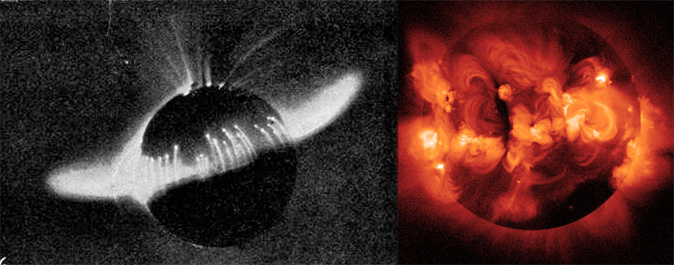
Oddly enough, whenever you've been asked to point out specifically where Birkeland wrote all about those solar winds, high temperature discharges in the solar atmosphere, jets, etc., you've never been able to do it. Yes, you wave around a document and a few looks-like-a-bunny pictures, but you obviously don't know enough about your hero Birkeland to actually quote him or point out his specific claims about those things. Okay, it's not oddly enough. It's just how you are.
It doesn't matter how steadfastly you cling to pure denial, you can't change history dude. He actually "predicted" high speed solar wind from real "experiments" in a real lab. He actually "predicted' coronal loop activity and took images of his loops from his simulations.

birkelandyohkohmini.jpg


That is what a physical "prediction" from empirical experimentation looks like by the way. I know you guys have no clue what empirical "prediction" is supposed to look like, but there you go.


No. That's what a photo of one of Birkeland's aurora borealis experiments looks like next to a filtered image of the Sun. The aurora borealis is a phenomenon that occurs on Earth. Coronal loops occur on the Sun. Apples and oranges. You see how miserably you fail when you try to apply that silly looks-like-a-bunny science?

But I'm still curious about why you fail. Why do you think that you haven't been able to sway any real physicists to accept your version of cosmology, Michael? Do you think it's because they're all too stupid to get it? Do you think maybe you're just doing a lousy job of communicating? Do you ever stop to consider that you might just be wrong? Is it a worldwide conspiracy to deny you your rightful place as a legitimate scientist? Really, why is it that you're not making any headway at all?
This is the start of several linked posts which, I think, goes some way to answering the question I asked in my last post ("given the objective mismatch between Birkeland's work and the reality of the solar wind and other solar phenomena (not to mention Saturn's rings, zodiacal light, formation of the solar system, ...), how did MM come to have such strong opinions to the contrary?").

First, it is necessary to be quite clear about the scope: it is the solar wind (modern term), and solar phenomena explicitly covered in the Birkeland tome; explicitly excluded are Birkeland's work on aurorae, terrestrial magnetism, and so on.

Another post by GeeMack is next*; then two replies by MM.

Some of MM's comments in the second are worth repeating (bold added):

- - - - - - - - - - - - - - - - - - - - - - - - - - - - - - - - - - -
GM: No. That's what a photo of one of Birkeland's aurora borealis experiments looks like next to a filtered image of the Sun.
MM: No, that is one of his "solar experiments" that he writes about next to a yohkoh x-ray image of the sun.

GM: You see how miserably you fail when you try to apply that silly looks-like-a-bunny science?
MM: Do you have any idea how stupid you sound when you ignore the variations in his experiments? Do you have any idea *HOW* he created the loops instead of the auroral patterns he also created in a lab? Just explain to us how Birkeland created the atmospsheric loops and how that was different from the auroral patterns he created in terms of polarity and magnetic field strengths?
- - - - - - - - - - - - - - - - - - - - - - - - - - - - - - - - - - -

MM is right in that figure 247a and figure 253 in Birkeland's document (thanks to RC) refers to a series of experiments Birkeland did to try to simulate some aspects of solar phenomena ...

... but MM is wrong, if only by implication, about how the Birkeland photograph and Yohkoh image are related.

At its most basic level, the Birkeland simulation fails, in a very big way, because the physical parameters are very different from the physical reality of the Sun, its corona, the sunspots, the magnetic fields, the solar wind, and so on. As far as I can see, nowhere does MM acknowledge this (if I am wrong, would a reader - preferably MM - say so, and point me to where MM does address this?).

Similarly, the image comparison also fails ... Birkeland did not take images in the soft x-ray waveband; images of the Sun in the visual waveband taken at the same time as the Yohkoh image look nothing like the Birkeland photograph; the dynamic range of the two images is very different; and so on.

But perhaps MM is (and was) fully aware of these inconsistencies, and addressed them. Perhaps he applied some sort of scaling relationship, that enabled him to conclude that Birkeland's simulations are physically reasonable? Ditto, to conclude that the SED of the luminous material in Birkeland's photographs can reasonably be compared with the SED of the soft x-rays in the Yohkoh images?

As far as I can see, nowhere does MM mention any of this, beyond this bland statement, from his website (if there is more, would a reader - preferably MM - say so, and point me to where MM does address this?):
The following theories are based on concepts that came from downloading, observing and analyzing gigabytes worth of "raw EIT" and other types of SOHO and TRACE videos over many months, and actively viewing TRACE SOHO, and YOHKOH satellite images and other videos and photos of the sun over many years. It is also based in large part on the work of Dr. Kristian Birkeland, Dr. Charles Bruce, and Dr. Oliver Manuel.
(bold added).

Thus, at this stage, I cannot find any objective evidence that falsifies GM's statement (that MM's conclusions re the validity of Bikeland's work - wrt the solar phenomena within scope - rely (almost completely) on "looks-like-a-bunny science"). Can any reader point to any?

* there are others, e.g. by DD, but I want to concentrate on those directly pertinent to my question.
 
So all I want to know is this: Why should we in 2009 care what Birkeland had to say about electricity and the sun 100 years ago, when we know that much of what he had to say is simply wrong?

On the whole, Birkeland's work sounds perfectly typical of pre-modern physics. The archives of the Physical Review, which are online (for subscribers, including most universities) back to 1893, have lots of this sort of stuff. I highly recommend going to this archive, at prola.aps.org, clicking through to the earliest decades, and reading random papers. It's fun---wow, what an incredible chore it was to do experiments back then! All of the threads and amber rods and soot-covered recording plates! Do a search for early papers with the word "theory" in the title and you'll find the weird stuff, the stuff where people were discussing whether the aether could accomodate an infinite number of electrostatic attractions or only a finite number.

Here's a fun example: Phys. Rev. (Series I) 28, 313 - 323 (1909). The author compares M. Planck's theory of thermal radiation to an alternative by J.J. Thompson and H. Lorentz, which basically treats thermal radiation as the bremsstrahlung produced in thermal electron collisions, and shows that adding a simple factor to the Thompson-Lorentz theory makes it agree with data. Why isn't there a crackpot rallying around this paper? Low-hanging fruit, people! Ivory tower academics continue to ignore Thompson-Lorentz theory---why? The proof is in a reputable journal! See my website at www.theelectrontheoryofblackbodies.info! And so on.
 
Last edited:
Some interesting things I found reading the 994 page Birkeland document, in relation to the content of several of MM's posts (in this thread):

-> you recall, dear reader, how highly MM praised Birkeland? And how vehement his comments on 'negative energy', and 'negative pressure', and ... are? One wonders whether MM did, in fact, read this massive tome by Birkeland; or if he read it, did he understand the math?

Where did Birkeland say anything about "negative pressure" in a vacuum, or shall I just assume that was a strawman of your own creation followed by an ad hominem?

What triggered this was reading, in several places in the long document, math - by Birkeland - that seemed to incorporate some of the concepts that MM so strongly and absolutely objected to! :D

Er, no. If he did things your way, he would have simply pointed at the aurora and claimed "dark energy did it, and here's the math to demonstrate it".

-> you recall, dear reader, some of the reasons MM stated for him being such a big fan of Birkeland, and some of the reasons why Birkeland's work provides such a firm, almost untouchable, basis for MM's statements concerning the solar wind, coronal loops, and (solar) jets*? A mixture of 'he did lots of experiments in his lab' AND 'he went out into the field and made lots of observations' AND 'he did lots of math to support his ideas' AND 'it is all consistent'? Well, as TT has pointed out, the 994-page tome also contains many pages on zodiacal light, and Saturn's rings.

So what?
http://www.nasa.gov/mission_pages/cassini/multimedia/pia10094.html

It also contains many pages on comet tails,

Many folks today seem to think there is some link between comets and electricity. X-rays and energy releases of a "billion watts"?

http://www.universetoday.com/2008/12/03/swift-detects-x-ray-emissions-from-comets/
http://www.spaceref.com/news/viewpr.html?pid=23892

planetary (solar system) formation, and a few mentions of "spiral nebulae". As far as I can tell - and I readily admit to not having read and absorbed all the Birkeland material - Birkeland's ideas on the solar wind, coronal loops, and (solar) jets* have the same foundations (in terms of the mixture of experiment, observation, and math) as his ideas on the zodiacal light, Saturn's rings, and comet tails. So why does MM so fiercely insist the former have great scientific merit but does not mention the latter?

I'm more than willing to add 100 years of knowledge to this process where applicable. Unfortunately you still can't explain any of the core observations in question. The ones you seem fixated on have been demonstrated to exist in the case of currents inside Saturns rings, whereas the zodiacal light has a "better" explanation.

-> Since 1913, a great deal of data concerning the Sun and solar wind has been obtained. This is more than adequate to permit a comparison between the regions of parameter space investigated by Birkeland and those of the physical world (the reality of the solar wind, for example). Does MM show - either in posts here or on his website - that the regions of parameter space at least overlap? Not that I have been able to find. What, then, is the basis for MM's statement?

Did you even read his work? Did you read anything about his actual experiments, or the conditions of his chamber, the sphere textures, etc?
 
Did you even read his work? Did you read anything about his actual experiments, or the conditions of his chamber, the sphere textures, etc?


What everyone has been trying to tell you, for years now, is that Birkeland's work doesn't mean what you think it means.
 
As stated, this is a somewhat dubious claim. We know that the solar wind contains equal numbers of protons and electrons, both moving away from the sun.

Those charged particles are whipping by us at over a million miles per hour Tim! That's "current flow".

It is of course possible to imagine that a surplus of positive ions is always being carried away from the sun

Come on Tim. There it is in his own words, and you sort of glossed over it as though it was not a valid "prediction"

or that negative ions are always being carried toward the sun,

Oh, did Birkeland just predict those "tadpole" events, and solar inflows we observe from time time?

http://www.nasa.gov/centers/goddard/news/topstory/2003/0411tadpoles.html
http://www.spacetoday.org/SolSys/Sun/SunGasFallsInward.html

As far as I can tell, Birkeland thinks of the "solar wind".

IMO this is pure denial on your part. Why would he turn the sphere into a cathode in the first place, and what do you figure he was doing in those experiments if not created "high speed current flow" in the chamber, and "predicting" things we observe today?

These were rather bold predictions at that time since it was *assumed* that space was a giant vacuum and all the energy from the sun came in the form of photons. There was no understanding of aurora, or the electrical currents in the aurora at that time. The idea of "flying electrons and flying ions" was pretty unusual at that time.

So while it is fair to say that Birkeland did think that there was a flow of material from the sun to the earth, it is clear that his conception of the flow is both qualitatively & quantitatively different from what we now call the "solar wind".

Er, no. It was "quantitatively different" to be sure, but the "qualitative" part is still right on the money. We know from his experiments that the key observations we're seeking to explain in solar phenomenon are in fact relate to electrical discharges. The numbers have changed to be sure, but the basic idea is sound and it works in a lab. You're confusing the notion of "quantitative differences" for "qualitative failure". There is no one to one correlation between these two ideas. Quantitatively things are different than he imagined, and even some of the physical parameters are a bit different, but the basic concept works in the lab.

Hence, I think it a stretch to claim that he "predicted" the solar wind.
Have you ever read my sig-line?

But consider this important point, where the emphasis is mine:
On page 661 he explicitly says that he thinks the corona is of electric origin.

He was definitely right on the money on that point too. The easiest way to explain a multimillion degree corona over a 6K photosphere is with "electricity".

But Birkeland is not the only one to think along these lines. The well known astronomer Charles Abbot, in his book The Sun (D. appleton, 1911 & 1929), on page 261 suggests that electricity might be involved in solar flares, though he was not enthusiastic about the idea.

So I guess MM and Birkeland aren't the only two guys to ever think the idea has merit eh? :)

In 1919 Sir Joseph Larmor suggested that sunspots were generated by the dynamo action of electric currents, but his model was later disproven by Thomas Cowling.

I have very different ideas about sunspots actually, mostly based on satellite observations none of them had access to however.

My point here is only that Birkeland was not alone in thinking about electricity in stars, it was not uncommon throughout the community.

Tim, it's still "common" in some "communities". :)

But the ideas were eventually discarded when it became evident that they just don't work.

Of course it "works". It works in a lab in controlled experiments. He did create full sphere, high speed charged particle emissions from his terella. He certainly did "predict" high speed positively charged ions too, and you even quoted him on it.

So as far as electricity being an important component in stellar physics, it was explored and discarded, for good reasons, long ago.

It was "discarded" prematurely then. Wake up and smell the coffee Tim. Even you 'explanation' of those Rhessi observations *requires* electrical discharges in the corona. How else did you intend to explain gamma rays in the solar atmosphere, when we know for a fact they are related to electrical discharges in the Earth's atmosphere?

But let us return to Birkeland. He was no more a God than was Alfven,

:) Right..... :)

but both of their names are bandied about as masters who were on to something big,

They were in fact "masters" of empirical physics, and one of them lived long enough to win the Nobel Prize. Evidently Alfven was a recognized "master" of MHD theory.

that the rest if us are ignoring.
You aren't just "ignoring" it, you're actively engaged in attacking the idea. You seem to have a personal investment in this topic going all the way back to Don Scott, even before my introduction to EU/PC theory. DRD there has been actively engaged in silencing all proponents of the idea, and banning it as a topic of conversation. You aren't just ignoring it, you're actively engaged in attempting to discredit the idea.

Are we to interpret this as a "prediction" that the light & heat radiated from the sun will carry electric charge? it certainly looks that way, even though he is not explicit, using the word "energy" instead of "charge". Still, if he wants to explain the maintenance of a large negative charge on the sun this way, I can't see how else to interpret the statement.

If the sun's corona is of an electric origin as we have here assumed, we might perhaps expect to see an enormous ring of light about the sun every time the earth, during an eclipse of the sun, stood very near the plane of the sun's equator. This would have to be upon the assumption that in the space far from the sun, there is a gas that can become electrically luminescent, or, in an electric state, able to reflect sunlight.

Instead what we observe are more "spread out" formations near and around the equatorial plane, much like the second image in this sequence. It's not like he only entertained *one* idea, or *one* magnetic or electrical configuration.

http://www.plasma-universe.com/images/3/3b/Fig-248.jpg

This too has proven wrong. We now know that the zodiacal light is sunlight scattered off of dust in the plane of the solar system.

Well, there are newer bits of information that we can and should incorporate into our understanding of the universe. Nobody is suggesting Birkeland or Alfven were infallible, or that scientific progress has not occurred.

So all I want to know is this: Why should we in 2009 care what Birkeland had to say about electricity and the sun 100 years ago, when we know that much of what he had to say is simply wrong?

While it may be true that *some* of his ideas were "wrong", or at least "incomplete", his core theories are empirically sound (even if wrong), they still explain things that the mainstream cannot, including solar wind and high speed jets and coronal loops.

IMO Tim, somewhere along the road you got yourself emotionally invested in discrediting the "electric sun" theory. That's a pity IMO. While you're original criticisms at Don's ideas may have had merit, I believe that has blinded you from the "bigger picture" here. Birkeland's theories have merit. He did in fact *predict* high speed solar wind particles, positively charged ions, and even flows back into the sun. I think you really need to take a step back from this issue for a moment and look at what Birkeland actually proposed. he was not suggesting that the sun was being powered externally, but rather he suggested it was "discharging" itself toward the heliosphere. He "predicted" those "loops" we observe in the atmosphere and Bruce has documented the successful prediction of discharge theory.
http://www.catastrophism.com/texts/bruce/era.htm

It's not as though anyone ever "gave up" on an electric sun theory Tim. It will continue to gain momentum over time because even mainstream theories now require "current flow" in order to work properly, particularly that paper you suggested on "magnetic reconnection". It's the 'electrons' that seem to be "reconnecting', not the magnetic fields.
 
What everyone has been trying to tell you, for years now, is that Birkeland's work doesn't mean what you think it means.
It doesn't mean what *you* think it means. He was in fact the first proponent of the "electric sun" theory to actually test his theories in a lab. You don't know what you're talking about because I'll bet you *still* have not read Birkeland's work.
 
Did you even read his work? Did you read anything about his actual experiments, or the conditions of his chamber, the sphere textures, etc?
Given the recent postings I would say that at least 4 posters have read Birkeland's work (myself, DeiRenDopa, Tim Thompson and probably ben m).

We have all come to a similar conclusion - Birkeland's experiments were excellent examples of experimental physics.
His use of them as analogies to terrestrial, solar and planetary physics has mixed success mostly because he was restricted to the knowledge of the day. At the time everyone was excited about the recent discovery of corpuscles (electrons) and applied them in many situations. Birkeland assumed that the Sun emitted corpuscles and so his experiments were applicable.

We have known for many years that the solar wind contains both electrons and protons. Thus any model that consists of just electrons (Birkeland's) has to be incomplete and probably wrong.

The terrestrial part of Birkeland's model is still correct in its basics since aurora are an result of electrons interacting with the Earth's magnetic field.

We read that there was soot on his windows, there was grease on the windows ("conditions of his chamber"), that he had smooth and sand-blasted metal spheres ("sphere textures"), etc.
What relevance does this have to the solar system? Is the sun a sand-blasted or a smooth metal sphere?

ETA:
Just noticed this in Wikipeda:
In 1916, Birkeland was probably the first person to successfully predict that the solar wind behaves as do all charged particles in an electric field, "From a physical point of view it is most probable that solar rays are neither exclusively negative nor positive rays, but of both kinds"; in other words, the Solar Wind consists of both negative electrons and positive ions.
So he is an even more impressive scientist than I thought.
It is a pity that you have an obsession with a book that predates this prediction that actually turned out correct.
 
Last edited:
Status
Not open for further replies.

Back
Top Bottom