• Quick note - the problem with Youtube videos not embedding on the forum appears to have been fixed, thanks to ZiprHead. If you do still see problems let me know.

Lambda-CDM theory - Woo or not?

Status
Not open for further replies.
...

I remind you again that Ari's solution to the redshift problem requires no inflation, just EM fields. Your choice of redshift "interpretations" is entirely "subjective" and it is not "tested" anymore than Ari's theory is "tested". The difference is that his theory "could" be "tested", whereas you theory cannot be "tested" at all.

So, is it claimed that the cosmological red shift is due to EM fields and we have a steady state universe? Now, that is confusing since it was the expansion of the observable universe that allowed Einstein to get rid of his cosmological constant. If the universe doesn't expand we are back to needing a Lambda to counter gravity and avoid a collapsing universe. But one of your passionate beliefs is that there is no lambda (dark energy). Am I missing something?
 
You accept an apple falling as sufficient physical evidence that space could be curved (despite no measurement of curved space),

I accept that "gravity" has some influence on me and on on objects. Whether your math calls it "curved space" or "gravitational force" or "quantum gravity", I have no doubt it has some influence on "reality".

Your math is meaningless as far as it relates to "generic qualification" of concept. I'm more interested in the fact that the apple falls and does so repeatedly than I am interested in the exact mathematical expression of that process. I can reach all the objects in this solar system with nothing but Newton's equations. I couldn't honestly claim to use GPS and only be the benificiary of Newton's equations, so I really have no problem with GR theory or "curved space" theory. Everything in space tends to be curved, and follows a curved path, so the notion that space itself is "curved" seems rather logical to me, but then I've had 30+ years to chew on Einstein's formulas and watch them be cludged to hell by the mainstream over that same time period.

yet you don't accept astronomical red shifts as indicating that galaxies are moving away from each other at rates proportional to their distance, even though we CAN measure doppler shifts and even Lorentz time dilation right here on earth.

I have no problem with "doppler shifts" related to moving objects, but show me an experiment where "expanding space" produced a "redshift". I accept that there may be several if not many different kinds of redshift involved in any given observation. What was wrong with Ari's theory of redshift? What makes your ideas superior?

http://arxiv.org/abs/astro-ph/0411666

He's got a 95 page "whopper" of a mathematical presentation that you are welcome to read through at your leisure.

Forget space expanding: red shifts show that everything is moving away from everything else,

No. Redshift is *presumed* to be related to "movement". In Ari's paper it's simply a result of Compton scattering effects, much like all tired light theories. You are subjectively 'choosing' to "interpret" that redshift observation to be related to "space expansion". Demonstrate it. If you can't, Ari's paper look equally valid, and in an Occum's razor argument, it wins hands down. I know for a fact EM fields exist in nature.

which means that going backwards in time, everything moves towards everything else. Guess what the limit of that process is.

Again, this is all related to you subjective "interpretation' of the redshift observation. How do you respond to Arps criticisms of that idea, or do you simply ignore the data that doesn't jive with your preconceived ideas?
 
Last edited:
So, is it claimed that the cosmological red shift is due to EM fields and we have a steady state universe?

Virtually all "tired light" theories are based upon the idea of Compton scattering effects on the photons from their interaction with electrons and typically require no specific state, be it a steady state, slight expansion or slight contraction. Most would probably "presume" that the universe has reached a point of "equilibrium" in some way, so I think that the general consensus among PC/EU theorists is a "steady state" model, but I doubt that this is a universal belief among all EU/PC advocates. I personally do entertain an "objects in motion stay in motion" type of "spacetime" expansion, but not the idea of "expanding space". I accept that it could just be a "steady state" that is "steadied" and made stable by EM fields.

Now, that is confusing since it was the expansion of the observable universe that allowed Einstein to get rid of his cosmological constant.

Yes, and pervasive and persistent EM fields to stabilize the process, or some limited expansion or contraction would do the same thing. Einstein realized that GR theory was a great theory all by itself, and any "additions" to GR theory were not only unnecessary, but they were probably not related to "gravity" in the first place and therefore they didn't belong in a gravity theory. The mainstream has been stuffing Einstein's simple and elegant physics theory with metaphysics ever since.

If the universe doesn't expand we are back to needing a Lambda to counter gravity and avoid a collapsing universe.

I'm sure most PC/EU advocates would assume it's related to an EM field rather than anything else.

But one of your passionate beliefs is that there is no lambda (dark energy). Am I missing something?

The only thing you're missing perhaps is the fact that I personally believe that it's possible that we do experience an "objects in motions stay in motion" sort of "spacetime" expansion, but not the "space expansion" of Lambda-Gumby theory. I'm probably in the minority on that point inside the EU/PC community, but I've never taken a pole. :) I'm fine with either possibility.
 
Virtually all "tired light" theories are based upon the idea of Compton scattering effects on the photons from their interaction with electrons and typically require no specific state, be it a steady state, slight expansion or slight contraction. Most would probably "presume" that the universe has reached a point of "equilibrium" in some way, so I think that the general consensus among PC/EU theorists is a "steady state" model, but I doubt that this is a universal belief among all EU/PC advocates. I personally do entertain an "objects in motion stay in motion" type of "spacetime" expansion, but not the idea of "expanding space". I accept that it could just be a "steady state" that is "steadied" and made stable by EM fields.


Yes, and pervasive and persistent EM fields to stabilize the process, or some limited expansion or contraction would do the same thing. Einstein realized that GR theory was a great theory all by itself, and any "additions" to GR theory were not only unnecessary, but they were probably not related to "gravity" in the first place and therefore they didn't belong in a gravity theory. The mainstream has been stuffing Einstein's simple and elegant physics theory with metaphysics ever since.


I'm sure most PC/EU advocates would assume it's related to an EM field rather than anything else.


The only thing you're missing perhaps is the fact that I personally believe that it's possible that we do experience an "objects in motions stay in motion" sort of "spacetime" expansion, but not the "space expansion" of Lambda-Gumby theory. I'm probably in the minority on that point inside the EU/PC community, but I've never taken a pole. :) I'm fine with either possibility.

What is your response to s. i.'s view that if there were EM fields that could have cosmological effects they would be easy to detect, since EM fields so readily influence light and other EM radiation.
 
How about that “experiment”, or did you miss the whole connection between inflation and the Higgs field?

What "experiment"? You mean all the other particle physics experiments that showed all the other particles of the standard particle physics theory? That was a non response to my point. LHC is intended to provide you with empirical support of the last of key particles, the Higgs. There is no such experiment for inflation, nor any link between the Higgs and inflation other than in your mind.

Well I’m sure they are grateful for the time you will be ‘giving’ them just as I’m sure they will be waiting for you to make up your mind. When did I ever say that the Higgs boson must exist?

You keep sidestepping the point. The search for the Higgs is here on Earth in "controlled experiments". The search for inflation faeries is always based on uncontrolled events in space.

Wait first you claim I have made up my mind, now you make a point of me specifically asserting the lack of certainty (which any skeptic should). You do seem to have demonstrative problem making up your mind and simply not contradicting your own assertions.

As long as you keep sidestepping the difference between "controlled experimentation" and "interpretation of uncontrolled observation", we will continue to talk past one another. They are not the same thing and they never will be equivalent.
 
What is your response to s. i.'s view that if there were EM fields that could have cosmological effects they would be easy to detect, since EM fields so readily influence light and other EM radiation.

My response is that they *are* easy to detect. Every key "prediction" that Birkeland made with his empirical tests have been observed. We observe solar wind acceleration as he "predicted" *and simulated empirically*. We observe coronal loops as he predicted and photographed in his experiments. We observe "jets" flying off the sun as he "predicted". We observe lightning around planets and aurora and rings around planets just as he predicted and simulated in his lab. The are *extremely* easy to detect in those "flux tubes" they keep talking about and Birkeland first described in his writings.

The mainstream just doesn't want to admit that they've been beaten to the "explanation" of these observations by over 100 years now.
 
My response is that they *are* easy to detect. Every key "prediction" that Birkeland made with his empirical tests have been observed. We observe solar wind acceleration as he "predicted" *and simulated empirically*. We observe coronal loops as he predicted and photographed in his experiments. We observe "jets" flying off the sun as he "predicted". We observe lightning around planets and aurora and rings around planets just as he predicted and simulated in his lab. The are *extremely* easy to detect in those "flux tubes" they keep talking about and Birkeland first described in his writings.

The mainstream just doesn't want to admit that they've been beaten to the "explanation" of these observations by over 100 years now.

None of that has anything to do with cosmology.

But you wouldn't know that, because you don't know even basic physics. I keep forgetting that, because usually when someone posts with such vehemence on a topic they actually know at least the basics of it.
 
You're still stuck on the idea that there's some fixed number of Higgs particles, and you construct the condensate by stuffing a bunch of them together. But that's simply not the case. Yes, I know your link made it sound that way, but that was a gross simplification which is actually wrong.

Oh my goodness we are constantly talking past each other.

Let's consider the electric field of a point charge.

Why? In that case the photon is presumed to be the carrier particle of the EM Field. In this case a Higgs boson is the carrier particle of mass. EM fields do not retain constant density over exponential increases in distance or volume.

We can describe it as a function E(x). If we take the Fourier transform of this, we can decompose this function into sine waves. But sine wave electric fields are photons, so the electric field of a point charge is really just a collection of photons.
Except it isn't.

Correct. Its a collection of protons and electrons with a "carrier particle" that is *presumed* to be the photon.

If you take the photon number operator (the thing that tells you how many photons you have) and try to apply it to your electric field, you'll find out that the number of photons is indeterminate.

That isn't surprising since it's not the point charge, nor is the point charge a collection of photons. The point charge may be transported by photons, but then they must transfer in discrete units and all energy is conserved.

The field and excitations of the field are not the same thing......

Same thing with the Higgs field........

No so. In the case of the EM field the protons and electrons are the "point charges" as you are calling them and the photons are simply the carrier particle. In the case of the Higgs field, the Higgs particle is also the carrier particle.

When describing how it interacts with other particles, some physicists like to talk about it as if you can decompose it into a collection of individual particles, but that's not really correct.

Do I have more than your word on that from experimentation, or do I have to take your word for that one as well?

Your reliance on basically one line from a source that's dumbing down the theory for a general audience is not exactly convincing people who know more about what's going on than that target audience.

I'm not relying on *one* source and I have actually published a paper on particle physics and fusion. I have no idea what qualifications you might have on this topic.

I will grant you that you could have a pervasive "field of flowing particles" that can be seen as some sort of all pervasive "Higgs field" from which Higgs particles can manifest, but you can't do that if all your energy/mass is all collected to an object that is smaller than a breadbox. You skipped ahead and provided no details of how your Higgs field came to do anything but cause everything to be crushed together again by the force of gravity the moment the field became "energized" at any "point".

Once again, you fail to grasp that there are in fact different kinds of condensates.

You're now turned a "condensate" into something it is not. A basic "condensate" is nothing but an organized group of particles.

As my earlier link already pointed out. You cannot use them interchangeably.

Your link did not in any way suggest that you could increase the volume by exponential amounts and maintain constant density. That's not what it claimed.

It will probably be a few years before we will have solid evidence that we've created any Higgs bosons.

I agree, assuming we find them.

But I already know you are wrong. And I know you're wrong because you clearly don't understand the theory.

Which theory? Inflation theory or Higgs theory? It's not clear that you actually separate the two.

Whether or not the theory is correct (it may not be), your statements about the theory are unambiguously wrong.

I don't think you've adequately separated your ideas about inflation from the notion of a Higgs boson or an existing Higgs field as you are calling it. I get the feeling we are simply talking past each other on this issue because somehow you got involved in a conversation about the idea that Higgs condensate will maintain constant density over multiple exponential increases in volume. Is that even your personal contention?

Inflation doesn't create Higgs bosons.

What did, and what kept them from being crushed back together by the force of gravity?
 
I have no problem with "doppler shifts" related to moving objects, but show me an experiment where "expanding space" produced a "redshift".

For the moment, I'm only concerned with showing that galaxies are moving away from each other.

I accept that there may be several if not many different kinds of redshift involved in any given observation. What was wrong with Ari's theory of redshift? What makes your ideas superior?

Tired light ideas don't match observations. It's also quite amusing that you insist on having on-earth verified phenomena before you accept them in any physics theory, and yet you uncritically buy into a paper which violates one of the most basic, fundamental constraints we have on our physics theories: the second laws of thermodynamics. An everylasting universe (as Ari proposes) will suffer heat death. There's no way around that without violating the 2nd law. How does he pull that off? He can't: instead, he simply ignores the problem. How do you justify him pulling that off? You're no skeptic: you're a true believer.

Redshift is *presumed* to be related to "movement". In Ari's paper it's simply a result of Compton scattering effects, much like all tired light theories.

Compton scattering should smear out line shapes - the redder the spectrum, the wider the linewidths should be. But that's not what actually happens.

You are subjectively 'choosing' to "interpret" that redshift observation to be related to "space expansion". Demonstrate it.

You will note that I explicitly did NOT invoke expansion of space. I only said galaxies are moving away from each other. Do that on a flat spacetime background if you want, I don't care: they're still moving away from each other.

I know for a fact EM fields exist in nature.

And you know that Doppler shifts exist in nature. But you don't know any tired light mechanisms which can uniformly shift spectra without blurring them. And you don't know of any process which can violate the 2nd law of thermodynamics.
 
[...]

I have no problem with "doppler shifts" related to moving objects, but show me an experiment where "expanding space" produced a "redshift". I accept that there may be several if not many different kinds of redshift involved in any given observation. What was wrong with Ari's theory of redshift? What makes your ideas superior?

http://arxiv.org/abs/astro-ph/0411666

He's got a 95 page "whopper" of a mathematical presentation that you are welcome to read through at your leisure.

[...]
Michael,

May I ask if you're prepared to go through this "whopper" in detail, to see just how well it accounts for all directly relevant astronomical observations?

I'm pretty sure that you've already spotted at least one of the fatal errors in the theory part of this paper*, being a serious sceptic and heavy duty critical thinker and all, so I don't feel a need to ask similar questions concerning those aspects ...

* unpublished, not least because of the 'bloopers' in the theory parts!
 

Just for the record, which of these do you believe to be a legitimate "experiment" complete with a "control mechanism"? I'm beginning to wonder if your entire industry is even capable of discerning an "experiment" from a "subjective interpretation of uncontrolled observations".
 
No, Michael. No, he didn't.

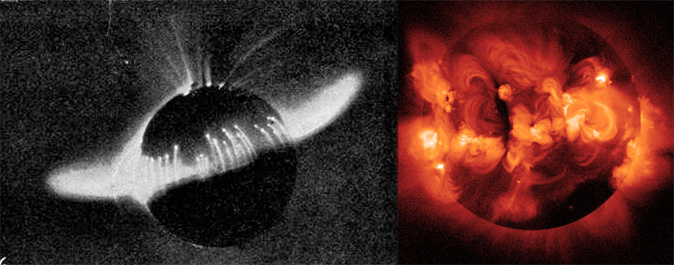
Yes GeeMack, he did. You'll find images of his work on my website. Here is a Yohkoh image (orange) next to a black and white image of coronal loops (and polar jets) simulated by Birkeland in his lab:

birkelandyohkohmini.jpg
 
Last edited:
Michael,

May I ask if you're prepared to go through this "whopper" in detail, to see just how well it accounts for all directly relevant astronomical observations?

I'm pretty sure that you've already spotted at least one of the fatal errors in the theory part of this paper*, being a serious sceptic and heavy duty critical thinker and all, so I don't feel a need to ask similar questions concerning those aspects ...

* unpublished, not least because of the 'bloopers' in the theory parts!

I know of only one specific issue that I still "question" about his work, but to this point in time, nobody inside your industry has even mentioned it. It's just something that evidently bothers me, not you folks. The only criticism I've heard thus far from any astronomer is more of a problem with their understanding of individual photons rather than a problem with the actual paper. Perhaps you would be so kind as to point out the "fatal flaw" that you believe negates his work?
 
For the moment, I'm only concerned with showing that galaxies are moving away from each other.

I'm interested in how you intend to "show" that from an observation of redshift.

Tired light ideas don't match observations.

Which ones specifically and how so?

It's also quite amusing that you insist on having on-earth verified phenomena before you accept them in any physics theory, and yet you uncritically buy into a paper which violates one of the most basic, fundamental constraints we have on our physics theories: the second laws of thermodynamics. An everylasting universe (as Ari proposes) will suffer heat death.

Er, why?

There's no way around that without violating the 2nd law.
Typically when I hear one of these "there is no way around it" claims, it turns out to be false. I'll have to wait to hear your explanation I suppose before passing judgment but this claims sound pretty "out there" at first glance.

How does he pull that off? He can't: instead, he simply ignores the problem. How do you justify him pulling that off? You're no skeptic: you're a true believer.

Um, before you pass judgment on my "skepticism", perhaps you could enlighten me on your idea a bit. A good skeptic likes to hear the explanation, and so far all I've heard is a handwave.

Compton scattering should smear out line shapes - the redder the spectrum, the wider the linewidths should be. But that's not what actually happens.

How would you know? It's only a "point source" in most images and there is no way to tell much about "smearing" to begin with.

You will note that I explicitly did NOT invoke expansion of space. I only said galaxies are moving away from each other. Do that on a flat spacetime background if you want, I don't care: they're still moving away from each other.

I will grant you that they *could be* physically moving away from each other, as in galaxies in motion stay in motion, but superluminal expansion is not possible IMO. I will also point out that this is not a "given", it's just something I will and do entertain as "possible". It is certainly not a "given" just based on the observation of redshift.

And you know that Doppler shifts exist in nature.
And for that reason I can and do entertain doppler shifts due to movement.

But you don't know any tired light mechanisms which can uniformly shift spectra without blurring them.

But I know of at least one proposed such theory. It doesn't look "untestable" to me unlike the inflation thing.

And you don't know of any process which can violate the 2nd law of thermodynamics.
I don't know why you figure this violates that law in the first place.
 
...snip...
There is no such experiment for inflation, nor any link between the Higgs and inflation other than in your mind.

Michael: This may have been pointed out to you before since it is fairly obvious but in case it has not:

No experiment will ever detect cosmological inflation here on Earth. This is because inflation happens to be a phase during the initial expansion of the universe. It happened well before the quark epoch (between 10-12 and 10-6 seconds after the Big Bang) and is generally estimated to have happened 10-36 seconds after the big bang.

Thus there is no "inflation" to detect in modern experiments (unless you have a time machine handy!).

However we can make predictions from inflation and test them against the universe. There are a number of number of predictions that have been confirmed by observations.

IMHO, inflation is the weakest part of the Big Bang theory since there are many open questions about it. The physical evidence for BBT (redshift, CMB, Lyman-alpha forest, etc.) is strong enough to justify adding inflation to fix the horizon, flatness and magnetic monopole problems - especially since we get the above tested predictions as a bonus.

Another small point: The Lambda-CDM model actually ignores inflation since it starts after the inflationary period.
The model uses the FLRW metric, the Friedmann equations and the cosmological equations of state to describe the universe from right after the inflationary epoch to present and future. WP
 
Originally Posted by Ziggurat
For the moment, I'm only concerned with showing that galaxies are moving away from each other.
I'm interested in how you intend to "show" that from an observation of redshift.

The first question is easy:
  1. Think of ways that light can be redshifted.
  2. Devise empirical controlled experiments to test the redshift.
  3. Measure the redshifts of galaxies.
  4. Analyze the redshifts according the the various causes.
  5. Make a deduction about the galaxies from the analysis.
For example:
  1. Maybe velocity causes redshift?
  2. Test in it an empirical controlled experiment (yes it does - In 1901 Aristarkh Belopolsky verified optical redshift in the laboratory using a system of rotating mirrors.)
  3. Done by Hubble.
  4. We see that there is a range of redshifts.
  5. We deduce that galaxies move with different velocities. Standard candles tell us the distance to the galaxies. We deduce that there is a relationship between the distance and velocity of the galaxies.
Or Ari's theory of redshift:
  1. Maybe plasma causes redshift?
  2. Umm... Perhaps you can give a citation to the paper containing the empirical controlled experiment confirming this cause.
  3. ...
Tired light ideas don't match observations.
Which ones specifically and how so?
Errors in Tired Light Cosmology
 
Michael: This may have been pointed out to you before since it is fairly obvious but in case it has not:

No experiment will ever detect cosmological inflation here on Earth. This is because inflation happens to be a phase during the initial expansion of the universe. It happened well before the quark epoch (between 10-12 and 10-6 seconds after the Big Bang) and is generally estimated to have happened 10-36 seconds after the big bang.

Thus there is no "inflation" to detect in modern experiments (unless you have a time machine handy!).

Ya, I've mentioned it here earlier in fact. How handy I will never be able to see inflation ever demonstrated here for me on Earth. I'm supposed to just keep funding this nonsense with my tax dollars? In this economy? Get real. If in fact that is the "consensus" of your industry, and you'll never be able to demonstrate your claims empirically, I am hereby disinterested in this absolutely stupid theory forever. It has *zero* useful predictive value and will forever have zero predictive value.

However we can make predictions from inflation and test them against the universe.

Yet if I pilfer your inflation faerie math and call it magic, you can't physically distinguish between your theory and magic theory so what use is it? It's numerology on a stick.

IMHO, inflation is the weakest part of the Big Bang theory

Ya, me too which is why I just went for the jugular from the start. No sense even wasting any time on dark energy since inflation is the "supernatural" cousin with zero useful byproducts.

Another small point: The Lambda-CDM model actually ignores inflation since it starts after the inflationary period.
Yet another reason it's a stupid theory. It has skeletons in the closet that nobody wants to discuss, and even then it's got good ol' "dark energy" front and center in the theory. How can you guys peddle this nonsense as "science" to unsuspecting youth and look yourselves in the mirror in the morning?
 
Last edited:
Status
Not open for further replies.

Back
Top Bottom