• Security incident: ISF was recently accessed by intruders. Please change your password, and change it anywhere else you used it. Read more

JWST's Little Red Dots are.... galaxies?

Mike Helland

Philosopher
Joined
Nov 29, 2020
Messages
5,248
There have been lots of conjectures regarding the "Little Red Dots" seen by JWST.

But are they much more mundane? Are they just spiral galaxies plus observation bias?

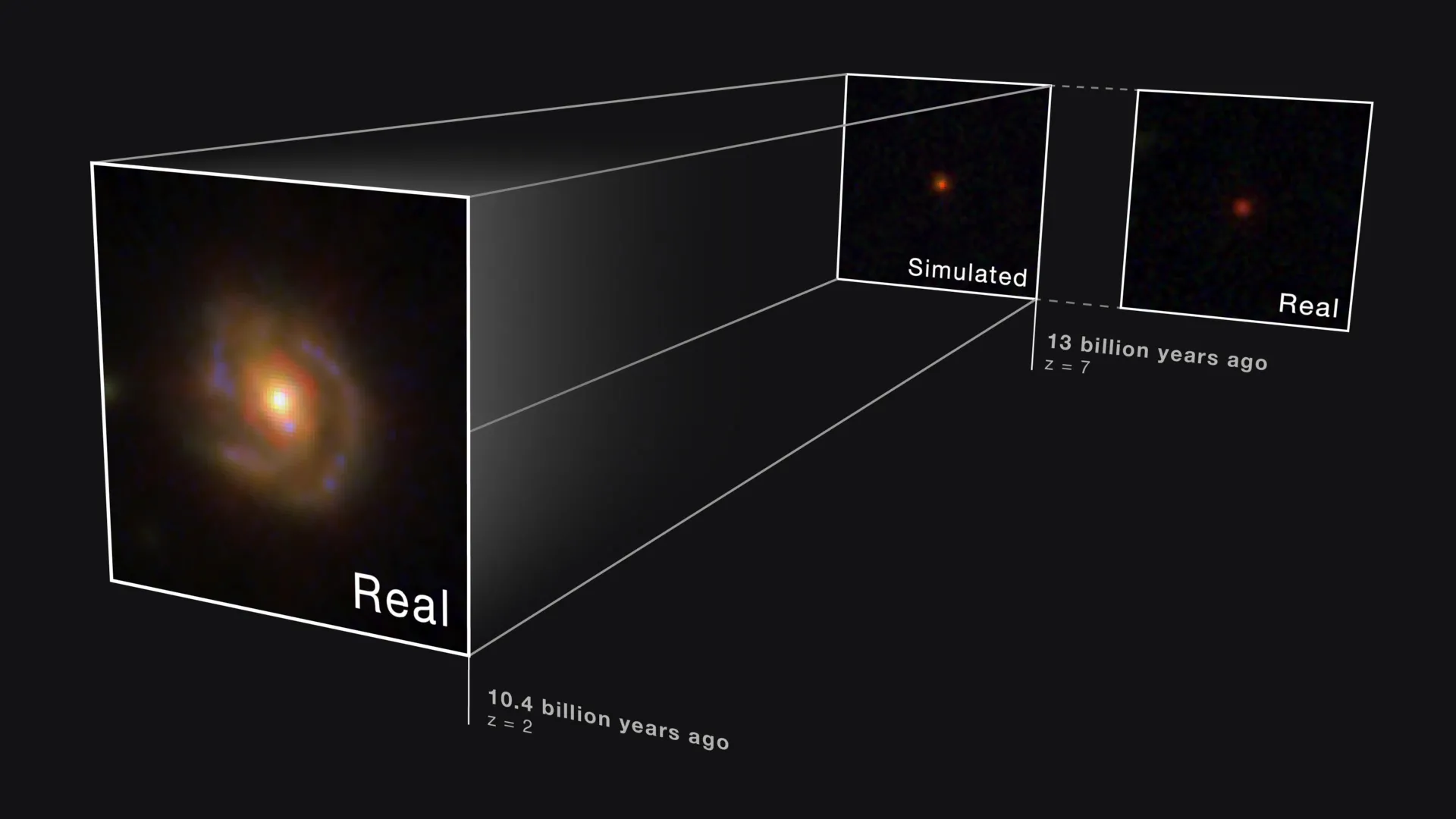
It features a compact LRD-like nucleus surrounded by a face-on spiral host. Its connections to LRDs include the following: (1) its nuclear spectrum shows a clear “V-shaped” SED, and (2) when redshifted to z = 7, surface brightness dimming makes the host undetectable, thus mimicking an LRD. This suggests that high-redshift LRDs may be embedded in extended hosts.

Journal paper:

Science Daily:

Video by Anton Petrov:
 
No, they’re not all spiral galaxies, and even if they were, it wouldn't explain LRDs. Firstly, the interesting part of LRDs is the nucleus, not so much the host. The spiral galaxy in that case doesn’t really change the key mystery of LRDs. What is the central engine, and what is the surrounding structure. Even if they all lived in spiral galaxies, it wouldn’t change this point. The current thinking is that they are accreting supermassive black holes embed in a dense star-like atmosphere.

That one is not going to be representative. It’s much later (lower redshift than most). It’s also detected at x-ray wavelengths and in the far infrared, while most LRDs have very low emission (largely undetected), in contrast with normal Active Galactic Nuclei. Also, the spectrum clearly looks unlike normal LRDs. The galaxy is also very massive, LRDs at high redshift cluster like low-mass galaxies. It’s not typical.
 
That one is not going to be representative. It’s much later (lower redshift than most).
Are you referring to the galaxy named "Saguaro" in the paper?

I think the point of the paper was that this galaxy, at z=2, would look like an LRD if it were at z=7. Figure 6:

1787608657766.png
 
I believe that at least some of them (at least one that we know of, and by implication, probably some others as well) turned out to be brown dwarfs in our own galaxy. Too faint to be seen by visible light telescopes, but they appear in the infrared and could be mistaken for highly redshifted distant objects.

 
Are you referring to the galaxy named "Saguaro" in the paper?

I think the point of the paper was that this galaxy, at z=2, would look like an LRD if it were at z=7. Figure 6:

Yes. It might appear in images to look be like most LRDs, but my point was that the other observables are in conflict with typical LRDs. It is a ULIRG for one, an ultra luminous infrared galaxy, whereas most LRDs are not detected at these wavelengths. This object may just be a dusty AGN, and not a real LRD. If most LRD hosts at z=7 looked like this, it would be known.

It's always a bit dubious to find one example, and then extrapolate it to all objects. "One swallow does not make a summer." Particularly when the reason for writing the paper is that the object is unusual. They say it resembles and LRD, not that it is one.
 
Last edited:
Yes. It might appear in images to look be like most LRDs, but my point was that the other observables are in conflict with typical LRDs. It is a ULIRG for one, an ultra luminous infrared galaxy, whereas most LRDs are not detected at these wavelengths.

What wavelengths are we talking about? You said:

>It’s also detected at x-ray wavelengths and in the far infrared, while most LRDs have very low emission (largely undetected),

It doesn't seem possible that JWST would detect the x-ray wavelengths of anything, unless it was about z=100. UV crosses over to x-ray at about 10 nm. NIRCam/NIRSpec top out at 600 nm, so you'd have to surpass z>60 to see any x-rays in there.

If we're talking about trying to find x-rays of LRDs in different telescopes, nothing really compares to the resolution of JWST at the moment (that I know of) so what other telescopes fail to see isn't surprising.

That said, we seem to automatically want to compare them to AGN. It seems more likely LRD are not active, but dormant galaxies.

Another thing you mentioned was this:

>Also, the spectrum clearly looks unlike normal LRDs. The galaxy is also very massive, LRDs at high redshift cluster like low-mass galaxies.

Do you have links for that? Sounds interesting.
 
ULIRGs are detected in the far-infrared. I didn't say it was from JWST. It comes from a variety of sources, see the paper.

It is not about resolution. Detection is a matter of sensitivity. LRDs are undetected in the deepest x-ray data, even when dozens of them are stacked. Note that more normal AGN are detected. Many LRDs have deep ALMA data, few are detected. They are not hosted in massive galaxies.

 
There have been lots of conjectures regarding the "Little Red Dots" seen by JWST.

But are they much more mundane? Are they just spiral galaxies plus observation bias?


Journal paper:

Science Daily:

Video by Anton Petrov:
Only one pressing question I care about wet 'little red dots' suddenly appearing: Is the Sun dimming😳??
 
Just for clarification, for the V-shaped SED, is this a good representation:
1787740326858.png

It's the prominent lopsided V from about 1.2 to 6, right?

ULIRGs are detected in the far-infrared. I didn't say it was from JWST. It comes from a variety of sources, see the paper.

It is not about resolution. Detection is a matter of sensitivity. LRDs are undetected in the deepest x-ray data, even when dozens of them are stacked.
Here's a paper from late 2025:

We also find that the occupation fraction decreases dramatically with decreasing M⋆: in high mass galaxies (M⋆ ≈ 1011−12 M⊙), the occupation fraction is > 93% (a 2σ lower limit), and then declines to 66+8−7% (1σ errors) between M⋆ ≈ 109−10 M⊙, and to 33+13 −9 % in the dwarf galaxy regime between M⋆ ≈ 10 8−9 M⊙.

1787738952331.png

Even if only 6% of massive galaxies have no central black hole and/or are x-ray undetected... that's still, like, millions of galaxies.

So far we've only observed like 1000 LRDs. (Maybe a few thousand by now?)


Note that more normal AGN are detected. Many LRDs have deep ALMA data, few are detected. They are not hosted in massive galaxies.

Probably not all of them, or even most of them. But again... why the fixation on AGNs?

Doesn't most of LRDs' properties point towards an inactive galaxy?
 
Yes, that's the V shape.

Probably not all of them, or even most of them. But again... why the fixation on AGNs?

Doesn't most of LRDs' properties point towards an inactive galaxy?

Not really no. The very broad emission lines are usually the characteristic of a Type I AGN. They are also compact and unresolved. People initially assumed that they were just dusty low-luminosity AGN. Which is consistent with most of what is seen. That picture only broke down when it became apparent that they weren't compatible with classical AGN, 1) they are very x-ray weak, 2) they show no emission from the dust, 3) they show evidence of absorption from dense gas. If LRDs are something exotic, like the quasi-stars, then it's a matter of definitions about whether you class them as AGN. It is currently debated whether the central engine is a black hole, or something else like a supermassive star, or a dense cluster.

Normal galaxies don't have spectra like LRDs, nor do they look like them in images. The spiral galaxy in the paper you posted is not a normal inactive galaxy, it is both a dusty AGN and a ULIRG. The x-ray paper you posted about is very different, I'm not comparing LRDs to all galaxies, it's about comparing them to typical AGN. Typical AGN have much higher ratios of x-rays to optical.
 

ISF - Join now!

Every member here is approved by hand. No bots, no spam, just people who care about evidence and honest debate.

Membership is free!

Create your free account

Back
Top Bottom