First of all, if you had bothered to read for comprehension, you'd understand that those tests were conducted on steel components at the periphery of the fire zone, and not in the hottest areas. They come out and note this. Heck, they openly talk about "perimeter columns" and "exterior panels" - go reread what you yourself posted - yet you think that somehow is representative of the entire fire? No. What those did were match the fire models; the models predicted temperatures in the areas were the steel was recovered to be within a certain range.
And those recovered steel pieces matched that prediction. The models went on to predict the temperature ranges farther in, where the fires were the hottest, and other experiments written up in NCSTAR 1-5 matched
that. You are showing a complete and utter misunderstanding of the NIST information when you try to say that NIST claimed
none of the steel exceeded 600
oC. That is not what they said; rather, they were saying that those samples matched what their model predicted the fire would burn at in the areas in the towers those samples had come from. And had you had bothered to read NCSTAR 1-5 and the subreports, you'd see that their model predicted far higher temperatures farther in the towers.
Furthermore, the steel you showed
was already studied by the Worcester Polytechnic group; google the forum for "eutectic". That was not done by an energy weapon. An examination of the corrosion clearly established that the steel underwent a sulfidation attack.
Two strikes in one swing. Takes a truther to pull that off.
Greetings elmondo,
And thank you for responding to my post directly. Your research into the NIST report is greatly appreciated for its contribution to this group effort in seeking to understand what destroyed the WTC complex on 9/11. Of course, the conclusion is already apparent: NIST did not determine what destroyed the WTC complex. In terms of official reporting, there is no valid determination of what happened. Your post, for whatever it may be said to stand for, certainly does not stand for the proposition that NIST explained what destroyed the WTC. They did no such thing.
I reply to your post, in detail, as follows:
First of all, if you had bothered to read for comprehension, you'd understand that those tests were conducted on steel components at the periphery of the fire zone, and not in the hottest areas.
Shame on you elmondo for trying to get away with an unproven assumption. Neither NIST nor anyone else has proven what zones were hot and/or what areas were hottest. You are making an unsubstantiated assumption. Furthermore, the claim "hottest" is inapporpriate in this context; namely, a discussion of what temperature was reached by the steel samples that NIST had. NIST was clear in stating no steel it had exceeded 600degreesC. That temperature is not high enough to deform, warp or in any other way cause any serious damage to steel.
They come out and note this. Heck, they openly talk about "perimeter columns" and "exterior panels" - go reread what you yourself posted - yet you think that somehow is representative of the entire fire? No. What those did were match the fire models; the models predicted temperatures in the areas were the steel was recovered to be within a certain range. And those recovered steel pieces matched that prediction. The models went on to predict the temperature ranges farther in, where the fires were the hottest, and other experiments written up in NCSTAR 1-5 matched that.
I am going to have to call on you to cite the portions of NCSTAR1-5 you are referencing and ask that you put what you are claiming it says into an understandable context. Surely you ARE NOT saying that NIST made a determination, based on the steel that it tested, that it reached a high enough temperature, are you?
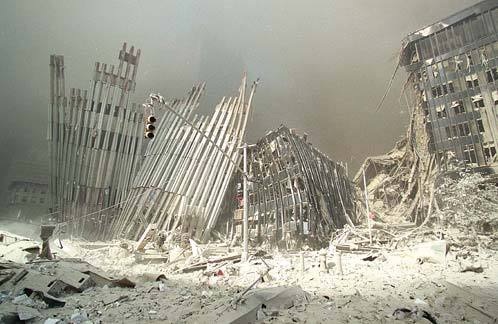
As I recall, NIST had to make assumptions about both temperature and the complete and total loss of the fire protection from steel and then only under the worst of the three assumption-riddled "cases" that it postulated could its computer come up with a "probable initiation of collapse" scenario. Note that phrasing: "probable initiation of collapse" thus having nothing whatever to do with the actual destruction that resulted in the turning of the WTC complex into dust as shown here:
You are showing a complete and utter misunderstanding of the NIST information when you try to say that NIST claimed none of the steel exceeded 600oC. That is not what they said; rather, they were saying that those samples matched what their model predicted the fire would burn at in the areas in the towers those samples had come from. And had you had bothered to read NCSTAR 1-5 and the subreports, you'd see that their model predicted far higher temperatures farther in the towers.
elmondo, what is the highest temperature NIST found any of the steel it tested to have been exposed to? Please state the temperature in degrees, either C or F and provide a source. I'm not sure what difference you're trying to make with the distinctions you try so mightily to put forward in the above quote. NIST's models can predict whatever NIST wants its models to predict. The information I am here referencing is what temperature did the 236 sample pieces they had show they had been exposed to.
Furthermore, in modeling temperatures, while not taking into consideration that the dust cloud was not very hot, NIST has engaged in fraud.
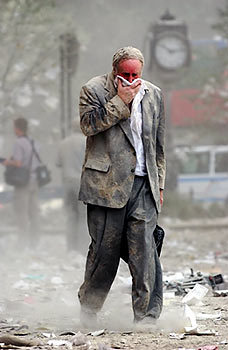
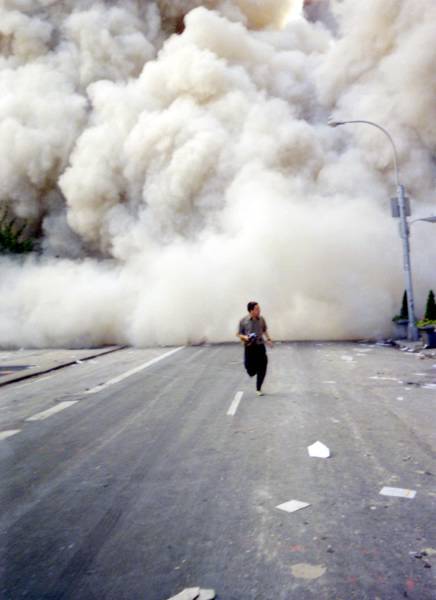
Do posters remember this iconic photo? The person seen in the foreground was interviewed. That cloud caught up with him and completely enveloped him. It wasn't hot. Thus, by what claim of evidence does NIST justify making assumptions about temperature that it did not obtain in the samples it actually tested?
Furthermore, the steel you showed
was already studied by the Worcester Polytechnic group; google the forum for "eutectic". That was not done by an energy weapon. An examination of the corrosion clearly established that the steel underwent a sulfidation attack.
Your declaration about what was not done by an energy weapon is your conjecture. And, what is equally obvious, the declaration that the steel "underwent a sulfidation attack" does not address how on earth that could have occurred, let alone what caused it.
We're actually making progress here because we are, at long last, focusing on the information that confirms how little has been officially determined about what happened to the WTC complex and how it was destroyed.
Thanks, elmondo, for your contributions in that respect.