• Security incident: ISF was recently accessed by intruders. Please change your password, and change it anywhere else you used it. Read more

James Webb Telescope

Yeah, thanks for that Pixel42, but I'm afraid I see too much wrong from such sources to consider that reliable.
 
That's a great site.

I do have a question on the day 30+ orbit.

The orbit for Webb is roughly circular at the L2 Lagrange point. Since the L2 point doesn't have mass there, the Webb is not orbiting a body in space (like the earth). So, how does it maintain its orbit without constant thruster firing? It must be in constant acceleration, no?
Lagrange points are actually the only stable orbits, where the gravitational forces balance out. However the complications of other massive bodies makes L2 less than perfectly stable.
 
That's a great site.

I do have a question on the day 30+ orbit.

The orbit for Webb is roughly circular at the L2 Lagrange point. Since the L2 point doesn't have mass there, the Webb is not orbiting a body in space (like the earth). So, how does it maintain its orbit without constant thruster firing? It must be in constant acceleration, no?

Its not really a circular orbit, its the way the object at L2 orbits the sun under the influence of gravitational forces of the Earth and Sun combined that makes it appear as if it is circling the L2 point from our perspective.

Scott Manley has a great video that describes halo orbits, and how the forces at Lagrange points keep objects there stable.


If you don't want to watch the whole 13½ minute video, the bit about L2 starts at 11:00, and there is an excellent graphic that exactly answers your question starting at 12:21.
 
Last edited:

Yeah, thanks for that Pixel42, but I'm afraid I see too much wrong from such sources to consider that reliable.

Agree with RY here. There was an early plan to have some kind of rudimentary docking apparatus to allow a spacecraft to grip it for servicing and refuelling, but that plan has been abandoned

https://jwst.nasa.gov/content/about/faqs/faq.html

"Why is Webb not serviceable like Hubble?

Hubble is in low-Earth orbit, located approximately 375 miles (600 km) away from the Earth, and is therefore readily accessible for servicing. Webb will be operated at the second Sun-Earth Lagrange point, located approximately 1 million miles (1.5 million km) away from the Earth, and will therefore be beyond the reach of any crewed vehicle currently being planned for the next decade. In the early days of the Webb project, studies were conducted to evaluate the benefits, practicality and cost of servicing Webb either by human space flight, by robotic missions, or by some combination such as retrieval to low-Earth orbit. Those studies concluded that the potential benefits of servicing do not offset the increases in mission complexity, mass and cost that would be required to make Webb serviceable, or to conduct the servicing mission itself.​
 
Its not really a circular orbit, its the way the object at L2 orbits the sun under the influence of gravitational forces of the Earth and Sun combined that makes it appear as if it is circling the L2 point from our perspective.

Scott Manley has a great video that describes halo orbits, and how the forces at Lagrange points keep objects there stable.


If you don't want to watch the whole 13½ minute video, the bit about L2 starts at 11:00, and there is an excellent graphic that exactly answers your question starting at 12:21.

Nothing at all wrong with 13.5 minutes of Manley!
 
It's presumably got something that can be latched on to even if it's not a traditional "dock" such as the ISS would have. Presumably some of the structure that mates it to the launch vehicle is sturdy enough to support a docking.

What I can't find is a reliable statement that the fuel tanks have a robotic compatible way of refilling. There is an alternative that something could dock and then take over the positioning of the satellite. I don't know what complications there might be with that approach.

And sending a human presumably changes the cost by a lot, not to mention the risk.

I'm thinking they could send a fully-fueled thruster pack to the telescope, dock with it, and used that for station-keeping after the main tank goes dry. The robotic tanker has to be able to maneuver on its own anyway, and do the docking maneuver as well, and it's less complicated than trying to transfer fuel from one tank to another.

In theory that attachment could be designed to accept another robotic tank, or they could send a larger than necessary tanker with enough fuel to keep the telescope in place for, say, fifty years.

I'm also thinking that this is an obvious solution, so it's either been considered and rejected for technical reasons, or it's on the list of things to do.
 
Last edited:
When can we expect the first pictures?

You know it's not an optical telescope, right? It's an infra red telescope, it's looking at the heat, rather than the light, that astronomical objects emit. So the pictures it takes won't look much like the Hubble ones. But ground based optical telescopes can now be made which are as good as Hubble, whilst ground based infra red telescopes are not much use as the atmosphere blocks a lot of those frequencies.

But yes, about six months before we see the first results.
 
You know it's not an optical telescope, right? It's an infra red telescope, it's looking at the heat, rather than the light, that astronomical objects emit. So the pictures it takes won't look much like the Hubble ones. But ground based optical telescopes can now be made which are as good as Hubble, whilst ground based infra red telescopes are not much use as the atmosphere blocks a lot of those frequencies.

But yes, about six months before we see the first results.

They should be able to take a picture of a highly redshifted galaxy, and color correct it to look something like we would expect.
 
Well, there are other reasons not to park it at L2. It's crowded there.
You're probably joking, but it's not the least bit crowded at L2. The volume of space available for the orbits that are useful there is easily a million times the volume of low Earth orbit. And I'm being very conservative there, I think the actual number is somewhere around 50 million times larger than LEO. The region of space we are talking about is fairly thin but it is wider than the Sun. It's freaking enormous.
 
You know it's not an optical telescope, right? It's an infra red telescope, it's looking at the heat, rather than the light, that astronomical objects emit. So the pictures it takes won't look much like the Hubble ones.

I imagine they can and will be color-corrected thanks to modern technology, so that they will appear just as we would perceive them with our own eyes, if only they were powerful enough.

I recently watched a video NASA put out from the Perseverance Mars rover. The color in the video was adjusted to make it more pleasant on the eyes. At one point in the video, the narrator shows the difference between pictures with and without color adjustment.

The same sort of color adjustment will be possible for images from the Webb telescope, assuming we actually get any.
 
I imagine they can and will be color-corrected thanks to modern technology, so that they will appear just as we would perceive them with our own eyes, if only they were powerful enough.

I recently watched a video NASA put out from the Perseverance Mars rover. The color in the video was adjusted to make it more pleasant on the eyes. At one point in the video, the narrator shows the difference between pictures with and without color adjustment.

The same sort of color adjustment will be possible for images from the Webb telescope, assuming we actually get any.

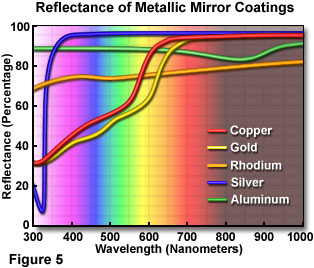
You can see here that gold doesn't reflect short wavelengths all that well, that's why it's gold:

mirrorsfigure5.jpg


So any redshifted deep enough could be color corrected back.

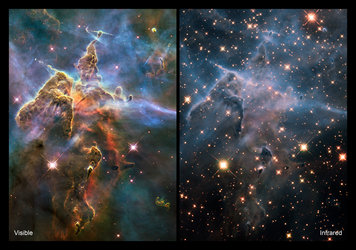
But anything not redshifted, those shorter wavelengths won't be there to color correct, resulting in a different view.

For example:

Comparison_views_of_Mystic_Mountain_card_medium.jpg
 

It says that the telescope is now 286 thousand miles from Earth (461 thousand kilometers) or 31% of the distance to the L2 point.

I also read that the high gain antenna was successfully deployed. One of many parts that will need to work as designed.

This is not insignificant as there have been missions in the past which were crippled because an antenna did not successfully deploy. Still many more steps to go of course, but so far, so good.
 
Last edited:

ISF - Join now!

Every member here is approved by hand. No bots, no spam, just people who care about evidence and honest debate.

Membership is free!

Create your free account

Back
Top Bottom