
-
Security incident: ISF was recently accessed by intruders. Please change your password, and change it anywhere else you used it. Read more
You are using an out of date browser. It may not display this or other websites correctly.
You should upgrade or use an alternative browser.
You should upgrade or use an alternative browser.

... sure dishonesty is a bad thing, and I'm fine with seeing that exposed ... I want it rooted out as much as you do.
God you can almost hear your nose growing....
ufology
Master Poster

- Joined
- Jun 30, 2011
- Messages
- 2,681
God you can almost hear your nose growing....
You believe in God?
j.r.
You believe in God?
Belief without evidence...that's your side of the tracks, not mine.
....but your mistakes are many, so I can see why you continue to post such "drivel".
Answer my previous question, "Mr. Hubris".
... and that you most cerytainly did. Good additional point on the growing prevalence of mass media with respect to the UFO phenomenon. Another point that I think deserves further attention is this constant touting of Occam's Razor as the most probable answer.
It seems to me that what we're seeing when the skeptics put it forth is their own bias about what is "simplest". In normal science Occam's Razor is reasonable because there is a controlled set of circumstances with known limits of complexity. For example there is no need to assume a supernatural explanation for why one plant might grow faster than another. They're just plants in soil with measurable properties and conditions.
On the other hand, with UFOs, we don't know for sure what we are dealing with. There is no way to guage what the simplest thing is for them. Therefore Occam's razor shouldn't even be used as a guage in the first place, but if we are to use it, we must admit that because we don't know all the limiting factors, it is entirely possible that it is really easy for them to travel interstellar distances.
But first, you'd have to prove they really are alien spacecraft. Whether or not they can travel easy or not is 100% irrelevant until that is done.
Occam's razor says this:
http://en.wikipedia.org/wiki/Occam's_razor
Occam's razor (or Ockham's razor)[1] often expressed in Latin as the lex parsimoniae, translating to law of parsimony, law of economy or law of succinctness, is a principle that generally recommends selecting the competing hypothesis that makes the fewest new assumptions, when the hypotheses are equal in other respects;[2] for instance, if all the hypotheses can sufficiently explain the observed data.
Explanations involving aliens require new assumptions (that they exist and are capable of reaching Earth, at least), and something similar goes for explanations involving new phenomena in general, while explanations involving phenomena known to exist do not. So, by Occam's razor, we should consider the last kind of explanation first.
Stray Cat
Philosopher

- Joined
- Sep 6, 2006
- Messages
- 6,829
Well the middle one is a secret department of NASA that no one knows about except for the massive sign they put on the building that houses the top secret stuff they don't want anyone to see:BTW, I know the UFP is Star Trek, but what are the others? Are they actual organizations or just colorful spoofs?
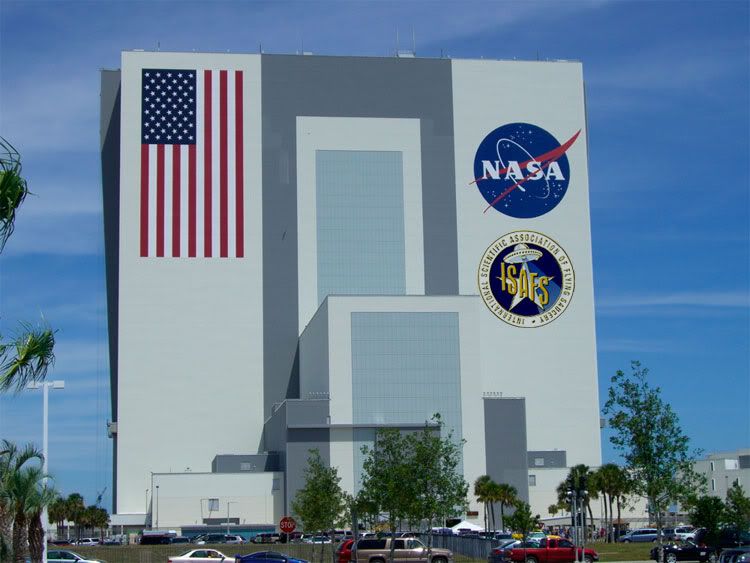
And the one on the right is a micky take.
Last edited:
ufology
Master Poster
- Joined
- Jun 30, 2011
- Messages
- 2,681
Well the middle one is a secret department of NASA that no one knows about except for the massive sign they put on the building that houses the top secret stuff they don't want anyone to see:
And the one on the right is a micky take.
Well we've gone way off the topic of critical thinking here ... but that's really funny ... thanks for that Stray!
j.r.
Last edited:
Astrophotographer
Graduate Poster

- Joined
- Jun 3, 2004
- Messages
- 1,843
Well the middle one is a secret department of NASA that no one knows about except for the massive sign they put on the building that houses the top secret stuff they don't want anyone to see:
Now you did it. You just gave proof of NASA's involvement in Kecksburg! If you keep this up, you will be drummed out of the debunker corps.
ufology
Master Poster
- Joined
- Jun 30, 2011
- Messages
- 2,681
But first, you'd have to prove they really are alien spacecraft. Whether or not they can travel easy or not is 100% irrelevant until that is done.
Occam's razor says this:
Explanations involving aliens require new assumptions (that they exist and are capable of reaching Earth, at least), and something similar goes for explanations involving new phenomena in general, while explanations involving phenomena known to exist do not. So, by Occam's razor, we should consider the last kind of explanation first.
You forgot to consider that one part on the end there in your post that quotes the Wikipedia article:
TO QUOTE: "for instance, if all the hypotheses can sufficiently explain the observed data."
In ufology the "observed data" are UFOs and all natural and conventional hypotheses have been ruled out in numerous cases, therefore not all the pre-existing hypotheses can sufficiently explain the observed data. Therefore it is perfectly acceptable to consider a new hypothesis ( generic ).
It isn't necessary to "prove" the existence of UFOs to consider the new hypothesis. That is why it's still called a hypothesis. If it were proven it wouldn't be a hypothesis anymore. All we need is enough data to make a reasonable case that the new hypothesis is worth consideration. And that can be done fairly easily based on historical observation.
Where Occam's Razor is still most useful is in examining new reports, or applying new data to old reports that could offer a less exotic explanation. Every new report should, I agree, be subjected to the kind of elimination process that Occam's Razor offers. That only makes sense. But care has to be taken not to allow the "mirror of prejudice" to color the evaluation so as to either dismiss or embellish observational data.
j.r.
Last edited:
LOL. Starting to get a sense of what the JREF is all about yet ufology?
Do the terms closed-minded, faith-based, dogmatic and cultist figure anywhere in that understanding perchance?
But of course you're too polite (and thoroughly deserving of a commendation in that regard) - me on the other hand ....
Critical thinking? - At this point it seems we are reduced to merely searching for the thinking bit...

Do the terms closed-minded, faith-based, dogmatic and cultist figure anywhere in that understanding perchance?
But of course you're too polite (and thoroughly deserving of a commendation in that regard) - me on the other hand ....
Critical thinking? - At this point it seems we are reduced to merely searching for the thinking bit...
LOL. Starting to get a sense of what the JREF is all about yet ufology?
Do the terms closed-minded, faith-based, dogmatic and cultist figure anywhere in that understanding perchance?
But of course you're too polite (and thoroughly deserving of a commendation in that regard) - me on the other hand ....
Critical thinking? - At this point it seems we are reduced to merely searching for the thinking bit...
Poor, poor baby. We don't accept your ideas without conformational evidence...so you "cry" about how closed-minded etc. we all are...
Why would you think such an insulting post was "proper debate technique"?...it only exposes your own personal bias.
Akhenaten
Heretic Pharaoh

But first, you'd have to prove they really are alien spacecraft. Whether or not they can travel easy or not is 100% irrelevant until that is done.
Occam's razor says this:
Explanations involving aliens require new assumptions (that they exist and are capable of reaching Earth, at least), and something similar goes for explanations involving new phenomena in general, while explanations involving phenomena known to exist do not. So, by Occam's razor, we should consider the last kind of explanation first.
You forgot to consider that one part on the end there in your post that quotes the Wikipedia article:
TO QUOTE: "for instance, if all the hypotheses can sufficiently explain the observed data."
You're very big on telling people about what they've forgotten/failed to consider and various other aspects of their thought processes. Have you considered submitting this marvellous psychic ability of yours to the scrutiny of the MDC?
In ufology the "observed data" are UFOs and all natural and conventional hypotheses have been ruled out in numerous cases, therefore not all the pre-existing hypotheses can sufficiently explain the observed data. Therefore it is perfectly acceptable to consider a new hypothesis ( generic ).
Piffle.
As has already been pointed out to you (and it's unlikely that you haven't always been aware of it yourself anyway) it's impossible for all "natural and conventional" (what's the difference between these?) hypotheses to be ruled out.
This is obviously especially the case where the hypotheses in question relate to phenomena that are, by definition, unidentified.
How, for example, does ufology go about eliminating the hypothesis that I just this minute thought up or the one that Robo Timbo formulated last year in the discussion with Rramjet of this very same ludicrous Infallible Process of Elimination™ bunk?
How did you eliminate the possibiity of a mischievous god? (you'll probably find yourself discussing this with GeeMack)
It isn't necessary to "prove" the existence of UFOs to consider the new hypothesis.
You really should stop putting scare quotes around words like that. It marks you as a Redefiner™ and we already have more than enough of those here.
Anyway, there's no need to prove, or even provide evidence for the existence of UFOs for any purpose since they're as common as dirt.
What's necessary is for you to show that "Eeek! Flying saucers!" is a more reasonable explanation than any other. Given that people like yourself have been failing spectacularly to do so for more than 60 years I won't be holding my breath.
That is why it's still called a hypothesis. If it were proven it wouldn't be a hypothesis anymore. All we need is enough data to make a reasonable case that the new hypothesis is worth consideration. And that can be done fairly easily based on historical observation.
Obviously not, or you wouldn't be having such a struggle to get people to believe your silly flying saucer stories.
Rebranding anecdotes as 'historical observations' and overusing the italics tag aren't going to get you across the line either.
Where Occam's Razor is still most useful is in examining new reports, or applying new data to old reports that could offer a less exotic explanation. Every new report should, I agree, be subjected to the kind of elimination process that Occam's Razor offers. That only makes sense. But care has to be taken not to allow the "mirror of prejudice" to color the evaluation so as to either dismiss or embellish observational data.
j.r.
There's no mirror of prejudice involved in pointing out that despite the best efforts of every ufologist that ever existed we still have exactly zero evidence of aliens/ETs or their flying saucers.
If you want to put an end to all the nasty critical thinkers raining on your parade then you're going to have to bring in a body (to borrow a phrase from the bigfeet debunkers), not just keep telling the same fanciful stories over and over again with ever more impressive sounding terms like 'observational data' and 'historical observation' in them.
Last edited:
Akhenaten
Heretic Pharaoh
LOL. Starting to get a sense of what the JREF is all about yet ufology?
My guess is "No." There's considerable evidence, close at hand, that some people can be here for years and never figure it out.
Do the terms closed-minded, faith-based, dogmatic and cultist figure anywhere in that understanding perchance?
You forgot the FLIR again.
But of course you're too polite (and thoroughly deserving of a commendation in that regard) - me on the other hand ....
It not about you, Rramjet. The debri of your failed arguments is elsewhere. Perhaps you should attend to that before infecting this thread with your adjectivitis.
Critical thinking? - At this point it seems we are reduced to merely searching for the thinking bit...
What you really need to be searching for is a flying saucer. That would shut all the meanie sceptics up far better than your Walls o' Waffle™ or your Glossary of Rredefined Words and Phrases™ have managed.
Last edited:
Akhenaten
Heretic Pharaoh
OMG!!! Look what's shown up on the FLIR!!!

Access Denied
Critical Thinker

- Joined
- Oct 24, 2009
- Messages
- 338
Might as well throw another log on the fire…
Well ufology the bottom line is you and Rramjet can try all you want to redefine science, critical thinking, the null hypothesis, extraordinary evidence, and even the word “alien” to justify your irrational belief in ET visitation to yourselves (make no mistake, you came to JREF seeking validation) but at the end of the day and 200+ page long threads, the reality is you can’t get past the conclusions of Chapter 1 of the “The Scientific Context” section of the Condon Report…
[you have read the entire Condon Report haven’t you?]
Perceptual Problems
http://files.ncas.org/condon/text/s6chap01.htm
[emphasis mine]
But wait, there’s more! You’re not done yet. If you think that’s tough, getting past Chapter 2 may be a real doozy…
Perception, Conception, Reporting
http://files.ncas.org/condon/text/s6chap02.htm
It gets better, finally there’s the all important “taboo” topic of Chapter 3…
Psychological Aspects of UFO Reports
http://files.ncas.org/condon/text/s6chap03.htm
Only in UFOlogy (and other pseudoscientific endeavors like it) are anecdotal accounts assumed to be a priori correct despite the fact that all the available evidence to date shows they are incorrect in some significant way most of, if not all, the time.
UFOs explained using critical thinking: Sometimes people see things in the sky they, and subsequent analysis, can’t positively identify for a number of known, but virtually unlimited, reasons. Despite ever increasing crowded skies and numbers of potential observers, the overwhelmingly vast majority of the time they don’t. However, when they do, and report it to someone else, this results in the phenomenon known as UFOs.
And to think we haven’t even begun to discuss using critical thinking to evaluate the alleged physical evidence…
In conclusion: The psychosocial hypothesis remains the single most important mundane explanation all UFOlogists fail to rule out.
AD
Well ufology the bottom line is you and Rramjet can try all you want to redefine science, critical thinking, the null hypothesis, extraordinary evidence, and even the word “alien” to justify your irrational belief in ET visitation to yourselves (make no mistake, you came to JREF seeking validation) but at the end of the day and 200+ page long threads, the reality is you can’t get past the conclusions of Chapter 1 of the “The Scientific Context” section of the Condon Report…
[you have read the entire Condon Report haven’t you?]
Perceptual Problems
http://files.ncas.org/condon/text/s6chap01.htm
[emphasis mine]
Care to demonstrate your alleged commitment to embrace critical thinking and acknowledge that fact?UFO reports are the product of a long chain of events, from distal stimulus through to the final reporting; at every link in this chain there are sources of distortion. Details of specific reports, are, by the very nature of the processes of human sensation, perception, cognition and reporting, likely to be untrustworthy. Thus any report, even those of observers generally regarded as credible, must be viewed cautiously. No report is an entirely objective, unbiased, and complete account of an objective distal event. Every UFO report contains the human element; to an unknown but substantial extent it is subject to the distorting effects of energy transmission through an imperfect medium, of the lack of perfect correlation between distal object and proximal stimulus, and of the ambiguities, interpretations, and subjectivity of sensation, perception and cognition.
But wait, there’s more! You’re not done yet. If you think that’s tough, getting past Chapter 2 may be a real doozy…
Perception, Conception, Reporting
http://files.ncas.org/condon/text/s6chap02.htm
Of course some objective evidence (as opposed to unfalsifiable subjective anecdotal accounts, most of which is archaic in nature) of alien spaceships could certainly change that figure to > 0% but the burden of proof rests solely on proponents of ET visitation to either a) present said objective evidence or b) rationally explain why absence of evidence is not evidence of absence in this case… good luck with that. Of course invariably UFOlogists will choose option b) to invoke all manner of unsubstantiated conspiracy “theory” to try and blame the dog (the ever omniscient, omnipotent, and omnipresent “they” aka the secret government) for eating their homework when they could simply go outside and setup a camera network instead… go figure.As we have already stated, some students of the UFO problem have used the argument, either directly or by implication, that where there is so much smoke there must be some fire, i.e. that some of the UFO reports must involve truly extraordinary phenomena such as alien space-ships or unknown meteorological effects. This chapter is addressed to the question: is it conceivable and defensible that all of the UFO reports could result from mistakes, illusions, unusual conditions, and fabrications?
The answer appears clearly affirmative, although we claim no proof that all reports can be so explained. We have looked at a three-stage process: a perception is received of some unusual apparition; a conception is created by interpreting the percept and combining it with prior concepts; a report is eventually made to an investigator or on some public document. Each step introduces possibilities for error.
The number of phenomena and combinations of phenomena that can produce unusual percepts is so enormous that no investigation can begin with an a priori list of explanations and expect to match one to each case. The variety is effectively infinite and it must be realized that in effect the investigator is asking for a report each time an unusual percept is generated. Obviously, this will be frequent.
Our data demonstrates beyond question not only that weird and erroneous concepts are widely formed, but also that these erroneous concepts are often precisely those that show up in the UFO phenomenon. Perhaps as a result of their popularization in the UFO literature, the phenomenon feeds on itself to a certain extent.
Finally, the reporting processes are demonstrably such that very low signal-to-noise ratio is generated. That is, certain social forces conflict with clear, concise, and thorough presentation of UFO reports. Sarcasm is employed at the expense of logic. A whole body of literature exists by virtue of the sensational aspects of the problem.
In conclusion, it appears that the number of truly extraordinary events, i.e. sightings of alien spaceships or totally unknown physical-meteorological phenomena, can be limited to the range 0-2% of all the available reports, with 0 not being excluded as a defensible result.
It gets better, finally there’s the all important “taboo” topic of Chapter 3…
Psychological Aspects of UFO Reports
http://files.ncas.org/condon/text/s6chap03.htm
To that last sentence I would add that similar to the Condon Report, the whole of UFOlogy is founded entirely on denying the importance of answering those questions scientifically… with the exception being in the case of UFOlogy, by any means necessary.In addition to the evaluation of individual observers, it would seem wise in future investigations to make use of sociologists and psychologists in those cases where more than one person has made a sighting, to rule out the possibility of hysterical contagion, as well as to contribute to our knowledge of this condition. There should be opportunity to investigate both people who sight UFOs and those who do not.
This chapter raises more questions than it answers. There are many interesting psychological questions: Why have some fervid "believers" in UFOs never seen one? Why do some persons who see an UFO regard it as simply an unidentified aerial phenomenon, while others are sure it is a "space vehicle ?" Why do some refuse to accept evidence that what they saw was really an airplane, weather balloon, etc., while others readily accept such explanations? The answers to such questions must await future research. It was not the purpose of the project to explore the psychology of UFO sighters, but rather to explore the nature of the UFOs themselves.
Only in UFOlogy (and other pseudoscientific endeavors like it) are anecdotal accounts assumed to be a priori correct despite the fact that all the available evidence to date shows they are incorrect in some significant way most of, if not all, the time.
UFOs explained using critical thinking: Sometimes people see things in the sky they, and subsequent analysis, can’t positively identify for a number of known, but virtually unlimited, reasons. Despite ever increasing crowded skies and numbers of potential observers, the overwhelmingly vast majority of the time they don’t. However, when they do, and report it to someone else, this results in the phenomenon known as UFOs.
And to think we haven’t even begun to discuss using critical thinking to evaluate the alleged physical evidence…
In conclusion: The psychosocial hypothesis remains the single most important mundane explanation all UFOlogists fail to rule out.
AD
ufology
Master Poster
- Joined
- Jun 30, 2011
- Messages
- 2,681
Piffle ...
The usage of the word "Piffle" here is really quite quaint. It's the most interesting part of the whole response in that it conjures up imagery of some curmudgeonly but otherwise filial misanthrope. Not that I'm saying the author is guilty of any querulousness or ambivalence of orientation that may resemble such a protagonist, but rather, compared to the term "codswallop", which was used earlier in another post, it is somewhat anemic. If one is going to be a critic, at least do it with style. Consider for example the following quote:
A critic is a bunch of biases held loosely together by a sense of taste.
Whitney Balliett (1926– ), U.S. jazz critic.
Now in this example ( the one you are reading now ) the euphemism is transcendendent of the literal interpretation and therefore although the style is implicit, it's lost on the intended recipient ... and to any such recoil upon this revelation ... twaddle I say !
j.r.
Last edited:
Akhenaten
Heretic Pharaoh
The usage of the word "Piffle" here is really quite quaint. It's the most interesting part of the whole response in that it conjures up imagery of some curmudgeonly but otherwise filial misanthrope. Not that I'm saying the author is guilty of any querulousness or ambivalence of orientation that may resemble such a protagonist, but rather, compared to the term "codswallop", which was used earlier in another post, it is somewhat anemic. If one is going to be a critic, at least do it with style. Consider for example the following quote:
A critic is a bunch of biases held loosely together by a sense of taste.
Whitney Balliett (1926– ), U.S. jazz critic.
Now in this example ( the one you are reading now ) the euphemism is transcendendent of the literal interpretation and therefore although the style is implicit, it's lost on the intended recipient ... and to any such recoil upon this revelation ... twaddle I say !
j.r.
You misspelled 'transcendent', genius.
Maybe you'd be better off just trying to address the substance of the post from which you're trying to divert attention.
Last edited:
all natural and conventional hypotheses have been ruled out in numerous cases
This is the core of the debate imo. Rramjet has in case after case tried to provide evidence for this claim and failed miserably. Can you bring something new to the table?
Btw, I'm amazed that the discussion is still going.
Aepervius
Non credunt, semper verificare
PS: the USI logo you posted is copyrighted. Don't use it again without permission.
Fair use FULLY allow part reproduction or reproduction of the picture for the purpose of discussion. Comparing logo for the purpose of their ressemblence fall in fair use. Read it up.
Stray Cat
Philosopher
- Joined
- Sep 6, 2006
- Messages
- 6,829
It's actually not as far off the topic of critical thinking as you think it is.Well we've gone way off the topic of critical thinking here ... but that's really funny ... thanks for that Stray!
But critical thinking is really easy, when the answer is obvious isn't it?
So you determined that I was telling a joke and not reporting a real set of facts.
Now think about; how does the critical thinking differ when the conclusion is not so obvious?