Moderated Is the Telekinesis Real?

“Several generalities about the anomalous signals have been reported.
The signals vary in strength from a few millivolts to a few volts and are
generally two to three times the background noise. Compared to signals
produced by physically touching the specimen, they have sharp peaks and
short rise times (approx. 200 is). It is not clear whether Hasted is
claiming that signals with these characteristics cannot be reproduced by
touching or whether typical touches do not have these characteristics” .’Palmer, page 180

This is not what Hasted said – in his article he clearly stated that these characteristics cannot be produced by touching the specimen in any way. Palmer should have put his reading glasses on before studying Hasted’s work.

“It seems that a total of 54 signals appeared during the course of the
experiment, of which 34 were designated as "synchronous" and 20 as
"nonsynchronous." The classification was apparently made by visual
inspection. Only in the equidistant, purely horizontal configuration did
nonsynchronous signals seem to predominate. Although Hasted did not perform
statistical tests, a chi-square test I performed comparing the proportion of
' synchronous signals in this configuration to the combined totals for the
other configurations was significant. Permanent bends of the keys were
detected in two of the sessions but the videotaped session was not among
them. “ Palmer, page 181

Palmer is obsessed with the positions of the specimens, which shows that he doesn’t understand the experimental setup – the positions have no effect on the observations, they are irrelevant, as every engineer and scientists knows. But Palmer is neither, as he admits in the article.

A chi-square test or any other statistical test is irrelevant because the purpose of Hasted’s experiments is to test telekinetic abilities of particular individuals, not of a group of people as it was done in the Princeton research. No wonder why Palmer doesn’t know how to interpret the results of his useless statistical analysis – he provided no interpretation of them in his article.
 
No wonder why Palmer doesn’t know how to interpret the results of his useless statistical analysis – he provided no interpretation of them in his article.

But you're not any kind of authority on statistical analysis, what it's for, or how it's used. The previous 15 pages of this thread have proven that. So what good is your judgment here?
 
Few words about the experimental setup that Jeffers used for his failed experiment: if you have the cheapest equipment that fits your goal you buy it, you do not need a highly sophisticated one. For example, if you can reach your objective with a primitive PLC with the ladder logic, you do not need a sophisticated computerized control system to do the same work (I learned this dogma at the very beginning of my control system student’s study). Jeffers might have used more sophisticated equipment that the Princeton team, but that doesn’t mean anything. Besides, a double-slit apparatus, or whatever that thing is called, is not terribly sophisticated, you can buy it at eBay, so I heard.

Jeffers failed to use a random process with normal distribution of events for the generation of signals during his experiment; the process that he employed doesn’t produce a bell-shaped curve, which is the sign of a Gaussian process. As I said before, a t-test cannot be used to analyze a non-Gaussian process.

Jeffers didn’t have to use the same process that the Princeton team chose; for example he could have used a random numbers table, which doesn’t require any equipment. Here is the link for those who want to learn more these tables:

https://mathbitsnotebook.com/Algebra2/Statistics/STrandomtable.html

Jeffers said that the instruction that he gave his subjects were “slightly’ different from the ones given to the Princeton subjects. This is a lie – his changes were fundamental. Jeffers told his subjects that they should not use mental effort to try to change the outcome of the experiment, while Jahn asked his subjects to do the exact opposite. The way I see it, Jeffers sabotaged his experiment for some reason.

Some might say that a person with PhD in Physics is eminently qualified to run this experiment. The way I see it, a PhD itself doesn’t say much. For example, couple of years ago I met an idiot with PhD in Physics who believes that quantum mechanics is false, and the science is better off without it.

Now I am going to have fun at someone’s expense. The Pied Piper discovered a mysterious connection between the normal distribution, t-tests and hyperbolic distribution. Here is the link to an article about hyperbolic distribution

https://en.wikipedia.org/wiki/Hyperbolic_distribution

“Thus the distribution decreases exponentially, which is more slowly than the normal distribution. It is therefore suitable to model phenomena where numerically large values are more probable than is the case for the normal distribution.”

As this quotation shows, there is no connection between the normal distribution and the hyperbolic distribution.

“The generalised hyperbolic distribution (GH) is a continuous probability distribution defined as the normal variance-mean mixture where the mixing distribution is the generalized inverse Gaussian distribution (GIG). Its probability density function (see the box) is given in terms of modified Bessel function of the second kind, denoted by .[1] It was introduced by Ole Barndorff-Nielsen, who studied it in the context of physics of wind-blown sand."

https://en.wikipedia.org/wiki/Generalised_hyperbolic_distribution

But all this material is not likely to convince the Pied Piper that he is wrong. Or, perhaps, he is right and there is an unseen connection between these distributions and t-tests. I am dying to know everything about that connection. Any printed material about it? If there is none, I refuse to follow the Pied Piper into his land of mathematical Shangri-La.
 
This is starting to read like the product of an automated buzzword ******** generator; the same phrases are always present but are being spliced together in a different order.

Dave
 
Jeffers failed to use a random process with normal distribution of events for the generation of signals during his experiment; the process that he employed doesn’t produce a bell-shaped curve...

And you still haven't figured out that this is not how statistics works.

The way I see it, Jeffers sabotaged his experiment for some reason.

Jeffers gives his reasons for doing this in his papers. Address that.

As this quotation shows, there is no connection between the normal distribution and the hyperbolic distribution.

That's what I've been trying to tell you for 15 pages.

But all this material is not likely to convince the Pied Piper that he is wrong.

You don't even know what my claim is.

Or, perhaps, he is right and there is an unseen connection between these distributions and t-tests.

The t-test for significance uses the t-distribution as its basis. The t-distribution is a hyperbolic distribution, not a normal distribution. This is not an unseen connection. It's how the test works. It's been common knowledge for years.

I am dying to know everything about that connection. Any printed material about it? If there is none, I refuse to follow the Pied Piper into his land of mathematical Shangri-La.

Name-calling appears to be the new depth to which you've sunk. No, I don't think you're at all interested in understanding this principle. Two weeks ago you were denying any such test even existed. You seem to be more interested in dumping a lot of irrelevant Googlage into the thread in hopes of convincing people you somehow knew all this stuff all along.
 
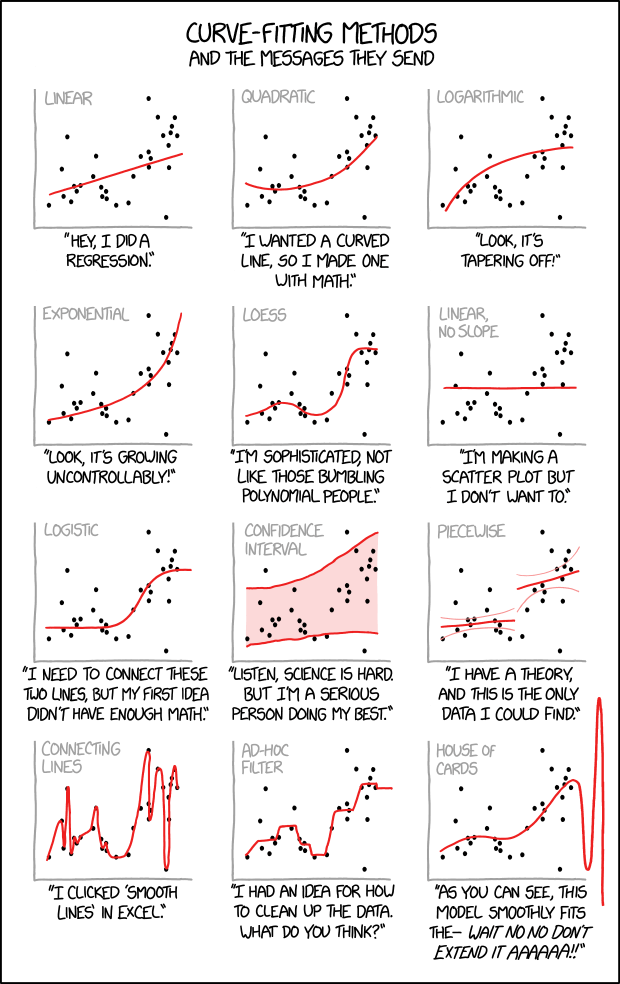
curve_fitting.png

Cauchy-Lorentz: "Something alarmingly mathematical is happening, and you should probably pause to Google my name and check what field I originally worked in."
 
Few words about the experimental setup that Jeffers used for his failed experiment: if you have the cheapest equipment that fits your goal you buy it, you do not need a highly sophisticated one. For example, if you can reach your objective with a primitive PLC with the ladder logic, you do not need a sophisticated computerized control system to do the same work
Really? Please explain the PLC loop problem.
 
Let's start with Physics

""""Buddha"""" said:
<uncalled drivel deleted>

Jeffers might have used more sophisticated equipment that the Princeton team, but that doesn’t mean anything. Besides, a double-slit apparatus, or whatever that thing is called, is not terribly sophisticated, you can buy it at eBay, so I heard.

You could buy yourself a clue at eBay, so I heard.

""""Buddha"""" said:
Jeffers failed to use a random process with normal distribution of events for the generation of signals during his experiment; the process that he employed doesn’t produce a bell-shaped curve, which is the sign of a Gaussian process.

Nor the one-slit experiment you suggested it would do.

Let's stop at one of the most stupid phrases I have heard/read in a long time: «the process that he employed doesn’t produce a bell-shaped curve, which is the sign of a Gaussian process.»

That's just a buzzword salad said with mala fide.

With the risible way you understand the different "processes" in both Jahn and Jeffers, you'd need a Gaussian slit (with a special variable translucity) to get a real bell-shaped curve.

You even got it "wronger" when you pompously posted this...

""""Buddha"""" said:
For his experiment Jeffers used a double-slit setup.

http://hyperphysics.phy-astr.gsu.edu/hbase/phyopt/slits.html

Obviously, this is not a bell-shaped curve but an interference pattern, which is not a normal distribution.

a Fraunhoffer diffraction pattern, when that's not what Jeffers' shows nor what is possible to get with Jeffers' equipment (slits 10mm width, laser beam producing an orangy-red light, duhhh!!!!)

The problem continues to be YOU DON'T KNOW YET WHAT THE VARIABLES TESTED WERE, BOTH IN JAHN'S AND JEFFERS'

""""Buddha"""" said:
As I said before, a t-test cannot be used to analyze a non-Gaussian process.

You don't have the slightest idea of what you're talking about. As JayUtah said to you before, the variable tested with Jeffers' double-slit experiment clearly follows a normal distribution (yes, one of those with the shiny bell-shaped curve you like to talk about that much) for reasons any person with a modicum of Statistics in their education know. The same reasons we haven't made explicit here yet because we enjoy seeing you messing things up more, and more, and more again, and then more again.
 
""""Buddha"""" said:
A chi-square test or any other statistical test is irrelevant because the purpose of Hasted’s experiments is to test telekinetic abilities of particular individuals, not of a group of people as it was done in the Princeton research. No wonder why Palmer doesn’t know how to interpret the results of his useless statistical analysis – he provided no interpretation of them in his article.

It looks we are going to have a trip around all the Statistics """"Buddha"""" doesn't know.

Let me guess:

not_adi-Buddha said:
"
The chi-squared test is used to determine whether there is a significant difference between the expected frequencies and the observed frequencies in one or more categories. In the standard applications of the test, the observations are classified into mutually exclusive classes
falls into the corresponding class.
The purpose of the test is to evaluate how likely the observations that are made would be
A chi-squared test can be used to attempt the data are independent."
That's when Palmer and Stalin decided to use a Gaussian manoeuvre to invade Poland so ask for whom the bell-shaped tolls.
"If a sample of size n is taken from a population having a normal distribution, then there is a result (see distribution of the sample variance) which allows a test to be made of whether the variance of the population has a pre-determined value. For example, a manufacturing process might have been in stable condition for a long period, allowing a value for the variance to be determined essentially without error."
So its Gaussian and not hyperbolic

https://en.wikipedia.org/wiki/Chi-squared_test
 
The problem continues to be YOU DON'T KNOW YET WHAT THE VARIABLES TESTED WERE, BOTH IN JAHN'S AND JEFFERS'

Agreed. Buddha thinks the raw output of the apparatus is the dependent variable in both the PEAR and Jeffers studies. It is not.

The same reasons we haven't made explicit here yet because we enjoy seeing you messing things up more, and more, and more again, and then more again.

Except that I did sort of explain it a couple days ago. Buddha could probably figure out his error if he would but read the thread.
 
Except that I did sort of explain it a couple days ago. Buddha could probably figure out his error if he would but read the thread.

Well, on that we disagree. I told you about this before. I don't believe we should give weapons to the endless parade of delusional users who parachute themselves into here, for later seeing them used to take things up a notch into deeper deliriums. That's why I adopted the juvenile, a bit disperse persona who posts here and rarely the usual me.

Discussing Physics with jabba, that's not a problem because he won't find anything useful in what he might learn. But he's basically badmouthing Palmer and later Jeffers' based on idiotic mix ups. And you will patiently explain him a dozen things many times to see him pouring more ill-intended badmouthing against the same. In that Christian site they already got rid of him in just 26 posts.
 
Schmidt investigated a different ESP phenomenon, precognition. I am not interested in this stuff, so I kept reading the Palmer report. In chapter 9 Palmer writes about metal-bending experiments, which is a form of telekinesis.

“The most extensive metal-bending research has been conducted by
Dr. John Hasted, Professor of Experimental Physics at Birkbeck College,
University of London. His most substantive work, which will be the focus of
this review, has been published in five experimental reports in the Journal
of the Society for Psychical Research (Hasted, 1976, 1977, 1978; Hasted & Robertson, 1979, 1980, 1981).” Palmer, page 178

J.B Hasted had a PhD in Physics (he died in 2001); he is the author of the book, Metal-Bending. Palmer didn’t give a single reference to Hasted articles; I had to look for them on my own, which took me about an hour.


Did you try looking in the references section, which you should have found at either the end of the chapter or article or at the end of the book?
 
Last edited:
Well, on that we disagree. I told you about this before. I don't believe we should give weapons to the endless parade of delusional users who parachute themselves into here, for later seeing them used to take things up a notch into deeper deliriums. That's why I adopted the juvenile, a bit disperse persona who posts here and rarely the usual me.

Discussing Physics with jabba, that's not a problem because he won't find anything useful in what he might learn. But he's basically badmouthing Palmer and later Jeffers' based on idiotic mix ups. And you will patiently explain him a dozen things many times to see him pouring more ill-intended badmouthing against the same. In that Christian site they already got rid of him in just 26 posts.

Buddha*
 

Back
Top Bottom