Puppycow
Penultimate Amazing

To consider this question, first we should establish what totalitarianism means.
For purposes of this thread, I referred to the Wikipedia article on Totalitarianism and extracted the following:
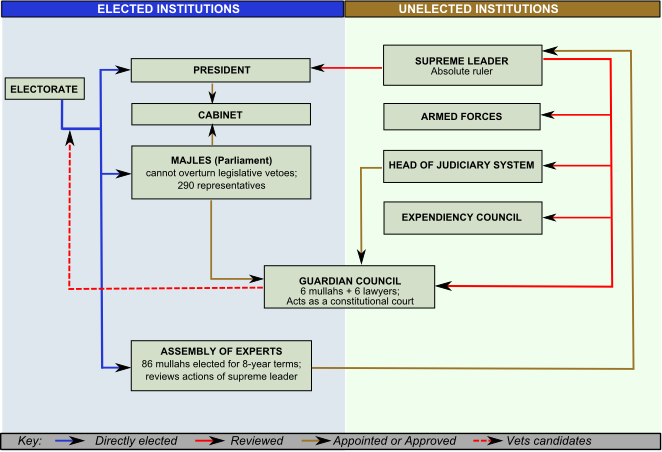
It seems to me that at least two Islamic states where Sharia is the official law, Saudi Arabia and Iran, are in fact Totalitarian in nature, although in practice the control may not always be absolute, however it aspires to be (note that Iranian president Ahmadinejad denies the existence of homosexuality in Iran). Other Middle-eastern states may also be similar, but for simplicity, I'll limit my discussion here to these two.
Please forgive the ad hoc nature of my argument here, but I'll just sort of make a (non-exhaustive) list of the things about Islam as practiced in these states that I perceive to be indicative of totalitarianism:
1) The very word Islam means "submission"
2) Saudi Arabia and Iran maintain religious courts for all aspects of jurisprudence, and religious police assert social compliance. (source)
3) Sharia does not allow freedom of speech on such matters as criticism of Muhammad. Such criticism is considered blasphemy against Muhammad. Many Muslims believe that if there is no freedom of speech, or if freedom of speech is very limited then people will learn to control what comes out of their mouths.
4) Apostasy likewise is punishable by death.
5) The European Court of Human Rights determined that "sharia is incompatible with the fundamental principles of democracy":
6) Less than 1% of the people in Saudi Arabia say that they don't believe in God (read this in an article, sorry but I don't remember the link). To me this indicates that they aren't allowed any access to alternative viewpoints.
7) Practicing the religion seems to be a full-time job. With 5 prayers a day and rules against reading un-Islamic information, it seems like the faithful are kept too busy and protected to think freely.
For purposes of this thread, I referred to the Wikipedia article on Totalitarianism and extracted the following:
Totalitarianism is a term employed by some scientists, especially those in the field of comparative politics, to describe modern regimes in which the state regulates nearly every aspect of public and private behavior.
[snip]
Eric Hoffer in his book The True Believer argues that mass movements like Communism, Fascism and Nazism had a common trait in picturing Western democracies and their values as decadent, with people "too soft, too pleasure-loving and too selfish" to sacrifice for a higher cause, which for them implies an inner moral and biological decay. He further claims that those movements offered the prospect of a glorious, yet imaginary, future to frustrated people, enabling them to find a refuge from the lack of personal accomplishments in their individual existence. Individual is then assimilated into a compact collective body and "fact-proof screens from reality" are established.[3]
It seems to me that at least two Islamic states where Sharia is the official law, Saudi Arabia and Iran, are in fact Totalitarian in nature, although in practice the control may not always be absolute, however it aspires to be (note that Iranian president Ahmadinejad denies the existence of homosexuality in Iran). Other Middle-eastern states may also be similar, but for simplicity, I'll limit my discussion here to these two.
Please forgive the ad hoc nature of my argument here, but I'll just sort of make a (non-exhaustive) list of the things about Islam as practiced in these states that I perceive to be indicative of totalitarianism:
1) The very word Islam means "submission"
2) Saudi Arabia and Iran maintain religious courts for all aspects of jurisprudence, and religious police assert social compliance. (source)
3) Sharia does not allow freedom of speech on such matters as criticism of Muhammad. Such criticism is considered blasphemy against Muhammad. Many Muslims believe that if there is no freedom of speech, or if freedom of speech is very limited then people will learn to control what comes out of their mouths.
(source)The Qur'an says that Allah curses the one who harms the Prophet in this world and He connected harm of Himself to harm of the Prophet. There is no dispute that anyone who curses Allah is killed and that his curse demands that he be categorized as an unbeliever. The Judgment of the unbeliever is that he is killed. [...] There is a difference between ... harming Allah and His Messenger and harming the believers. Injuring the believers, short of murder, incurs beating and exemplary punishment. The judgment against those who harm Allah and His Prophet is more severe -- the death penalty.
4) Apostasy likewise is punishable by death.
5) The European Court of Human Rights determined that "sharia is incompatible with the fundamental principles of democracy":
[T]he Court considers that sharia, which faithfully reflects the dogmas and divine rules laid down by religion, is stable and invariable. Principles such as pluralism in the political sphere or the constant evolution of public freedoms have no place in it. […] It is difficult to declare one’s respect for democracy and human rights while at the same time supporting a regime based on sharia, which clearly diverges from Convention values, particularly with regard to its criminal law and criminal procedure, its rules on the legal status of women and the way it intervenes in all spheres of private and public life in accordance with religious precepts.
6) Less than 1% of the people in Saudi Arabia say that they don't believe in God (read this in an article, sorry but I don't remember the link). To me this indicates that they aren't allowed any access to alternative viewpoints.
7) Practicing the religion seems to be a full-time job. With 5 prayers a day and rules against reading un-Islamic information, it seems like the faithful are kept too busy and protected to think freely.