
Is "European civilization" overrated?

Is it just possible that people of European descent think European civilization is superior because that's the one history teachers spend the most time on in school? How many people know enough about civilizations not their own (or the dominate one where they live) to be able to compare them on their merits?

After reading few of Ian Morris' books, I found his arguments in support of his "social development index" quite reasonable:
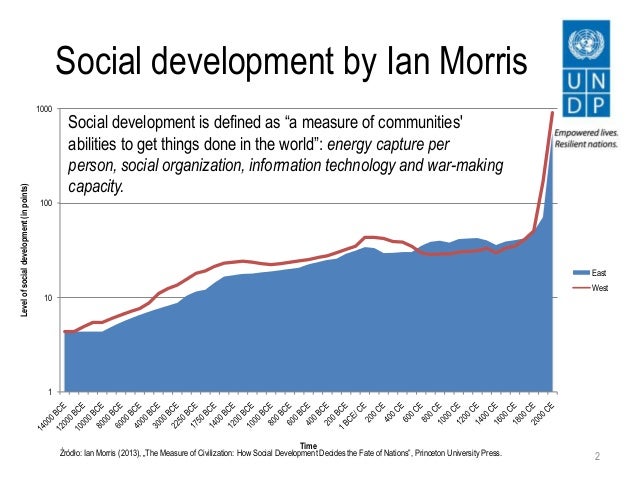
the-local-human-development-index-policy-tool-in-poland-2-638.jpg


ETA: I should point out that under his definitions the middle east is considered part of "the west".
 
Last edited:
To put it another way: wherever fact-based reasoning arises, science and tech advance, including that old science favorite, weapons. Wherever this happened first in the world would have a large, sustainable advantage. (As for Europe, fun additional fact: polluted rivers following intensive manure-assisted agriculture drove densely populated Europe to seafaring to find protein. Where animal power and fertilizer were not available (Americas), protein deficits/crop failures led to unstable civilizations. No cows and pigs... no globe-trotting Europe!) Whoever first became a seafaring culture in possession of superior weapons....

To test the race-neutrality of the effects of having access to key methods, see Japan, the Asian Tigers, and now, China (and parts of SA and Africa). Now extrapolate from the above; adjust for market size and total government cash flow (weapons). Is it wise to promote ideological tropes that might be used against oneself in future, with others using the same snowballing advantages to claim superiority on the basis of contemporary appearances? Precedent is a bitch.
 
I wasn't ignoring them I just wasn't including them in 'non-European' examples because they are European. Although I think it's a stretch personally to claim that the Romans, Spanish and British empires were of the same 'European' culture.

I didn't make that claim nor did I imply it.

What do you mean by 'influence on world history' for the time it existed the Qing for example ruled more people than any other empire on Earth so its influence was pretty great.

I think what I meant was very clear.
 
To put it another way: wherever fact-based reasoning arises, science and tech advance, including that old science favorite, weapons. Wherever this happened first in the world would have a large, sustainable advantage.
Well, guns were first developed in China, but they weren't particularly useful for the type of warfare being fought there (here) at the time, whereas they were more applicable in Europe, which is why their development progressed faster over there.
 
Just think of the Renaissance for starters, then look at the architecture of Europe and listen to some classical music. Hard to say it's overrated.

Now, European food may be a bit overrated, especially French. But that's a topic for another thread.
 
Well, guns were first developed in China, but they weren't particularly useful for the type of warfare being fought there (here) at the time, whereas they were more applicable in Europe, which is why their development progressed faster over there.

I'm curious, can you elaborate on the way in which Chinese warfare was unsuitable for gunpowder weapons but European warfare wasn't?
 
Just think of the Renaissance for starters, then look at the architecture of Europe and listen to some classical music. Hard to say it's overrated.

Now, European food may be a bit overrated, especially French. But that's a topic for another thread.

Imho, I think if anything is overrated, it's the notion that European food isn't good. European food, like any food anywhere in the world, can be both great, and crap. The good, the bad, and the ugly.

I don't really get why everything is questioned on whether or not it is overrated, everyone's opinions vary greatly.

Is Elvis overrated, the Beatles? Is cheese overrated? What does it even mean? Asking if European culture is overrated is just an odd bloody question, tbh.
 
Oh, I don't think it has anything to do with colour. It's culture and location. And culture is sure tied to location in the first place. Geography has a lot to do with all this.

I tend to agree. Having browsed quite a few times around the Islamic section of the British Museum, their pottery and glassware was so advanced compared to Europe. The artwork is stunning.
 
Well, guns were first developed in China, but they weren't particularly useful for the type of warfare being fought there (here) at the time, whereas they were more applicable in Europe, which is why their development progressed faster over there.

For the sake of brevity, I skipped over the broader conditions for "knowledge explosions," a term I borrow. China was always defeated by a singular aspect: all flowed toward the Empire and Emperor. As a nascent naval power, they gave gifts to show the grandeur of the Middle Kingdom instead of exacting tribute, a practice they had to eventually abandon. All the fruits of science, such as an early clock, went to the Emperor. No knowledge diffusion means each spark lights and then dims again.

The first knowledge explosion, in terms of a recognizable broad body of work that acts to ratchet up a civilization, was in Greece, if anything the place where Europe met with the outside world, and thus became a knowledge hub. No surprise this happened on the very shores of much of the ancient world, and that advances became rapidly diffused.

Anyway, how odd the same ones who in one breath wish to defend Judeo-christian tradition, then in the next, spout white supremacy.
 
Last edited:
Look up 'Pygmy' tribes and you will see they are still largely Hunter-Gatherers.

IOW their time is spent foraging or hunting for food, eating it and little else, other than usual family life.

Even if this is so (it mainly isn't), this doesn't imply they all sit around in the sun*, as you said. Hunter-gatherers divide work along gender lines, with men hunting, and women gathering. Gathering is a full time job, almost all day, almost every day.

* Africans don't sit in the sun. They sit in the shade.

It doesn't change the thrust of my argument. In fact, it underlines it.

When early Europeans were Hunter-Gathers (before the arrival from the Middle East of Agriculturalist/Farmers) all of their time was spent searching for food.

There wasn't any impetus to invent advanced technological systems. Spears and flints were extremely refined and well-made, some from the most exquisite of naturally occurring hard materials.

There was no impetus or need to invent farming technology.

If you live in a nice sunny temperate climate, why would you bother inventing central heating, for example?
 
I'm surprised that nobody has thrown this in yet, so ...

Journalist: What do you think of Western civilization?
Gandhi: I think it would be a good idea.
 
What are we using as rough definition of "European civilization"? If it is just any group that's lived in "Europe" it would seem a poor definition.

For me I would date it from somewhere around WW1 time which is when we see egalitarianism finally starting to emerge across many of the major countries of Europe.
 
Just think of the Renaissance for starters, then look at the architecture of Europe and listen to some classical music. Hard to say it's overrated.

Now, European food may be a bit overrated, especially French. But that's a topic for another thread.

Spend some time in India, look at the architecture they were making in the same period. You've heard of the Taj Mahal, but have you heard of Fatehpur-Sikri, with the Buland Darwaza?

I've been there, I've been to Cologne. Fatahpur Sikri was much more impressive, the photos in Wikipedia don't do it justice.

Try the tomb of Jahangir, Lahore fort, or the Delhi Red Fort.

India is covered in that kind of stuff, I could go on and list more and more. What we see now is ruins, stripped of furnishings and decorations, but when in use, those places would have been easy rivals of the best architecture Europe had to offer at the time.

Guns, Germs and Steel has been mentioned in this thread. 1491 is also worth a read. Despite being focused on the Americas, it touches on much of the same subject matter.
 

ISF - Join now!

Every member here is approved by hand. No bots, no spam, just people who care about evidence and honest debate.

Membership is free!

Create your free account

Back
Top Bottom