
Moderated Iron sun with Aether batteries...

Status
Not open for further replies.
Why does this RD debate continue? As GeeMack says, "A running difference image is a simple graph representing differences in thermal characteristics over time." I think I understand what that means. So, how can such an image show any fixed features?


It can't. For several reasons. One, it's just a graph, like a pie chart or a bar graph. Two, the data used to create it comes from thousands of kilometers above where Michael claims to see his mythical solid iron surface. And three, because several branches of science applied to solar research show that the solid iron surface Michael sees can not possibly exist according to the laws of physics.

The reason it continues? Hard telling. Michael's first epiphany moment in this whole crackpot adventure came from being fooled by an optical illusion he saw in a running difference image. For some reason he has argued all these years that it wasn't an illusion. I've seen people react very strangely to being fooled by magic tricks. Pride, intellectual insecurity, simple inability to acknowledge a mistake. I dunno. Perhaps his is a simple argument from cognitive dissonance?
 
The Solar EUV Radius II

Why does this RD debate continue?
Because Mozina is an idiot? Because the gathered throng wants to humor him? My post on the topic has already fallen to the previous page, but allow to to quote myself in full from last night ...
The Solar Radius and Limb Brightening in the EUV during Cycle XXIII
12th European Solar Physics Meeting, Freiburg, Germany, held September, 8-12, 2008
The Solar Radius in the EUV during Cycle XXII
Astronomy and Astrophysics 476(1): 369-372, December II 2007

The meeting poster and the published paper are essentially duplicates of each other. I was able to download the PDF of the former with no problems, while the latter has a PDF via arXiv.

Abstract (common to both): We have determined the solar transition region and coronal radius at EUV wavelengths and its time evolution during Solar Cycle XXIII using daily 30.4 and 17.1 nm images obtained by the Extreme Ultraviolet Imager (EIT) aboard the SoHO satellite. The radius was obtained by fitting a circle to the limb brightness ring. The weighted mean of the temporal series gives (967''.56 ± 0''.04) and (969''.54 ± 0''.02) at 30.4 and 17.1 nm respectively. No significant correlation was found with the solar cycle at neither of the two wavelengths. Since the temperature formation of the 30.4 nm line is between (60 - 80) 103 K (Transition Region), the obtained result is greater than that derived from present optical atmospheric models. On the contrary, this height is compatible with radio models. We also present results of the limb brightening time evolution.

Note that the shorter wavelength (17.1 nm = 171A) gives a slightly but significantly larger radius. Also note that both are larger than the optical radius. The optical radius is the photosphere and the 30.4 & 17.1 nm radii are in the transition region, which is seen to be above the photosphere. No surprise here, since we already know from a few decades of direct observation that the transition region is above the photosphere.

Note that the EIT instrument on SoHO is used to measure the solar disk radius at Mozina's favorite wavelength, 171A, and the number is 969''.54 ± 0''.02. Now see this ...

On the Constancy of the Solar Diameter II; Kuhn, et al., The Astrophysical Journal 613(2): 1241-1252, October 2004
Abstract: The Michelson Doppler Imager instrument on board SOHO has operated for most of a solar cycle. Here we present a careful analysis of solar astrometric data obtained with it from above the Earth's turbulent atmosphere. These data yield the most accurate direct constraint on possible solar radius variations on timescales from minutes to years and the first accurate determination of the solar radius obtained in the absence of atmospheric seeing.

Download the PDF and look at table I, a list of solar disk radius measurements spanning 1979 - 2004. They are all between 960''.52 and 958''.54. And see the last page of the paper, where the authors determine a SoHO MDI radius 959''.28 (all are normalized to a standard distance of 1 AU).

What Mozina wants to do has already been done, and with far greater accuracy & precision that his RD diddling could ever hope to achieve. It has already been determined that the solar disk radius at 171A (transition region - chromosphere) is roughly 10 arcseconds larger than the optical (photospheric) radius. At a distance of 1 AU that angular measure translates into 7253 km, assuming I have done the conversion correctly. So there is in fact nothing to debate. It has all been done already and the Mozina model is the loser, as one would naturally expect.

The MDI instrument images the photosphere in the 6767.8 Angstrom Ni I (that's neutral, non-ionized Nickel) absorption line. That's slightly redder than the eyeball center wavelength of about 5500 Angstroms, in the rough eyeball range 4000 - 7000 Angstroms (with much variation between individual eyes). So there is no doubt that it is sensitive to the eyeball photosphere "surface", where the effective temperature is around 5800 Kelvins.
 
Since the total extent of Michael's quantitative descriptions are based on staring at pictures and counting pixels, I think he'd rather avoid the actual measurements of the Sun and its parts, and stick to sizes measured in pixels. His argument so far doesn't appear to have come from doing any hard homework like, you know, looking up the size of the Sun on Google. :eek:

It's worth mentioning here that even in our largest, best resolution solar images to date, those coming in from the SDO with the diameter of the Sun scaled to over 3200 pixels across, the thickness of the photosphere, in scale, is just about a single pixel. The Sun is typically measured to have a radius of about 695,500 kilometers at the uppermost level of the photosphere. By the time you'd travel into the Sun by the distance of just one single pixel in those highest resolution images, about 430 kilometers, the solar atmosphere would have gone from transparent to opaque. Again, that change occurs across the distance of one single pixel.

Any claims made about seeing deeper in any image, like 4800 kilometers, or in the case of looking long ways through the plasma along the limb, 80,000+ kilometers, are based on ignorance, fantasy, delusion, wishful thinking, possibly even flat out lies, but are not based in any way on the state of reality where sane intelligent people dwell.

OK, then MM, can you tell me why you believe RD images show fixed features? If you have already answered this question elsewhere, I apologize for the redundancy -- I'm only an old layman.
 
Because Mozina is an idiot? Because the gathered throng wants to humor him? My post on the topic has already fallen to the previous page, but allow to to quote myself in full from last night ...


Note that the EIT instrument on SoHO is used to measure the solar disk radius at Mozina's favorite wavelength, 171A, and the number is 969''.54 ± 0''.02. Now see this ...

On the Constancy of the Solar Diameter II; Kuhn, et al., The Astrophysical Journal 613(2): 1241-1252, October 2004
Abstract: The Michelson Doppler Imager instrument on board SOHO has operated for most of a solar cycle. Here we present a careful analysis of solar astrometric data obtained with it from above the Earth's turbulent atmosphere. These data yield the most accurate direct constraint on possible solar radius variations on timescales from minutes to years and the first accurate determination of the solar radius obtained in the absence of atmospheric seeing.

Download the PDF and look at table I, a list of solar disk radius measurements spanning 1979 - 2004. They are all between 960''.52 and 958''.54. And see the last page of the paper, where the authors determine a SoHO MDI radius 959''.28 (all are normalized to a standard distance of 1 AU).

What Mozina wants to do has already been done, and with far greater accuracy & precision that his RD diddling could ever hope to achieve. It has already been determined that the solar disk radius at 171A (transition region - chromosphere) is roughly 10 arcseconds larger than the optical (photospheric) radius. At a distance of 1 AU that angular measure translates into 7253 km, assuming I have done the conversion correctly. So there is in fact nothing to debate. It has all been done already and the Mozina model is the loser, as one would naturally expect.

The MDI instrument images the photosphere in the 6767.8 Angstrom Ni I (that's neutral, non-ionized Nickel) absorption line. That's slightly redder than the eyeball center wavelength of about 5500 Angstroms, in the rough eyeball range 4000 - 7000 Angstroms (with much variation between individual eyes). So there is no doubt that it is sensitive to the eyeball photosphere "surface", where the effective temperature is around 5800 Kelvins.

Thanks.
 
I would like to adopt Clinger's prediction as my own. I'm willing to wager on it, whatever terms you like. Money, eyebrows, whatever. Just name it.

You in?

For you it will just cost you your public change of position. I only want GM's hair. :) So if the disk fits inside the chromosphere, you'll agree I'm right?
 
It can't. For several reasons. One, it's just a graph, like a pie chart or a bar graph. Two, the data used to create it comes from thousands of kilometers above where Michael claims to see his mythical solid iron surface. And three, because several branches of science applied to solar research show that the solid iron surface Michael sees can not possibly exist according to the laws of physics.

Then you have absolutely nothing to lose. Ready to bet?

This *SHOULD* be a no brainer. There's no possible way according to standard theory that the RD outline of the sphere will fit inside the chromosphere. It would defy all the laws of physics according to you. Do we have a bet?
 
For you it will just cost you your public change of position. I only want GM's hair. :) So if the disk fits inside the chromosphere, you'll agree I'm right?
No, I'm taking W.D. Clinger's position from this post:

http://www.internationalskeptics.com/forums/showthread.php?postid=5886932#post5886932

His estimate of the circumference of the RD sphere is what I am betting on. You already stated that this would differentiate the standard model from your model.

If it turns out that Clinger is wrong, I will publicly and humbly change my position using the most abjectly apologetic terms that I can. You might say that I will eat some humble...pie.
 
Last edited:
This *SHOULD* be a no brainer. There's no possible way according to standard theory that the RD outline of the sphere will fit inside the chromosphere. It would defy all the laws of physics according to you. Do we have a bet?

a) Helloooo? There IS a way in the standard theory. I explained it nine times. Did you forget?

b) Your image analysis "skills" seem not to be able to tell the difference between a bright band and a dark band. What bright/dark pattern---if any---are you planning to use to identify an "edge"?

c) Is there something wrong with the (published, peer-reviewed, not-based-on-PR-JPEGs-analyzed-by-confirmation-bias) SOHO paper we just saw?
 
No, I'm taking W.D. Clinger's position from this post:

http://www.internationalskeptics.com/forums/showthread.php?postid=5886932#post5886932

His estimate of the circumference of the RD sphere is what I am betting on. You already stated that this would differentiate the standard model from your model.

If it turns out that Clinger is wrong, I will publicly and humbly change my position using the most abjectly apologetic terms that I can. You might say that I will eat some humble...pie.

Well, as I see it, essentially the bet boils down the edges of the RD image in relationship to the chromosphere. Anything outside off that smooth inside surface falsifies my model. Anything inside of it falsifies standard theory. Is that acceptable to you? In other words I don't care about the distance if it's "outside" the chrmosophere boundary, but if it's under (generally where I say it is), then I win.

I have already committed myself to shaving my head bald assuming GM has intestinal fortitude to put his hair where his mouth is. I am prepared to post a picture of me bald and eat some humble pie even if GM won't bet his hair. I sure wish GM would just get off the fence and make this fun. :)
 
Last edited:
Well, as I see it, essentially the bet boils down the edges of the RD image in relationship to the chromosphere. Anything outside off that smooth inside surface falsifies my model. Anything inside of it falsifies standard theory. Is that acceptable to you? In other words I don't care about the distance if it's "outside" the chrmosophere boundary, but if it's under (generally where I say it is), then I win.

I have already committed myself to shaving my head bald assuming GM has intestinal fortitude to put his hair where his mouth is). I am prepared to post a picture of me bald and eat some humble pie either way. I sure wish GM would just get off the fence and make this fun. :)

I'm begging you, Michael. Don't make me keep stringing this out. What was W.D. Clinger's prediction? Do you remember? Consider this a friendly test of reading comprehension.
 
a) Helloooo? There IS a way in the standard theory. I explained it nine times. Did you forget?

b) Your image analysis "skills" seem not to be able to tell the difference between a bright band and a dark band. What bright/dark pattern---if any---are you planning to use to identify an "edge"?

c) Is there something wrong with the (published, peer-reviewed, not-based-on-PR-JPEGs-analyzed-by-confirmation-bias) SOHO paper we just saw?

Your theory would explain how a RD image disk will fit inside of the chromosphere? I must have missed that one. Try one more time to explain that to me.
 
Since the total extent of Michael's quantitative descriptions are based on staring at pictures and counting pixels, I think he'd rather avoid the actual measurements of the Sun and its parts, and stick to sizes measured in pixels. His argument so far doesn't appear to have come from doing any hard homework like, you know, looking up the size of the Sun on Google. :eek:

Then why won't you place your bet and be done with it GM? Ante up, or admit you're afraid.
 
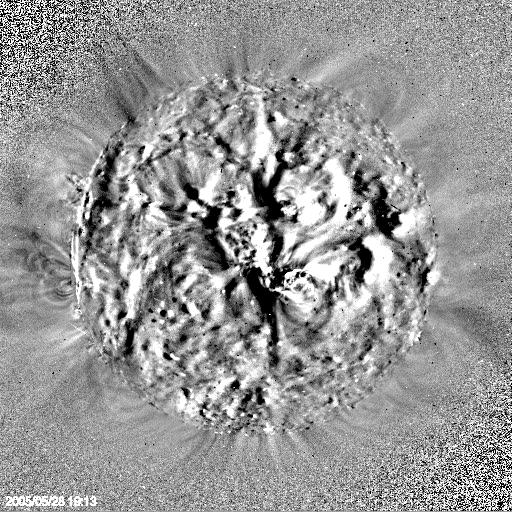
20050528-1913.JPG


Will the outlined disk in a long duration RD image from SDO fit inside the chromosphere or go outside the chromosphere GM?
 
Your theory would explain how a RD image disk will fit inside of the chromosphere? I must have missed that one. Try one more time to explain that to me.

For the love of God. Not only did I explain it, I repeated it several times asking why you were ignoring it. Post #1969 was the first attempt.

What else have you been ignoring? All attempts to correct you on anything, apparently.
 
Last edited:
While Michael is momentarily alert, let's reiterate:

a) I don't know what 3D feature you think is emitting what color in the SDO image.
b) I don't know where you think the "darkening" is in the SDO image.
c) You obviously haven't devoted three brain cells to the Sun's optical spectrum; several people have asked.
d) You seem to disagree with the 80,000-km number but won't show your own projection calculation. If you have done such a calculation at all, you may have done it wrong.
 
It would seem that high quality observations, and analyses, have shown that the (visible light) photosphere is closest to the Sun's centre, that the transition region is above (= greater radial distance from centre) the photosphere, and the corona above that.

That only leaves the chromosphere.

Solar eclipse observations, stretching back many decades, put the chromosphere above the photosphere, and below the transition region.

These observations, and analyses, are far more precise and accurate than the observations MM has proposed, using SDO RD images (as far as I know MM has not proposed any objective, independently verifiable method of analysing the observations, so we have no way to judge what their accuracy and precision might be).

Thus we can conclude that MM's ideas (calling them a model would be a joke) are inconsistent with decades of observations.

Now for something completely different.

Readers may be interested in a recent preprint, entitled "Solar LImb Prominence CAtcher and Tracker (SLIPCAT): An Automated System and Its Preliminary Statistical Results". This give you an idea of what sorts of automated analysis of solar images, taken by observatories in space, are possible (and some results):
Wang et al. (Abstract) said:
In this paper, we present an automated system, which has the capability to catch and track solar limb prominences based on observations from EUV 304 passband. The characteristic parameters and their evolution, including height, position angle, area, length and brightness, are obtained without manual interventions. By applying the system to the STEREO-B/SECCHI/EUVI 304 data during 2007 April -2009 October, we obtain a total of 9477 well-tracked prominences and a catalog of these events available online at this http URL A detailed analysis of these prominences suggests that the system has a rather good performance. We have obtained several interesting statistical results based on the catalog. Most prominences appear below the latitude of 60 degrees and at the height of about 26 Mm above the solar surface. Most of them are quite stable during the period they are tracked. Nevertheless, some prominences have an upward speed of more than 100 km/s, and some others show significant downward and/or azimuthal speeds. There are strong correlations among the brightness, area and height. The expansion of a prominence is probably one major cause of its fading during the rising or erupting process.
 
What do you say to the post quoted below, Michael?

Neither this result (that the 171A disk is larger than the optical disk) nor its opposite would (necessarily) disconfirm the standard model, for reasons ben has been trying to explain to you. But it does appear to rule out your own model, based on what you said it predicted.

Am I right? Does this falsify your iron sun model?

Because Mozina is an idiot? Because the gathered throng wants to humor him? My post on the topic has already fallen to the previous page, but allow to to quote myself in full from last night ...


Note that the EIT instrument on SoHO is used to measure the solar disk radius at Mozina's favorite wavelength, 171A, and the number is 969''.54 ± 0''.02. Now see this ...

On the Constancy of the Solar Diameter II; Kuhn, et al., The Astrophysical Journal 613(2): 1241-1252, October 2004
Abstract: The Michelson Doppler Imager instrument on board SOHO has operated for most of a solar cycle. Here we present a careful analysis of solar astrometric data obtained with it from above the Earth's turbulent atmosphere. These data yield the most accurate direct constraint on possible solar radius variations on timescales from minutes to years and the first accurate determination of the solar radius obtained in the absence of atmospheric seeing.

Download the PDF and look at table I, a list of solar disk radius measurements spanning 1979 - 2004. They are all between 960''.52 and 958''.54. And see the last page of the paper, where the authors determine a SoHO MDI radius 959''.28 (all are normalized to a standard distance of 1 AU).

What Mozina wants to do has already been done, and with far greater accuracy & precision that his RD diddling could ever hope to achieve. It has already been determined that the solar disk radius at 171A (transition region - chromosphere) is roughly 10 arcseconds larger than the optical (photospheric) radius. At a distance of 1 AU that angular measure translates into 7253 km, assuming I have done the conversion correctly. So there is in fact nothing to debate. It has all been done already and the Mozina model is the loser, as one would naturally expect.

The MDI instrument images the photosphere in the 6767.8 Angstrom Ni I (that's neutral, non-ionized Nickel) absorption line. That's slightly redder than the eyeball center wavelength of about 5500 Angstroms, in the rough eyeball range 4000 - 7000 Angstroms (with much variation between individual eyes). So there is no doubt that it is sensitive to the eyeball photosphere "surface", where the effective temperature is around 5800 Kelvins.
 
Michael Mozina;5888642 ... said:
This *SHOULD* be a no brainer. There's no possible way according to standard theory that the RD outline of the sphere will fit inside the chromosphere. It would defy all the laws of physics according to you. Do we have a bet?
:popcorn1
Originally Posted by Tim Thompson
...

Note that the EIT instrument on SoHO is used to measure the solar disk radius at Mozina's favorite wavelength, 171A, and the number is 969''.54 ± 0''.02. Now see this ...

On the Constancy of the Solar Diameter II; Kuhn, et al., The Astrophysical Journal 613(2): 1241-1252, October 2004
Abstract: The Michelson Doppler Imager instrument on board SOHO has operated for most of a solar cycle. Here we present a careful analysis of solar astrometric data obtained with it from above the Earth's turbulent atmosphere. These data yield the most accurate direct constraint on possible solar radius variations on timescales from minutes to years and the first accurate determination of the solar radius obtained in the absence of atmospheric seeing.

Download the PDF and look at table I, a list of solar disk radius measurements spanning 1979 - 2004. They are all between 960''.52 and 958''.54. And see the last page of the paper, where the authors determine a SoHO MDI radius 959''.28 (all are normalized to a standard distance of 1 AU).

What Mozina wants to do has already been done, and with far greater accuracy & precision that his RD diddling could ever hope to achieve. It has already been determined that the solar disk radius at 171A (transition region - chromosphere) is roughly 10 arcseconds larger than the optical (photospheric) radius. At a distance of 1 AU that angular measure translates into 7253 km, assuming I have done the conversion correctly. So there is in fact nothing to debate. It has all been done already and the Mozina model is the loser, as one would naturally expect.

The MDI instrument images the photosphere in the 6767.8 Angstrom Ni I (that's neutral, non-ionized Nickel) absorption line. That's slightly redder than the eyeball center wavelength of about 5500 Angstroms, in the rough eyeball range 4000 - 7000 Angstroms (with much variation between individual eyes). So there is no doubt that it is sensitive to the eyeball photosphere "surface", where the effective temperature is around 5800 Kelvins.

:popcorn1
 
Just wanted to say this thread is awesome.

I want to say thank you, Michael. Without all your crazy I would never have gotten such a good education from those with actual knowledge of the subject, and would instead be prone to accept fantasies such as the one you beleive.

And a big thank you to the following posters for putting the "E" in JREF:
sol invictus
dasmiller
Dancing David
ben m
W.D. Clinger

And I'm sure I've missed some, and if I have I apologize. There's been so much good info posted I can't keep track of everyone. I'm tempted to giggle like a schoolgirl ;)

Thanks Hellbound, but I am the baby amongst giants.
 
For five years now GM you've been dogging me around the internet calling me a crackpot and claiming I am deluded. You've claimed I don't have the math skills to balance a checkbook, let alone do anything useful as it relates to solar physics.

This is your golden opportunity to ensure that this hick hay-seed plowboy (and I'm not ashamed to admit I've bailed hay in my day) is completely off his rocker. You can ensure that I will go down in astronomical fork lore history as the biggest crackpot to ever live, and make my bald face the laughingstock of your entire industry for years to come.

I have staked out a tiny little 7-8 pixel sliver *inside* the surface of your supposedly "opaque" photosphere. The photoinization aspects of standard theory alone *INSIST* that not a single photons can come from inside the photosphere at these energy states. This is a complete "no brainer" based on standard solar theory. You can't lose. I"ve given you *everything in the universe outside of your supposedly "opaque' area under the chromosophere.

If we take an RD image based on standard theory that disk *MUST* be larger than the bottom of that red/orange chromosphere.

After five years of hunting me around the internet, you finally have your chance for the kill. Man or mouse?
 
Status
Not open for further replies.

Back
Top Bottom