Michael Mozina
Banned
- Joined
- Feb 10, 2009
- Messages
- 9,361
Anything with a +- 1200 Km will do by the way, nothing fancy is necessary.

Come on. I'm not looking for the anything other than a ballpark figure on the circumference of the RD sphere at 171A?
Michael, please answer a few simple questions.
a) Did I or did I not explain where an optically-thin corona layer will show up in 2D projection? Was there something wrong with that explanation?
b) Did I or did I not explain where a self-semi-opaque corona layer will show up in 2D projection? Was there something wrong with that explanation?
c) Did I or did I not explain where a externally-absorbed corona layer will show up in 2D projection? Was there something wrong with that explanation?

Dear Mr. Spock,
Since you were so kind to give GM a hand on his last project about how far GM thinks I can see into the atmosphere, and you obviously have the angle stuff down pat, could you please be so kind as to help him again with his RD image project? He seems to be the resident expert on things related to RD images so the two of you should be able to work out something.
I'm not looking for anything fancy, just a simple "ballpark" will do. I'm specifically interested in 171A, and I'll be happy with 1200KM either direction. Anything close will do, so long as we have some way to distinguish between the two theories. I just want to know what you think the circumference of the RD sphere will be.

Come on. I'm not looking for the anything other than a ballpark figure on the circumference of the RD sphere at 171A?
Come on. I'm not looking for the anything other than a ballpark figure on the circumference of the RD sphere at 171A?
The moss consists of hot gas at about two million degrees Fahrenheit which emits extreme ultraviolet light observed by the TRACE instrument. It occurs in large patches, about 6,000 - 12,000 miles in extent, and appears between 1,000 - 1,500 miles above the Sun's visible surface, sometimes reaching more than 3,000 miles high. It looks "spongy" because the patches are composed of small bright elements interlaced with dark voids in the TRACE images. These voids are caused by jets of cooler gas from the Sun's lower atmosphere, the chromosphere, which is at about 10,000 degrees Fahrenheit. The bright moss elements move around and can vary in brightness over very short periods of time -- 30 seconds or less.
There is no such thing as a "figure on the circumference of the RD sphere at 171A". That's a string of words, yes, and they are pretty much all English, yes, but the way they're strung together makes the combination meaningless.
http://www.solarviews.com/eng/tracepr2.htm
Does that help?
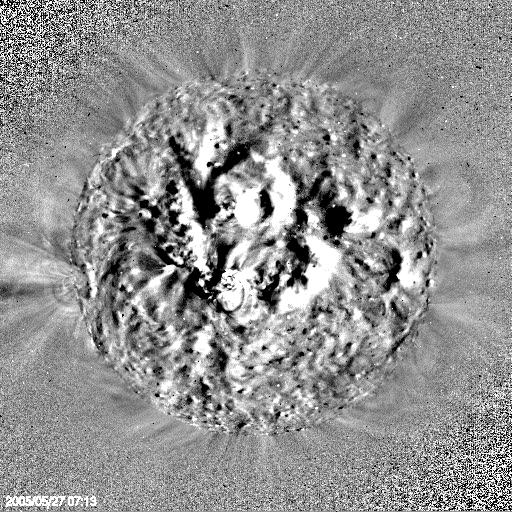
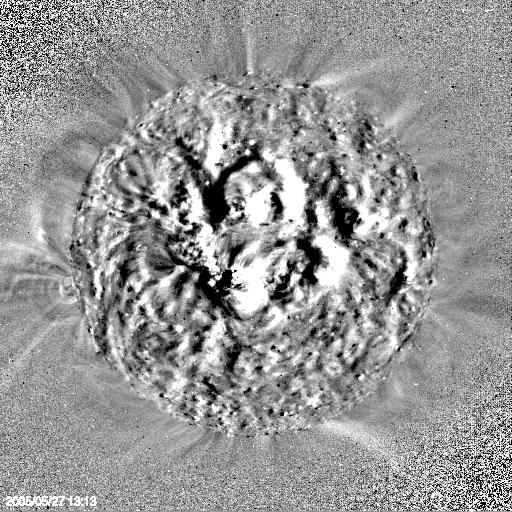
Those are three separate RD images (from NASA). You can't see a sphere and a figure out a circumference?
[qimg]http://www.thesurfaceofthesun.com/images/20050527-0713.JPG[/qimg]
[qimg]http://www.thesurfaceofthesun.com/images/20050527-0713.JPG[/qimg]
[qimg]http://www.thesurfaceofthesun.com/images/20050527-1313.JPG[/qimg]
Those are three separate RD images (from NASA). You can't see a sphere and a figure out a circumference?
I do not see a sphere. I see a disk. A disk is the projection of a 3D sphere onto 2D, and such projections are complicated by viewing angle and absorption issues. Do any of these words ring a bell?
"2D" is an interesting word, I wonder if it has ever come up on this thread before ...
Ok, start with a diameter then. Anything will do. Please, just come up with a way to differentiate between standard theory and the predictions I have made. I'm not looking for anything fancy.
All I want is the diameter of the disk according to standard theory. Is that really too much to ask?
A sphere is a three dimensional object. Those running difference graphs are two dimensional renderings of mathematical calculations based on comparisons between sequences of thermal data gathered over a period of time.
And the circumference of the Sun is still about 4.37 million kilometers.
All I want is the diameter of the disk according to standard theory. Is that really too much to ask?
The diameter of the Sun is about 1,391,000 kilometers, or in miles that's about 864,000. Is it too much to ask that you Google these things yourself?
