Moderated Iron sun with Aether batteries...

Status
Not open for further replies.
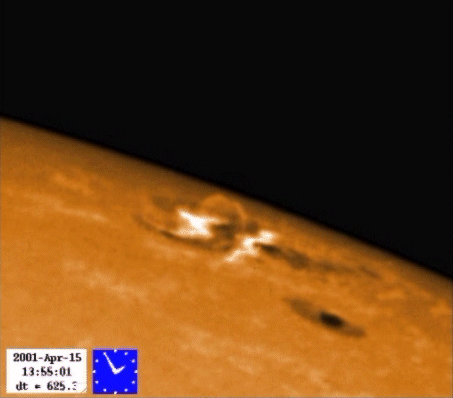
http://www.thesurfaceofthesun.com/images/15 April 2001 WL.gif
http://www.thesurfaceofthesun.com/images/mossyohkoh.jpg

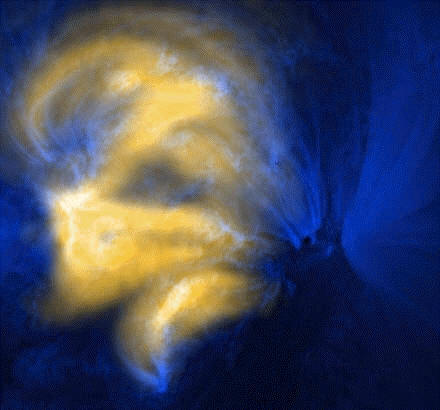
Both of these images demonstrate that the bases of the coronal loops originate far below the surface of the photosphere and *occasionally* rise up and through the photosphere where they become visible in x-ray.
Neither of these images demonstrate that the bases of the coronal loops originate far below the surface of the photosphere and *occasionally* rise up and through the photosphere where they become visible in x-rays.

All images in 171A, 195A, soft x-rays are of coronal loops above the photosphere as any one with a basic knowledge of science knows.
 
You are still not hearing me, or not understanding me. The *ORIGINAL* light sources are coronal loops. The terrain dictates the overall discharge patterns, as does the atmospheric plasma flow.
You are still not hearing me, or not understanding basic science.
The *ORIGINAL* light sources in the RD movie images is the plasma at a temperature of > 160,000 K. This is in the coronal loops. These coronal loops can only be imaged in the chromosphere and corona because that is what the 173A passband of the TRACE instrument is designed to do.
Making an RD movie of images of:
  1. Material at 160,000 K
  2. That is 1000's of kilometers above the photosphere.
gives you running differences in images of material at 160,000 K that is 1000's of kilometers above the photosphere.
That is a plasma.
That is above the photosphere, i.e. not a thermodynamically impossible iron shell/crust.

The belief that discharges do not occur in a plasma is itself idiocy. FYI most plasmas (including the photosphere) are "dusty" meaning they are composed of non ionized liquids if not solids, not simply plasma.
The belief that discharges do occur in a plasma is itself idiocy.
Plasmas are highly conductive because they are ionized (even dusty plasmas). Electrical discharges require dielectric (insulating) materials to breakdown to form the discharge.

FYI: Dusty plasmas.
 
Which images did you use as your input for the PM-A.gif image, etc.

First asked 6 April 2010

Originally Posted by GeeMack
  1. Which images did you use as your input for the PM-A.gif image?
  2. What mathematical process did you apply to obtain your result?
  3. In that image, the pixel in column 1371, row 758 has a value of about 20% black. Why is it that color?
    Where in that image do you believe you're seeing solid physical features? Why does no professional physicist on Earth agree that's what you're seeing?
  4. And perhaps most importantly, what is it about the creation process that makes you think you see physical features below the photosphere when the data gathered to create the original images was taken from thousands of kilometers above the photosphere?
(a link to this question is now in the other MM Iron Sun thread)
 
Last edited:
Except that it doesn't explain how the data used to create the original images, you know, data that came from thousands of kilometers above the photosphere, can be processed in such a way that the results show surface features thousands of kilometers below. So nope. Not evidence of a solid surface.

Ok. I took the liberty of going to the Opacity database and making up a mixture of H 90% He 5% Ne 2% with all of the relevant parameters of the photosphere like density, temperature, taken right from wiki.

Here is the TOPS opacity database.
http://www.t4.lanl.gov/cgi-bin/opacity/tops.pl

I had actually done this a few years ago but I will do it for you. Using this mixture I plotted absorption for a set of temperatures.
Notice at right around .6eV that it becomes transparent across the board. Even if there is some absorption on the high temp graph, 10^-3KeV, right at 171A there is a dip that would account for allowing high intensity light through, enabling the imaging of structures under the photosphere at just the right wavelength.
For water at room temp, the cutoff is about 280nm. Air passes soft x-rays, water doesnt.

If you have issues with the mixtures you can generate your own or tell me what mixture to to use.
From the help page.
"The TOPS code calculates the plasma cutoff frequency, the frequency below which photons may not propagate in a plasma. Any group which lies partly or fully below this frequency has the opacity in that group set to 10^10. Normally this cutoff frequency is very low relative to the temperature and should not make any difference in a radiation transport calculation."

Photosphere absorption and scattering By brantc 4-7-2010.
http://www.box.net/shared/or4yp441nk
 
CaveDave said:
Labs seem to duplicate the conditions necessary to heat plasma to millions of degrees. It requires "electricity".
To some extent, perhaps.

I seriously doubt that ALL the relevant conditions can be duplicated, though.

The "electricity" part is purely an artifact of your fevered imaginings, however.


Exactly Dave, if we could initiate proton-proton or carbon cycle fusion (and contain it), even with electricity, here on earth, I’d surmise all our energy problems would be solved. Just because using electricity to “heat plasma to millions of degrees” is the most efficient way we can do so here on earth does not mean that it is the most efficient way possible or that “It requires "electricity"“ “to heat plasma to millions of degrees”.
 
Here is the TOPS opacity database.
http://www.t4.lanl.gov/cgi-bin/opacity/tops.pl

I had actually done this a few years ago but I will do it for you. Using this mixture I plotted absorption for a set of temperatures.
Notice at right around .6eV that it becomes transparent across the board. Even if there is some absorption on the high temp graph, 10^-3KeV, right at 171A there is a dip that would account for allowing high intensity light through, enabling the imaging of structures under the photosphere at just the right wavelength.
Thank you brantc for proving that your iron shell is at a temperature of over 160,000 K (the bottom of the 171A passband) and so is a plasma.
Of course it may be at a temperature of 2,000,000 K - the top of the 171A passband. :D

Of course it is irrelevant since you did not enter your 100% iron Sun as the parameters.
 
brantc,
I take it that you are OK with discussing MM's Iron Sun idea that is thermodynamically impossible in a thread about your "Iron sun with Aether batteries" idea that is thermodynamically impossible (and combined with fantasies about "aether reactions").

So I will bring the many outstanding questions for MM here after updating your list. Hopefully his continuous display of an inability to learn will soon push this thread over the 2000 mark and beat the other thread he touted his Iron Sun idea in :D .
 
Last edited:
Outstanding questions for brantc

Hi brantc you probably missed these questions due to the large number of posts in the last day or so:
  1. Why is your solid iron surface emitting IR or EUV light that is typical of plasma?
    First asked 31 March 2010
  2. What part of the Sun emits a nearly black body spectrum temperature of 5777 K?
    First asked 29 March 2010
    No actual answer that I can see.
  3. What density measurments does the hollow iron shell account for?
    First asked 2 April 2010
  4. What is your "slightly different model of gravity"?
    First asked 2 April 2010
    So far it is any model that he want so long as it "supports" his thermodynamically impossible iron shell :eye-poppi .
  5. How thick is your thick hollow shell made of iron?
    First asked 2 April 2010
    First answer : 93 986.4865 kilometer thick shell but the Sun is all iron and a vaccuum inside the shell :eye-poppi !
  6. Cite the detection of your 93,986.4865 kilometer thick iron shell in helioseismology?
    First asked 6 April 2010
  7. Prediction of the solar neutrino flux from "aether based" reactions?
    First asked 7 April 2010
  8. Please list the empirical controlled experiments for "aether based" reactions.
    First asked 7 April 2010
 
Where is the spike of Fe composition in the remnants of novae and supernovae

Where does does the iron crust go in novae?

We should expect to see the remnants of novae and supernovae to be very rich in iron. Yet (as far as I know) these remnants do not have high iron concentrations. The metals (He and higher) are enhanced when compared to the interstellar medium.

First asked 8 April 2010
brantc:
Where is the spike of Fe composition in the remnants of novae and supernovae?
 
Ok. I took the liberty of going to the Opacity database and [*irrelevant rambling snipped*]


The source images used to create the running difference graphs and videos under discussion were obtained using filters that gather data from the Sun's corona. That is why they use those particular filters. There is no possible way that images of thermal characteristics of the corona, thousands of kilometers above the photosphere, can be processed in such a way that they show surface features below the photosphere.

For the newbies and lurkers: Michael Mozina and brantc claim they are able to see a surface on the Sun in these running difference images. That would be like taking a couple of photos of the Statue of Liberty in New York and somehow processing them in such a way that you could see the Eiffel Tower in Paris, nearly 6000 kilometers away.

Michael has been asked to address this particular issue many dozens of times over the past several years, yet tends to not even acknowledged the question. The reply brantc gave above (it could loosely be defined as gibberish) doesn't address the issue of using data taken from one region of the Sun's atmosphere to create images of an area thousands of kilometers away.
 
The source images used to create the running difference graphs and videos under discussion were obtained using filters that gather data from the Sun's corona. That is why they use those particular filters. There is no possible way that images of thermal characteristics of the corona, thousands of kilometers above the photosphere, can be processed in such a way that they show surface features below the photosphere.

For the newbies and lurkers: Michael Mozina and brantc claim they are able to see a surface on the Sun in these running difference images. That would be like taking a couple of photos of the Statue of Liberty in New York and somehow processing them in such a way that you could see the Eiffel Tower in Paris, nearly 6000 kilometers away.

Michael has been asked to address this particular issue many dozens of times over the past several years, yet tends to not even acknowledged the question. The reply brantc gave above (it could loosely be defined as gibberish) doesn't address the issue of using data taken from one region of the Sun's atmosphere to create images of an area thousands of kilometers away.

In other words, even though brantc went to all the trouble to demonstrate the basic flaw in your argument, and even though I've shown you the satellite images that blow your theory out of the water, you simply ignore them, call them 'gibberish' and go back to pure denial. Yawn.
 
You might me surprised that Occam's razor isn't automatically the BEST indicator of probable correctness of a proposition.
Amateur mistake. (Mozina makes that mistake frequently, and has never even learned how it is spelled:rolleyes:).

Actually, if you read Wiki, you'll find there are a number of variations on the spelling, and everyone insist *their* way is the 'right' one. :)

The main issue here is we don't need anything exotic to explain higher energy wavelengths in the atmosphere of an object in space. We already know from discharges on Earth that they occur "naturally'. There is no need to reinvent any new wheels to explain gamma and x-rays from the atmosphere of the sun, especially since discharges will do just fine and occur naturally in many atmospheres of many objects in this solar system, including the sun.

Sound travels even in rarefied gasses. Does that give you a problem?

Nope, not until you get to the somewhere that supposed to "reflect" the waves, all the waves mind you, not just a couple of them. That's going to requires a major shift in density.

ANY medium that carries sound and has a boundary can resonate. Does that give you a problem?
Any bounded transmissive medium can have resonances. Does that give you a problem?
So what IS your problem?

What is the density just inside the photosphere, and 10 KM into the chromosphere? There isn't enough density change to explain a reflective surface, and you folks can't even explain the clearly defined density transition between the photosphere and chromopshere in your model in the first place! Why is their a "layer" between them at all?

My model actually 'predicts' such a layering process and explains why the light from each layer is sometimes unique to that layer.

To some extent, perhaps.

I seriously doubt that ALL the relevant conditions can be duplicated, though.

The "electricity" part is purely an artifact of your fevered imaginings, however.

That last line is the type of thinking that has limited astronomers to dark sticks and stones and primitive belief systems now for decades. We already know that electrical discharges occur in the atmospheres of every large planet in the solar system with an atmosphere of any sort. Why would we not *predict* such things to occur in the solar atmosphere as well?

I'm afraid as you drag you feet, and never accept the one obvious solution to explain higher energy wavelengths of light, you will forever be blind to solar physical processes.

I'll stop here for now. I need some more coffee this morning. :)
 
Exactly Dave, if we could initiate proton-proton or carbon cycle fusion (and contain it), even with electricity, here on earth, I’d surmise all our energy problems would be solved. Just because using electricity to “heat plasma to millions of degrees” is the most efficient way we can do so here on earth does not mean that it is the most efficient way possible or that “It requires "electricity"“ “to heat plasma to millions of degrees”.

There's a problem however once you get the atmosphere of the sun. Without electricity, you simply don't have the conditions necessary to explain fusion, and yet fusion does occur inside coronal loops above the photosphere of the sun. How? Why?
http://svs.gsfc.nasa.gov/vis/a000000/a002700/a002750/

You're going to need electrical energy to explain that sort of energy release once you get above the photosphere, because there is simply no other way to create that sort of process without it. The conditions simply do not exist to explain it any other way. The photosphere is only 6K degrees. You still need to explain a 10-20 million degree energy release above that surface, and electrical discharges would in fact be the logical first choice.
 
As to the photosphere

Absolute rubbish. Nobody "assumes" any such thing.

Oh Boloney! Why did they name the spacecraft "Trace" in the first place Tim?

They made their mistake before launch the day they named the damn thing, before they even took a single solar image.

And as for sunspots ...

"But the sunspot remains relatively cool because the surrounding magnetic field inhibits convective energy transport into the sunspot. But this magnetic field does not interfere with radiative heat transport at all. That's why sunspots can't get cooler than about 3200 Kelvins"

This is where you guys turn magnetic fields into pure magic entities. You have them "cooling" hundreds of kilometers of plasma, and creating million degree coronal loops above them when you want them too. It's cool but somehow hot too? Nice trick if you never have to demonstrate any of it empirically.

Helioseismology is well known to validate the standard model of the sun, which requires the temperature to continue increasing below the photosphere.

Helioseismology depends on a "reflective surface' and it wouldn't work out all were it now for the crust. You can even see it's effect on Nickel ions in the Doppler images Kosovichev has personally created. There's no point in ignoring the *REASON* it works in the first place. You need a reflective surface to do that, and the density of the top of the photosphere is simply way too thin to even begin to explain that reflective process.
 
Last edited:
Neither of these images demonstrate that the bases of the coronal loops originate far below the surface of the photosphere and *occasionally* rise up and through the photosphere where they become visible in x-rays.

All images in 171A, 195A, soft x-rays are of coronal loops above the photosphere as any one with a basic knowledge of science knows.

So how do you respond to brantc's demonstration RC?
 
Where does does the iron crust go in novae?

New suns, planets, comets, meteorites, etc.

We should expect to see the remnants of novae and supernovae to be very rich in iron. Yet (as far as I know) these remnants do not have high iron concentrations. The metals (He and higher) are enhanced when compared to the interstellar medium.

Let's look back in time, shall we?

http://www.mpe.mpg.de/Highlights/pr20020708.html

Analyzing the quasar's X-ray light, detected with the European X-ray satellite XMM-Newton, Günther Hasinger, Stefanie Komossa and Norbert Schartel noticed that the material streaming away from the center of the quasar contains huge amounts of iron. From the "dip" in the quasar spectrum (figure 2) the scientists could determine the amount of iron located in the central region of the quasar, and thus in the early Universe. Interestingly, iron appears to be the only element clearly showing up in the spectrum; other elements, like oxygen, are barely detected. The estimated ratio of iron to oxygen is about 3 to 5 times higher than in our solar system. All the heavy elements, which planets like our Earth, and we ourselves, are composed of, were created inside stars billions of years ago. This is also the case for the element iron, which is mainly created by a special type of supernova (type I): supernovae are suns at the end of their lives which pass away in giant explosions, blowing the elements produced in their interior out into interstellar space. Some fraction of this "star dust" is used to build new stars, another fraction is ultimately sucked in by supermassive black holes at the centers of galaxies. Since, however, stars which pass away as type I supernovae have rather long lifetimes (about one billion years), large quantities of iron in the early universe are quite remarkable.

Emphasis mine. It looks to me like iron has always been abundant RC.

Now let's look at what happens when a star actually explodes:

http://www.chandra.harvard.edu/photo/2004/kepler/

The combined image unveils a bubble-shaped shroud of gas and dust that is 14 light years wide and is expanding at 4 million miles per hour (2,000 kilometers per second). Observations from each telescope highlight distinct features of the supernova remnant, a fast-moving shell of iron-rich material from the exploded star, surrounded by an expanding shock wave that is sweeping up interstellar gas and dust.

Emphasis mine. Why in the world is the there an "iron rich shell" around the outside of the explosion RC?
 
Neither of these images demonstrate that the bases of the coronal loops originate far below the surface of the photosphere and *occasionally* rise up and through the photosphere where they become visible in x-rays.

http://www.solarviews.com/cap/sun/moss8.htm

mossyohkoh.jpg


Please explain for us why we can see the bases of the coronal loops in 171A from the Trace spacecraft (Blue), but we only observe the the tops of the loops in Yohkoh x-ray images (Yellow)? If the loops are millions of degrees at the bases of the loops as indicated by the TRACE 171A filters, why aren't they emitting x-rays too at the bases of the loops, or why are the x-rays being absorbed near the bases of the loops, and not at the top of the loops?
 
There's a problem however once you get the atmosphere of the sun. Without electricity, you simply don't have the conditions necessary to explain fusion, and yet fusion does occur inside coronal loops above the photosphere of the sun. How? Why?
http://svs.gsfc.nasa.gov/vis/a000000/a002700/a002750/

You're going to need electrical energy to explain that sort of energy release once you get above the photosphere, because there is simply no other way to create that sort of process without it. The conditions simply do not exist to explain it any other way. The photosphere is only 6K degrees. You still need to explain a 10-20 million degree energy release above that surface, and electrical discharges would in fact be the logical first choice.


Who is trying to “explain fusion” in “the atmosphere of the sun”? Where does the link you provided say anything indicating “fusion does occur inside coronal loops above the photosphere of the sun”?
 
You are still not hearing me, or not understanding basic science.
The *ORIGINAL* light sources in the RD movie images is the plasma at a temperature of > 160,000 K. This is in the coronal loops.

They're akin to lightening discharges in the atmospheres of a planet. They aren't limited to a single "layer" of the solar atmosphere.

These coronal loops can only be imaged in the chromosphere and corona because that is what the 173A passband of the TRACE instrument is designed to do.

No, that's NOT what it's "designed to do". It is designed to pickup higher energy wavelengths of light from wherever they might occur. There's no guarantee that these wavelengths only occur in some magic layer of the sun's atmosphere or that they are limited to a single position in the solar atmosphere. That image you picked out of the LMSAL video clearly demonstrates that they come up and through the surface of the photosphere RC.

15%20April%202001%20WL.gif
 
Last edited:
Status
Not open for further replies.

Back
Top Bottom