Moderated Iron sun with Aether batteries...

Status
Not open for further replies.
What exactly is a quark

http://en.wikipedia.org/wiki/Quark

and why dont we use it for energy here on earth?

Because they're not a source of energy.

1987: Only 14% +- 23% of proton’s spin carried by quarks’ spins!

Nope. Quarks are spin-1/2 particles. Three such particles can in principle either produce a total quantized spin of 1/2 or of 3/2. In the case of a proton, it's three quarks forming a spin-1/2 total. There's no missing spin anywhere.
 
1987: Only 14% +- 23% of proton’s spin carried by quarks’ spins!

The Proton Spin Crisis begins!!
Ziggurat, brantc is doing the usual crank techniques of
  • ignoring the fact that science progresses (what is correct in 1987 is not true in 2010!)
  • cherry picking information
  • not citing his sources
  • and bringing up something that has nothing to do with the topic
However this is interesting in its own right and since the topic of this thread is defunct (the Sun's surface has temperatures greater than the meilting point of iron as well as numerous other problems with brantc's idea), we may as well explore it.

A quick Google reveals that he got this from a PowerPoint presentation done by Christine Aidala in 2008: Solving the Proton Spin Crisis.
The problem is that it is not as simple as just adding up the spin of quarks to get the proton spin. This is because gluons also have spin and there are also virtual quark–antiquark pairs known assea quarks in the proton.
This is what the inital 1987 experimental results showed, more experiments (experiments done in 2004 cited) have not solved this but the RHIC is expected to reveal more about the situation by investigatin gluon spins. The 2008 RHIC data though does not solve the proton spin crisis.
 
Nope. Quarks are spin-1/2 particles. Three such particles can in principle either produce a total quantized spin of 1/2 or of 3/2. In the case of a proton, it's three quarks forming a spin-1/2 total. There's no missing spin anywhere.

Naively that looks fine; if it were that simple, you'd expect to be able to do polarized e-p scattering, zoom in on the sort of scattering events that probe the usual three valence quarks, and see this structure---scattering off of a +polarized proton should look like scattering off of two +quarks and one -quark. It doesn't, it looks a lot more like unpolarized-proton scattering. (We call this "deep inelastic scattering" or DIS and the HERA and CEBAF accelerators got very good at it.)

Don't forget that the proton is, in fact, a rather messy QCD slopbucket with a bunch of sea quarks and gluons, whose spins also contribute to the proton net angular momentum. You need to do very different scattering experiments to see the sea quarks (low-x) and gluons (via, say, polarized pp collisions, only possible at RHIC).

So perhaps instead of viewing the proton as three quarks, you should view it as five---three valence quarks, let's call them abc, and (say) one q-qbar pair in the sea, let's call them d and e. Your "naive" p+ would could get its spin from a+b+c-. But let's include the sea quarks; suppose that a p+ is actually an admixture of (a+b+c-d-)e+ and (a+b-c-d+)e+. The valence quarks are "unpolarized" (50%+, 50%-), even though the proton has a consistent + net spin.

Throw in the gluons and things are even more complicated; the complication, of course, is simply that the valence quarks are easier to experiment on than the sea quarks, and much easier than the gluons. So any spin that's not carried by the valence quarks appears "missing". What's the answer? Where IS the missing spin? Ten years ago I would have said "probably in the gluons" but I'm not conversant enough with recent RHIC results to know whether that's still a fair answer; there was also something about whether translation from DIS-asymmetry to target-particle-spin was complicated by the dense QCD environment.

But yeah, this is of no possible relevance to anything Brantc could have been talking about.
 
What is the basis for this belief? If there were a solid iron surface, wouldn't spectographic absorption (spelling and/or term may be wrong there) lines indicate this, given a surface of this nature would block any light from underneath it? Is this seen? If not, why would it not, in accordance with this bizarre model?

I suppose the simplest way to answer that question is to say that 20 years of satellite image analysis was the original source of information that caught my attention, along with the SERTS data and of course Birkeland's work (eventually). You'll find plenty of spectral evidence of iron, nickel and other heavy elements in the solar spectrum. Keep in mind that this is *NOT* a "mixed plasma" model, where iron supposedly stays "mixed" with hydrogen and helium. The spectral data can be "interpreted" in a variety of ways, and this is a "plasma separated" solar model.

171surfaceshotsmall.JPG

http://trace.lmsal.com/POD/movies/T171_000828.avi

tsunami1.JPG

http://www.thesurfaceofthesun.com/images/vquake1.avi
 
Last edited:
What exactly is a quark and why dont we use it for energy here on earth?

1987: Only 14% +- 23% of proton’s spin carried by quarks’ spins!

The Proton Spin Crisis begins!!

Well, at least we have observed quarks and we do used them here on Earth, maybe not for energy, but the simplest example is Beta-decay, where a neutron turns into a proton and an electron and a neutrino, whereas your magical aether has not been shown anywhere on Earth.

So instead of coming up with obviously wrong information, why not show evidence of electron creation by the aether.

From Hyperphysics;
"When a voltage is generated by a battery, or by the magnetic force according to Faraday's Law, this generated voltage has been traditionally called an "electromotive force" or emf. The emf represents energy per unit charge (voltage) which has been made available by the generating mechanism and is not a "force"."
http://hyperphysics.phy-astr.gsu.edu/hbase/electric/elevol.html
Yeah, but there IS no battery on ... through discharges or something of that ilk.
 
So any spin that's not carried by the valence quarks appears "missing". What's the answer? Where IS the missing spin? Ten years ago I would have said "probably in the gluons" but I'm not conversant enough with recent RHIC results to know whether that's still a fair answer; there was also something about whether translation from DIS-asymmetry to target-particle-spin was complicated by the dense QCD environment.

As far as I understand (which is barely at all), it is thought that it is a sum of quark spin, gluon spin, quark orbital angular momentum and gluon oam. But at least one of these (gluon oam IIRC) is very difficult to measure. But I could be talking nonesense.
 
Coronal Heating & Solar Wind III

This is an edited copy of post #3953 on page 99 of the unmoderated thread "Lambda-CDM Theory - Woo or not?", which has been marching along now since 10 February 2009. Obviously, the material below has nothing at all to do with that thread, a not unusual derail these days. I submit it to this thread as it is relevant and a reminder of points not yet effectively answered by those of an "alternative" frame of mind.

Zeuzz says: The coronal heating anomaly where the inverse square law of radiation is explicity violated is dually thermodynamically impossible if using the standard solar model. Still no theory has been backed up by adequate data to explain coronal heating, and coronal acceleration for that matter.

1 "The coronal heating anomaly where the inverse square law of radiation is explicity violated is dually thermodynamically impossible if using the standard solar model." That statement is factually false, there is no inverse square law violation of radiation. Evidently Zeuzzz does not understand the difference between radiant energy and particle kinetic energy, which is a pretty severe mistake for somebody who claims some expertise in physics. The kinetic temperature of the particles that make up the solar corona is on the order of 1,000,000 Kelvins, whereas the kinetic temperature of the particles that make up the solar photosphere, which lies below the corona, is roughly 5800 Kelvins. Since the spontaneous flow of heat energy is in all cases from higher temperature to lower temperature, and never the other way around (second law of thermodynamics), one might naively assume that this is an example a well established law of physics being violated. This is the "anomaly" to which Zeuzzz refers, and it has nothing at all to do with the inverse square law for radiation. It is also not an "anomaly" of any kind, although some who style themselves as alternative thinkers, but are actually rather careless thinkers, would like you to believe it is.

A moment of non-careless thinking will quickly reveal that a refrigerator prominently displays the transfer of heat from lower temperature regions inside the refrigerator to the higher temperature regions outside the refrigerator, in obvious violation of the fabled second law. Yet nobody seems upset about that, so what's the deal with these physics violating refrigerator things? The deal is that in a refrigerator, the transfer of heat is not spontaneous. I draw your attention to the critical presence of the word "not". Left to its own devices, water will always flow downhill, but we all know that it can be pumped uphill. Likewise, heat energy can be pumped "uphill", in the direction cold -> hot, as opposed to the natural direction hot -> cold. A refrigerator is simply a heat pump, which does work and expends energy and results in the pumping of heat "uphill". All one needs is a pumping mechanism and the "anomaly" of the corona becomes an interesting problem in physics, but violates no law of physics. So Zeuzzz is wrong on both counts: There is no "anomaly" at all, unless Zeuzzz is prepared to prove from first principles that any and all pumping mechanisms are impossible in this physical context, and since radiation is not involved, there is clearly no violation of the inverse square law for the decrease in radiation intensity.

And this leads us into the next topic ...

2 "Still no theory has been backed up by adequate data to explain coronal heating, and coronal acceleration for that matter." Not only is that statement factually incorrect, it is the exact opposite of the truth. There are in fact so many viable pumping mechanisms to choose from that the real scientific debate centers on which mechanisms are responsible for what fraction of the pumping, and whether or not there are still more pumping mechanisms that we have yet to elucidate. This is easy to determine with a cursory glance at the scientific literature. We should expect someone who claims knowledge & expertise in any field of science to at least have a minimal grasp of the published literature in that field.

These are all points I have made before: Coronal Heating & Solar Wind I (17 April 2010). This matter of the alleged impossibility of the solar corona temperature compared to the photospheric temperature has never yet been properly addressed by those who have alternative models for solar physics. I just thought I would drop by and remind you all of this fact.

 
I suppose the simplest way to answer that question is to say that 20 years of satellite image analysis was the original source of information that caught my attention, along with the SERTS data and of course Birkeland's work (eventually). You'll find plenty of spectral evidence of iron, nickel and other heavy elements in the solar spectrum. Keep in mind that this is *NOT* a "mixed plasma" model, where iron supposedly stays "mixed" with hydrogen and helium. The spectral data can be "interpreted" in a variety of ways, and this is a "plasma separated" solar model.

http://www.thesurfaceofthesun.com/images/171surfaceshotsmall.JPG
http://trace.lmsal.com/POD/movies/T171_000828.avi

http://www.thesurfaceofthesun.com/images/tsunami1.JPG
http://www.thesurfaceofthesun.com/images/vquake1.avi
Mister Earl
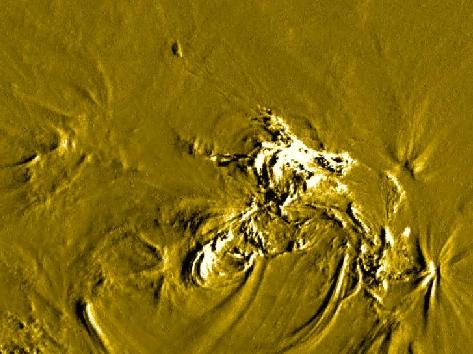
These 2 images are examples of what we have been calling "bunnies in the clouds" logic. Note that Michael Mozina has just shown the images, not cited the sources or described what is in them. This should tell you that they are at least dubious support for his idea.

The first image is a great running difference movie from the TRACE spacecraft. It was constructed by taking the difference beween 2 images in a series of images of a coronal mass ejection event.
  • This is in the 171A passband of the instrument. It is recording light from plasma at a temperature of 160,000 K to 2,000,000 K. There is nothing solid there.
  • It is of activity in the corona not the photosphere.
  • The dark areas are where the temperature is decreasing, the light where it is decreasing. These areas happen to be next to each other (actually on either side of flares if you look at the original images). This gives the illusion of "mountain ranges".
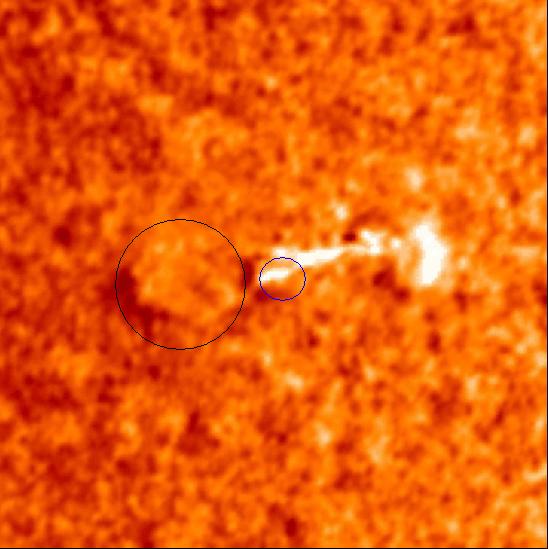
The second image is a an example of a bit of honesty from MM. He asked the author about it and placed the reply on MM's web site.
MM's optical illusion of "rigid features" are actually areas of constant change happening in one location. As Dr Kosovichev has told him
The consistent structures in the movie are caused by stationary flows in magnetic structures, sunspots and active regions.
We know this from the simultaneous measurements of solar magnetic field, made by SOHO. These are not solid structures which would not have mass flows that we see.
These images are Doppler shift of the spectral line Ni 6768A.
The Doppler shift measures the velocity of mass motions along the line of sight. The darker areas show the motions towards us, and light areas show flows from us. These are not cliffs or anything like this. The movie frames are the running differences of the Doppler shift. For the illustration purpose, the sunquake signal is enhanced by increasing its amplitude by a factor 4.
(my emphasis added)

In both cases optical illusions created by the processing of the images have fooled Michael Mozina. This has been pointed oiut to him many timed over a period of 5 or more years.
 
I suppose the simplest way to answer that question is to say that 20 years of satellite image analysis was the original source of information that caught my attention, along with the SERTS data and of course Birkeland's work (eventually). You'll find plenty of spectral evidence of iron, nickel and other heavy elements in the solar spectrum. Keep in mind that this is *NOT* a "mixed plasma" model, where iron supposedly stays "mixed" with hydrogen and helium. The spectral data can be "interpreted" in a variety of ways, and this is a "plasma separated" solar model.

[qimg]http://www.thesurfaceofthesun.com/images/171surfaceshotsmall.JPG[/qimg]
http://trace.lmsal.com/POD/movies/T171_000828.avi

[qimg]http://www.thesurfaceofthesun.com/images/tsunami1.JPG[/qimg]
http://www.thesurfaceofthesun.com/images/vquake1.avi


Okay, Michael, now that you've decided to rejoin this discussion, how are you coming on the evidence that you were so certain you'd get from the data sent back from the SDO program? Remember way back before you temporarily abandoned the thread you were saying stuff like this for many, many days...

The RD images at 171A and probably FEXX wavelengths will show opaque edges that are 4800Km inside the chromosphere.


How's that coming? Where are the running difference images you said you'd make which would show us all beyond any doubt that the Sun does indeed have a solid iron surface? As I recall you were even trying to get everyone to take your bet. Is that still on, or have you abandoned that, too?
 
I suppose the simplest way to answer that question is to say that 20 years of satellite image analysis was the original source of information that caught my attention, along with the SERTS data and of course Birkeland's work (eventually). You'll find plenty of spectral evidence of iron, nickel and other heavy elements in the solar spectrum. Keep in mind that this is *NOT* a "mixed plasma" model, where iron supposedly stays "mixed" with hydrogen and helium. The spectral data can be "interpreted" in a variety of ways, and this is a "plasma separated" solar model.

*Snipped images*

Since Brantc never awnsered my post, perhaps you will.
Your model for the sun implies that iron has physical properties vastly different from what current physics ascribes to it.
Ie. you believe it to be far stronger and/or differently affected by gravity than the mainstream models propose, as a hollow iron shell the size of the sun, according to the current model, would collapse in on itself.
The easiest way to prove this would be to show that iron can actually handle far more pressure than we currently apply to it in buildings and the like and can easily lead to massive improvement across the board for humanity.
How far are you along with proving this?
 
Since Brantc never awnsered my post, perhaps you will.
Your model for the sun implies that iron has physical properties vastly different from what current physics ascribes to it.

Well, that isn't *MY* belief. I assume it's just a standard crust and I'm not suggesting the crust is entirely composed of iron, it just has lots of iron in it.

you believe it to be far stronger and/or differently affected by gravity than the mainstream models propose, as a hollow iron shell the size of the sun, according to the current model, would collapse in on itself.

You're oversimplifying it IMO. It's not "hollow". It has pressurized plasma inside. Surface tension and internal pressure can have that effect on objects in space.

http://www.youtube.com/watch?v=4Iax3wNqktA

Why doesn't that water shell collapse in on the central bubble?

The easiest way to prove this would be to show that iron can actually handle far more pressure than we currently apply to it in buildings and the like and can easily lead to massive improvement across the board for humanity.
How far are you along with proving this?

I'd say "not very" because I'm not suggesting that the shell is "solid iron". That's not what I'm suggesting. I'm suggesting it's a standard crust and floats on magma with core of superheated plasma. There is a lot of iron in a sun IMO, but it doesn't all have to be located in the crust.
 
A moment of non-careless thinking will quickly reveal that a refrigerator prominently displays the transfer of heat from lower temperature regions inside the refrigerator to the higher temperature regions outside the refrigerator, in obvious violation of the fabled second law. Yet nobody seems upset about that, so what's the deal with these physics violating refrigerator things? The deal is that in a refrigerator, the transfer of heat is not spontaneous.

Actually, I think this description of the problem confuses the issue. I'm sure you already understand what I'm going to say, but others might not. Heat isn't transferred from cold to hot at all, even in a refrigerator. Energy is transferred from cold to hot, and the temperature of the refrigerant is changed by means other than the flow of heat. But at each point in the refrigerator, heat always and only travels from hot to cold, never the reverse.

Let me give a simpler example which is, I think a little more relevant to the issue of the corona. Suppose I have a see-saw. On one end of the see-saw, I place a 1 kg block of hot iron. That end of the see-saw is now down on the ground. Now, what happens if I place a 2 kg block of cold iron on the other end of the see-saw? Well, the 2kg end will drop, and the 1 kg end will rise. And in the process, energy will be transferred from the 2kg mass to the 1 kg mass. Note what happened: energy flowed spontaneously from cold to hot. But energy is not synonymous with heat. No heat flowed from cold to hot.

And we can take this process a step further. Suppose I stuck a vertical board in the ground next to the see-saw, and coated the side in sand paper. Now, when the 1 kg mass moves, it scrapes against the sand paper. I repeat the process from the start: begin with the 1 kg hot iron on the ground, put the 2 kg cold iron on the other end, and let go. The cold iron drops, the hot iron rises, but now, as it rises, it scrapes along the sand paper and heats up. So we can heat up a hot object using a cold object. But not by the transfer of heat, but by the transfer of energy which is then converted into heat.

So what does this have to do with the corona? Simple: we can transfer energy (not heat) from the sun to the corona even though the corona is hotter. And this transferred energy can turn into heat. But we can't transfer heat to the corona. Because heat never flows from cold to hot.
 
You're oversimplifying it IMO. It's not "hollow". It has pressurized plasma inside.

What's the pressure of this plasma, Michael? And what's the corresponding density and temperature?

Surface tension and internal pressure can have that effect on objects in space.

http://www.youtube.com/watch?v=4Iax3wNqktA

Why doesn't that water shell collapse in on the central bubble?

We've been through this before, Michael.

Here I calculate the pressure inside an iron shell, finding that it's far too large for any known material to withstand:
http://www.internationalskeptics.com/forums/showthread.php?p=5797482#post5797482
Here I point out that solids don't have surface tension, and that it doesn't scale in liquids:
http://www.internationalskeptics.com/forums/showthread.php?p=5802412#post5802412
And here you even conceded that it wasn't surface tension:
http://www.internationalskeptics.com/forums/showthread.php?p=5802470#post5802470

So in the only cases where I can ever recall seeing you concede a mistake and learn something, you've actually managed to go and unlearn it.

But you never did figure out the gravitational self-attraction of that water bubble you keep referring to. You're so keen on claiming that plasma physics "scales" (though it's unclear you even know what that means), so let's see if you can figure this out.

For your water bubble, gravitational self-attraction is miniscule, and the force it produces is far weaker than surface tension for that bubble. Gravity is an irrelevant perturbation. But surface tension doesn't scale: when we increase the size of our water bubble, the surface tension remains the same. But gravitational self-attraction DOES scale: it gets bigger as we make our water bubble bigger. So at some point, gravity will produce stronger forces than surface tension. And if we keep going, then surface tension will become the irrelevant perturbation, and gravity will dominate. And that point will happen long before we get to anything the size of the sun. In fact, the sun is so massive that, as I showed in that first link above, even the bulk stresses that solids can withstand (which are far stronger than any liquid surface tension) are orders of magnitude weaker than the force of gravity.

I'd say "not very" because I'm not suggesting that the shell is "solid iron". That's not what I'm suggesting. I'm suggesting it's a standard crust and floats on magma with core of superheated plasma

That inner magma would fall inwards. Or, if you prefer, that inner plasma would bubble up. You've made the problem worse by adding a magma layer, not better.
 
Okay, Michael, now that you've decided to rejoin this discussion, how are you coming on the evidence that you were so certain you'd get from the data sent back from the SDO program? Remember way back before you temporarily abandoned the thread you were saying stuff like this for many, many days...

[...]

How's that coming? Where are the running difference images you said you'd make which would show us all beyond any doubt that the Sun does indeed have a solid iron surface? As I recall you were even trying to get everyone to take your bet. Is that still on, or have you abandoned that, too?


Okay, Michael, we're going to stay on this, because many months ago, for several days, tens of pages of this thread, you were absolutely certain that everyone else was wrong and you were right about the running difference images you could make from the SDO data. You declared without any ambiguity that the results of your creation of those running difference images would be the proof that you were looking for, the evidence that would convince us all that your conjecture is correct, or it would be the nail in the coffin, the evidence that would demonstrate the failure of your entire claim.

You seemed to abandon this thread, I'd suggest by no coincidence, at the point where the necessary data was becoming available. But now you've decided to get involved in the discussion again. You claim to be a legitimate scientist with every bit as much interest in falsifying your conjecture as proving it. So when can we expect you to post those running difference images?

Either way it turns out will be good for you. If you are correct, it will mean getting the attention of the entire world of astrophysical scientists. You'll get the assistance you need with your weaknesses like math, physics, image analysis, and communication. And with all that help from professionals, real scientists, you'll be able to flesh out your conjecture so it becomes a subject of legitimate science.

And if it turns out you're wrong, it will mean you're finally off the hook after all these years with the work of keeping up your claim. You'll be out from under all the ridicule that has been directed at your conjecture by pretty much every person who has heard of it. You'll be able to take down your web site, spend more time with your friends and family, and dedicate your attention to your other interests, hobbies, and your life. Are you prepared to finally show us what you've got and get this whole issue resolved?
 
http://en.wikipedia.org/wiki/Quark
Because they're not a source of energy.

Nope. Quarks are spin-1/2 particles. Three such particles can in principle either produce a total quantized spin of 1/2 or of 3/2. In the case of a proton, it's three quarks forming a spin-1/2 total. There's no missing spin anywhere.

Oh. My mistake. I didnt realize the Proton Spin Crisis had been solved!!
 
Ziggurat, brantc is doing the usual crank techniques of
  • ignoring the fact that science progresses (what is correct in 1987 is not true in 2010!)
  • cherry picking information
  • not citing his sources
  • and bringing up something that has nothing to do with the topic
However this is interesting in its own right and since the topic of this thread is defunct (the Sun's surface has temperatures greater than the meilting point of iron as well as numerous other problems with brantc's idea), we may as well explore it.
Stop calling me names.

And the proton crisis has not been solved by your admission so there is nothing wrong with bringing up a problem to show how long it has been a problem. There are many things that still valid after many years.:eye-poppi

This is also to bring light that the aether is not out of the realm of possibility. That the standard model has a few problems that may be solved by the judicious application of an alternate theory..
 
Naively that looks fine; if it were that simple, you'd expect to be able to do polarized e-p scattering, zoom in on the sort of scattering events that probe the usual three valence quarks, and see this structure---scattering off of a +polarized proton should look like scattering off of two +quarks and one -quark. It doesn't, it looks a lot more like unpolarized-proton scattering. (We call this "deep inelastic scattering" or DIS and the HERA and CEBAF accelerators got very good at it.)

Don't forget that the proton is, in fact, a rather messy QCD slopbucket with a bunch of sea quarks and gluons, whose spins also contribute to the proton net angular momentum. You need to do very different scattering experiments to see the sea quarks (low-x) and gluons (via, say, polarized pp collisions, only possible at RHIC).

So perhaps instead of viewing the proton as three quarks, you should view it as five---three valence quarks, let's call them abc, and (say) one q-qbar pair in the sea, let's call them d and e. Your "naive" p+ would could get its spin from a+b+c-. But let's include the sea quarks; suppose that a p+ is actually an admixture of (a+b+c-d-)e+ and (a+b-c-d+)e+. The valence quarks are "unpolarized" (50%+, 50%-), even though the proton has a consistent + net spin.

Throw in the gluons and things are even more complicated; the complication, of course, is simply that the valence quarks are easier to experiment on than the sea quarks, and much easier than the gluons. So any spin that's not carried by the valence quarks appears "missing". What's the answer? Where IS the missing spin? Ten years ago I would have said "probably in the gluons" but I'm not conversant enough with recent RHIC results to know whether that's still a fair answer; there was also something about whether translation from DIS-asymmetry to target-particle-spin was complicated by the dense QCD environment.

But yeah, this is of no possible relevance to anything Brantc could have been talking about.

Your assuming that we know what the deepest structure of the universe is.
We do not.
Particles that "glue" other particles together doesnt make sense.
How do you get attraction from a sphere(quark, gluon, etc)?? It still requires some force that emanates from the particle.

If you have something like wave structures that make up particles, that go into resonance, as the waves over lap you can have "attraction". Particles are made of Aether waves...per se.

If you were to read some of the Aetherometry stuff I posted, it goes a little bit into atomic structure. I think this has a bearing on how the sun operates.
 
  • This is in the 171A passband of the instrument. It is recording light from plasma at a temperature of 160,000 K to 2,000,000 K. There is nothing solid there.
  • It is of activity in the corona not the photosphere.
  • The dark areas are where the temperature is decreasing, the light where it is decreasing. These areas happen to be next to each other (actually on either side of flares if you look at the original images). This gives the illusion of "mountain ranges".

Again. If I take my 15000K spectrum light, or my 6500K lamp, I can take pictures with this lamp because the light reflects. I can take pictures with x-rays.
The temperature of the human body is not 220,000,000K for a 20kEv x-ray.
I can take pictures of objects that are cooler than 1 million degrees with light at 171nm...

So the idea that you cant see objects that are NOT at the emission temperature of the light with said light is not correct.
 
Well, at least we have observed quarks and we do used them here on Earth, maybe not for energy, but the simplest example is Beta-decay, where a neutron turns into a proton and an electron and a neutrino, whereas your magical aether has not been shown anywhere on Earth.

So instead of coming up with obviously wrong information, why not show evidence of electron creation by the aether.

I posted some stuff from aetherometry about this a page ago.

Yeah, but there IS no battery on the Sun, the electron beams that you want to have emit X-rays are generated by the change in magnetic field.

Thats what this whole thread is about.

From a previous post. The iron sun acts like an antenna. Antennas take EM(photons) and transform them into electricity.

So the sun takes the "aether" and transforms it into electricity. The leakage current is large enough to generate the effects that we see.

Oh I am not confused, only confused about your "model" of the iron sun with aether electrons and other nonsense stuff.

See above. The output of the sun is high voltage. Thats why there is not the corresponding high current magnetic field.

Yes, it is easy to talk about EMF when a magnetic field is changing because that describes in a way what is happening, however, it all comes back to Faraday's law that says that the change of the magnetic field over time in a current loop will generate an electric field. However, at the same time this electric field will generate electric currents. So basically all the energy through the changing magnetic field is pumped into the motion of the charged particles in the loop, and naturally most of it in the electrons. Thus we have highly energetic electrons that flow along the loop and hit the photosphere and there light up the footpoints in X-rays through bremsstrahlung. However, I think you would most likely like to generate the X-rays through discharges or something of that ilk.

Yes, that is true. But you have to have a starting point. I think that starting point is the kinetic energy of the electrons from the iron surface. That kinetic energy is imparted by the aether/antenna(the field) configuration. Geometry is important. Just look at antenna design theory.

I dont think its the mechanical motion of the sun changing the magnetic field as a driver. I also think that the Aether may be the driver for the suns rotation.
 
Well, that isn't *MY* belief. I assume it's just a standard crust and I'm not suggesting the crust is entirely composed of iron, it just has lots of iron in it.


But that just means that you consider a certain mixture of materials, containing iron, to have an amount of tensile strength far greater than modern physics currently ascribes to it. If this is true, then this particular mix would have the strength to seriously alter modern day building techniques.

You're oversimplifying it IMO. It's not "hollow". It has pressurized plasma inside. Surface tension and internal pressure can have that effect on objects in space.


But pressurized plasma and/or magma would add a considerable amount of mass.
The sun's mass is calculated pretty well. Given that your shell is not hydrogen, most of the currently known mass of the sun would be in there making it effectively hollow. The only way to produce enough outward pressure with some internal plasma would be to make this plasma so intensly hot it would instantly vaporize any known material. So in your model either this plasma/magma would have some from of anti-mass or anti-gravity to account for the sun's current known mass, or the shell is capable of maintaining its coherence in extreme temperatures.
Again, demonstrating either of these three properties should be possible on earth and would immediatly validate your theory AND gain immense prestige as practical applications of each would be immense. Surely that is the best way to convince people rather than try to point at solar pictures that can also be interpreted using current physics without the need for a solid shell?

http://www.youtube.com/watch?v=4Iax3wNqktA

Why doesn't that water shell collapse in on the central bubble?


See Ziggurats excellent post on why a small water bubble is not a good model for a giant hollow sphere in space


I'd say "not very" because I'm not suggesting that the shell is "solid iron". That's not what I'm suggesting. I'm suggesting it's a standard crust and floats on magma with core of superheated plasma. There is a lot of iron in a sun IMO, but it doesn't all have to be located in the crust.

Again, what happens to the mass of the sun, and why is this iron/crust material not found in similar abundancy in the gas giants, the rest of the solar system or (super)nova remnants?
 
Status
Not open for further replies.

Back
Top Bottom