
Merged "Iron-rich spheres" - scienctific explanation?

Oystein: OK, according to wiki, so-called Ostwaldt ripening (sounds good:cool:) is an important process during sintering of any powder (larger particles "eat" smaller ones and become rounder at temperatures above ca 70 % of melting point of the stuff), but microspheres in Fig. 20 seem to be still "suspiciously" spherical for such low-temperature experiments.

Probably only Ostwaldt ripening in a typical two-phase system we have here (paint/rust bilayer) can explain the formation of distinct microspheres (one phase "does not like" other one, leading to the minimizing/rounding of its surface, etc)... it is perhaps a matter of several weeks of study - and a theme for some PhD thesis, but who would pay for it?

Since (among others) the whole concept of thermitic CD of WTC is a very clear idiocy and no metallic aluminium components of thermite were found by Jim Millette, there is no need to prove that such microspheres can be formed in the WTC primer paints heated to 700 degrees C without thermitic reaction, as you/we have noted maybe fifty times (?). They were simply formed in paint chips attached to oxidized steel (together e.g with some translucent microspheres created probably from silicate or other non-metallic stuffs). Period (so far):o)

This is an awesome discussion, I wasn't fully aware of sintering and a non-melting reason for sphere formation. Looking up why it happens is being very educational for me.
 
By the way, I played a bit with fire today and made my living room smelly:

I heated several small (milli-sized) organic particles over a candle. Used two different sample holders:
  • Aluminium wrap. Standard houshold grade. Probably 10-15 µm thin, and probably pretty pure aluminium. This heats very quickly if held just above the tip of the candle, seems to go to nearly the melting point of Al within seconds (you can see how the surface flickers and changes in funny way, but I rarely melt a hole in the strip)
  • A roundish piece (a shard, actually) of not totally fire-prrof glass. Since this is thicker and less condictive for heat, the top side heats up much slower than the Al wrap, but I suppose it does eventually go to >400°C, perhaps >500°C.

I hold both with a pipe wrench.


I tried these materials:
  • A pit of dried rose petal. This hardly reacted at all, only got darker, but mostly retaines shape. But didn't make much contakt with the sample holder
  • Wood splinter - smoldered a bit
  • Nail clipping (no comments, please!) - melted and burned surprisingly quickly, with significant loss of mass
  • a bit of a reddish paint scraped off of the lower (never subjected to heat) part of my iron barbeque. Binder seems rather softish, a bit like rubber, not what a steel primer what look like. This burned smooth and speedily
  • Some white paint designed for stove pipes, that's supposed to be resistant to up to 400°C. Old can of paint, but I burned it fresh out of the canm uncured, with some solvent running around. The solvent cooked and burned off, the remaining paint mostly charred and decomposed but didn's show much signs of burning
  • The most interesting bit was bits of a clear, hard plastic shaved off of an Oral-B tooth brush - I suspect it's polycarbonate, but I am not sure. Second guess would have been polypropylene, but PP is lighter than water, and this brush sinks in water. This plastic burned very rigorously and quickly (<3 s) on the Al strip, leaving only a tiny bit of char. On the glass shard, getting much more slowly heated, it showed a complex series of changing shape, then changing optic properties, then swelling, giving off gas in bubbles, finally smoldering, and leaving much more char than it did when heated quickly

Tomorrow I'll try cured paint, and perhaps some cured glue, and whatever else I can find.

I wish I had a microscope, and I wish I had a good video camera...
 
By the way, I played a bit with fire today and made my living room smelly:

I heated several small (milli-sized) organic particles over a candle. Used two different sample holders:
  • Aluminium wrap. Standard houshold grade. Probably 10-15 µm thin, and probably pretty pure aluminium. This heats very quickly if held just above the tip of the candle, seems to go to nearly the melting point of Al within seconds (you can see how the surface flickers and changes in funny way, but I rarely melt a hole in the strip)
  • A roundish piece (a shard, actually) of not totally fire-prrof glass. Since this is thicker and less condictive for heat, the top side heats up much slower than the Al wrap, but I suppose it does eventually go to >400°C, perhaps >500°C.

I hold both with a pipe wrench.


I tried these materials:
  • A pit of dried rose petal. This hardly reacted at all, only got darker, but mostly retaines shape. But didn't make much contakt with the sample holder
  • Wood splinter - smoldered a bit
  • Nail clipping (no comments, please!) - melted and burned surprisingly quickly, with significant loss of mass
  • a bit of a reddish paint scraped off of the lower (never subjected to heat) part of my iron barbeque. Binder seems rather softish, a bit like rubber, not what a steel primer what look like. This burned smooth and speedily
  • Some white paint designed for stove pipes, that's supposed to be resistant to up to 400°C. Old can of paint, but I burned it fresh out of the canm uncured, with some solvent running around. The solvent cooked and burned off, the remaining paint mostly charred and decomposed but didn's show much signs of burning
  • The most interesting bit was bits of a clear, hard plastic shaved off of an Oral-B tooth brush - I suspect it's polycarbonate, but I am not sure. Second guess would have been polypropylene, but PP is lighter than water, and this brush sinks in water. This plastic burned very rigorously and quickly (<3 s) on the Al strip, leaving only a tiny bit of char. On the glass shard, getting much more slowly heated, it showed a complex series of changing shape, then changing optic properties, then swelling, giving off gas in bubbles, finally smoldering, and leaving much more char than it did when heated quickly

Tomorrow I'll try cured paint, and perhaps some cured glue, and whatever else I can find.

I wish I had a microscope, and I wish I had a good video camera...

Oystein: Hehe, you become even pyromaniac now, on behalf of mankind (its mental sanity as for 9/11):cool:

Here I would like to remind again that I prepared Laclede primer paint imitation last summer and tested its flamability . It burned vividly, ignited on microscopic glass slide, leaving a dark char. Btw, I tested its flamability again ca one month ago and burning was not so quick - perhaps owing to additional slow curing in the course of time, I don't know.

My colleague also heated this paint imitation up to 700 degrees C and another colleague was so kind that he made a micrograph of the resulting ash using optical microscope (magnification ca 200x).
There are some rounded and even shiny objects visible.

For a comparison, my colleague also took the picture of the starting iron oxide.

Micrographs are basically similar, but perhaps pigment particles in the heated paint/imitation are more "sticked together" and larger, which may indicate some "sintering". Perhaps:rolleyes:

That time, I decided that it does not really make sense to continue with e.g. electron microscopy. If microspheres in Bentham paper are formed from gray layers in DSC, only bilayer of paint imitation casted on some mill scale could be a model system good enough (for comparison with WTC red-gray chips).
 
Last edited:
Ivan:
I did my little pyromaniac tests not to find microspheres (I don't have any instruments to see and analyse them anyway) but to get a feel for how different materials react when heated on a plate. So that was a little off-topic here, but I thought I might share.

I remember your LaClede imitation paint videos of course. My impression was that it burned rather calmly (but burn it did).

And of course I agree that looking for spheres in mere paint ash doesn't make too much sense.

I'm watching for the News Headlines:

"German Science Freak Burns down Apartment Block"

..."iron rich microspheres implicate a US Government conspiracy to cover up the 9/11 Attacks"

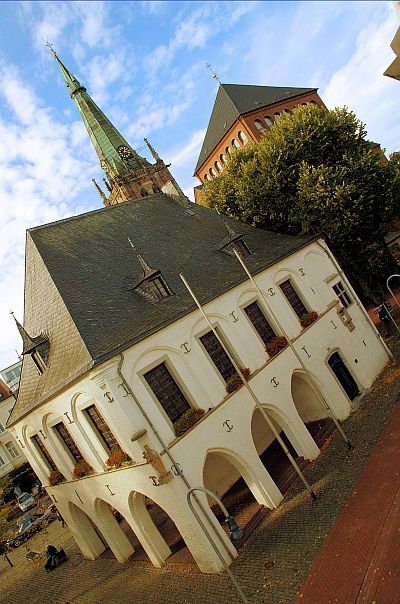
Apartment block? Center of town! :D The couch table on which I did my flame tests is only about 15 meters (as the bird flies) away from our historic (built 1546) town hall, the second most recognizable historic landmark in the city (the most recognizable landmark, the second-highest church steeple in Germany west of the river Rhine, trailing only the Cologne cathedral's, is right behind the town hall) :cool:
DSC_5509_400x604_095.jpg
 
Last edited:
Apartment block? Center of town! :D The couch table on which I did my flame tests is only about 15 meters (as the bird flies) away from our historic (built 1546) town hall, the second most recognizable historic landmark in the city (the most recognizable landmark, the second-highest church steeple in Germany west of the river Rhine, trailing only the Cologne cathedral's, is right behind the town hall) :cool:

[qimg]http://i1088.photobucket.com/albums/i328/MikeAlfaromeo/DSC_5509_400x604_095.jpg[/qimg]
It's already leaning to the left - is that a strong political statement?
 
Ivan:
I did my little pyromaniac tests not to find microspheres (I don't have any instruments to see and analyse them anyway) but to get a feel for how different materials react when heated on a plate. So that was a little off-topic here, but I thought I might share.

I remember your LaClede imitation paint videos of course. My impression was that it burned rather calmly (but burn it did).

And of course I agree that looking for spheres in mere paint ash doesn't make too much sense.


Apartment block? Center of town! :D The couch table on which I did my flame tests is only about 15 meters (as the bird flies) away from our historic (built 1546) town hall, the second most recognizable historic landmark in the city (the most recognizable landmark, the second-highest church steeple in Germany west of the river Rhine, trailing only the Cologne cathedral's, is right behind the town hall) :cool:

[qimg]http://i1088.photobucket.com/albums/i328/MikeAlfaromeo/DSC_5509_400x604_095.jpg[/qimg]

Your town square is beautiful, but looks like after controlled demolition at first glance:rolleyes:

I understand well your attempts to know how various materials behave when ignited/heated.
I was myself used to be pyromaniac during my childhood in Sixties (around 13-15 years). I was a kind of "rocket modeller", and since there was almost no pyrotechnics, chemicals and even relevant literature available in communistic Czechoslovakia, my experiments were pretty dangerous sometimes.

Looking for some proper rocket propellant, I experimented with e.g. mixtures of aluminium powder with permanganate - results were spectacular (kind of "thermitic effects"), but unusable in the rockets.
As I vaguely remember, only the mixtures of potassium chlorate (Travex was a brand name for this chemical used as herbicide) with a sugar or similar organic fuel were good in my rockets. As "fuses", I used either Christmas sparklers, or the strips of laboratory filter paper soaked in the solution of potassium nitrate and then dried.

Fortunately, my amateur interest in pyrotechnics faded soon after I discovered girls, beer and rock'n'roll:cool:
 
Last edited:
Oystein,
I know you guys are working on finishing your white paper re the red-gray chips, but if you can also include some kind of summary of what you know about the iron-rich microspheres, as you know, Jim Millette is actively researching this too. From here it seems like you don't have a precise "take" on what is going on.
 
Oystein,
I know you guys are working on finishing your white paper re the red-gray chips, but if you can also include some kind of summary of what you know about the iron-rich microspheres, as you know, Jim Millette is actively researching this too. From here it seems like you don't have a precise "take" on what is going on.

Hmmm there really isn't so much that I "know" about iron microspheres "in general", how they form, what to expect, etc. In this latter regard, "what toi expect", no doubt Jim know a million times as much as we do, for he no doubt has looked at that stuff countless times from all sorts of sources.

I think the only useful thing I could tell him is some specific observations I can make in the Bentham paper, which I have certainly read more often and more closely than he has.

Perhaps this can become a blog post?
 
Chris, Oystein:
Well, as for sintering as a driving force for the creation of microspheres in heated red-gray chips, I can't add anything substantial, the system is apparently too complex (two substantially different phases - paint and rust, both phases are subjected to substantial physical and chemical changes during heating), and no papers seem to deal with the heating of such primer coating on rust scales (except Bentham paper of course:cool:)

Still, here is e.g. a paper dealing with a heating of maghemite (perhaps a constituent of gray layers) up to 650 degrees C leading to the formation of hematite.

In Fig. 8, there are TEM micrographs of parent maghemite (Fig. 8 c) and resulting hematite (Fig. 8 d) particles. Those are larger and rounded, and authors attributed their formation just to sintering.

Here, only experiments can tell us more.

(Btw, for about one year, I have been trying to past here directly figures and graphs from my "web stores" in Rajce, Flickr etc., using icon "insert image", without any success. It is a really silly question after such long time, but what am I doing wrong? I have never met such a problem in any other web.)
 
Last edited:
(Btw, for about one year, I have been trying to past here directly figures and graphs from my "web stores" in Rajce, Flickr etc., using icon "insert image", without any success. It is a really silly question after such long time, but what am I doing wrong? I have never met such a problem in any other web.)

I *believe* that to use that, you have to have copied the image to your album here. Otherwise, it has to be a link.
 
TSR: OK, let's try...

maghemite.jpg


Thanks a lot, TSR, finally success:o)

Anyway, there is a Fig. I mentioned above, showing some sintering of iron oxide at 650 degrees C in the last Fig. d (used maghemite contained some trace elements, Co, Ni, Zn, Cu, Mn, V, and Cr).
 
Last edited:
It's been five months and we still have not heard back from RJ Lee regarding their letter positing hurricane winds and blast-furnace-like temperatures acting on rust flakes to produce microspheres in the WTC dust.

Interesting. So much for Ron Wieck's brand of "investigative journalism." :rolleyes:

when I mentioned Lee's letter in an article in the July/August 2012 Skeptical Inquirer, "New Info Challenges 9/11 Thermite Claims," I made it a point to advise Lee and Kennedy of its publication.

If that letter was fraudulent in any way, shape or form, I think Lee and/or Kennedy would have complained about its publication in S.I.

They didn't - ergo, it was genuine.
 
when I mentioned Lee's letter in an article in the July/August 2012 Skeptical Inquirer, "New Info Challenges 9/11 Thermite Claims," I made it a point to advise Lee and Kennedy of its publication.

If that letter was fraudulent in any way, shape or form, I think Lee and/or Kennedy would have complained about its publication in S.I.

They didn't - ergo, it was genuine.

I am not questioning its authenticity. I am questioning its logic and scientific validity. As are others.
 

Back
Top Bottom