
• Security incident: ISF was recently accessed by intruders. Please change your password, and change it anywhere else you used it. Read more

Internal structure of electrons, quarks and gluons

wise47

Thinker
Joined
Oct 15, 2025
Messages
152
Location
Poland
According to the galactical model, particles such as electrons, quarks, and gluons possess a structure; they are composed of vast numbers -quadrillions - of smaller particles on the order of 10⁻³⁵ m in size. Furthermore, according to the cosmical model - an extension of the galactical model - these smaller constituent particles are themselves composed of quadrillions of even smaller particles, on the order of 10⁻⁵⁰ m in size. My theory offers an explanation for, among other things, the mystery of dark matter, positing that the matter missing from the universe consists precisely of the particles predicted by my theory. The particles constituting electrons, quarks, and gluons correspond to photons, while the components of those particles correspond to gravitons.
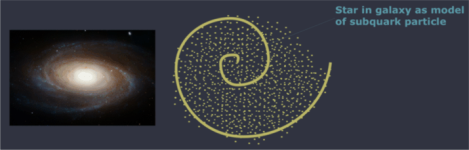
1789381888768.png

diagram. Galatical model

Gregory Podgorniak, Poland, 2014

about the author, My name is Gregory Podgorniak (brn. 01.1977, Szczecinek, West Pomerania, Poland). I am working on field of natural as well as social sciences. During philosophical studies at Adam Mickiewicz University in Poznan (1996-1999) I was actively act in student scientific organisation, got a scientific scholarship, and one from my articles titled Circulus vitiosus and fourfold petitio principii in the system of Descartes was published in Humanistic Drafts of Publishing House of Humaniora Foundation in Poznan, no. 6, 1998. Unfortunately certain fate events made impossible to me continuing studies to master's and later doctor's degree. Thence I was forced to be content only with a title of bachelor.
Thanks to deep and penetrating researchings I was able to establish indisputably some number of my past incarnations reaching of ancient period, these data are certain, these incarnations are: Auguste Comte (1798-1857) French philosopher and sociologist, Edme Mariotte (1620-1684) French physicist and meteorologist, Aenesidemus (1 st century BC) Greek sceptical philosopher, Arcesilaus (315-241 BC) Greek sceptical philosopher, Gorgias (485-380 BC) Greek sophist.
 
Last edited:
I feel a Goody Wuthrie moment coming! It's here!

Gluon Szczecki gluon!
Ten minus fifty (a small little fifty)
Is math and beyond!
Our sausage is particles,
Small as can be!
Our beer's just the same,
And Poznan has photanz
Foaming out o'er the plain!
So
Gluon, Szczecki, gluon!
Tuesday's a-comin', and
Protons begone!
 
Here's a question about your galactical model that shouldn't require any math. Galaxies are all different sizes and contain vastly different numbers of stars. If electrons are similarly made of vast numbers ("quadrillions") of smaller particles, why do they all have exactly the same mass and charge? (If that weren't true, many famous and often-repeated physics experiments would have had different results, and many common devices including CRT televisions wouldn't work.) Explain, in words, the cause and effect processes that determine the quantity of sub-electronic particles that form each electron and guarantees that they all have the same number of them or at least the same total mass.
 
Full presentation of above theory you can find here: New horizons in physics
Yes, we discussed this previously at the forum and concluded it was garbage. Since you don't seem to have revised your "theory" since then, there is no point in a renewed discussion unless you are ready to provide additional rigor.

Your "full presentation" contains a pile of assumptions, such as the existence of particles that can move faster than the speed of light and particles smaller than 10-50 m.

Let's focus on Maxwell's fourth equation, by which we understand that electromagnetic radiation and light are the same phenomenon. Einstein correctly interpreted that this holds true across all inertial reference frames, thereby showing that the speed of light must be an absolute. Understanding that Einstein's formulation of relativity has empirical strength, please show (using the proper mathematics) how there can exist an inertial reference frame in which particles can move faster than a photon.

Then collect your Nobel Prize.

Now we can't say that particles smaller than Planck length (or area) can't exist. But observing them becomes an impossible chore. And at that scale, "observation" becomes the essence of existence.

In the Standard Model, quarks don't have a volume. Nor do the Gauge Bosons. They don't have diameters. You can't subdivide their volume any more than you can subdivide a Euclidean point, so the whole concept that they are made up of even tinier particles is immediately nonsensical. What that means is that it's meaningless to ask you to show your work in terms of quantum field theory. But what it also means is that you need your own sub-quantum field theory that not only describes what we can observe about the Standard Model but also your new "galaxy" behavior.

"Field theory" in this case means equations that describe the structure and quantitative behavior of the fields that define your little galaxies. You may have seen this little guy,∇, floating around. It will need to become your new best friend if you want anyone to do anything except point and laugh at you.
 
According to the galactical model, particles such as electrons, quarks, and gluons possess a structure; they are composed of vast numbers -quadrillions - of smaller particles on the order of 10⁻³⁵ m in size. Furthermore, according to the cosmical model - an extension of the galactical model - these smaller constituent particles are themselves composed of quadrillions of even smaller particles, on the order of 10⁻⁵⁰ m in size. My theory offers an explanation for, among other things, the mystery of dark matter, positing that the matter missing from the universe consists precisely of the particles predicted by my theory. The particles constituting electrons, quarks, and gluons correspond to photons, while the components of those particles correspond to gravitons.

View attachment 75725

diagram. Galatical model

Gregory Podgorniak, Poland, 2014

about the author, My name is Gregory Podgorniak (brn. 01.1977, Szczecinek, West Pomerania, Poland). I am working on field of natural as well as social sciences. During philosophical studies at Adam Mickiewicz University in Poznan (1996-1999) I was actively act in student scientific organisation, got a scientific scholarship, and one from my articles titled Circulus vitiosus and fourfold petitio principii in the system of Descartes was published in Humanistic Drafts of Publishing House of Humaniora Foundation in Poznan, no. 6, 1998. Unfortunately certain fate events made impossible to me continuing studies to master's and later doctor's degree. Thence I was forced to be content only with a title of bachelor.
Thanks to deep and penetrating researchings I was able to establish indisputably some number of my past incarnations reaching of ancient period, these data are certain, these incarnations are: Auguste Comte (1798-1857) French philosopher and sociologist, Edme Mariotte (1620-1684) French physicist and meteorologist, Aenesidemus (1 st century BC) Greek sceptical philosopher, Arcesilaus (315-241 BC) Greek sceptical philosopher, Gorgias (485-380 BC) Greek sophist.
Electrons, quarks, and gluons do not behave in ways predicted by your galactical model.

Dark matter observations are not consistent with the predictions of your galactical model.

So we already know that your model and theory are wrong.

The end.
 
Thanks to deep and penetrating researchings I was able to establish indisputably some number of my past incarnations reaching of ancient period, these data are certain, these incarnations are: Auguste Comte (1798-1857) French philosopher and sociologist, Edme Mariotte (1620-1684) French physicist and meteorologist, Aenesidemus (1 st century BC) Greek sceptical philosopher, Arcesilaus (315-241 BC) Greek sceptical philosopher, Gorgias (485-380 BC) Greek sophist.
Gorgias might have been impressed by your deep and penetrating speculations, but Arcesilaus and Aenesidemus would have been skeptical. Mariotte and Comte would have laughed at your theory's dearth of mathematical rigor.

Today, in this thread, we laugh at your use of phrases such as "deep and penetrating researchings", "establish indisputably", and "these data are certain", even as we have to admit the certainty of your past incarnations has a more solid empirical foundation than does your galactical model.
 
According to the galactical model, particles such as electrons, quarks, and gluons possess a structure; they are composed of vast numbers -quadrillions - of smaller particles on the order of 10⁻³⁵ m in size. Furthermore, according to the cosmical model - an extension of the galactical model - these smaller constituent particles are themselves composed of quadrillions of even smaller particles, on the order of 10⁻⁵⁰ m in size. My theory offers an explanation for, among other things, the mystery of dark matter, positing that the matter missing from the universe consists precisely of the particles predicted by my theory. The particles constituting electrons, quarks, and gluons correspond to photons, while the components of those particles correspond to gravitons.

View attachment 75725

diagram. Galatical model

Gregory Podgorniak, Poland, 2014
Bollocks.
 
According to the galactical model,
Provide a link to this "model"
particles such as electrons, quarks, and gluons possess a structure; they are composed of vast numbers -quadrillions - of smaller particles on the order of 10⁻³⁵ m in size.
Wikipedia mentions that the electronWP, the quarkWP, and the gluonWP can all be described as an elementary particleWP. Provide evidence that there are particles that make up the three [electrons, quarks, gluons].
  • Provide evidence that, "they [electrons, quarks, gluons] are composed of vast numbers -quadrillions - of smaller particles on the order of 10⁻³⁵ m in size."
  • Provide evidence there exists particles that are 0.0000000000000000000000000000000001mm wide.
  • Provide evidence that there are "quadrillions" of these "medium size" particles that make up one of the elementary particles. I am calling them "medium sized" because you claim that there are even smaller particles.
Furthermore, according to the cosmical model - an extension of the galactical model -
Provide a link to this "model"
these smaller constituent particles are themselves composed of quadrillions of even smaller particles, on the order of 10⁻⁵⁰ m in size.
Here's a good place to stop before I start asking you for more evidence.
 
Last edited:
Thanks to deep and penetrating researchings I was able to establish indisputably some number of my past incarnations reaching of ancient period, these data are certain, these incarnations are: Auguste Comte (1798-1857) French philosopher and sociologist, Edme Mariotte (1620-1684) French physicist and meteorologist, Aenesidemus (1 st century BC) Greek sceptical philosopher, Arcesilaus (315-241 BC) Greek sceptical philosopher, Gorgias (485-380 BC) Greek sophist.
I'll tell you something. Something I've never told anyone.
When I was fifteen, I went to Macedonia on a school trip, to the site of Alexander The Great's palace. And for the first time in my whole life, I felt I was home. This place was where I belonged.
Years later, I got friendly with a hypnotherapist called Donald and told him about the Alexander the Great thing, and he said that he'd regress me back through my past lives. I was dubious, but I let him put me under.
It turned out my instincts were absolutely correct, I had lived a past life in Macedonia. That palace was my home. Because, believe it or not, he told me that, in a past incarnation, I was Alexander the Great's chief eunuch.
 
Last edited:

ISF - Join now!

Every member here is approved by hand. No bots, no spam, just people who care about evidence and honest debate.

Membership is free!

Create your free account

Back
Top Bottom