• Quick note - the problem with Youtube videos not embedding on the forum appears to have been fixed, thanks to ZiprHead. If you do still see problems let me know.

Intelligent Design

How can he not, by now? All I can conclude is that it's his schtick and he's schticking with it.

A clear case of 'if you can't win the argument, make sure the other side can't win either and hope they give up before you do'.
 
:thumbsup: .

The multiverse idea is unfalsifiable. The God idea is at least based on observation and deduction - supported by the many people who have experienced the supernatural and God. The evidence is at least there - whether it is scientific proof or not is another matter. It is possible that it might be proved if God chooses to reveal himself.

This is where you get stupid. The God idea is also unfalsifiable. Unless you have come up with some experiment to prove god, that I have never heard of. As for people 'experiencing the supernatural, you don't know that. All you know is that some people 'claim' to have experienced the supernatural. How can we tell the difference between something supernatural and something natural that we just presently don't understand?

Is it more likely that an invisible transcendent being placed a baby in an illiterate girl or a Jewish minx got knocked up?

Also deduction is great except when it's wrong. And what are we deducing? Something no one can confirm seeing, touching feeling or detecting through our own eyes or through any scientific instrument.

Every single other phenomenon we know to be true can be confirmed through repetitive tests. Considering that man has been claiming there is a God for the last six to ten thousand years, deduction tells us that our failure to prove it means it is almost certainly to be our imagination and nothing more.
 
It seemed fine tuning evolved, and continues to evolve. But 1802 seems defined start.

Scientific multiverses had a defined start of 1954, despite a long history of parallel dimensions and other "places".

Atheists definitely use the multiverse as their defense against fine tuning.

https://en.wikipedia.org/wiki/Watchmaker_analogy

Watches and timepieces have been used as examples of complicated technology in philosophical discussions. For example, Cicero, Voltaire and René Descartes all used timepieces in arguments regarding purpose. The watchmaker analogy, as described here, was used by Bernard le Bovier de Fontenelle in 1686, but was most famously formulated by Paley.

Paley used the watchmaker analogy in his book Natural Theology, or Evidences of the Existence and Attributes of the Deity collected from the Appearances of Nature, published in 1802. In it, Paley wrote that if a pocket watch is found on a heath, it is most reasonable to assume that someone dropped it and that it was made by at least one watchmaker, not by natural forces:

https://en.wikipedia.org/wiki/Teleological_argument

The earliest recorded versions of this argument are associated with Socrates in ancient Greece, although it has been argued that he was taking up an older argument. Plato, his student, and Aristotle, Plato's student, developed complex approaches to the proposal that the cosmos has an intelligent cause, but it was the Stoics who, under their influence, "developed the battery of creationist arguments broadly known under the label 'The Argument from Design'".

https://www.newscientist.com/article/dn26261-hugh-everett-the-man-who-gave-us-the-multiverse/

Hugh Everett’s many-worlds interpretation of quantum mechanics arose from what must have been the most world-changing drinking session of all time. One evening in 1954, in a student hall at Princeton University, grad student Everett was drinking sherry with his friends when he came up with the idea that quantum effects cause the universe to constantly split.
 
....Atheists definitely use the multiverse as their defense against fine tuning.

:rolleyes: Sheesh. You don't think that, you know, actual atheists might have a better idea of what atheists do than god botherers such as you? Don't generalise, particularly when you don't have a clue what you're talking about.

This particular atheist has no view whatever on fine tuning or multiverses (other than the abuse of English involved with the latter). They're parked, awaiting evidence.

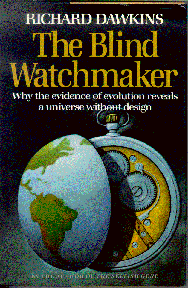
Oh, and before you whitter on about watches, read "The Blind Watchmaker". And for the three thousandth time, why on earth have you included the word sceptic in your forum title?
 
Last edited:
(snip the stupid bit)

Unless you have come up with some experiment to prove god, that I have never heard of. As for people 'experiencing the supernatural, you don't know that. All you know is that some people 'claim' to have experienced the supernatural. How can we tell the difference between something supernatural and something natural that we just presently don't understand?

(snip)


You really miss the point that I claim to have had quite a number of supernatural experiences. In many areas. So I know what I am talking about.

"Knowing" that a biker is about to die just ahead - with absolute certainty - does not have a natural explanation.
 
If you are truly interested in fatal flaws in the “watchmaker” analogy, this is a good place to start:

BlindWatchmaker.gif
 
......"Knowing" that a biker is about to die just ahead - with absolute certainty - does not have a natural explanation.

It has multiple possible straightforward explanations. As does a failing gasket in your damn hot water cylinder.
 
So has "Intelligent Design" came up with a new excuse since basically Aquinas?
 
One reply was that there is only one puddle so there is nothing to compare it with.

Wow. No. Only one that we currently have to work with is notably different than the claim that there is only one. The former is true and the latter is entirely unsubstantiated.

My answer is that even if that is the case, the unusual shape would be something to wonder about. After all, it is a very intelligent puddle to be able to ponder such questions.

You've yet to provide any good reason for us to actually consider it to be unusual. It might help if there was agreement on what's usual, though, which there isn't.

The other reply was that it would still be exactly the right shape - not one atom more (but of course it could be a whole lot of atoms less to the point of no puddle at all).

Not even close. Are you trying to get these things wrong? It's getting a little hard to believe otherwise with how consistent and bad your failures in reading comprehension would be to justify the caricatures that you keep making.

This misses your point that the puddle should be thinking why the puddle is the remarkable shape it is. And a puddle can flow into another proving that multiple puddles can exist.

:rolleyes:

I also agree that the multiverse hypothesis does deal with the question of a possible WHY seemingly random numbers are what they are. The problem is that the only support for multiverses is the imagination of people who think that parallel worlds/universes could exist.

No. The main "support" for multiverse theories is that there being a multiverse can provide a solution to certain questions in physics. MWI, for example, is a proposed solution to the questions about how waveform collapse works.

The multiverse idea is unfalsifiable. The God idea is at least based on observation and deduction - supported by the many people who have experienced the supernatural and God. The evidence is at least there - whether it is scientific proof or not is another matter. It is possible that it might be proved if God chooses to reveal himself.

:rolleyes:
 
Last edited:
You really miss the point that I claim to have had quite a number of supernatural experiences. In many areas. So I know what I am talking about.

"Knowing" that a biker is about to die just ahead - with absolute certainty - does not have a natural explanation.

One of the things that we encounter again and again are people who claim to have had supernatural experiences. For a variety of reasons, many of us who frequent this place discount these claims. Although they are sincere, we doubt they really happened.

Far be it from me to say that you could not possibly have had such experiences, but I don't think you'll get anyone to take your word for it.

If you accept supernatural forces, then the argument from design, regardless of which variation is used, probably seems reasonable, and I suppose it is. However, being reasonable and being scientific are two different things. It is based on faith, not on actual empirical results.
 
You really miss the point that I claim to have had quite a number of supernatural experiences. In many areas. So I know what I am talking about.

"Knowing" that a biker is about to die just ahead - with absolute certainty - does not have a natural explanation.
Just because you don't have an explanation for something it doesn't mean the explanation is a supernatural one. What about all the times we think something bad happened and it was nothing? People forget those.

Years ago, I entered a contest at my video store to pick the the Academy Award winners in 9 separate categories. I picked every single one. Is that supernatural? I was broke once way back in 1977 without enough money to pay my rent which was due and I went into a tavern with my friend. This place sold the cheapest meals so we went there often. They also sold pull tabs. I never played them. The meal was $2.00 and I bought 1 pull tab and won $50. I decided to buy 3 more tickets and two were winners one paying $100 and the other $75. My rent was paid! Is that supernatural or was it just lucky?

How does one differentiate between something natural like a process in our mind or something else that they don't understand? People claim to be abducted by aliens or that they talk to Elvis. That doesn't mean they did. I've seen people speak in tongues and writhe on the floor in church. Is this God? Or is it brought on by human suggestion?
 
Last edited:
It seemed fine tuning evolved, and continues to evolve. But 1802 seems defined start.

Scientific multiverses had a defined start of 1954, despite a long history of parallel dimensions and other "places".

There's a cleverly concealed fallacy of equivocation there. You're equivocating between Paley's blind watchmaker argument, which relates to the unlikelihood of self-organisation and the arising of complexity, with Dicke's argument from fine tuning as applied to the fundamental constants. The latter is a different argument, and dates back only to the early 1960's; the theories to which it relates did not exist in 1802. At the same time, you're limiting multiverse theories to the specific inferences drawn by Schrodinger in the early 1950s, even though you admit that the idea existed in a more general form - in precisely the way Paley's argument was a more general one than Dicke's. And you clearly haven't done it by accident, have you? because you knew all that. Nice try, but you've been caught with your hand in the cookie jar.

Atheists definitely use the multiverse as their defense against fine tuning.

Well, yes, because it's a perfectly legitimate response. Saying we're not allowed to use it because it's a valid counter-argument is one of those classic woo-slinging tactics where you spuriously exclude all counter-arguments to a claim then pretend they're invalid because you don't want to address them.

Dave
 
:thumbsup: We have some progress. I like it.

Wishful thinking

Snip

The multiverse idea is unfalsifiable. The God idea is at least based on observation and deduction - supported by the many people who have experienced the supernatural and God. The evidence is at least there - whether it is scientific proof or not is another matter. It is possible that it might be proved if God chooses to reveal himself.


Oh yes! ...... There are a couple of different versions of this of course.

1. An unambiguous demonstration of supernatural ability is one. Although commonplace thousands of years ago when God was parting the seas, turning a woman into a pilar of salt, and stopping the movement of the Sun ...... oops stopping the rotation of Earth. Be nice if we could have some of these demonstrations today. This would definitely have some clout.

2. Observation of events that have been predicted, and the subsequent deduction that a supernatural cause was behind the observation, because no other explanation fits. I will go along with this but do we have any? Any more that is than covered by chance/probability?

Oh sure we have many cases where folk claim to have predicted something after the event. One must be skeptical (at least in part :)) to these post event predictions.

3. Demonstration of the ability to see things unseeable that can subsequently be verified as true.

Clairvoyants routinely make these claims and have been listened to by police in the past when trying to find missing persons. The lack of success has stopped police from following this practice I believe.

-----

You mention "scientific proof as if it is something special PartSkeptic. It is not and we all use it - even yourself I suspect, because you have survived till this day.
 
As was already agreed it's a response to the argument that people who can't wrap their brains around why puddle thinking is erroneous can understand, so of course it's used.

https://en.wikipedia.org/wiki/Fine-...rding_the_existence_and_extent_of_fine-tuning

The link does not say what you think it says:

"The Multiverse hypothesis proposes the existence of many universes with different physical constants, some of which are hospitable to intelligent life (see multiverse: anthropic principle). Because we are intelligent beings, we are, by definition, in a hospitable universe.

"This idea has led to considerable research into the anthropic principle and has been of particular interest to particle physicists, because theories of everything do apparently generate large numbers of universes in which the physical constants vary widely
."

In other words, the puddle analogy is an unsatisfactory explanation for why our universe is the way it is. The coincidences are too extreme. Part of the appeal of multiverse theory is it explains fine-tuning, which is a prima fascie problem

"Interesting hints of a Level II multiverse come from the observation that many constants of nature appear fine-tuned for life, having values in the narrow range allowing our existence (if they vary across the multiverse, we'll find ourselves in one of those places where we can exist, and there's no embarrassing fluke coincidence to explain)."
http://space.mit.edu/home/tegmark/crazy.html
 
Last edited:
And if the hole was bigger or smaller by even a single atom at any point at all it would not be exactly the right shape for the puddle. Far too many coincidences to hand wave away ....

There is no reason to label our particular hole "regular" rather than "irregular". For all we know there are different combinations of values for the constants (or even entirely different constants) which would produce universes which are far more hospitable to sapient life of some kind than this one is. If there is a multiverse, this could be one of the universes less hospitable to sapience than average.


No, that's not why the multiverse theory is popular - if indeed it is; lots of people seem to absolutely hate it.

Yes, it's a large reason why it's so popular.

https://en.wikipedia.org/wiki/Flatness_problem
 

Back
Top Bottom