• Security incident: ISF was recently accessed by intruders. Please change your password, and change it anywhere else you used it. Read more

Independent discoveries of the same thing

I'm not sure you need toknow Pythagoras to draw squares and circles.

But squares and circles arose independently in places nonetheless.
Pythagoras makes certain you get right-angled corners otherwise you might get a rhombus.
 
We know the Egyptians used trial and error to build pyramids. There are examples of failed ones
 
This is a cool thread, am enjoying reading it, and the links people have presented.

The "steam-engine time" thing was an interesting idea! ...Is it actually a thing, though? Had the Romans actually gone ahead and invented a full-on steam engine, rather than toys merely, then I guess we'd have said that that period was when the steam-engine time was. ...What I'm asking is, has anyone heard of this thing, apart from this guy's take? Is it something that's seriously considered as ...well, true? By sociologists, I suppose?

(But even if it is just one guy's idiosyncratic take, a sci-fi writer's imagination doing its thing, even so it's a very interesting idea, and persuasively enough presented. Enjoyed reading that interview.)

__________

No one seems to have mentioned agriculture in this thread yet, unless I'm mistaken. I suppose that also would qualify as a discovery, invention, technology, whatever, that happened independently across cultures?

 
Just a few others: clothing, jewelry, art, music, tools, cooking, social structures... this list might get awfully long.

Eta: no one said gods, religion, marriage yet? And while on that subject, war and murder?
 
Last edited:
This is a cool thread, am enjoying reading it, and the links people have presented.

The "steam-engine time" thing was an interesting idea! ...Is it actually a thing, though? Had the Romans actually gone ahead and invented a full-on steam engine, rather than toys merely, then I guess we'd have said that that period was when the steam-engine time was. ...What I'm asking is, has anyone heard of this thing, apart from this guy's take? Is it something that's seriously considered as ...well, true? By sociologists, I suppose?

(But even if it is just one guy's idiosyncratic take, a sci-fi writer's imagination doing its thing, even so it's a very interesting idea, and persuasively enough presented. Enjoyed reading that interview.)

__________

No one seems to have mentioned agriculture in this thread yet, unless I'm mistaken. I suppose that also would qualify as a discovery, invention, technology, whatever, that happened independently across cultures?
I haven't mentioned agriculture et. al because discoveries whose origins are lost to the mists of time and the fog of prehistory don't really interest me in this context. We have records and artifacts that tell us various civilizations figured out the principles of right angles ("the Pythagorean theorem") more or less independently. We have no records or artifacts telling us that this hunter-gatherer tribe and that hunter-gatherer tribe each figured out agriculture independently. Without being able to trace the history of who and when, it's boring to me. Just truthy hand-waving.
 
I seem to recall reading about remains of prehistoric teeth found which "showed" that the people there used stone to grind flour earlier than was known. That's kind of "truthy" but kind of "facty".

But yeah, not really the area of knowledge the thread was about, but I thought Agriculture was at least worth mentioning, thanks Chanakya.
 
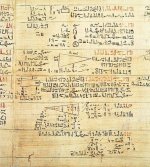
The Rhind Mathematical Papyrus is the oldest manuscript written in algebra and trigonometry, dating back to 3,550 years ago.

It shows that the Egyptians used first-order equations, geometric series and a second-order algebraic equation, related to the Pythagorean theorem a² + b² = c²

It also describes how to obtain an approximation of π accurate to within less than 1% and one of the earliest attempts at squaring the circle.GdyiTW5WEAAFGHF.jpg
 
As monuments go a pyramid is bound to be the one most folk think of, probably the first as after all they are manmade hills.
They are most likely to survive long periods too, hence the famous question:

"Why did so many civilisations build pyramids?"

"Everything else they built fell over."
 
They are most likely to survive long periods too, hence the famous question:

"Why did so many civilisations build pyramids?"

"Everything else they built fell over."
“When I first came here, this was all swamp. Everyone said I was daft to build a castle on a swamp, but I built in all the same, just to show them. It sank into the swamp. So I built a second one. That sank into the swamp. So I built a third. That burned down, fell over, then sank into the swamp. But the fourth one stayed up.“
 
They are most likely to survive long periods too, hence the famous question:

"Why did so many civilisations build pyramids?"

"Everything else they built fell over."
The first stone masons were as clever as modern humans, but they hadn't yet invented arches, flying buttresses, domes etc, or concrete or mortar, all they knew how to do how to do was pile one stone on top of another (although they were very good indeed at that). Then the big chief decides he wants an impressive tomb built. So they need to build the tallest possible building, for the minimum possible amount of stone and effort. What are they going to build?
 
The first stone masons were as clever as modern humans, but they hadn't yet invented arches, flying buttresses, domes etc, or concrete or mortar, all they knew how to do how to do was pile one stone on top of another (although they were very good indeed at that). Then the big chief decides he wants an impressive tomb built. So they need to build the tallest possible building, for the minimum possible amount of stone and effort. What are they going to build?
A pile of dirt with rocks stuck on the outside.

:)

I also suspect that pyramids are a natural extension of the 'barrow' idea. (i.e. a pile of dirt).

(I know, I know, I'm over-simplifying.)
 
The "steam-engine time" thing was an interesting idea! ...Is it actually a thing, though? Had the Romans actually gone ahead and invented a full-on steam engine, rather than toys merely, then I guess we'd have said that that period was when the steam-engine time was. ...What I'm asking is, has anyone heard of this thing, apart from this guy's take? Is it something that's seriously considered as ...well, true? By sociologists, I suppose?
My impression is that the Roman era knew of steam engines as a concept, they had some little steam powered spinny toys.

But they lacked the metallurgical ability to size it up very much. I remember seeing a documentary claiming that an armor breastplate was just about the biggest single-piece bit of steel or iron thing that could be made at the time. Rivets were used to make bigger things by joining smaller things, but those joints might not have been capable of sealing in steam under pressure. They could make waterproof things with lead, like liners for aqueducts - but nothing that could handle enough pressure for a working steam engine.

So steam-engine time was an offshoot of "really big and good quality iron things" time. Plus the valves and controls to allow actual control.

Think of as a it like a space elevator. We have the concept, we have actual elevators for buildings. But we already know that we can't make an actual space elevator until we develop some sort of super-high tensile strength thing to build it with. We are with space elevators where the Romans were with steam engines. We have the concept, but we don't yet have the materials to build it.
 
One more for the, it would have been surprising if pyramids weren't invented independently around the world, I invented them when I was 3, as I imagine all of you did too. Oh but how come they are so much alike all over the world. Dude, they're basically a pile of rectangular rocks, what do you think they're gonna look like? That element of the ancient aliens or super civilization stuff struck me as stupid by the time I was 6, How does that convince anyone?

Cows were domesticated twice, that always seemed cool to me. Both are descended from aurochs but look very different.

Calculus has always amazed me that two guys working independently somehow figured it out almost at the same time when most folks even now struggle with it.

Similarly, evolution, Wallace and Darwin almost at the same time too.
 
We actually know quite a lot about how ancient Egyptians expressed their mathematics. There are several papyri specifically posing problems and questions about mathematics and geometry that were thought to have been used in the education of scribes. For example, we know they had a formula for calculating the volume of a truncated pyramid.

Once upon a time I had a copy of The Crest of the Peacock: Non-European Roots of Mathematics by George Gheverghese Joseph. I don't know what happened to it, and whenever I look for it online it's ridiculously expensive for a paperback. Fascinating book.

This makes me wonder what sort of math the meso-American cultures had.
 
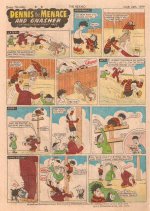
I don't know if this counts as independent discovery but it is one of the most bizarre coincidences of all time. You guys are probably familiar with the American Comic Strip Dennis the Menace. Well there is or was a British comic strip called Dennis the Menace which started at nearly the same time and neither creator had any idea about the other. Oh and strips were about the same thing a really bratty kid getting into trouble all the time.
 
Well there is or was a British comic strip called Dennis the Menace which started at nearly the same time and neither creator had any idea about the other.
They both launched on the same day—12 March 1951! The UK boy has dark hair, is brattier, more destructive, and in earlier years was on the receiving end of severe punishments for his antics. That strip is still going as Dennis the Menace and Gnasher in The Beano.

 
The Beano Dennis also has Jacob Rees-Mogg as a protagonist, although they changed his name to Walter.

Beano Dennis has changed a lot since I was a kid.
Dennis was a violent bully and would receive regular beatings from his dad.
Dennis had a female equivalent called Beryl the Peril with her own strip, they sometimes crossed.

There was also a female equivalent called Minnie the Minx in the Dandy comic.

They were all taken to the extreme with Bully Beef in Dandy who was an actual violent psychopath and parodied in Vis! comic as Biffa Bacon.

beanoback.jpgCeFhbMkXIAAyUjV.jpeg
 

ISF - Join now!

Every member here is approved by hand. No bots, no spam, just people who care about evidence and honest debate.

Membership is free!

Create your free account

Back
Top Bottom