• Security incident: ISF was recently accessed by intruders. Please change your password, and change it anywhere else you used it. Read more

Implications of Original Sin

The sad thing is that she could actually have been honest about being technically a virgin. Check out: http://en.wikipedia.org/wiki/Splash_conception

What I don't understand, though is: why is anyone pretending that that's a miracle?

Girls figuring out that if it's not in their pussy it's not really sin, is as old as sexual restrictions. It was popular enough at least during the renaissance that a writer noted that unmarried women were saints from the front and martyrs from the back. And occasionally one got pregnant while technically still a virgin.

It was at least common enough to warrant the incubus/succubus explanation for how come virgin girls occasionally get pregnant anyway.

So, really, how inconsistent must someone be to believe that if it happened to Mary it was a unique divine miracle and proof of God... unlike every Annie, and Jill, and Katie, and Sue, who also got the same, but for those it's not a miracle. It's like pretending that I'm special and unique and the messiah because I was born on a full moon... same as every 28'th person on the planet.
 
Here you seem to advocate the theology of the perpetual virginity of Mary. What, precisely, do you base this on? Mark 6:3 mentions the several siblings of Jesus, not step-brothers and step-sisters. Since there is really no biblical basis for the assumption that Mary remained a virgin all her life, what is the source of your assumtion that the siblings were from Joseph's previous marriage?
When Jesus was born, Mary had no other children. Any subsequent births would not be as important to Jesus as the children who were older and would have had a part in his upbringing. Any other children would not have been important to my argument.
 
Original sin is pride, not sex. ...


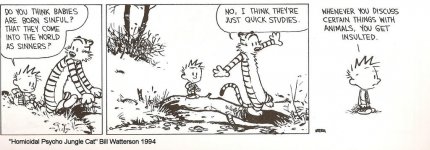
I think the [act of] original sin of Adam & Eve is from pride, according to Aquinas etal; or disobedience, according to Augustine etal. The state of original sin for us descendants is depravity, concupiscence, lust (in what must be one of the most stringently-reasoned bits of theology in the xtian canon, Augustine argues that lust produces a disobedience of the flesh to mirror the disobedience of the spirit A & E demonstrated, hence the instant shame and fig leaves; in other words, original sin shows up as embarrassing boners). Since original sin is transmitted via boner, kids are always infected (except virgin births, of course... and in vitro fertilisation, I suppose... who the hell knows, really).

Anyway, re the OP, according to St. Augustine in his magnum opus The City of God, one important implication and likely the most prominent artefact of Original Sin is boners, and our embarrassment thereof.
 
Last edited:
Augustine didn't consult the right source...
 

Attachments

  • OriginalSin.jpg
    OriginalSin.jpg
    81.8 KB · Views: 19
When Jesus was born, Mary had no other children. Any subsequent births would not be as important to Jesus as the children who were older and would have had a part in his upbringing. Any other children would not have been important to my argument.

Okay, are you saying that Jesus was her OLDEST child, or her ONLY child? If you are arguing the latter. consider Mark 6:3:

". . . Is not this the carpenter, the son of Mary and brother of James and Joses and Judas and Simon, and are not his sisters with us?" And they took offence at him.

Mark, the earliest of the gospels, makes no mention of a virgin birth, a curious lapse if its author know of such an event. Therefore, we can reasonably assume that the story was a later invention. There is no reason to believe that the siblings of Jesus were foster siblings. I challenge you to show me one solid biblical support for the idea that these brothers and sisters were anything but actual siblings.
 
Okay, are you saying that Jesus was her OLDEST child, or her ONLY child? If you are arguing the latter.
I am only saying that Mary's husband, Joseph, had children from a previous marriage, and that God would have taken that into consideration when placing His Son on Earth. If they were bad kids, God might not have wanted Jesus being born into that family. The point I was working on was the sin thing. If we are born sinful. Just by looking at this one case, I would have to say no. Jesus was special and his situation was special. Jesus somehow kept himself innocent of sin.
As for the other kids, they may have been old enough to be left behind, when Joseph and Mary took their journey. He was an older dude and was already dead when Jesus was doing his ministry.
 
Okay, Ethnikos, I'll say this one more time:

There is no reason to believe that the siblings of Jesus were foster siblings. I challenge you to show me one solid biblical support for the idea that these brothers and sisters were anything but actual siblings.

You have stated that Joseph had children from a previous marriage. Again, what is your biblical source for this? Please state chapter and verse.
 
what is your biblical source for this? Please state chapter and verse.
Aparently it comes from some other writings that are not in the canonical Bible. I am not promoting some sort perpetual virginity. I am sure Mary had later children.
Here is a nice verse I ran across that is on the subject of original sin from 2 kings 14:6 But he did not execute the sons of the assassins. He obeyed the Lord’s commandment as recorded in the law scroll of Moses, “Fathers must not be put to death for what their sons do, and sons must not be put to death for what their fathers do. A man must be put to death only for his own sin.”
Here's something you could do. Tell me what scroll that is referring to.
 
Last edited:
Aparently it comes from some other writings that are not in the canonical Bible. I am not promoting some sort perpetual virginity. I am sure Mary had later children.
Here is a nice verse I ran across that is on the subject of original sin from 2 kings 14:6 But he did not execute the sons of the assassins. He obeyed the Lord’s commandment as recorded in the law scroll of Moses, “Fathers must not be put to death for what their sons do, and sons must not be put to death for what their fathers do. A man must be put to death only for his own sin.”
Here's something you could do. Tell me what scroll that is referring to.

If you're going to accept non-canonical writings about Jesus and his famiy, are you also going to accept the infancy gospels and the story that, as a boy Jesus supernaturally killed one of his playmates in a snit, then brought him back to life? I am glad, hou=wever, that you don't subscribe to the thesis of the perpetual virginity of Mary.

My Oxford Annotated Version (OAV) translation of 2 Kings 14:6 calls it "the book of the law of Moses" and the notes say the verse in question is Deuteronomy 24:16. I looked it up, and it checks out. Since this verse says that "every man shall be put to death for ihis own sin," would I be right in judging that by calling attention to this you reject the doctrine of original sin?
 
If you're going to accept non-canonical writings about Jesus and his famiy, are you also going to accept the infancy gospels and the story that, as a boy Jesus supernaturally killed one of his playmates in a snit, then brought him back to life? I am glad, hou=wever, that you don't subscribe to the thesis of the perpetual virginity of Mary.
No, I am not using some alternate gnostic or something version. It comes from an ordinary sort of Bible commentary, or something. I have read tons of books and it would be difficult to remember where I got that from. Again, my point was nothing to do with any question on where Jesus' siblings came from. I was making an argument about how it could have been possible for someone to live a sinless life, given the fact that we are all descended from sinful people. I could use myself as an example. I grew up in like a bubble and never even considered doing anything bad. A lot of that was because I had an older brother and two older sisters who were good people and a good influence on me. Later on, my younger brothers turned out to being hell bent on being evil. Once they got to a certain age, where they were more my equal, they became a very destructive influence on me.
In the case of Jesus, he would have had to have had some decent older siblings to have a chance of not sinning. His younger ones may have been more of a given, since they would have been from the same mother. She would have had to have been a saint, just to be allowed to be the mother of God. So you would expect any of her children to be pretty good, to start with.
My Oxford Annotated Version (OAV) translation of 2 Kings 14:6 calls it "the book of the law of Moses" and the notes say the verse in question is Deuteronomy 24:16. I looked it up, and it checks out. Since this verse says that "every man shall be put to death for ihis own sin," would I be right in judging that by calling attention to this you reject the doctrine of original sin?
Thanks for checking that. I am pretty busy working on the translation from Hebrew of Genesis 3:16. When I worked on it before, I was only working off some sketchy notes on the back of an envelope. I am doing a more thorough investigation, which is hogging up my time , right now.
The reason I was working on it before is because it is something pointed at as some sort of proof that we were cursed, through Eve. My argument is first, it is not a curse; second, it only applies to that one person, and is not something passed down.
As for original sin, I do not buy into the "official" version any more than I buy into the "official" version of the trinity. What I believe is that we are incapacitated from being able to save ourselves through our own good works. If that was so, Jesus coming to earth and suffering would have been redundant.
 
Last edited:
...
What I believe is that we are incapacitated from being able to save ourselves through our own good works. If that was so, Jesus coming to earth and suffering would have been redundant.
.
And that's the core of your problem.
No concept that everyone has the good common sense to not be evil.
Evil behavior is learned, it's not innate.
When one's self image is so damaged that he expects bad things as the normal course of events through his own actions, then religion comes along to reinforce that bad image, and promise "salvation" through acceptance of fairy tales and fables.
Good areligious people abound through history.
Religions just con men of good will who need no assistance in living good moral lives other than that which is self-evident, into prostrating themselves into the self-flagellation and denigration of one's own character that religions feed from in their parasitic lives.
Without the psycho-babble of "sin" from the conmen of religions most people would live perfectly good lives.
 
With all due respect, I Ratant, while what you say is true and insightful in its own right, it seems to me like it's orthogonal to what he was saying there. He didn't say you're incapable of being a good person or doing good deeds without Jesus, just that you're incapable of "saving yourself" through good deeds alone.

In other words: Daddy won't let you in heaven unless you brown-nose Junior, no matter how good and moral you are.

Which is really the beauty of having an imaginary being. Who's going to prove that he said otherwise?
 
Hans, I wonder why Christianity and the baggage that it imposes on the believer isn't a subject in the study of aberrant psychologies.
The basic premise of omnipotence is irrational from the git-go, and yet it's promoted by otherwise intelligent folk who really should know better, if they can use the brains god gave us :) to think the precepts through.
 
While I'm not a believer, I have to say that the Pelagian view is the least offensive. Pelagius, a contemporary of Agustine, put our estrangement from God in terms of someone who's living in pverty because their great-grandfather squandered a vast fortune. His view was that God had to bridge that gap of estrangement because humans werent able to. Still, being God's creations, humans were, in his view, basically good and could, of their own free will, respond to Gods's offer of grace.

Augustine's view was that we were so depraved that we lacked even that bit of free will. Thus, God arbitrarily chose some and consigned the rest to hell. Augustine further argued that because we were conceived as a result of sexual desire or, as he called it, "concupisence (sp.?), " we inherited original sin through sex.

To some degree, the sense of estrangement, whether from God or the cosmos is, I suspect, a side effect of self awareness. Thus, throughout the world we find myths in which death and isolation accompany the change in consciousness that makes us individuals.

If we can aunderstand such myths in this light, we can still use them as a form of literature and wisdom, while dispencing with the baggage. Yes, because we changed, we are separate entities destined to die. Such problems never bother amoebas.
 
Hans, I wonder why Christianity and the baggage that it imposes on the believer isn't a subject in the study of aberrant psychologies.
The basic premise of omnipotence is irrational from the git-go, and yet it's promoted by otherwise intelligent folk who really should know better, if they can use the brains god gave us :) to think the precepts through.

To be honest, omnipotence -- or at least damn near omnipotence -- is the least illogical thing there. Think of my standard analogy of a programmer and the simulated universe he created. Yes, he can't create a rock he can't move afterwards and other such paradoxes, and some don't apply because he's outside it, but otherwise it's as close to omnipotence as it possibly gets. Or at least if you had to explain it to a bronze age goat herder, "omnipotent" would be a good enough approximation.

It's the rest of the stuff in there that gets my goat more than that.
 
It is likely that the very act of sinning corrupts the soul.

Because of this, any progeny from corrupted being will be inherently corrupt.

The Bible is specific in places that a son is not responsible for the sins of his father, nor the other way around. That doesn't mean the son is free from sin, just that they aren't held accountable for those sins.
 

ISF - Join now!

Every member here is approved by hand. No bots, no spam, just people who care about evidence and honest debate.

Membership is free!

Create your free account

Back
Top Bottom