
If There Had Never Been Automobiles

Have we talked about bicycle trailers yet?

Modern bicycles can tow incredible loads on trailers.
(There was a Californian company that would deliver furniture and whitegoods via bicycle trailer.)

It would be fairly trivial for those trailers to have their own braking system.

I met a couple who were touring Australia on recumbent three wheelers, and they were both towing trailers.

When I used to do bicycle touring, I only hauled about 20kg of gear in my panniers (front and rear).

They didn't have anywhere near that limitation.

(From memory, they had 50kg each, in their trailers.)

Edited to add:

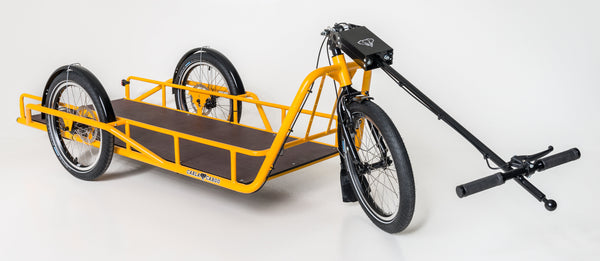
Here's one that's load rated for 200kg:
 
Last edited:
Steam powered cars?
Electric cars?
Bigger (steam/electric) railway networks?
Canals still in use for non-urgent goods?
Slower pace of life?
Not sure about the canals. Canals were replaced more by rail than cars and highways.

I think prestige is largely correct, if we are talking about ICE vehicles, then yes, electric vehicles would have been a thing a lot earlier. Early on, it would have been a tough bet as to whether ICE or Electric would domination the vehicle market.

If we are just talking about personal vehicles. I stand by we would still have horses. Its possible they would never get as cheap as cars and so we'd never have had a world where almost every American owned a horse. So sure, cities would be denser, mass transit would better including some intraurban but mostly interurban with buses still be the go-to for intraurban in most places. Why buses, flexibility and roads are just cheaper than rail.

In the US, outside the East and midwest, we'd probably still rely more on aircraft than trains or buses for interurban travel on account of the distances involved. The west coast might have managed a working interurban rail system but
 
I posted in a thread many years about about what modern history and the world today would be like if there had never been any fossil fuels. That would be a good starting point for discussing a world without cars specifically (especially since wood burning trains and ships existed first, but the limitations of the wood supply would have precluded most wood-powered private cars). If only there were some way of seeking, hunting, scanning, sifting, combing, foraging, questing for, or otherwise casting about for old thread titles or post titles.
It may have a devastating effect on the world whale population with constantly increasing demand for whale oil probably wiping them out?
 
It may have a devastating effect on the world whale population with constantly increasing demand for whale oil probably wiping them out?
Yep - I think whales would have been wiped out pretty early on in the non-fossil fuel world.
 
I didn't say it would be good for the environment, nobody seems to care about that in the fossil fuel world.
 
I didn't say it would be good for the environment, nobody seems to care about that in the fossil fuel world.
Part of that is because the fossil fuel world is better for the environment in a lot of ways than the wood-fired, whale-powered world.

But without fossil fuels...

Air travel would probably never take off. There's just nothing out there with the energy density of refined jet fuel. Mass air transport of goods and people just wouldn't be feasible.

Rocketry might also get off to a slow start.
 
Can you picture Mick Jagger singing "Jumping Jack Flash, it's a woodburnerwoodburnerwoodburner"? It would have tanked his career, man.
 
Interesting thought experiment.

We would've probably had to phase out horses eventually anyway, because otherwise, as people have stated, the cities would simply drown in manure. So I guess a higher dependence on boats and ships as well as bikes of all kind, maybe horses and other beasts of burden at least outside of cities. Oh, and we'd probably have to build more along rail lines. Coastal communities relied on boats more than bikes or horses before the car became commonplace.

If, magically, we had trucks and buses but not cars, that would've obviously made things much easier as well as you'd solve the last mile problem from rail stations to homes and workplaces. Since we're in the realm of magical thinking, I think I'd want to make an exception for emergency vehicles, too.

Would this work as well as today's world? No idea. We'd certainly have to live more densely, which... Arguably could be a good thing from a climate crisis and environmentalist standpoint, since less nature would be lost?

There's a balance to be struck between this and the current car-centric planning we went for in reality, of course, but it's still an interesting thought.
 
Have we talked about bicycle trailers yet?

Modern bicycles can tow incredible loads on trailers.
(There was a Californian company that would deliver furniture and whitegoods via bicycle trailer.)

It would be fairly trivial for those trailers to have their own braking system.

I met a couple who were touring Australia on recumbent three wheelers, and they were both towing trailers.

When I used to do bicycle touring, I only hauled about 20kg of gear in my panniers (front and rear).

They didn't have anywhere near that limitation.

(From memory, they had 50kg each, in their trailers.)

Edited to add:

Here's one that's load rated for 200kg:

Oh, and we haven't even talked about the loophole of motorbikes (and, for the pedants, similar vehicles like mopeds) yet ;) .
 
Interesting thought experiment.

We would've probably had to phase out horses eventually anyway, because otherwise, as people have stated, the cities would simply drown in manure. So I guess a higher dependence on boats and ships as well as bikes of all kind, maybe horses and other beasts of burden at least outside of cities. Oh, and we'd probably have to build more along rail lines. Coastal communities relied on boats more than bikes or horses before the car became commonplace.

If, magically, we had trucks and buses but not cars, that would've obviously made things much easier as well as you'd solve the last mile problem from rail stations to homes and workplaces. Since we're in the realm of magical thinking, I think I'd want to make an exception for emergency vehicles, too.

Would this work as well as today's world? No idea. We'd certainly have to live more densely, which... Arguably could be a good thing from a climate crisis and environmentalist standpoint, since less nature would be lost?

There's a balance to be struck between this and the current car-centric planning we went for in reality, of course, but it's still an interesting thought.
Well “we” went from the first powered flight to landing on the moon in less than 70 years.
It is then probable that the development of alternative fuel; hydrogen, steam and electric would also progress just as aggressively in the absence of fossil fuels for cars trucks and other transport.

So it is likely we’d have automobiles anyway
 
Last edited:
Well “we” went from the first powered flight to landing on the moon in less than 70 years.
It is then probable that the development of alternative fuel; hydrogen, steam and electric would also progress just as aggressively in the absence of fossil fuels for cars trucks and other transport.

So it is likely we’d have automobiles anyway
Yeah, obviously, but this is a thought experiment.
 
I think it we modified the OP premise, it would be more interesting. The OP asks us to assume that it never occurred to us to invent personal powered transportation. That kinda requires us to be amazingly stupid, and we'd have to factor that in to our responses. How about we assume that we recognized the pollution resulting from personal ICE vehicles and the other hazards, and collectively thought it best not to pursue mass production of ICE personal vehicles, and sought alternatives?
 
I think it we modified the OP premise, it would be more interesting. The OP asks us to assume that it never occurred to us to invent personal powered transportation. That kinda requires us to be amazingly stupid, and we'd have to factor that in to our responses. How about we assume that we recognized the pollution resulting from personal ICE vehicles and the other hazards, and collectively thought it best not to pursue mass production of ICE personal vehicles, and sought alternatives?
C. J. Cherryh has a novel about humans getting stranded in a system where one planet has a medieval civilization. The humans make contact, and begin trading bits of advanced technology for consumables and peaceful coexistence.

One of the first and most important policies the humans adopt with the alien government is a strong policy against personally operated vehicles. Trucks and trains and associated infrastructure, yes. Private cars, no. For obvious environmental and civic planning reasons.
 
Incidentally, the wonderful textbook, A Field Guide to American Houses, details exactly how communities in North America developed, as various modes of transportation became common. There is a well-documented, real-world, large-scale case study of what cities would look like if there were trolleys and buses but few cars.
 
Have we talked about bicycle trailers yet?

Modern bicycles can tow incredible loads on trailers.
(There was a Californian company that would deliver furniture and whitegoods via bicycle trailer.)

It would be fairly trivial for those trailers to have their own braking system.

I met a couple who were touring Australia on recumbent three wheelers, and they were both towing trailers.

When I used to do bicycle touring, I only hauled about 20kg of gear in my panniers (front and rear).

They didn't have anywhere near that limitation.

(From memory, they had 50kg each, in their trailers.)

Edited to add:

Here's one that's load rated for 200kg:

There's a lad working for Cork city council who uses a very similar set up to transport rental bikes from stop to stop to balance numbers.
 

Back
Top Bottom