If it doesn't agree with experiment, it's wrong. Part II

I think you need to look up the concept of a free body diagram. Then maybe you'll get a better understanding why both "G+" and "N-" are necessary in the model ("F+" and "F-" when things get tilted).
Perhaps you should post a link to the model for me, then point out where anything I have said contradicts the model

Here's a thought, why don't you repost one of the links I posted. They contain free body diagrams. Do you think they prove I'm wrong? If so, please explain how they prove any one of my statements is wrong.
 
Perhaps you should post a link to the model for me, then point out where anything I have said contradicts the model

Here's a thought, why don't you repost one of the links I posted. They contain free body diagrams. Do you think they prove I'm wrong? If so, please explain how they prove any one of my statements is wrong.
I deleted my post - sorry. Not very awake here.
 
Here is your model

[qimg]http://www.internationalskeptics.com/forums/picture.php?albumid=1203&pictureid=10663[/qimg]

F+ and F- are unnecessary.

Your claim is,

Wrong. Wrong. Wrong.

What you should have said is that G+ = N-. If you wanted to take it to an unnecessary level, you could add the absolutely negligible magnitudes of the forces of G- and N+. Those forces are so minute, they are irrelevant when discussing macro physics and the collapse of 110 story buildings.

Your claim is that the earth exerts a gravitational force on the building pulling it downwards. That part is correct. You then claim that the building exerts a gravitational force on the earth, with the exact same magnitude but the opposite direction. That last part is absolutely wrong. It is massive error in understanding what is actually happening.

Do any of these credible sources have any diagrams that support your model? No, they don't. I know you won't listen to me, but you should listen to them.

https://www.khanacademy.org/science...ontact-force/v/normal-force-and-contact-force

https://www.youtube.com/watch?v=8_iatWOe4V0

https://www.youtube.com/watch?v=nSYJtRfaDfY

http://www.sparknotes.com/physics/dynamics/newtonapplications/section1.rhtml

http://www.physicsclassroom.com/class/newtlaws/Lesson-2/Types-of-Forces

Not one of those credible sources has a model that confirms your model is correct. Not one. What is the only logical conclusion? The only logical conclusion is that the credible sources prove that your model, and your understanding of physics, is wrong.

Einstein has the building and the earth have an equal attraction to each other, this does not mean Gravity is equal and opposite.

G=N when the building is standing and undamaged.
G converts to K when the steel weakens and allows collapse.
The ratio of K to N will determine speed of collapse.
When the Columns sheer and fall though the floors below the value of N falls rapidly while the value of K is constantly increasing.
Cole does not attempt duplication of structural dynamics, so Cole's experiments can not duplicate the interplay or ratios of K to N observed in the collapses it is physically impossible for Cole's models to duplicate the motion of the collapse, therefore Cole's models are Intellectually dishonest.
 
Please copy and paste the text where I allegedly say this.

" Cole is not trying to replicate the (structural) behavior of the towers. Cole is attempting to replicate the observed motions during the collapse."

If Cole's experiments are not trying to duplicate structural behavior, they can not demonstrate
The same energy ratios between, Kinetic energy and resistance in the collapses.

You have admitted Cole is trying to duplicate the motion involved in the events the collapses in a Fraudulent intellectually dishonest way. K-R= Collapse rate the energy values must be maintained for the motion to be duplicated.

That is why I keep asking you for a mathematically correct model and why you fail to provide one.
 
Why are you contradicting yourself? You claim I'm right, but then you say the paper can't even slow the brick down. You are playing the semantics game. You admit that the rice paper will reduce the acceleration at the instant of impact. Why does it matter if the velocity won't substantially change? What are you trying to prove?

The following statement is true. An accelerating brick will exert a force on a piece of rice paper at the instant of impact. The piece of rice paper will exert an equal and opposite force on the brick. This equal and opposite force will cause the acceleration of the brick to change at the instant of impact. The magnitude of this force will be minute. A minute change in the acceleration of the brick will have a minute change in velocity of the brick.

Can we agree on that statement? If we can agree, please explain your point.

How can you say I'm right twice in one post and then say I have no idea what I'm talking about?

Because, as Redwood and others pointed out, and I demonstrated in post 109, you're being sloppy. The brick does not decelerate, it continues to accelerate. It's also not correct to say that the velocity changes at the same "instant" (for purposes of discussion) the acceleration changes; that would require an infinite acceleration.

I'm not sure why I got involved in discussing bricks through tissues anyway. The issue I've been trying to help you with, most recently in post 58, is much more important for you; it's the failure to validate your understanding of the problem, and the closed loop you have locked yourself into in terms of evaluating what everyone else has to say, which requires you to reject everything that disagrees with your conclusions.

Logically speaking, you've painted yourself into a corner with Super Glue[tm]; dealing with that, so that you have the ability to learn and consider the possibility that you may be wrong, is way more important than whether you understand the difference between a change in velocity and a time rate of change.

 
I see FF's currently trying to demonstrate that he doesn't understand Newton's Law of Universal Gravitation either, and doing a damned good job.

Dave
Please explain how I don't understand it. Please provide a link to a credible source that shows I don't understand the concept. Also, please provide a link to a credible source that shows why this matters when discussing the collapse of large buildings.
 
Why are you contradicting yourself? You claim I'm right, but then you say the paper can't even slow the brick down. You are playing the semantics game. You admit that the rice paper will reduce the acceleration at the instant of impact. Why does it matter if the velocity won't substantially change? What are you trying to prove?

The following statement is true. An accelerating brick will exert a force on a piece of rice paper at the instant of impact. The piece of rice paper will exert an equal and opposite force on the brick. This equal and opposite force will cause the acceleration of the brick to change at the instant of impact. The magnitude of this force will be minute. A minute change in the acceleration of the brick will have a minute change in velocity of the brick.

Can we agree on that statement? If we can agree, please explain your point.


How can you say I'm right twice in one post and then say I have no idea what I'm talking about?


Clock. Day. Twice.

Remember?
 
Support your claim with proof. Provide a link to a credible source that proves I am wrong. Wait. Provide a link to a different credible source that proves the two credible sources I have posted are wrong.

Please understand that shifting the burden of proof is still a logical fallacy no matter how times you utilize it. There's no expiration date.

You need to prove you're right. No one needs to prove you're wrong.

Repeating the same error in logic doesn't help your arguments any.

https://yourlogicalfallacyis.com/burden-of-proof

Hank
 
Here is your model


Do any of these credible sources have any diagrams that support your model? No, they don't. I know you won't listen to me, but you should listen to them.

https://www.khanacademy.org/science...ontact-force/v/normal-force-and-contact-force

https://www.youtube.com/watch?v=8_iatWOe4V0

https://www.youtube.com/watch?v=nSYJtRfaDfY

http://www.sparknotes.com/physics/dynamics/newtonapplications/section1.rhtml

http://www.physicsclassroom.com/class/newtlaws/Lesson-2/Types-of-Forces

Not one of those credible sources has a model that confirms your model is correct. Not one. What is the only logical conclusion? The only logical conclusion is that the credible sources prove that your model, and your understanding of physics, is wrong.

How about this one, page 23.

http://ww2.odu.edu/~jdudek/Phys111N_materials/3_forces.pdf
 
Because, as Redwood and others pointed out, and I demonstrated in post 109, you're being sloppy. The brick does not decelerate, it continues to accelerate. It's also not correct to say that the velocity changes at the same "instant" (for purposes of discussion) the acceleration changes; that would require an infinite acceleration.

I'm not sure why I got involved in discussing bricks through tissues anyway. The issue I've been trying to help you with, most recently in post 58, is much more important for you; it's the failure to validate your understanding of the problem, and the closed loop you have locked yourself into in terms of evaluating what everyone else has to say, which requires you to reject everything that disagrees with your conclusions.

Logically speaking, you've painted yourself into a corner with Super Glue[tm]; dealing with that, so that you have the ability to learn and consider the possibility that you may be wrong, is way more important than whether you understand the difference between a change in velocity and a time rate of change.

No. Just, no.

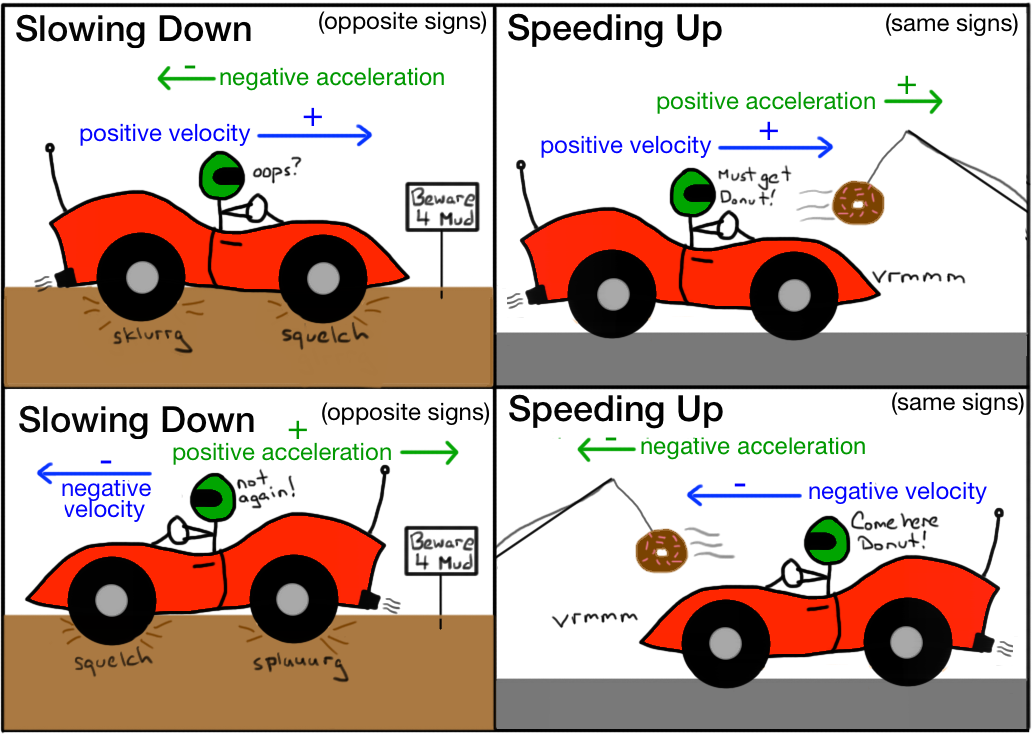
From - https://www.khanacademy.org/science.../acceleration-tutorial/a/acceleration-article

1a144eed22c1be721d2f1537fd164d93bb52dd4f.png


What does the above image clearly show?

Here is the exact relevant text from that page, "Another way to say this is that if the acceleration has the same sign as the velocity, the object will be speeding up. And if the acceleration has the opposite sign as the velocity, the object will be slowing down. "

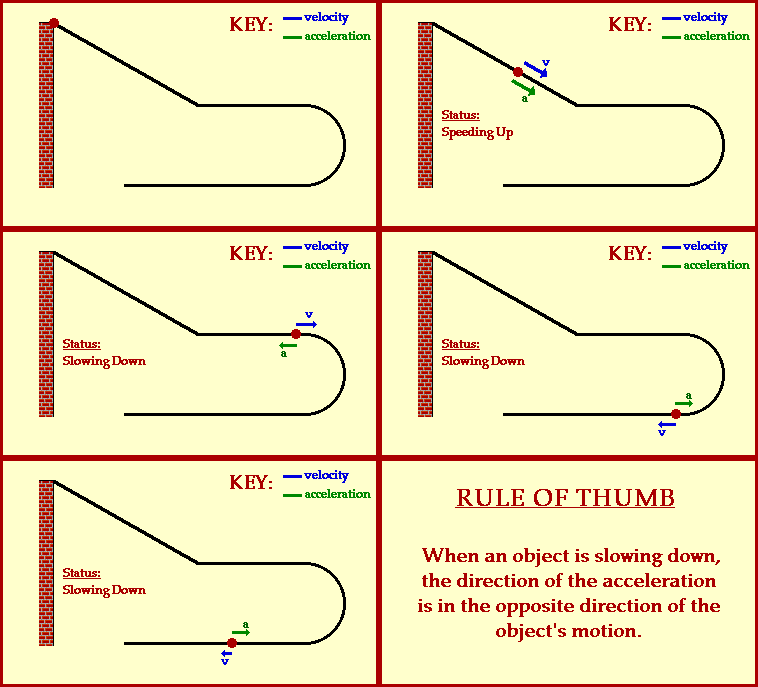
http://www.physicsclassroom.com/mmedia/kinema/avd.cfm

avd.gif


What does that image clearly show? It shows an object slow down when the acceleration changes.

http://www.school-for-champions.com/science/force_motion.htm#.VwTjLHr59Ro

From the above link -

Applied force can cause deceleration

If an object is moving and there is an applied force in the opposite direction of the motion, the object will decelerate or slow down. If you throw a ball up at a given velocity, it will slow down as it travels upward due to the force of gravity. Likewise, an airplane will decelerate if flying into a strong headwind.


https://www.britannica.com/science/acceleration

Acceleration, rate at which velocity changes with time, in terms of both speed and direction. A point or an object moving in a straight line is accelerated if it speeds up or slows down. Motion on a circle is accelerated even if the speed is constant, because the direction is continually changing. For all other kinds of motion, both effects contribute to the acceleration.

Because acceleration has both a magnitude and a direction, it is a vector quantity. Velocity is also a vector quantity. Acceleration is defined as the change in the velocity vector in a time interval, divided by the time interval. Instantaneous acceleration (at a precise moment and location) is given by the limit of the ratio of the change in velocity during a given time interval to the time interval as the time interval goes to zero (see analysis: Instantaneous rates of change). For example, if velocity is expressed in metres per second, acceleration will be expressed in metres per second per second.

What you are saying is that the overall velocity of the brick will not change just because of the impact of the brick. This statement is actually correct. Where you are wrong, as the credible sources show you, is at the instant of impact the brick will experience a force in the opposite direction. This will, only for an instant, change its velocity. Since acceleration is defined as the change in the velocity vector in a time interval, divided by the time interval, acceleration must also change.

Where you are confusing the issue is that the brick continues to accelerate after the impact because of the force due to gravity.
 
Please explain how I don't understand it.

Since you said Please, here you go.

If you wanted to take it to an unnecessary level, you could add the absolutely negligible magnitudes of the forces of G- and N+. Those forces are so minute, they are irrelevant when discussing macro physics and the collapse of 110 story buildings.

Your claim is that the earth exerts a gravitational force on the building pulling it downwards. That part is correct. You then claim that the building exerts a gravitational force on the earth, with the exact same magnitude but the opposite direction. That last part is absolutely wrong.

You are wrong. The gravitational forces are equal and opposite. This is fundamental to Newton's Law of Universal Gravitation.

Please provide a link to a credible source that shows I don't understand the concept.

I'm not going to bother doing your homework for you, so you can start from Wikipedia and find one for yourself. I suggest you start from the page on Newton's Law of Universal GravitationWP, scroll down to the diagram showing the gravitational attraction between two masses, and ponder the meaning of the statement F1 = F2 = G(m1 x m2)/r2, particularly the bit before the second = sign.

Also, please provide a link to a credible source that shows why this matters when discussing the collapse of large buildings.

After all the posts you've made in which you claim that your thorough understanding of Newton's Laws allows you to over-ride any expert's statements on the collapses, this request is simply laughable.

Dave
 
You are wrong. The gravitational forces are equal and opposite. This is fundamental to Newton's Law of Universal Gravitation.
Please show me a correct free-body diagram where this is taken into account, and why it matters. Once you do that, please show why it proves I am wrong.

I can't believe that this is all you have left. You know I'm right. All you can do is to move the goalposts to complicate the discussion as much as possible. That is all you can do. You have nothing else left.

You have also failed to show why an understanding of Newton's Law of Universal Gravitation is even remotely necessary to see what actually happened during the collapse of WTC1, WTC2, WTC7. Here, I will do your work for you. You haven't shown me why I need to understand this because it is absolutely irrelevant.

Stop wasting your time. Your tricks are transparent, ineffective, and the only thing they prove is how much you must grasp at the most trivial concepts to try to discredit me.
 
Last edited:
What is the point? How does this show that Phantom Wolf is right and every one of the credible sources I have linked is wrong?

It demonstrates the point about action-reaction pairs. In a non-moving system the force due to gravity is the same magnitude as the normal force but they aren't an action-reaction pair. In a moving system, such as a collapse there's no reason for the normal force to be the same as the force due to gravity.
 
It demonstrates the point about action-reaction pairs. In a non-moving system the force due to gravity is the same magnitude as the normal force but they aren't an action-reaction pair. In a moving system, such as a collapse there's no reason for the normal force to be the same as the force due to gravity.

Correct the normal force is electromagnetic, that's exactly why Cole is a fraud as you pointed out earlier.

N has to be greater than GP, during static loading or the building collapses.

If N is less than K the buildings collapse.
 
Last edited:
I actually need to change this statement from post 135.

The following statement is true. An accelerating brick will exert a force on a piece of rice paper at the instant of impact. The piece of rice paper will exert an equal and opposite force on the brick. This equal and opposite force will cause the acceleration of the brick to change at the instant of impact. The magnitude of this force will be minute. A minute, instantaneous change in the velocity of the brick will have a minute, instantaneous change on the acceleration of the brick.
 
It demonstrates the point about action-reaction pairs. In a non-moving system the force due to gravity is the same magnitude as the normal force but they aren't an action-reaction pair. In a moving system, such as a collapse there's no reason for the normal force to be the same as the force due to gravity.

In other words, as we've being saying for weeks now, the issue isn't the physics, or the sources that FF links to, but in FF's interpretation of what those sources are saying. With the weight of contra-evidence to his viewpoint approaching "staggering", I've moved from thinking the refusal to accept this was just sheer ignorance to believing that it is simply game-playing.
 
It demonstrates the point about action-reaction pairs. In a non-moving system the force due to gravity is the same magnitude as the normal force but they aren't an action-reaction pair. In a moving system, such as a collapse there's no reason for the normal force to be the same as the force due to gravity.

What does your statement try to prove? How does this affect what was observed during the collapses?
 

Back
Top Bottom