• Quick note - the problem with Youtube videos not embedding on the forum appears to have been fixed, thanks to ZiprHead. If you do still see problems let me know.

I need a method for detecting crevices

Definitely, don't focus on just one solution... you could have the very best crevice-detecting fog ever, and then be overrun the next time your cable guy brings an infested box.

- Deny bugs access to what they crave and they will piss off on their own to some extent.
- Consult a professional, and heed as much of their advice as you can, even if inconvenient.
 
I would guess that your most effective blower would be a shop-vac---and if you don't have one, you probably have a neighbor who does. (More likely than an neighbor with a blower door, anyway.) Open a window just enough to admit the nozzle and tape up the rest of the opening.

But seriously: my guess is that this is a lost cause. You will have so many "huge" air leaks in "normal" places---around windows and doors, your bathroom exhaust fans, the kitchen hood, the furnace chimney, the dryer hose, any recessed lighting, etc.---that will prevent you from getting enough overpressure to get a detectable breeze through the sort of gaps (a millimeter here and there under a baseboard, etc.) that are relevant to ants.

If you really want to plug things up, I would guess you'd start be removing ALL of your baseboard molding and caulking the entire wall-floor boundary.
 
I was going to suggest filling the house with water and seeing where it runs out, but I assume this is your house so we'll give that idea a pass.

Good luck with that. When I was living in New Mexico I found that on windy days I had drafts coming in through the electrical sockets. I figure there's too many holes for one to realistically expect to block them all.

But if you wanted, one thing you could do is get a fog machine (only $30-40 these days), fire it up, and see where the smoke is pouring out of the house. Be prepared to meet your local fire department if you do -- they showed up when a friend did this. :D
 
Definitely, don't focus on just one solution... you could have the very best crevice-detecting fog ever, and then be overrun the next time your cable guy brings an infested box.

Just in case anyone thinks he's exaggerating, I worked 6 months at the office of a cable company. We'd get infested boxes back from nasty houses and then they'd infect our office and warehouse. We had periodic pest control, but even the amount of creepy crawlies around the cube farms and break room, I'm guessing plenty found their way into new boxes to ride to new homes.
 
Our problem is wasps.

The little buggers arrive without warning and the first we know is dead ones inside the windows. The local council have very good - but expensive - pest control officers. Unfortunately, just blocking up the access points to the nest only (like shooting Mungo) makes them angry and they just chew their way out another way.

We've had two nests in the last 10 years, and we think we may have a third.
 
Last edited:
Plumbers used to use a small, relatively cool, smoke generator with integrated igniter; they were commonly used to detect leaks in drain pipes. Otherwise smoke mixtures aren't difficult to create, though there may be residue.

ETA: this may be of interest.
 
Last edited:
Place little piles of ant bait in strategic locations throughout the house. When the ants find it, follow their trail back to the entry point, and seal it.

I'm serious. Year by year, this is how we seal our house.
 
I remember a scene in the latest Sherlock Holmes movie where Robert Downey Jr sits in a room, and puffs a bit of body powder. We then see a close up of a cloud of body powder which is then absorbed by a small crevice in a wall. In this way, Holmes detects a secret passage behind the wall.

Now, obviously this is a movie and if anything, such phenomena would need very specific conditions for that to happen just like that. However, I'm looking for a scientific method to locate each and every single crevice in the house, as I am currently on a pest control mission and I'm trying to block every single hole in the house with sealing caulking.

So I need a practical method for locating them. Is there any way you sciencey-minded people would know?

This isn't quite sciency, but a bit more empirical. The few times I've dealt with pest control on my own, I've noticed that the instructions for chemical products discussed creating a perimeter around each room with them and laying the stuff down that way. Now, if you're not for using chemical pesticides, might as well quit here because that's what I'm referring to, but anyway, my point is that instead of trying to locate every crack and crevice, I've simply taken the horizontal planes (floor, countertops where those matter, and cabinet/closet shelves) and simply applied the pesticides there where the vertical and horizontal surfaces met (obviously I'm not talking about covering the entire surface, but merely laying a line down at those junctions). Eventually, the critters'll have to go horizontal, right? Well, at ever junction I could reach where I'd noticed them coming in, they'd run into the stuff I'd laid down and, if they survived, would track it back to their nest and kill off the nest.

It took a couple of years, but it was successful. Now I hardly have any insect invasions.

Again, this may not apply to you if you choose to avoid chemical pesticides, but my overall point is that I noticed that practical application suggestions were to create virtual perimeters in the rooms. This in contrast to attacking each entry point. That's what I was getting at. And the suggestions felt very much like they were informed by experience. It sounds like it's harder, but it actually was not, at least not for me. I wasn't crawling around each and every area looking for minute places and laid the protection down pretty fast.

(Jokes are inevitable iin a thread like these, but please, I need actual answers too)

You can use the alpine method for detecting crevasses: Just walk until you fall into one.

... wait. What? Not the same thing?? :eye-poppi
 
This isn't quite sciency, but a bit more empirical. The few times I've dealt with pest control on my own, I've noticed that the instructions for chemical products discussed creating a perimeter around each room with them and laying the stuff down that way. Now, if you're not for using chemical pesticides, might as well quit here because that's what I'm referring to, but anyway, my point is that instead of trying to locate every crack and crevice, I've simply taken the horizontal planes (floor, countertops where those matter, and cabinet/closet shelves) and simply applied the pesticides there where the vertical and horizontal surfaces met (obviously I'm not talking about covering the entire surface, but merely laying a line down at those junctions). Eventually, the critters'll have to go horizontal, right? Well, at ever junction I could reach where I'd noticed them coming in, they'd run into the stuff I'd laid down and, if they survived, would track it back to their nest and kill off the nest.

It took a couple of years, but it was successful. Now I hardly have any insect invasions.

Again, this may not apply to you if you choose to avoid chemical pesticides, but my overall point is that I noticed that practical application suggestions were to create virtual perimeters in the rooms. This in contrast to attacking each entry point. That's what I was getting at. And the suggestions felt very much like they were informed by experience. It sounds like it's harder, but it actually was not, at least not for me. I wasn't crawling around each and every area looking for minute places and laid the protection down pretty fast.

Actually I have been following this procedure and it has proven successful. I have left a thin trace of boric acid tracing the entire perimeter of my bedroom and most of the living room (some areas are harder to reach). And most of the times I have found roaches, they've been dead. I'm also using Combat, which is a deadly gel that they consume and then kills them, and apparently they take it to the nest, killing the rest of them.

So yes, of course I've been very careful and very responsible with the pesticide methods. But lately as the weather got slightly warmer I've been finding roaches again and I wanted to avoid any possibility of there ever being an intruder coming in. Especially in my bedroom where I've been mostly successful.
 
If they are German cockroaches, I found that the combat gel significantly reduced the population once. You need a different solution to maintain though, because they tend to develop immunity and it becomes ineffective. If the population is increasing again despite using more gel, this is probably what is happening.
 
If they are German cockroaches, I found that the combat gel significantly reduced the population once. You need a different solution to maintain though, because they tend to develop immunity and it becomes ineffective. If the population is increasing again despite using more gel, this is probably what is happening.

It's too soon too tell. I mean they just recently began reappering as the weather became slightly warmer. So lets say it's been about a month since they began reappearing. Last week the apparition of roaches began increasing, where I would find one or two dead roaches a day and only once I found one that was alive but wasn't moving at all so maybe it was weakening.

Now it's been two days since I haven't seen a single one.

So, long story short, it's too early to tell if the population has been increasing again.

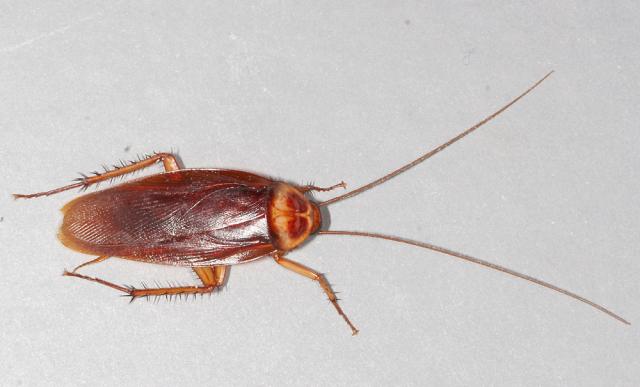
But then again, you said that such immunity only was with the German cockroach and with the exception of one, most of them have been the American Cockroach which, according to my google search is this one:

American-cockroach.preview.jpg
 
I say we back off, nuke the site from orbit. It's the only way to be sure.
 
The first time I moved into a house with a whole house fan, I turned it on without opening a window. After a few minutes the house depressurized enough that dozens of old dead cockroaches came flying out of the cracks in the walls.

I've moved into a lot a houses with minor cockroach problems, and they never continued to be a problem. I think it was because I tended to stay up all night, so at the times when they wanted to be active, the lights were on and I was around to kill them.
 
The first time I moved into a house with a whole house fan, I turned it on without opening a window. After a few minutes the house depressurized enough that dozens of old dead cockroaches came flying out of the cracks in the walls.

If it wasn't for the "came out flying out" part, I'd think this was not a joke.
 
Take two small glasses or plastic cups. Fill one half full of household ammonia, the other half full of muriatic acid (from a hardware store, sold for cleaning concrete and brick). When you hold the cups close to each other, a white smoke will form over them where the vapors mix. The vapors are reacting to form ammonium chloride in particles small enough to act like soot or smoke. Do this near windows and doors, and you'll be able to see which way the smoke drifts.

I got some blowback on one of the steampunk forums for suggesting that this was a good way to make smoke for someone's fake plastic steam boiler a year or two ago. I was officially labeled a dangerous influence for advocating using 'real chemicals'. Hopefully you're enough of an adult to realize that I'm in no way implying you should drink from the cups, pour them down your pants, or otherwise be a fool. In any case while muriatic acid and ammonia are not things you'd want to drink and in fact would have an extraordinarily difficult time keeping in your mouth long enough to swallow, ammonium chloride is safe enough to eat, and used as a flavoring in such 'delicacies' as salty licorice. (salmiakki or some variant in northern europe)
 
Take two small glasses or plastic cups. Fill one half full of household ammonia, the other half full of muriatic acid (from a hardware store, sold for cleaning concrete and brick). When you hold the cups close to each other, a white smoke will form over them where the vapors mix. The vapors are reacting to form ammonium chloride in particles small enough to act like soot or smoke. Do this near windows and doors, and you'll be able to see which way the smoke drifts.

Man... I don't know. This has Hazmat written all over it. Are you sure it's safe? What happens if I breathe that smoke?
 
You can easily construct a plywood barrier into an open outside doorframe and rent (most towns have equipment rental businesses) a blower for workspace ventilation or carpet drying and put it in an opening cut in the barrier to raise or lower the interior pressure, depending on which way you face it.

Here are several methods of making test "smoke".

There are also ultrasonic methods for detecting turbulence caused by air leakage. Someone with electronics skills can easily design an ultrasonic detector using off-the-shelf cheap components. Downconvert to audible range or visual readout / threshold detector.

There is a free software package called "Spectrum Lab", made for amateur radio people, that can run on a laptop and uses the sound card for input - a simple ultrasonic transducer (microphone) and preamp/filter connected to the "MIC" input will do. It comes with a pre-defined setup for animal (bat) chirps that is neat. It gives a nice "waterfall" display of the spectrum that helps visualize the sound.

You may be able to borrow or rent a unit used to locate leaks in car weatherstrip and windows.

Household ammonia vapors and burning sulfur fumes combine to make a useful smoke.

ETA: One of the devices/apps that allow adults to "hear" the ringtones that kids use for stealth cellphone use in classrooms might work for the ultrasonic detection - I don't know for certain...

HTH

Cheers,

Dave
 
Last edited:

Back
Top Bottom