I don't think space is expanding.

Status
Not open for further replies.
What nonsense this is developing into!

That was inevitable. As the somewhat more rational ideas get refuted it becomes necessary, in an effort to maintain the discussion, for the remaining claims to become more and more bizarre. It's all that is left.
 
Fitting data to a curve doesn't mean anything if you can't justify the curve. And you can't. You pulled it out of your ass, with no reasoning or justification. And it's not a prediction if you're fitting the curve to existing data.

Indeed so!

About the only thing that 'Mike Helland' has produced since this thread started is his various curve fitting schemes where each successive scheme is as worthless as the previous scheme.
 
That was inevitable. As the somewhat more rational ideas get refuted it becomes necessary, in an effort to maintain the discussion, for the remaining claims to become more and more bizarre. It's all that is left.

Ok.

I'm down for bizarre.

Tell me.

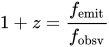
What are the units of z redshift?

8747551886d0568e0d61ac980fdc9646872f67a6
 
Indeed so!

About the only thing that 'Mike Helland' has produced since this thread started is his various curve fitting schemes where each successive scheme is as worthless as the previous scheme.

Back in November, when I was reading about the Hubble tension, I thought, "maybe Hubble's law isn't right?"

I took v=c-HD, my old mock expansion trick, and came up with three alternatives, variations of dividing c by an increasing number rather than subtract.

v=c/(1+HD)
v=c/(1+HD)2v=c/(1+(HD)2)

https://forum.cosmoquest.org/showth...ay-a-solution-to-the-quot-Hubble-tension-quot

When I found the Supernovae Cosmology Project data was already in z and distance, which was accessible to my ignorance, I found that one of the equations nails the acceleration curve.

Not exactly the Hubble tension, but something.

It's not like this is an elaborate curve with multiple co-efficients.

It's a basic inverse square law. Nature seems to love 'em.

 
It's a basic inverse square law. Nature seems to love 'em.

Leaving aside the distinction between 1/r2 and 1/(1+r)2, do you have even the slightest idea as to why inverse square laws are common in physics? I doubt you do. And even if you did, you would find that those reasons don't apply here.
 
Back in November, when I was reading about the Hubble tension, I thought, "maybe Hubble's law isn't right?"

I took v=c-HD, my old mock expansion trick, and came up with three alternatives, variations of dividing c by an increasing number rather than subtract.

v=c/(1+HD)
v=c/(1+HD)2v=c/(1+(HD)2)

https://forum.cosmoquest.org/showth...ay-a-solution-to-the-quot-Hubble-tension-quot

When I found the Supernovae Cosmology Project data was already in z and distance, which was accessible to my ignorance, I found that one of the equations nails the acceleration curve.

Not exactly the Hubble tension, but something.

It's not like this is an elaborate curve with multiple co-efficients.

It's a basic inverse square law. Nature seems to love 'em.

Once again, you are demonstrating your ignorance, because the units in all three of your equations fail to work out.

Therefore, each one of your equations is as worthless as the other equation.

Accordingly, if you cannot grasp the simple concept of how units have to work out in equations, then it is quite obvious that you do not know what you are talking about.
 
Once again, you are demonstrating your ignorance, because the units in all three of your equations fail to work out.

Therefore, each one of your equations is as worthless as the other equation.

Accordingly, if you cannot grasp the simple concept of how units have to work out in equations, then it is quite obvious that you do not know what you are talking about.

It started at v=c-HD, so H was in the standard km/s/Mpc.

Then I tried v=c/(1+HD), which puts H into inverse distance.

The value for H is more intuitive if you use the form v=c/(1+D/H), putting H as just distance.

But by all means.

Stick with the same z-distance relation and units since 1930. I'm sure it's fine.
 
It started at v=c-HD, so H was in the standard km/s/Mpc.

Then I tried v=c/(1+HD), which puts H into inverse distance.

The value for H is more intuitive if you use the form v=c/(1+D/H), putting H as just distance.

But by all means.

Stick with the same z-distance relation and units since 1930. I'm sure it's fine.

You continue to demonstrate your ignorance.

And I (as well as several other people here at the Forum) are sure you are wrong because your units in your own equation do not work out.

However, your continual assertions that obviously incorrect equations provide you with validation do an excellent job of showing just how little you actually do know about this subject.
 
You continue to demonstrate your ignorance.

And I (as well as several other people here at the Forum) are sure you are wrong because your units in your own equation do not work out.

However, your continual assertions that obviously incorrect equations provide you with validation do an excellent job of showing just how little you actually do know about this subject.

Please explain.

The hypothesis is velocity = velocity / (1 + distance/distance)2
Where did I mess up?
 
Please explain.

The hypothesis is velocity = velocity / (1 + distance/distance)2
Where did I mess up?

You messed up because you are too ignorant to grasp basic facts.

In this case,

If you wish to use the equation:

velocity = velocity / (1 + distance/distance)2
Then, the equation becomes:

velocity = velocity / (1 + 1)2
Which reduces to:

velocity = velocity / (2)2
Therefore, by you own equation:

velocity = velocity /4

Which, if true, would mean that:

1 = 4

Which, of course, is completely incorrect.

However, you are too ignorant to grasp even this most fundamental concept. And since you constantly fail to understand even the most fundamental concepts, then you constantly fail everywhere else as well.
 
In the form v = c / (1 + D/H)2, what is it?

Let me guess.

"No, Mike. You're wrong. You're too ignorant to understand."

You got me.

At least you are correct about being too ignorant to understand.

After all, I pointed your error in this ridiculous equation about two weeks ago and you rapidly brushed it off with some nonsense about how the units cancel out.

And you are pushing this inane nonsense again.
 
You messed up because you are too ignorant to grasp basic facts.

In this case,

If you wish to use the equation:

velocity = velocity / (1 + distance/distance)2
Then, the equation becomes:

velocity = velocity / (1 + 1)2
Which reduces to:

velocity = velocity / (2)2
Therefore, by you own equation:

velocity = velocity /4

Which, if true, would mean that:

1 = 4

Which, of course, is completely incorrect.

However, you are too ignorant to grasp even this most fundamental concept. And since you constantly fail to understand even the most fundamental concepts, then you constantly fail everywhere else as well.
Mike did not mean to suggest
velocity = velocity / (1 + distance/distance)2is an equation. He was answering your challenge about units, so he was demonstrating that if the constant he calls H (which is not the Hubble constant) has units of length the thing is dimensionally balanced. He doesn’t know that we’d write that as:

L/T = L/T /(1+L/L) ^2. It’s just a dimension check not an equation. His equation can’t be right for many physical reasons but it’s not dimensionally screwed up.
 
To Mike: H is the symbol we use for the Hubble constant. It is generally given in km s-1 Mpc-1 and has dimensions of 1/T. If you want to talk about some other constant which has different dimensions, say, L, then use a different symbol.
 
Status
Not open for further replies.

Back
Top Bottom