I don't think space is expanding.

Status
Not open for further replies.
Yeah, no. You're making excuses for the failure of your theory, and forgetting that this isn't even the only way it fails, but simply one way out of many.

Which all seem to come down to treating the photon as classical light.

In QED the photons before the mirror are different than the photons after the mirror.

While absorbed by an electron in the mirror, does the electron retain information about the photon's speed?

If so, how does an electron do that?
 
Which all seem to come down to treating the photon as classical light.

No, it doesn't.

In QED the photons before the mirror are different than the photons after the mirror.

Not relevant.

While absorbed by an electron in the mirror, does the electron retain information about the photon's speed?

If so, how does an electron do that?

Speed isn't actually the issue. And this again shows you don't actually understand Snell's law or how it's derived.

But I'm curious: if QED is supposed to get photons out of obeying Snell's law, then why do they obey it at all? What ever made you think this was even a possibility? Desperation?
 
That process has kept the big bang theory afloat since the 1979.

To this day, no one can tell you the expansion rate of the universe.

And therefore........?

Hint - even if true this does nothing to advance your notion that it is not expanding at all. Which make it a totally irrelevant and inane comment.
 
Either Unicorns exist, or they do not. Therefore there is a 50% chance that unicorns exist.

That is, in essence, what you just said. And you think that is rational.

Maybe I misunderstand Bayes, but it seems like a rational Bayesian approach in principle.

"Snell's Law is either right or wrong. I've never heard of it, so... let's start with 50/50."

"Actually, Snell's Law has been extensively validated and is universally accepted by mainstream physicists."

"Oh, then I'm adjusting to 99/1. Just in case."

"There are some physicists who think it must be wrong because it contradicts their models."

"So... 80/20?"

"Their models are falsified by other observations, as well as by tests of Snell's Law."

"... And now I'm back to 99/1."
 
But I'm curious: if QED is supposed to get photons out of obeying Snell's law, then why do they obey it at all?

Good question.

It looks like that question was asked in 1995.

https://brucesherwood.net/wp-content/uploads/2017/06/Refraction.pdf

Blau and Halfpap posed the question in the American Journal of Physics of how to interpret refraction (Snell's law; index of refraction) and the (apparent) slower speed of light in glass in terms of quantum mechanics. The following response by Bruce Sherwood was published in the American Journal of Physics 64, 840-842 (1996). Answer to Question #21. ["Snell's law in quantum mechanics," Steve Blau and Brad Halfpap, Am. J. Phys. 63(7), 583 (1995)]

The question of how to interpret Snell's law and the index of refraction from the point of view of photons and quantum mechanics can usefully be recast as a question of how to interpret these concepts from a microscopic point of view, whether quantum-mechanical or (semi-)classical.

...

The original question asked about Snell's law from the point of view of photons. The main issue isn't really photons, but microscopic versus macroscopic analyses. The passage to quantum mechanics introduces still more mathematical complexity but doesn't change the main point. The reflected and refracted light consists of the (quantum) interference of incoming photons with photons re-emitted by atoms in the glass. The fundamental speed of light is unaffected.

My thinking is that if there are no atoms there to interact with, you won't different angles of reflection.
 
And therefore........?

Hint - even if true this does nothing to advance your notion that it is not expanding at all. Which make it a totally irrelevant and inane comment.

v=c/(1+HD)2 points at a pretty unambiguous 0.04 Gly-1.

sn_expanding.png


Think about that though.

How long have you believed in the expanding universe?

And still waiting for them to till you how fast its expanding.
 
That process has kept the big bang theory afloat since the 1979.

To this day, no one can tell you the expansion rate of the universe.

BBT has been around a lot longer that that.

Even if no-one could give a figure for the expansion rate of the universe, that still does not allow you to insert utter baloney into it.

What you are doing is taking 2 + 2 = 4 and stating that if you change that to 2 + 2 = 5, then that is perfectly valid.

That is the extent of what you are doing.
 
BBT has been around a lot longer that that.

Even if no-one could give a figure for the expansion rate of the universe, that still does not allow you to insert utter baloney into it.

What you are doing is taking 2 + 2 = 4 and stating that if you change that to 2 + 2 = 5, then that is perfectly valid.

That is the extent of what you are doing.

Close.

Mainstream cosmology is that H0 = 74 km/s/Mpc = 67 km/m/Mpc

I'm saying one of those is wrong.

I like your analogy though.
 
What about the this version of Hubble's law, where space is still expanding?
Once again you repeat your invalid equation after you have been told a couple of times that it has blatantly wrong units. That is past ignorance. It is purposely misleading posters.
10 March 2021: Mike Helland makes a high school science error (Therefore "c - c/(1+HD)2" is a high school science error).
10 March 2021: Mike Helland is abysmally ignorant about the units of H0 which are inverse time
10 March 2021: The total idiocy that he can change the units of Hubble's constant!

ETA: As well as having the wrong units we have an equation that
  • Has an expanding universe - read the title of this thread!
    Your galaxies are still receding from us with speeds that increased with D.
  • Makes human beings the center of the universe!
    The way I think about the Copernican principle is that the Earth is insignificant in the universe. Making the universe center around a random point where we happen to be is too coincidental. And of course the Earth is moving so we have a universe constantly tracking an insignificant planet.
 
Last edited:
Good question.

Not particularly. It's just that your position is so incoherent.

My thinking is that if there are no atoms there to interact with, you won't different angles of reflection.

This isn't even grammatically correct, let alone physically. And every mirror always has atoms. The presence of atoms doesn't change Snell's law. If it did, it wouldn't work at all, something you still don't actually have an answer for. The details of a quantum mechanical treatment of Snell's law don't matter here, it suffices to know that quantum mechanics doesn't change Snell's law. It cannot change Snell's law, because as already stated, Snell's law is observed to work.

And nothing about our setup would change that either.
 
My thinking is that if there are no atoms there to interact with, you won't different angles of reflection.
If there are no atoms there then there won’t be any reflection or refraction in the first place.

But you were asking about QED. I’m sure I’ve mentioned this before, but it seems you need to be told half a dozen times before something sinks in, and even then it might not. If you apply Feynman’s path integral approach to calculate the paths in reflection and refraction, the same laws of reflection and refraction are recovered. But that is unsurprising. The summation of a large number of photons must give the same result as the classical case.
 
Mainstream cosmology is that H0 = 74 km/s/Mpc = 67 km/m/Mpc

I'm saying one of those is wrong.
Which makes the other correct and the universe expanding at that rate!
Mainstream cosmology says that the Hubble constant has a value. Mainstream science says if we use multiple methods to measure something, the values should be compatible. The Hubble tension is that two ways of measuring the Hubble constant are now statistically different.

Note that it is one or both (which is not often mentioned) of the values that is wrong. New physics + a better cosmic distance ladder might shift both to the same value.
 
Close.

Mainstream cosmology is that H0 = 74 km/s/Mpc = 67 km/m/Mpc
Wow. You really are dimensionally challenged. km/s/Mpc cannot be equated in any way with km/m/Mpc.

I'm saying one of those is wrong.
All of them are wrong. H0 has not yet been accurately measured. All of the measurements to date put it in the same ballpark, but to claim it is exactly 74 km/s/Mpc is absurd. Hubble puts it at 72.1±2.0 but even that is subject to change.

I like your analogy though.
No, you don't. Because it calls into question the steaming pile you have been loading on here. You don't like that at all.
 
If you apply Feynman’s path integral approach to calculate the paths in reflection and refraction, the same laws of reflection and refraction are recovered. But that is unsurprising. The summation of a large number of photons must give the same result as the classical case.

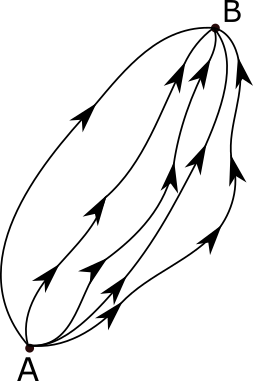
So you're saying something like this:

Feynman_paths.png


But with a mirror in the middle?
 
Wow. You really are dimensionally challenged. km/s/Mpc cannot be equated in any way with km/m/Mpc.
It’s a typo isn’t it? He’s got enough wrong that we don’t need to criticise things that are obvious typos.
 
If there are no atoms there then there won’t be any reflection or refraction in the first place.

But you were asking about QED. I’m sure I’ve mentioned this before, but it seems you need to be told half a dozen times before something sinks in, and even then it might not. If you apply Feynman’s path integral approach to calculate the paths in reflection and refraction, the same laws of reflection and refraction are recovered. But that is unsurprising. The summation of a large number of photons must give the same result as the classical case.

Ok, I'm guessing this is going to be another one of those moments where my ignorance achieves a new level up, but what about this:

"How fast does the little arrow rotate? As fast as the photon’s wavelength—that’s what a photon’s wavelength is. The wavelength of yellow light is ~570 nanometers: If yellow light travels an extra 570 nanometers, its little arrow will turn all the way around and end up back where it started."

https://www.greaterwrong.com/posts/oiu7YhzrDTvCxMhdS/feynman-paths

If that's the case, the decelerating photons lose frequency and speed, but not wavelength.

So... wouldn't the photons act the same (in a vacuum) regardless of speed?
 
Ok, I'm guessing this is going to be another one of those moments where my ignorance achieves a new level up, but what about this:...
Unfortunately you are right. What you quote from Feynman Paths is merely the statement that the "little arrows" rotate once per wavelength of the light. These arrows represent the phase of the Feynman path integral. It is the addition of paths that turns what looks like light being reflected at all angles into Snell's law.

There is no mirror to reflect photons in a vacuum so they do not "act the same (in a vacuum)".

This is is about real light, not light as waves in a medium that changes frequency with speed.
4 March 2021: Mike Helland still cannot understand Wavespeed = frequency * wavelength is for waves in a medium.

ETA:
This is a transcript of Richard Feynman lecturing on the reflection from mirrors: Optics: The Principle of Least Time. The QM explanation is at the bottom.
Richard Feynman spoke at the The Douglas Robb Memorial Lectures at the University of Auckland and they were recorded. Richard Feynman - Science Videos. The second is "Fits of Reflection and Transmission - Quantum Behaviour".

If you are wondering why there is a phase and thus these arrows, it is because QM is complex! A wave function is the mapping of the possible states of a system to a set of complex numbers. Complex numbers are z = a + bi where i is the square root of -1. They can equally be written as a radius and angle to the number on the complex number plane. That angle is called the phase.
 
Last edited:
Status
Not open for further replies.

Back
Top Bottom