• Quick note - the problem with Youtube videos not embedding on the forum appears to have been fixed, thanks to ZiprHead. If you do still see problems let me know.

How would a jungle planet work?

I was about to bring Distric 9 aliens to the table, regarding the comment on the need of having something the audience can identify. They are much more alien than the mega-smurfs but there is a strong visual connection- the big brown eyes with human-like expressions. I have my share of doubts about public rection if those aliens had composite eyes.

I believe the result would be much less empathy form most people watching the film.
 
Cool topic. If there's one thing we've learned from planetary geology it's that weird **** happens that we can't even begin to predict.

I was thinking of a tidally locked planet. Maybe there would be several type of habitat such as a desert closest to the sun surrounded by a ring of 'jungle' and another ring of temperate forests/plains and then a ring of twilight. The dark side would be cold and dark (maybe like Earth's polar regions during winter) and could have some interesting forms of life as well. Almost like a doughnut world.

If we're speculating on the next dominate form of life on Earth (I don't care, I am cause it's cool to speculate) I gotta go with the Cephalopods. They have arms for manipulation and exhibit some serious intelligence, at least for invertebrates.
 
The reason most land vertebrates have four limbs isn't because there's some advantage to it--the fish that we evolved from just happened to have four limbs. Similarly, there's no real advantage to having five fingers--our ancestors just happened to have five, and we haven't lost any. And remember, land vertebrates are a very tiny fraction of the animals out there. As for niches, most niches are created by other life forms. A woodpecker only has a niche because there are stationary trees that don't whomp them. Grazers exist because grass is sessile. While certain configurations would certainly be universal (again, cephalization; I'd probably include segmentation in this, as well as possessing some skeleton), I think those universals would be fairly limited, and fairly general. I mean, a race of centors is entirely plausible--all it would take is for the fish that crawled out to have six fins, rather than four. Monkeys with two tails are plausible. Four-winged birds actually existed. Mobile colonies in which each organism is highly specialized exist.

Life, in other words, is far more weird and wonderful than people generally think, and a sci-fi writer could blow people's minds just by showing what's already alive today. Alien worlds should be at LEAST as weird as what we share our biosphere with.

I did not mean to imply I thought otherwise. I said "limbs" "binocular vision" and "wings" specifically to avoid the concepts you're detailing. A branching appendage from a main central body can be expected, anything I said about a number of limbs earlier in the thread was simply passing on information from one specific science fiction universe I found interesting for it's amount of background information.
 
Halfcentaur said:
I did not mean to imply I thought otherwise.
It's my fault. This is one of the topics almost certain to put me firmly into Ranting from a Soapbox mode. "Aliens" that are just humans with funny skin is one of my pet peves in sci-fi.

Correa Neto said:
I have my share of doubts about public rection if those aliens had composite eyes.

I believe the result would be much less empathy form most people watching the film.
We just need someone to write a really, really moving book about it! :D

foxholeatheist said:
If we're speculating on the next dominate form of life on Earth (I don't care, I am cause it's cool to speculate) I gotta go with the Cephalopods.
We've gotta oust the FIRST dominant life forms first. I mean, aren't there more bacteria cells in you than your own cells?

foxholeatheist said:
I was thinking of a tidally locked planet.
That'd lead to a few very specific biomes. Not a jungle planet by any means, but certainly a large amount of "jungle" (assuming there's land mass at the point pointed to the star). Of course, the problem would be dealing with the extreme heat and nonstop solar radiation. A lot of desert plants (cacti) deal with it by forming very tall, narrow stalks with no leaves. Of course, that's because our plants use a limited band of radiation for photosynthesis--a plant (or plant-like organism) that used a much wider band of the spectrum may well deal with it differently, perhaps even doing the Earth-jungle thing (where the canopy is so dense that very little light filters into the floor). I could see two types of forests on such a world: tall and spiky (which would neatly circumvent the issue of water as well), and one broad swath of green with a few stalks once you break through.
 
I love many of the suggestions here.

Is there any way to get a planet with a temperate climate all over? That would seem to be even harder.
 
The planet is pure gold, covered with a thin layer of topsoil and/or shallow oceans. The higher thermal conductivity of gold vs. rock keeps the poles warmer.
Win!

Although pure copper will work just as well.
 
We just need someone to write a really, really moving book about it! :D
Don't get me wrong, Distric 9 was the best SF I've seen in ages. The aliens' eyes were one of the very few things which I didn't like (possibly the only one, since I can't remember the others). I would be happier with something completely alien, no emotional clues from expressions.

But I guess I would -again- be on the minority... I believe the general public would need something other than just good writing to side with the aliens.
 
I was making fun of the whole Ender Wiggins series of books--the premise of the later ones is that all it took to make humans sympathize with a species that tried to wipe them out, quite brutally, was one well-written book.
 
Win!

Although pure copper will work just as well.

No, you can't transfer heat by conduction over distances like that. The thermal conductivity of gold is "high" by engineering standards, but that's still only 300W/m/K. To conductively warm up a planet's poles by heating the equator, you're talking about moving 100s of W/m^2 (vaguely insolation-like energies) over distances of order 10^6 m (vaguely Earth-radius-like distances) under temperature drops of order 10K.

To do this via conduction, you'll need a factor of 10^5 higher conductivity than gold.
 
I was making fun of the whole Ender Wiggins series of books--the premise of the later ones is that all it took to make humans sympathize with a species that tried to wipe them out, quite brutally, was one well-written book.

Flew high above my head sunken within a vast intracontinental sea of ignorance...
 
No, you can't transfer heat by conduction over distances like that. The thermal conductivity of gold is "high" by engineering standards, but that's still only 300W/m/K. To conductively warm up a planet's poles by heating the equator, you're talking about moving 100s of W/m^2 (vaguely insolation-like energies) over distances of order 10^6 m (vaguely Earth-radius-like distances) under temperature drops of order 10K.

To do this via conduction, you'll need a factor of 10^5 higher conductivity than gold.

Well, I tried. A gold planet, however, could be significantly smaller than Earth and still have the same gravity...would that change the calculation at all?
 
Correa Neto said:
Flew high above my head sunken within a vast intracontinental sea of ignorance...
If you're interested, the author is Orson Scott Card. The first book, "Ender's Game", was good. The later ones.....well, Card is a Morman, and it shows pretty strongly. The way he establishes the immortality of the soul, and ties it to faster-than-light travel, is just WEIRD.

Madalch said:
No, it wouldn't- copper would rapidly form a thick surface of patina, which would insulate.
How?

That's the main issue I have with the "all one element" planets: how are you going to get enough material there to make life? Agradation via bolides and the like seems possible, but unlikely. And life would be hard-pressed to form under such conditions.

There's another option we haven't considered: terraforming. An alien species (mostly because we don't go into space much--we likely could, but we haven't yet) may decide to turn a planet into a jungle, for some alien reason. Sure, it's pushing the explanation back a step, but in this case it WOULD be an intelligent agent designing a planet, and they'd obviously have solved the issues (likely through continued monitoring and manipulation).
 
How?

That's the main issue I have with the "all one element" planets: how are you going to get enough material there to make life? Agradation via bolides and the like seems possible, but unlikely. And life would be hard-pressed to form under such conditions.

Well, it couldn't be -all- gold; you'd need enough dirt (at least in places) to support an ecosystem. And enough oxygen in the air to support jungle life (which is why the copper would get all patina-covered, and rust away into the oceans). But the core of Earth is mostly iron- if a solar system formed under conditions favouring heaver elements, you'd have a much thinner crust of silicates and a core of the really heavy metals.

(Okay, the copper in the core wouldn't rust, the same way that the iron inside our core doesn't, but there'd need to be some of the metal near the surface in order to conduct the heat...)
 
You don't necessarily need elevated temperatures to have a jungle planet, you need enough heat to evaporate sufficient water to provide enough precipitation. When I last visited Muir Woods, just north of SF, one of the rangers pointed out that it is officially counted a rain forest.

As far as making a planet sufficiently temperate, surely that could be achieved just by better placement in the goldilocks zone. IIRC correctly we are on the cold edge of our goldilocks zone and are only kept temperate because we have sufficient greenhouse gases in the atmosphere.
 
The most spectacular forest on Earth in my opinion is the Hoh Rainforest on the Washington state Olypmic peninsula. I've been driving their as a family ritual from Oklahoma every other summer since 1989. I've been all over the Redwoods and Sequoias, Vietnamese rain forest, Siberian Taiga, and many others,.... nothing compares to the ancient old growth being carpeted in thick lush mats of clean vibrant moss, it's like something out of a fantasy movie. It reminds me of the Spirit of the Forest's grove in Princess Mononoke.

The Hoh Rainforest thrives due to it's proximity to the Pacific ocean and being nestled in a low altitude valley that traps the moisture.
 
Halfcentaur said:
I've been all over the Redwoods and Sequoias, Vietnamese rain forest, Siberian Taiga, and many others,.... nothing compares to the ancient old growth being carpeted in thick lush mats of clean vibrant moss, it's like something out of a fantasy movie.
The Carpathians are like that. I always thought the woods in the fairy tales was just that--a fairy tale. Turns out no, it's actually pretty accurate.

Somewhat disconcerting to stand on nothing but 6'+ of moss, though...

The question is, is that a forest? In a rain forest you get surprisingly little light down at the bottom. What many of us think of as a forest--vines, thick underbrush, etc.--is really the edge of the biome, where light can still easily infiltrate. In the middle the only places you see stuff like that is where a tree has fallen. If we're NOT using that sort of criteria to define "forest", we're left with "a planet dominated by trees", which shouldn't be nearly as difficult to establish--all you'd need is sufficient rainfall, and that's assuming that the trees don't adapt for the desert environments.
 
You know what I would like to see?

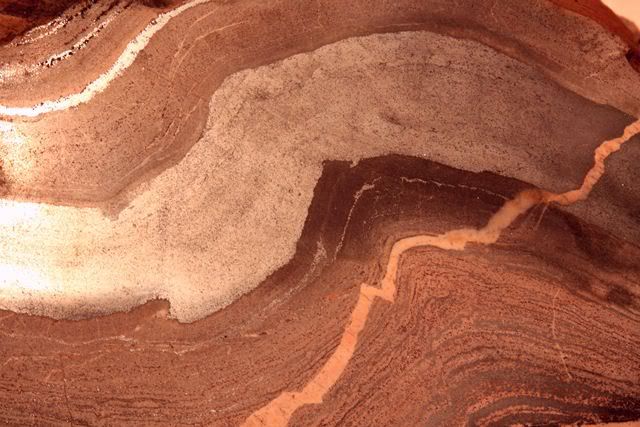
A terrestrial planet with only small islands, lots of volcanic and tectonic activity, a vast ocean, anoxic atmosphere, Fe+2 dissolved in greenish oceanic water, huge tides and storms, nothing but microbial lifeforms, some cyanobacteria colonies desperately cringing to life in lagoons and shallow seas while Fe-minerals are precipitated in parts of the seafloor...

Wait... I can see it!
IMG_1462.jpg

Banded Iron Formation, circa 2.7Ga, Onça do Pitanguí, Minas Gerais, SE Brazil.
 

Back
Top Bottom