Merged How Close is power from Nuclear Fusion

Others seem to think it is a real breakthrough.
Sorry. I don't mean to be a stick in the mud. However, there's a lot of hype and hot air in reporting on fusion power. Every incremental advance is hailed as an important breakthrough but we're still in the "50 years away, and always will be" stage. What we ultimately want is fusion power that is both practical and affordable. It needs to be economically competitive with other methods of generating electricity. Otherwise, what problem is it really solving?
 
Every incremental advance is hailed as an important breakthrough but we're still in the "50 years away, and always will be" stage.
As I have opined before, I believe that we are past that stage. I believe that every breakthrough is an advance - it's just that there are a lot of them yet to go before we have what we ultimately want. And by the time we get there, it probably won't be as good as widespread renewable power.
 
In the interest of saving you a click:

It seems more like an incremental step than a breakthrough. It's a paper about a method to design a stellarator, not an actual working prototype.

Others seem to think it is a real breakthrough.

<snip of links>

YMMV
They have, in theory, solved a major problem. It needs to be tested. Once tested, electricity from nuclear fusion will be only 20 years from the current date, instead of 50.

I say it will be very expensive electricity. Not sure how they could use it to generate electricity.

Also the difference between a breakthrogh and an incremental step is a matter of opinion.
 
Last edited:
I say it will be very expensive electricity. Not sure how they could use it to generate electricity.
I tend to agree. And if it is true, then what problem have we really solved?

Assuming we eventually know how to build a working fusion power plant (which can generate electricity), the cost per unit of electricity (kW⋅h or the like) is determined by how much it costs to build it, how long you can use it, and the running costs such as maintenance and replacing parts and so on. The fuel that it would use is unlikely to be simple hydrogen H1. It's more likely to require deuterium or even tritium as fuel, and those are more expensive materials.

 
I tend to agree. And if it is true, then what problem have we really solved?

Assuming we eventually know how to build a working fusion power plant (which can generate electricity), the cost per unit of electricity (kW⋅h or the like) is determined by how much it costs to build it, how long you can use it, and the running costs such as maintenance and replacing parts and so on. The fuel that it would use is unlikely to be simple hydrogen H1. It's more likely to require deuterium or even tritium as fuel, and those are more expensive materials.
Deuterium is a stable isotope of hydrogen and can be extracted from water, much easier than seperating uranium 235 and 238. The Norwegians did this prior to WW2 without even trying. The problem with using this as a fuel is that it is very hard to fuse. Tritium is much easier to fuse, but is very hard to manafacture.
 
I tend to agree. And if it is true, then what problem have we really solved?
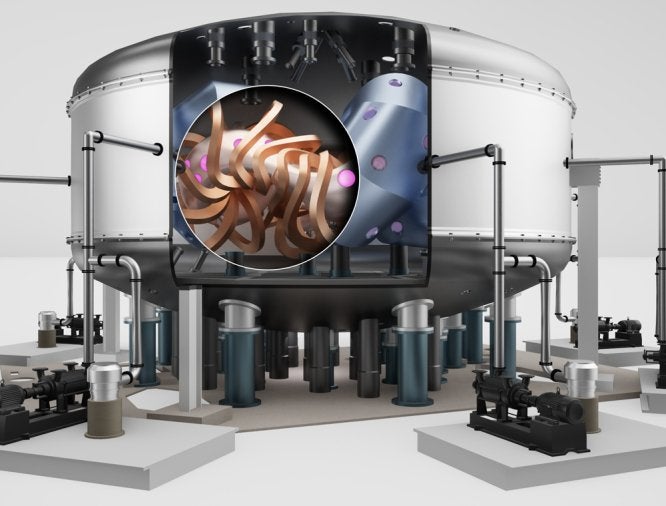
The problem of requiring huge magnetic coils to contain plasma. Every breakthrough is still a breakthrough, and nailing sustainable fusion power will be a massive milestone in the history of science, even if it isn't economical to deploy on the large scale compared to renewables. It's still a goal worth striving for.
 
And these:


Any day year decade now.
 
Now that Search is back *and somewhat usable) I'll toss these in:


At least researchers haven't given up yet.

:wink8:
 
Not progress but a it of a side bar:

Physicists Uncover Forgotten 1938 Fusion Breakthrough That Could Power the Future​


Interesting. If DT fusion reaction can happen at such low energy levels why is fusion not a commercial reality? Deuterium is a common isotope. Combining them may not be so easy, but should still be possible without extremely high energy levels.
 
Interesting. If DT fusion reaction can happen at such low energy levels why is fusion not a commercial reality? Deuterium is a common isotope.
Tritium is rather less so. In fact, with a half life of only about 12 years, you pretty much can't find any in nature. Basically any tritium you want to use must be made synthetically.
 

ISF - Join now!

Every member here is approved by hand. No bots, no spam, just people who care about evidence and honest debate.

Membership is free!

Create your free account

Back
Top Bottom