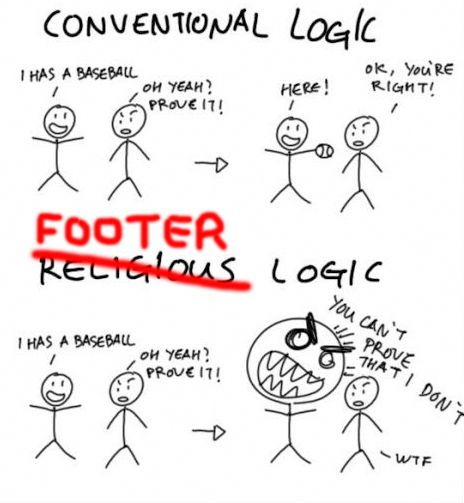
No, I have to do no such thing. It's not a double standard, it's simply choosing your battles. As you say, none of us is free of blind spots. It would be hypocritical to claim that because you have a blind spot, you therefore can't call yourself a skeptic.
Which is not what I said. I didn't say not to choose your battles. I didn't say having a blind spot made you not a skeptic.
I merely said skeptics should at least acknowledge they are choosing to have said blind spot or choosing not to do battle with certain unsupportable beliefs.
Just admit that is what is going on. It doesn't mean you are not a skeptic anymore than the crazy right wingers on the forum aren't skeptics in the science parts of their brains.

What I find disingenuous is trying to excuse god beliefs as NOMa, as if somehow critical thinking doesn't apply, but only to some gods, mind you, certainly not to all god beliefs.
Being a skeptic does not mean that you have to actively apply critical thinking skills to every possible aspect of existence. It means that you are aware of and use skeptical tools, but it carries no obligation that you must apply those tools to every moment of every day of your life.
I agree.
Some skeptics - Martin Gardner, for example - found it comforting to believe in a supreme being, even though he knew full well that there was no evidence of such a thing's existence. Is he therefore not a skeptic?
So why not apply this same principle to the placebo effect of homeopathy? That's where it becomes a problem for me. It's a double standard any way you look at it. Call it the god placebo, that's fine.
Magical thinking has a documented benefit in the grieving process. The placebo effect has some minor uses in medicine. Just don't tell me it's more than that or that certain god beliefs are different, special, in some way other unsupportable beliefs are not.
As skeptics we should be welcoming whoever we can, not excluding people from our special club if they won't recite the requisite verses about how awesome tigers are.
They're not necessarily the same thing. NOMA only applies inasmuch religion makes no testable claims. I think you would agree that there are times when it does, but there are also times when it doesn't, and at those times skepticism does not (and can not) apply.
I agree with Phil Plait's don't be a dick position. But for me personally, I cannot distinguish woo god beliefs from 'special' god beliefs. For me personally, it's inconsistent with an evidence based POV. But I don't care if someone else takes comfort in their god belief.
What does bother me, however, is when I say the evidence supports the conclusion that all gods are fictional human inventions, I get accused of some kind of offensive wrongdoing. Other than that, I don't think blind spots make one not a skeptic.